LFM Reviews Kore-eda’s I Wish

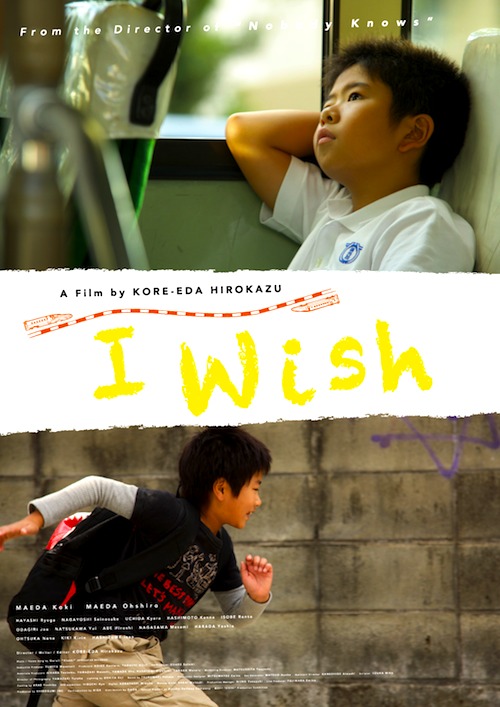
By Joe Bendel. Never dismiss the characters of Hirokazu Kore-eda’s latest film just because they are elementary school children. Unlike the parade of hipster man-children audiences see in indie after indie, many of these youngsters will amount to something in life. They are also facing some very real drama at a relatively early age in Kore-eda’s unusually wise and gentle I Wish, which opens this Friday in New York.

When their parents split up, Koichi decided to go with his mother to live with his grandparents in Southern Kyushu. His younger brother Ryunosuke opted to stay with their irresponsible garage-rocker father in the north. Always close, it is a difficult separation for the brothers, but they think their respective parents need them more. Still, it seems to weigh more heavily on Koichi, troubled to find himself not regularly fulfilling his duties as a big brother.
Koichi sees potential deliverance in the imminent opening of the new bullet train linking north and south Kyushu (completed in a mere fraction of the time needed for the still unfinished Second Avenue subway). Word has it that anyone standing on the exact spot where the maiden north and south bound trains cross will have their wish granted. Koichi convinces Ryunosuke to meet him there so they can both wish for their family to be reunited. (Finally, a real world application for those “two trains” math problems.) Of course, it is easier said than done. Arranging train tickets and school absences without the knowledge or consent of their parents will require caper-like planning.

As a result, both brothers bring along their co-conspirator friends, each of whom has a wish of their own. The way Kore-eda draws out their distinct personalities and captures their subtle interaction is a joy to behold. Likening Kore-eda to Ozu is a danger critics often succumb to, but I Wish particularly lends itself to such comparisons. He coaxes some remarkably rich and grounded performances from his youthful cast, placing them in situations of conflict with one another, but harboring malice for none.

Real life brother-performers Koki and Ohshiro Maeda clearly had an intuitive sense of how to distill the essence of their own fraternal relationship and infuse it into their on-screen roles. They are smart, resourceful, and sensitive, but never in an overly cloying way. Frankly, I Wish has a wealth of talented young actors, including the particularly noteworthy Kyara Uchida as Megumi, one of the older girls Ryunosuke befriends (remember, his dad is in a band). If, like her character, her driving ambition is to become an actress, she should be well on her way to a brilliant career.

As with Still Walking, Kore-eda’s last film to have significant American distribution, I Wish depicts serious family issues with a remarkably light touch, but it is the spirit of forgiveness and the acceptance of fate that make the films so special. Yet, the earnest young cast represents a potentially far greater crossover appeal for I Wish. Highly recommended, it opens this Friday (5/11) in New York at the Lincoln Plaza and Angelika Film Center.

LFM GRADE: A

Posted on May 8th, 2012 at 12:27pm.
The Banality of Evil: LFM Reviews Angst

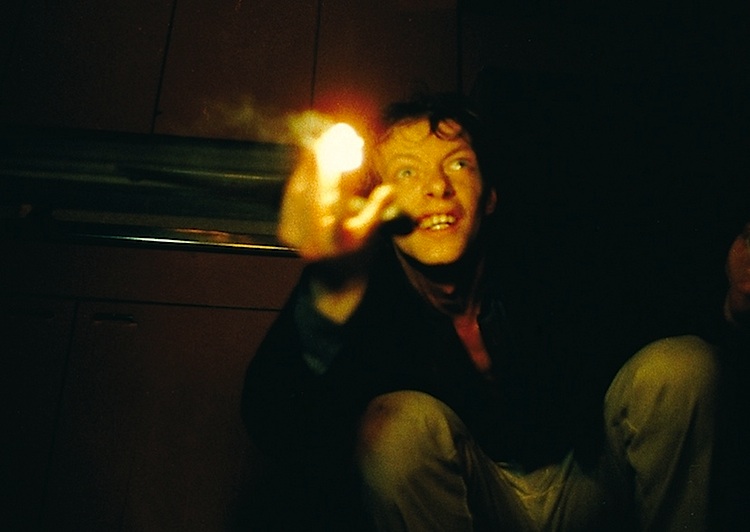
By Joe Bendel. Austria might summon images of famous composers, but it has also had its share of psychopaths. Ignoring the rather obvious historical examples, the recent case of Josef Fritzl horrified all of Europe in 2008. The case of Werner Kniesek similarly scandalized Austrians in 1980. Unrepentantly sadistic, the notorious Kniesek served as a model for the twisted protagonist of Gerald Kargl’s Angst. A rare Austrian foray into the serial killer genre, Angst featured the inventive cinematography of future Academy Award winner Zbigniew Rybczyński, who found Austria more hospitable after the Jaruzelski regime imposed Martial Law because of his vocal support for Polish Solidarity. A film indelibly marked by Rybczyński’s contributions, Kargl’s Angst (trailer here) screens this week as part of Shot by Rybczyński, a two film retrospective of the Polish filmmaker’s work as a cinematographer at the Spectacle Theater in Brooklyn.

Kargl’s unnamed POV character-narrator is about to make a good case for capital punishment. Twice convicted of murder, he can only think of one thing during his release from prison—finding new victims. The café he stumbles into is a little too public and the female cab-driver he eyes is a little too resourceful. However, she summarily ejects him near a secluded McMansion that should serve his needs well. It looks like their nearest neighbor is Dr. Heiter from Human Centipede.

Skulking about, the freshly released murderer begins stalking the residents: an apparently developmentally disabled man in a wheel chair, his younger sister, and their ailing mother. Though undeniably vicious, none of his attacks goes exactly according to plan, which further stokes his rage.

From "Angst."

Angst has quite a reputation in its own right. Though tagged with X ratings or the equivalent in several countries, it might seem relatively restrained to a generation weaned on Saw and Hostel movies, at least until the narrator’s third kill. Then all bets are off. Consider yourself warned.

Typically, psychological analysis in film is reserved for directors, screenwriters, and occasionally actors. However, it seems worth noting that this cinematic expression of extreme alienation was lensed by Rybczyński, the exile. Similarly, as a dissident from Communist Poland, he would be uniquely qualified to understand the evil that small banal men do.

Indeed, the nameless murderer of Angst is exceptionally unexceptional. Kargl’s refusal to glamorize or in any way build him up distinguishes the film from nearly every subsequent serial killer movie. Rybczyński’s work on the other hand is quite distinctive. Cool and severe, but rife with foreboding, the closest comparison would be Bruno Nuytten’s icily polished work on Andrzej Żuławski’s Possession. Shot from odd angles employing improvised slings, Angst is a restlessly kinetic, visually dramatic tour-de-force example of how a cinematographer can put their stamp on a film.

Angst is a bold and stylish depiction of human nature at its worst. If you are wondering whether it is for you, then the answer is probably no. However, it should be required viewing for adventurous fans of cult cinema. Highly recommended for those confident they won’t be scarred by the horrors found within, Angst kicks off the Spectacle’s Shot by Rybczyński tribute this Thursday (5/10) and screens again Sunday (5/13) and Friday (5/25).

Posted on May 8th, 2012 at 12:26pm.

Midnight Madness: LFM Reviews Asylum Blackout

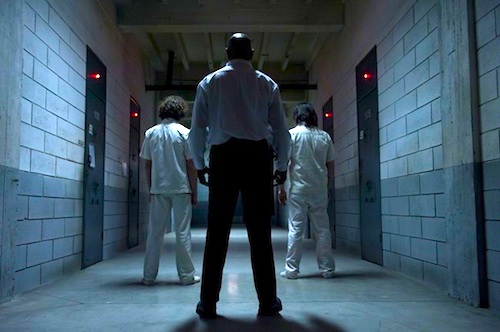
By Joe Bendel. If the Beatles had worked as cooks in a maximum security mental hospital, they still would have been vastly more talented than George and his slacker bandmates. Yet, for a day job, the pay is pretty good and supposedly they are completely out of harm’s way. Of course, when the power goes out, all bets are off in Alexandre Courtès’ Asylum Blackout, which opened a week of midnight screenings last week at the IFC Center in New York and is also now available on IFC Film’s VOD platforms.

It is 1989, so nobody will spoil the fun by calling for help on their cell-phones. We will be rooting for George to live, because he is a nice enough guy to care how the patient-inmates’ food tastes. He also has a hot girlfriend, so he has something to live for. Regardless, it is going to be a long night when the blackout hits.

The chief guard, J.B., sounds totally cool, but he is actually an abusive hardnose, which makes the opportunity for some score-settling even more attractive. In something of a perfect storm for loony bins, George suspects the scariest prisoner, Harry Green, has convinced the rest of the inmates to stop taking their meds. From there, things descend into bedlam, so to speak, with hints of further eeriness lurking in the margins.

From "Asylum Breakout."

Just to recap, the descriptively titled Asylum Blackout (a.k.a. The Incident) combines a fully stocked nuthouse with a power outage. As long as the execution is serviceable, this is a bullet-proof concept. As it happens, Courtès’ work easily surpasses competent, approaching the outright stylish. The audience never gets any backstory on the loonies, but many at least have weird distinguishing tics. While Courtès eventually meets the gore quota for midnight movies, he takes his time setting the scene and building the tension—what might be considered horror movie foreplay.

Okay, Asylum Blackout is not The Shining, but it will still creep you out from time to time. Paul Rouschop’s design team makes the sanitarium feel like a very real and very ominous place to be, even with the lights on. Rupert Evans is a decent lead and Richard Brake is all kinds of sinister looking as the nefarious Green. Not nearly the gross-out fest you might expect, Asylum Blackout is a pretty good time at the midnight movies. It screens late nights this week at the IFC Center and is also available nationwide through IFC’s VOD services.

LFM GRADE: B

Posted on May 8th, 2012 at 11:04am.

Tribeca 2012: LFM Reviews Wagner’s Dream; Film Screens Nationwide on Tuesday (5/8)

By Joe Bendel. It is the epic tale of a powerful ring that brings misfortune to all who seek it. Sound familiar? After technology advanced to the point that Peter Jackson could finally do justice to Tolkien’s Lord of the Rings, it is not surprising that the opera world might hatch some new ideas for Wagner’s Ring cycle. However, mounting a production on stage is a totally different proposition than making a film with extensive post-production effects, as renowned director Robert Lepage demonstrates with the Metropolitan Opera’s ambitious new production of the Ring. Director Susan Froemke (with editor Bob Eisenhardt) captures the ensuing flirting-with-disaster exhilaration of live opera in Wagner’s Dream, which had its world premiere at the 2012 Tribeca Film Festival, in advance of a special-event nationwide screening this coming Tuesday.

Reportedly, Wagner was not at all satisfied with the initial 1876 staging of his Ring cycle, but he died before he could implement any of the mysterious changes he promised. As a result, the questions of what Wagner would do and what is feasible have bedeviled opera companies ever since. Charged with developing something bold, Lepage did just that.

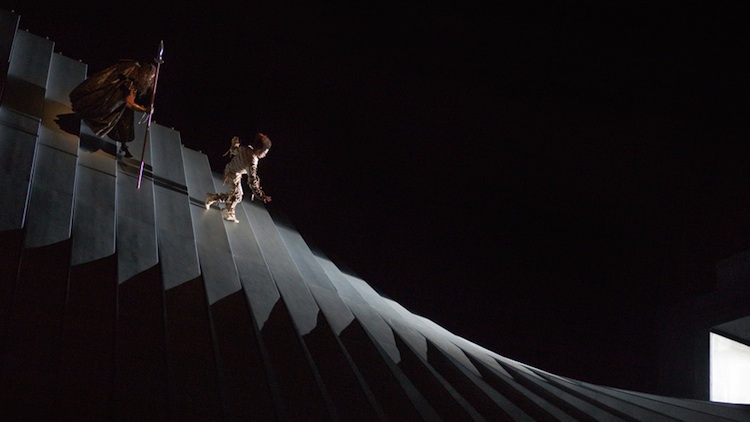
His radical concept centers on what will be referred to as “the Machine.” A series of interlocked, swiveling planks, sort of but not really resembling a double helix, the Machine will serve as the minimalist set for all four constituent productions of the Ring cycle. When it works, it facilitates some truly epic grandeur. Unfortunately, it is decidedly buggy.

Frankly, it is quite cool and surprising that the Met is so enthusiastically behind Dream, because it documents some embarrassing moments for the storied company. Complications with the machine put a damper on more than one opening night, which is awkward for the professionals bluffing their way through on-stage – but it makes for dramatic documentary cinema.

Traversing "the Machine."

Arguably, Lepage’s Ring cycle production might be thought of as the Met’s Apocalypse Now, with Wagner’s Dream corresponding to Hearts of Darkness: A Filmmaker’s Apocalypse. Like screenwriter John Milius sent to retrieve Francis Ford Coppola from the jungle only to be convinced “this would be the first film to win the Nobel Prize,” every cast-member and tech-hand approaching Lepage or Met General Manager Peter Gelb with logistical concerns winds up doubling down on the Machine. Again, just like Coppola’s film, the result is a sometimes flawed, but towering work of genius.

Dream is one of the few behind-the-scenes documentaries completely warranting the big screen treatment. A sense of scale is important here. Yet, it does not ignore the human element, following the challenges faced by the featured performers and sampling the reactions of loyal patrons. Having helmed two previous docs about the Met, including the profile of Maestro James Levine relatively recently broadcast on American Masters, Froemke clearly had the trust and confidence of the opera company. By now, many probably assume she is on staff there.

Even for opera neophytes, Wagner’s Dream is a fascinating film. It is also a highly effective teaser for its special encore screenings of Lepage’s Ring cycle productions. One cannot help wondering whether audiences will see the Machine cooperate or not. Highly recommended beyond the obvious opera and theater audiences, it screens across the country via Fathom Events this coming Tuesday (5/7) and will also be shown at the BAM Cinematek the following Saturday (5/12).

LFM GRADE: B+

Posted on May 2nd, 2012 at 10:10pm.

Shorts Sampler @ The Bosnian-Herzegovinian Film Festival 2012

By Joe Bendel. Is it possible to lead a normal life after witnessing the horrors of war? During the upcoming 2012 Bosnian-Herzegovinian Film Festival, at least two short films will directly grapple with that question – while one suggests that it is indeed possible, through its very example.

One of the best shorts just hitting the festival circuit, Jons Vukorep’s outstanding Short for Vernesa B. is a lamenting tribute to Bosnian actress-vocalist Vernesa Berbo, starring Vernesa Berbo. Through a complicated narrative structure, it depicts the challenges of her life after seeking asylum in Germany. It is hard to analyze the film in-depth without comprising the initial viewing experience, but it is safe to say Berbo is a very compelling screen presence.

Sadly, many viewers will have a good idea where Elvir Muminović’s Neverending Story is headed, but it is still a powerful trip. Emir was also an asylum seeker in Germany who eventually met and married Kirsten. When a miscarriage ends their hopes of having their own children, they turn to his native Bosnia with the intention of adopting. They find the perfect girl, but the revelation that she is in fact Serbian causes a deep fissure between the couple. Muminović eschews neat and tidy Oprah lessons, forcing the audience to face up to some hard facts about human nature.

In marked contrast, Al Mehičević’s English language Gold Diggers is a humorous anecdotal film in the tradition of O. Henry. As it opens, three miners trapped by a cave-in are eagerly anticipating their thirty minutes of fame as they await their imminent rescue. However, when their mistresses confront their wives at the disaster site, the media gets wind of a bigger story. Gold Diggers is amusing but rather light weight. Frankly, it is the sort of short that plays well at festivals, but its appearance here is somewhat significant. Never referencing the war (which would be out of place in this context), it has none of the terrible weight of history distinguishing many Bosnian films in recent years. Rather, it takes a potential tragedy and turns it into a vehicle for comedy.

Indeed, the paradox of the annual Bosnian-Herzegovinian Film Festival is that it is one of the friendliest and most welcoming festivals in New York, screening some of the deepest, most elegiac films. (Of course there are always notable exceptions, like last year’s drolly entertaining music documentary White Button.) A now well-established tradition coming hard on the heels of Tribeca, the BHFF is once again highly recommended, featuring many excellent short films making their American debuts. It opens tomorrow (5/3) with Danis Tanović’s sensitively rendered Cirkus Columbia, featuring the great Miki Manojlović, and ends this Saturday (5/5) with Angelina Jolie’s In the Land of Blood and Honey.

Posted on May 2nd, 2012 at 10:07pm.

Tribeca 2012: LFM Reviews Freaky Deaky

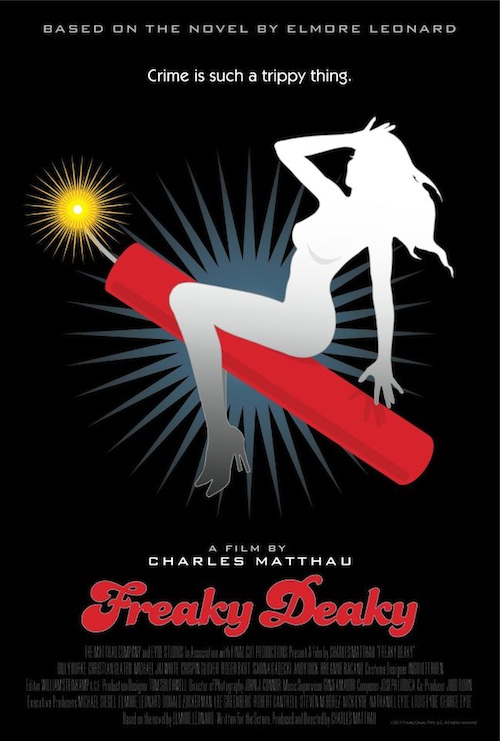
By Joe Bendel. Starting out as a western writer but eventually hitting his stride with crime novels, Elmore Leonard has a reputation for his sharp dialogue and lethal characters. Notable adaptations of his work include Out of Sight, Jackie Brown, Get Shorty, and 3:10 to Yuma. Indeed, the bard of badaassery’s support for a new big screen treatment of his work factored prominently in the Tribeca Talks panel discussion following the special screening of Charles Matthau’s Freaky Deaky (trailer here) during the 2012 Tribeca Film Festival.

Originally set in the 1980’s, Matthau shifted Freaky to the groovy 1970’s at Leonard’s suggestion. About to be transferred out of the bomb squad, Det. Chris Mankowski does not exactly kill himself trying to save a booby-trapped gangster. Still, it looks rather bad. Relegated to vice as a result, Mankowski takes the call when failed starlet Greta Wyatt files a rape report against wealthy creep Woody Ricks. Talk about a discordant way to kick off a supposedly madcap romp.

Initially, Mankowski downplays the legal recourse available to Wyatt, but he decides to rattle the nutter’s cage anyway. He is not the only one with his sights on the antisocial weirdo. Demolitions expert Skip Gibbs and his friend-with-benefits Robin Abbot blame Ricks for their own scrape with the law, for reasons that are hazily glossed over. To get to him, they will use his brother Mark as the tool he so obviously is. Meanwhile, Mankowski develops a personal interest in Wyatt and a sort of-kind of professional rivalry with Ricks’ bodyguard-fixer, Donnell Lewis.

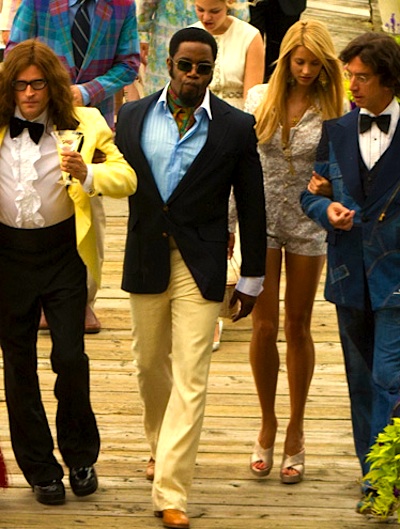
From "Freaky Deaky."

Once you get past the unseemliness of the film’s catalyst, it is a breezy enough distraction. However, despite the vintage cars and occasional file footage of Vietnam or Watergate, the film never really gets inside the 70’s mindset. This was a bizarre period of time, when millions of Americans were joining Est cults and taking Erica Jong seriously. By comparison, though not exactly a classic, the film version of Serial (released in 1980) is far more successful capturing the vocabulary and attitudes of the era. (It also offers the opportunity to see Martin Mull playing off Sir Christopher Lee). Still, there is one appealing era-appropriate in-joke. In a nod to the director’s father, every movie theater seen in Freaky is showing a Walter Matthau film, which might well have been possible in 1974.

Frankly, what distinguishes Freaky is the unusually eccentric cast it assembles, including Crispin Glover, Andy Dick, and Christian Slater. It begs two questions: how did they manage to insure this production, and where was Tom Sizemore? Perhaps he was already locked-in somewhere else. While it is nice to see blaxploitation veteran and former Bond girl Gloria Hendry, even in a small bone-thrown-to-genre-fans role, and Michael Jai “Black Dynamite” White doing his thing as Lewis, it is relative newcomer Breanne Racano who shines the brightest as femme fatale Abbot, clearly understanding villainesses should enjoy being devious.

According to the post-screening discussion, there may in fact be a Black Dynamite sequel in the works. Freaky Deaky actually compares reasonably favorably to White’s prospective franchise, but hardly so in the case of the senior Matthau’s gritty classics, like The Taking of Pelham One Two Three. Flawed but somewhat diverting, largely thanks to Racano’s head-turning work, Freaky Deaky has already had some rights announcements following its Tribeca Talks screening at the 2012 Tribeca Film Festival.

LFM GRADE: C+

Posted on May 1st, 2012 at 7:46pm.