Tribeca/San Francisco International Film Festival 2012: LFM Reviews Chicken with Plums

By Joe Bendel. Over an eight day period, Nasser-Ali Khan will become the anti-Scherezade. As he wills himself to die, stories from his past, narrated by the Angel of Death, will explain how the musician reached such a state of profound melancholy. Love and death become intimately intertwined in Marjane Satrapi & Vincent Paronnaud’s Chicken with Plums (trailer here), their fantastical but sophisticated live-action follow-up to the rightly acclaimed Persepolis, which screened at the 2012 Tribeca Film Festival and also unspooled yesterday at this year’s San Francisco International Film Festival.

Khan is widely regarded as the greatest Iranian violinist of his generation, but he has stopped playing. On the surface, his silence appears to be the fault of his wife Faringuisse, who destroyed his prized violin in one of their frequent squabbles. However, his depression is rooted in an elegantly tragic tale of love denied.

Technically proficient but never impassioned, Khan’s music took on uncommon richness after he was forbidden from seeing his true love Irâne, the traditional clockmaker’s daughter. Music never has been considered a stable profession by protective fathers. As Khan’s reputation rises, he acquiesces to his controlling mother’s wishes and marries Faringuisse. For him, it is a loveless union. For her, it is a marriage based on unrequited love.

Frankly, Khan is a crummy husband and a negligent father, but it is difficult to condemn him after witnessing his compounded heartache. Mathieu Amalric, with his big sad eyes, is perfectly cast as the exquisitely sensitive jerkweed. Viewers will sympathize with him, even as they shake their heads at his casual cruelty to Faringuisse. Likewise only more so, Maria de Medeiros (Bruce Willis’s girlfriend in Pulp Fiction) explodes the harpy exterior of his nagging wife, revealing the pain and vulnerability of Faringuisse.

Set in the late 1950’s pre-Shah, Western-leaning Iran, Satrapi and Paronnaud’s fable of star-crossed love would seem to hold limited political ramifications. However, it is not an accident that Khan’s forbidden love is named Irâne (as they confirmed in a post-screening Q&A). That she is played by Golshifteh Farahani is also clearly significant. The internationally acclaimed actress was barred from returning to Iran after (tastefully) posing nude in a French magazine to protest the Islamist regime’s misogynist policies. A radiantly beautiful woman, she also invests her character (and the film) with a graceful sadness.

Visually, Plums is also quite arresting, incorporating brief animated interludes, expressionistic sets, and highly stylized design elements. The inspired technical team definitely creates a seductive atmosphere of magical realism that is a pleasure to get caught up in. Highly recommended, Chicken with Plums was enthusiastically received by audiences at this year’s Tribeca Film Festival. For those in the Bay Area, it also screens Wednesday (5/2)  as part of the 2012 San Francisco International Film Festival, concluding this week.

LFM GRADE: A

Posted on May 1st, 2012 at 6:37pm.
Tribeca/San Francisco International Film Festival 2012: LFM Reviews Trishna

By Joe Bendel. Social class is a hard immutable fact of life in Thomas Hardy’s Tess of the D’Urbervilles. Plunking the classic story down in contemporary America would be highly problematic, but India is a different matter. Taking a few liberties here and there, Michael Winterbottom still captures the spirit of the original novel and its new setting in Trishna, which screened at the 2012 Tribeca Film Festival, with further screenings coming up this week as part of the San Francisco International Film Festival.

Jay will serve as both Trishna’s Angel and Alec. Touring the off-the-beaten-path attractions of Rajasthan, his head is turned by Trishna, the primary provider for her large family. The son of a British hotel mogul, Jay recruits the young woman for the resort he reluctantly manages. Things are quite pleasant for Trishna, making considerably more than she ever could in her village, while Jay harmlessly pines for her.

One night when her defenses are weakened, Trishna succumbs to Jay’s advances. Instinctively realizing a Rubicon has been crossed, Trishna retreats, but Jay pursues, whisking her off to Mumbai, where they are socially accepted as a couple. However, Trishna’s life and relationship will take a dark turn, paralleling Tess’s tragic history with men.

You never know what you’re going to get from Winterbottom, but he has emerged as the leading cinematic interpreter of Hardy’s novels, following up Jude and The Claim, very loosely based on The Mayor of Casterbridge. He is clearly comfortable navigating the film’s sexually charged power-dynamics, but Trishna also exhibits an affinity for India, even including musical montage sequences (with original songs composed by Amit Trivedi) that would not be out of place in high-end Bollywood cinema.

Winterbottom uses the subcontinent as a big canvas, covering a wide swath of geography, but his focus rarely strays from Frieda Pinto’s Trishna. While some might find her maddeningly passive, she is a product of her environment. Through Pinto’s haunted presence, viewers get a sense of the social and cultural weight crushing down on her. Thanks to Winterbottom’s streamlining, Riz Ahmed’s Jay has to turn on a dime from leading man to a cruel exploiter. Still, there are enough underlying consistencies in the impulsive, entitled persona he creates to maintain audience credibility. Pinto and Ahmed really carry the dramatic load, but veteran character actor Roshan Seth (Chattar Lal in Indiana Jones and the Temple of Doom) has some memorable moments as Jay’s stern but humanistic father.

Granted, everyone should have a pretty good idea where Trishna is headed. After all, Hardy is not exactly famous for his happy endings. However, Winterbottom’s treatment of Tess is boldly cinematic. (Incidentally, Polanski’s Tess will screen as a classics selection at this year’s Cannes, so cineastes might want to break out their Cliff Notes.) Literate and absorbing, Trishna is recommended for anglophiles and fans of Hindi cinema, alike. A strong selection of the recently wrapped 2012 Tribeca Film Festival, it screens Wednesday and Thursday (5/2 & 5/3) during this year’s San Francisco International Film Festival.

LFM GRADE: B

Posted on May 1st, 2012 at 6:37pm.

Tribeca 2012: LFM Reviews Michael Fassbender’s Pitch Black Heist

By Joe Bendel. Michael Fassbender is fully clothed, while Liam Cunningham is really drunk. Together, they are a mismatched pair of crooks hired to pull off a very dark caper in John Maclean’s Pitch Black Heist, the winner of the 2012 BAFTA Award for best short film, which screened over the weekend as part of the Status Update programming block at the 2012 Tribeca Film Festival.

Known simply as Michael and Liam, two safecrackers are meeting each other for the first time on a very unusual job. They are to retrieve some item (it hardly matters what) from a safe with a light-sensitive alarm. To prepare, they practice navigating a dummied-up room in complete darkness. On the day in question, they meet in a quiet pub and wait for their employer to send them the all-clear. However, they find themselves cooling their heels far longer than they expected, so they start doing what you’re supposed to do in a pub, lest they attract attention.

Pitch has a nice little twist at the end that Maclean adroitly lays the groundwork for, without glaringly telegraphing it. Frankly, this concept could be relatively easily expanded into a feature, which makes the economy of Maclean’s thirteen minute storytelling all the more noteworthy. Still, the real entertainment is watching the boozy interaction between co-executive producers Fassbender and Cunningham. Both actors have genuinely intense screen presences, perfectly suited to their roles in Pitch.

It all looks quite stylish as well, thanks to Robbie Ryan’s appropriately noir black-and-white cinematography. A neat little ironic crime drama, Pitch Black Heist is one of the overlooked treats of the Tribeca line-up. As per tradition, all short film blocks screened on the concluding day of this year’s festival.

Posted on May 1st, 2012 at 5:39pm.

Tribeca 2012: LFM Reviews BAM150

By Joe Bendel. In 1962, Rudolf Nureyev made his post-defection American debut at the Brooklyn Academy of Music (BAM). However, the 1960’s would be a difficult decade for the performing arts institution. Still, it survived and eventually thrived, as James Sládek documents in BAM150, a portrait of the venue in its sesquicentennial year, which screened again today during the 2012 Tribeca Film Festival.

Originally founded to rival the concert halls of Manhattan, BAM had a difficult time establishing its own identity, notwithstanding the appearance of high profile artists such as Nureyev, Sarah Bernhardt, and even Mark Twain. It was more in the business of leasing space than producing performances when Harvey Lichtenstein took the reins of leadership in 1967.

During his tenure, Lichtenstein dramatically raised BAM’s stock through the somewhat contradictory strategies of institutionalizing the avant-garde and pursuing big name performers. Ironically, the economic growth of the 1980’s helped stabilize the venue despite the many theater pieces it staged protesting the very policies that made it all possible. However, it was nearly all undone by Lichtenstein’s disastrous attempts to establish a repertory company.

BAM150 is a perfectly respectable survey of the hall’s history. Sládek has a nice approach to the material, smoothly blending moments of quiet, Wiseman-esque observation with more conventional talking head sequences. The combined effect gives audiences a pretty good feel for the rapidly expanding institution.

After previously profiling Mark Kostabi, a somewhat dubious artist more famous than he should be, Sládek has shifted gears, shining a spotlight on an arts organization that ought to be more widely recognized. It is also a rather shrewd filmmaking decision, since his documentary is a lead pipe cinch to be screened at BAM’s Cinématek. Still, he faced a bit of a challenge, considering dance and theater performances are fleeting by nature. As a result, viewers must often settle for descriptions rather than video documentation. Fortunately, the quality of interview participants helps to compensate, including the likes of Steve Reich, Peter Brook, Alan Rickman, and Isabella Rossellini.

Clearly produced in a celebratory spirit, Sládek never pushes or prods his subjects into any news-making revelations, but he keeps it all moving along briskly. Most likely destined for an engagement at the BAM Cinématek and an eventual PBS broadcast life, BAM150 is basically pleasant and informative. Modestly recommended for proud Brooklynites and those fascinated by the performing arts world, BAM150 screened again tonight (4/28) as this year’s Tribeca Film Festival enters its concluding weekend.

LFM GRADE: B-

Posted on April 29th, 2012 at 10:40pm.

Elles Belles: LFM Reviews Elles @ Tribeca 2012

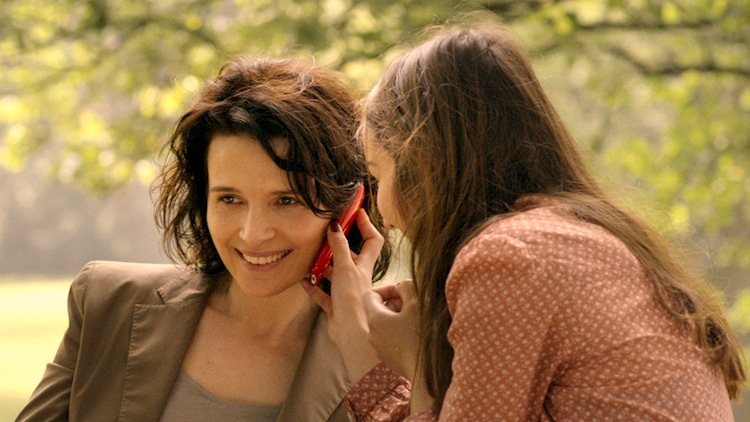
By Joe Bendel. Sex for money can be so liberating – at least, that is what some guys always say. A similar position is staked out in a rather mature new film produced and directed by women and featuring a largely female cast. Even if you adore Juliette Binoche, this is not a film to watch with your parents. However, a lot of people saw it with other people’s parents when it screened at the 2012 Tribeca Film Festival. And mere days later, Malgoska Szumowska’s Elles has opened its conventional theatrical run in New York.

Anne is a wife, a mother, and a freelance writer. Her latest story is a confidential profile of student prostitutes. The assignment came at an awkward period in her marriage, around the same time she busted her husband for a certain kind of net surfing. As she talks to these confident young women, she becomes obsessed with their explicit stories. According to Charlotte and Alicja, their approach to sex is healthier, because there is no hypocrisy. They make a comfortable living exploiting men’s weaknesses of the flesh. Maybe so, but liberation never looked so demeaning.

Films exploring the jujitsu ’empowerment’ of prostitutes are nearly as old as the profession itself. One obvious comparison is Steven Soderbergh’s The Girlfriend Experience, which also screened at Tribeca three years ago. Yet that film, starring an actual pornstar, is far more circumspect in what it depicts. In fact, there is no on-screen sex and only a spot of nudity is to be seen here or there. It is the emotional entanglements surrounding sex that concern GFE. In contrast, Elles jumps right into some of the more explicit scenes you will see in a public theater. And it was not tagged with an NC-17 rating for no reason.

Frankly, Soderbergh had the right idea. Even if Szumowska had a razor sharp analysis of sexual politics to offer, it is hard to get past some of the things she shows the audience. However, the film’s feminist themes are pretty threadbare and the drama is more frustrating than absorbing.

Normally a bedrock of reliability, even Binoche seems a little off here as the journalist. Her reactions to everything often seem wildly disproportionate to the circumstances at hand. Still, Anaïs Demoustier and Joanna Kulig both bring smart, attractive presences to bear on this material. For the record, I briefly met Kulig on the way to a post-screening Q&A and she seems like a lovely and engaging person. I imagine the audience had a lot of questions for her, but whether they had the guts to ask them is another matter entirely. It is also worth noting that the legendary Krystyna Janda (whose credits include Andrzej Wajda’s Man of Marble and Ryszard Bugajski’s The Interrogation) also co-stars in the largely thankless role of Alicja’s mother.

Something about Elles simply does not click. It is not necessarily because of the subject matter, but it makes the lack of depth and cohesion more conspicuous. Due to the accomplished cast, cineastes should have it on their radar, but it is not recommended as a satisfying theater-going experience. After its high profile Tribeca screenings, Elles is now open in New York at the Angelika Film Center.

LFM GRADE: D+

Posted on April 28th, 2012 at 10:38pm.

Tribeca 2012: LFM Reviews Postcards from the Zoo

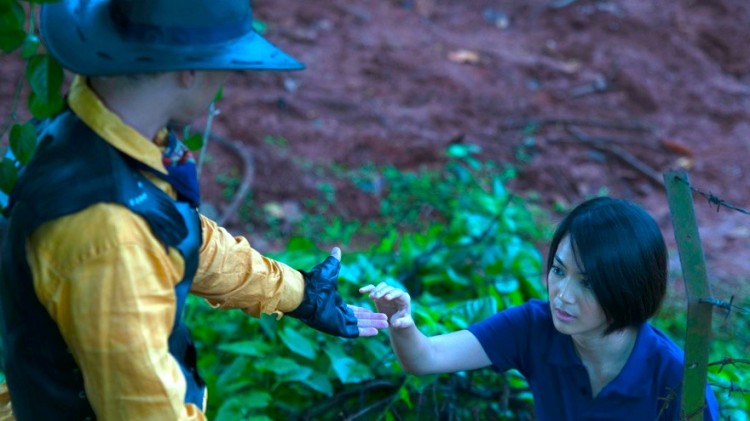
By Joe Bendel. The Ragunan Zoo is a slightly run down Eden, and the city around it is jungle. One innocent young woman will learn the nature of the world outside in the singularly named Edwin’s Postcards from the Zoo (see clips here), which screened today at the 2012 Tribeca Film Festival.

Abandoned in the zoo as a young girl, Lana simply stayed there, falling in with a group of itinerant workers who do odd jobs around the park and sleep on the premises. Growing up amongst the animals, she seems to have special bond with them, particularly the giraffe. However, her sheltered existence is turned upside down when word comes of the migrant workers’ imminent eviction from the zoo.

Fascinated by a mysterious street magician dressed as a cowboy, Lana is lured out of the park, becoming his assistant and ambiguous companion. While she acclimates to their performance routines, it is not long before she is working at a massage parlor in an even more ambiguous capacity.

Like Lana, Postcards should have never left the zoo. In those early scenes Edwin and cinematographer Sidi Saleh create a breathtakingly delicate, fable-like environment. It is fascinating to watch the quietly subtle ways Lana interacts with the animals. The Ragunan Zoo is also a truly wonderful setting, looking a bit wild and over-run by forest, in a way that further heightens the fantasy atmosphere.

However, once she leaves the idyllic zoo, Postcards becomes a largely by the numbers end-of-innocence tale. While there are arresting visuals to be found throughout the film, usually involving return trips to the zoo, we have been down this road hundreds of times before. Yes, it reflects the reality of Jakarta, which is also why it clashes with everything special in the film. It is also getting emotionally exhausting to see yet another little girl abandoned or abducted in a film from the region. The filmmakers ought to start picking on someone more their size.

Even if Postcards is undermined by its second half, it is impossible to take your eyes off Ladya Cheryl’s Lana. Her earnest engagement and exquisite vulnerability gives the film an emotional center of gravity, preventing it from becoming a mere exercise in archetypal tropes. It is haunting work.

There were obviously some crack animal trainers contributing their talents to Postcards. Cheryl is also an absolutely luminous presence. However, viewers are more likely to fall in love with her or the Ragunan Zoo than Edwin’s movie. Richly crafted but somewhat disappointing, Postcards from the Zoo screened again today (4/28) as this year’s Tribeca Film Festival enters the home stretch.

LFM GRADE: C+

Posted on April 29th, 2012 at 9:31pm.