New York’s New Directors/New Films 2012: LFM Reviews Romance Joe

By Joe Bendel. Even in Korea, the movie business is a tough racket. It disillusions people something fierce. However, the characters in Lee Kwang-kuk’s directorial feature debut might have been that way before they got into the industry. They also might be each other or possibly just passing their stories off as their own. Let the narrative games begin when Lee’s Romance Joe (trailer here), screens at the 2012 New Directors/New Films.

This will get complicated. Our first narrator will be Seo Dam, but as an aspiring screenwriter, his storytelling skills cannot compare to someone who has seen a bit of life, like Re-ji, who works for a coffeehouse, whose motto might as well be “coffee, tea, or me.” The parents of a long struggling assistant director have come to his friend Seo Dam fearing their absent son may have committed suicide, just like Woo Joo-hyun, a popular actress with whom he once worked.

As they mill about wondering what to do next, Seo Dam tells them the story of his new screenplay, in which a young boy arrives at Re-ji’s establishment looking for his long lost mother. Simultaneously, Re-ji delivers coffee and hard sells her services to Lee, a screenwriter-director in need of inspiration. She gets him to bite with the tale of “Romance Joe,” a depressed filmmaker who previously checked into the same hotel with suicidal intentions. She had inadvertently walked in on the man while making a delivery with the young boy from Seo Dam’s screenplay. As Romance Joe warms to her, he tells her an episode from his youth, when he fell in love with the haunting Kim Cho-hee after unwanted notoriety drove her to also attempt suicide.

Is Re-ji also the long lost mother of the boy in the screenplay, because they both once tried to end it all by cutting their wrists, just like Kim Cho-hee? This question will be definitively answered. Is Woo Joo-hyun also Kim Cho-hee? Is Re-ji Kim Cho-hee as well? No, most likely not (but don’t take my word for it). It appears safe to assume Re-Ji is Re-ji, whether appearing as subject or narrator and then subject again. Likewise, the missing assistant director is pretty clearly established to be Romance Joe. As for the sequestered director Kim, since Re-ji compliments him on his ironic approach to narrative, he seems the more likely fictional analog to Lee Kwang-kuk than Romance Joe.

From "Romance Joe."

That took more time to distill than you want to know. Yet, RJ is a tragic love story at heart, presenting an unlikely vehicle for such bravura postmodern gamesmanship. In contrast, a cerebral mystery like Mariano Llinás’ head-reeling Extraordinary Stories lends itself to such an approach quite well, because viewers do not resent having information withheld from them and perspectives fiddled with.

In a way, RJ is like a set of deliberately mismatched Russian dolls that do not quite fit within each other. Yet, the drama is so genuinely earnest, particularly that of the young lovers, it still pulls viewers in, even with the constant narrative shifts. Lee Chae-eun is quite remarkable, equally convincing and heartbreaking as the teenaged and thirtysome Kim Cho-hee. Yet it is Shin Dong-mi who really makes the film sing. It is a star-making turn, appealingly wry or saucy, depending on the circumstances. Unfortunately, the relative blandness of several male cast members does not help viewers looking for hooks to grab onto, but impressive young David Lee develops some poignant chemistry with the older Lee Chae-eun.

No matter how viewers respond to RJ, it is a film that will stick with them, daring them to make conclusions about what they saw and when it happened. Lee Kwang-kuk rather subversively deconstructs Korean tearjerkers like Il Mare (ill-advisedly remade by Hollywood as The Lake House), but it is Shin and the other Lees, David and Chae-eun, who really make it work. Recommended for adventurous film snobs, Romance Joe screens this Saturday (3/24) at MoMA and Monday (3/26) at the Walter Reade Theater, as part of New Directors/New Films 41.

LFM GRADE: A-

Posted on March 21st, 2012 at 11:26am.

New York’s New Directors/New Films 2012: LFM Reviews Goodbye

By Joe Bendel. It is not exactly a common cultural zeitgeist, but immigration has become an increasingly frequent topic of both American and Iranian films. In the case of the former, viewers are asked to identify with those trying to enter the country illegally. For the latter, audiences watch as desperate everyday people try to get out, by any means necessary. Needless to say, getting into America is much easier (and safer) then leaving Iran. One expecting mother-to-be struggles with this grim reality in Mohammad Rasoulof’s Goodbye, which screens during the 2012 New Directors/New Films, jointly presented by the Film Society of Lincoln Center and MoMA.

Noura was a human rights attorney in Tehran. Disbarred for obvious reasons, the only work now available to her is gift-wrapping. Her husband has been forced into an ambiguous exile up north, leaving her alone to deal with her pregnancy. This makes life particularly challenging, since Iran requires a man’s authorization for even the simplest medical procedures. Her baby is an important part of the immigration scheme hatched by a dodgy passport broker. However, she is having doubts whether she should keep her. But there is little to be done about it, without a husband’s permission.

Goodbye ought to be hailed as the international feminist watershed film of the decade. Yes, it directly addresses abortion, but the issues in question are far more fundamental than that single hot-button issue. As an unaccompanied woman, Noura is unable to undergo an ultrasound or check into a hotel on her own. Yet she faces more than just gender oppression, which becomes clear when the police confiscate her satellite dish.

Leyla Zareh in "Goodbye."

Facing a year in prison and the loss of his film production business, Rasoulof can clearly relate to such travails. Yet he could at least authorize his own medical treatment—a fact clearly not lost on him. While he previously employed layers of allegory to obscure his social critique in the visual arresting White Meadows (edited by his colleague Jafar Panahi, with whom he was arrested in late 2010), Goodbye is a bold exercise in street level realism. Still, from time to time he conveys Noura’s psychological state with powerfully impressionistic moments more in keeping with the tone of Meadows (an insufficiently heralded modern masterwork).

Considering Marzieh Vafamehr was sentenced to ninety lashes for her thematically similar role in Granaz Moussavi’s My Tehran for Sale (reduced on appeal to three months in prison), Leyla Zareh’s performance is courageous on multiple levels. Rather than play to audience sympathies, she portrays Noura emotionally guarded to an almost soul deadening extent, for the sake of self-preservation. It is a harrowingly convincing turn.

Of course, Goodbye ends as it must, to keep faith with those who experienced what happens to Noura. As a result there are no real surprises in the film, just tragedy compounded. In truth, this will be somewhat familiar ground for those who have seen Moussavi’s film and Panahi’s The Circle, but Rasoulof’s execution is quite compelling and sensitive, nonetheless. Important as a document of contemporary Iranian life and as an aesthetically distinctive work of cinema, Goodbye is one of the clear highlights of this year’s ND/NF. Earnestly recommended, it screens this Thursday (3/22) at the Walter Reade Theater and the following Saturday (3/24) at MoMA.

Posted on March 19th, 2012 at 2:37pm.

New York’s New Directors/New Films 2012: LFM Reviews The Minister

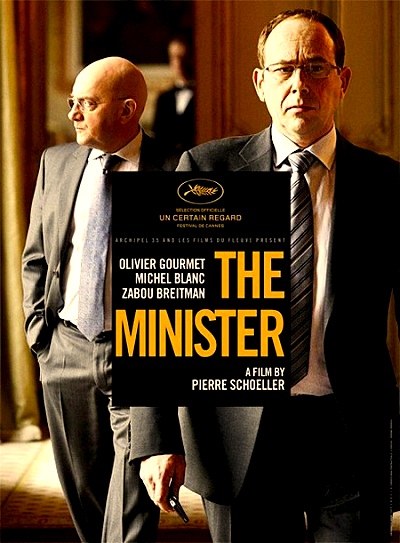
By Joe Bendel. Imagine Jonathan Lynn’s Yes, Minister played deadly seriously, in French. Such is the morality tale director-screenwriter Pierre Schöller has to tell. Bertrand Saint-Jean is a dull technocrat, but he does not lack ambition. He has built up his portfolio through the help of his loyal secretary, a respected veteran of the civil service. However, a series of political crises will shine a harsh light on his flawed character in Schöller’s The Minister (trailer here), which screens during the 2012 New Directors/New Films, jointly presented by the Film Society of Lincoln Center and MoMA.

The transport minister is woken from a wildly Freudian dream with grim news. A charter bus was involved in a severe traffic accident, killing many school children returning from a class trip. Saint-Jean heads to the crash site to lead the investigation and keep the media at bay. It will be his finest hour in the film, as a politician and a human being.

Subsequently, Saint-Jean’s public standing gets a nice little bump, but it is short-lived. Soon thereafter, he is a pulled into a controversy involving the privatization of train stations. Like his secretary Gilles, he is adamantly opposed, but the finance minister is in favor. In fact, it seems to be required by the EU, but Saint-Jean would prefer to kick the can down the road for his successor to deal with. Yet, it seems he will be forced to make some difficult choices, for the sake of his political career.

It is hard to think of a more cynical depiction of “the art of compromise” than Schöller’s Minister. As a former idealist, Saint-Jean’s self-contempt is palpable. Viewers watch some rather brazen pandering, including the temporary hiring of a long-term unemployed blue collar working as a ministerial driver, purely for PR purposes. Yet, despite the central role played by the privatization plan, Schöller’s screenplay sidesteps the issues of its normative and qualitative economic merits quite nimbly. Instead, it is treated simply as the MacGuffin to test Saint-Jean’s principles and loyalties. However, the Minister’s long, drunkenly patronizing visit to his new driver’s home rings distractingly false.

From "The Minister."

For the most part though, Dardenne Brothers regular Oliver Gourmet raises blandness to levels of epic tragedy as Saint-Jean. Yet there is something downright Clintonesque about his insecure need for approval. It is a shrewdly restrained but neurotic performance. Conversely, Michel Blanc makes mousiness dignified as the old school bureaucrat, ever loyal to his boss, as the embodiment of the system he has always served.

For those who really want to follow the specific issue at hand, the film’s treatment does not always make sense. Regardless, Schöller wields it effectively to cleave divisions in Saint-Jean’s staff and party. What emerges is a sort of modern Faust, as Saint-Jean makes the same awful bargain over and over again. Rare among political films, The Minister forthrightly depicts the psychological baggage of politicians in a way that can be appreciated by audiences across a wide ideological spectrum. Recommended for intelligent, slight jaded patrons, it screens this Friday (3/23) at MoMA and Sunday (3/25) at the Walter Reade Theater.

Posted on March 19th, 2012 at 2:28pm.

New York International Children’s Film Festival 2012: LFM Reviews A Letter to Momo

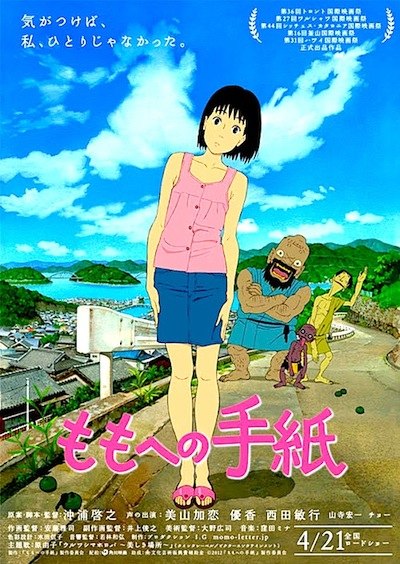
By Joe Bendel. They are the supernaturally incompetent: former gods demoted to mere goblins. It is not hard to see why. They certainly do not impress a young Japanese girl mourning her father after an initial round of scares. Still, they seem to have a specific reason for hanging around in Hiroyuki Okiura’s A Letter to Momo, which screens during the 2012 New York International Children’s Film Festival.

Momo Miyaura bitterly regrets her last words to her late marine biologist father. They had a fight. To be more accurate, she really let him have it. Shortly thereafter, his ship went down. Going through his things, she finds a letter he started writing to her, but never got beyond the “Dear Momo.” For obvious reasons, this letter preoccupies her thoughts as she and her mother relocate to the remote island of Shio.

Her stiff-upper-lip mother is not around much, leaving Miyuara with time on her hands. This becomes a real problem when she discovers three bizarre entities living in the attic and mooching their food. Apparently, nobody else around her can see them, with one exception having little bearing on the overall plot. At first she is understandably alarmed, but quickly gains the upper hand over the intruders. However, they continue to loiter about, making nuisances of themselves.

Of the three, only the rather addled Mame looks anything like a traditional goblin. However, his slimy tongue and Zenned-out mannerisms make him the most original of the trio. Iwa the gentle giant is also appealing in an archetypal way, but the amphibious-looking Kawa has an unfortunate Jar Jar thing going on.

Only Okiura’s second film, following-up his breakout 1999 debut Jin-Roh: the Wolf Brigade, Letter has been compared to Studio Ghibli both in terms of style and subject matter. Indeed, it bears strong thematic similarities to The Secret World of Arrietty and Makoto Shinkai’s Miyazaki-influenced Children who Chase Lost Voices from Down Below (which also screened at this year’s NYICFF). Yet, Okiura consistently elevates the realistic family drama well above the many otherworldly creatures. That unwritten letter is not merely a metaphor. It serves a genuinely important role in the story, which is quite earnest and touching.

Almost entirely generated by hand, Okiura’s animation is quite striking. Evidently that is one reason his sophomore feature was so long in coming. Reportedly he resolved only to work with Japan’s top animators (including animation director Masashi Andô) and was willing to wait until their schedules cleared. The lush nature backdrops are definitely Ghibli-esque and their figures are unusually expressive, by any animation standard.

There is definitely something very universal to Momo’s story. Okiura tells it with grace and emotional conviction. Indeed, this is the rare animated film that might hit too close to home for youngsters and parents dealing with similar losses. For the rest of us, its unabashedly open heart is rather refreshing. Recommended particularly strongly, but not exclusively, for young girls, A Letter to Momo screens again Saturday (3/24) at the Asia Society as NYICFF continues at venues throughout New York.

Posted on March 19th, 2012 at 2:20pm.

LFM Reviews Gerhard Richter Painting (and Scraping)

By Joe Bendel. Perhaps no artist represents the force of creative destruction better than Gerhard Richter. Not surprisingly, such a Schumpeterian painter was ill-suited to the Social Realist doctrine dominant in the former DDR. Finding refuge in the West two months before the construction of the Berlin Wall, Gerhard’s work has reached dizzying prices at recent auctions. Filmmaker Corinna Belz documents the artist at work in Gerhard Richter Painting, now showing in New York at Film Forum.

For some, Richter’s work probably confirms their uncharitable preconceived notions about modern art. The Dresden-born artist is best known for his large abstract paintings and photo-realistic work that would seem to be stylistically at odds with each other. Throughout the film, Belz captures the increasingly self-conscious Richter at work on two canvases in the former style.

After seeking asylum in West Germany in 1961, two Richter murals in the East were painted over out of dogmatic spite. Ironically, Richter deliberately subjects his work to similar treatment, roughly scraping his canvasses with paint squeegees to see how it alters their character. This process might continue past the point paintings are hung for exhibition. Indeed, there is something very Darwinistic about his approach, causing his assistants to openly speculate whether certain paintings will be able “to hold their own.”

GR Painting follows in the tradition of similar documentaries from Kino Lorber-Alive Minds, observing an artist or craftsman at work in their studio-space. However, the portrait of Richter is considerably more engaging than Gereon Wetzel’s El Bulli or Sophie Fiennes’s Over Your Cities Grass Will Grow, because Belz brings a more visually dynamic approach to bear on her subject, without the same hushed reverence. However, Richter and his colleagues do not offer the sort of witty commentary heard fly-on-the-wall style from photography book publisher Gerhard Steidl and his roster of artists in Wetzel & Adolphe’s shockingly entertaining How to Make a Book with Steidl.

While Belz touches briefly on Richter’s fateful flight west, her focus falls squarely on his creative process. Frankly, for those with more traditional aesthetic inclinations, each successive scraping often renders the two canvasses in question less interesting, blurring the color contrasts and breaking down the paintings’ implied compositional structure. That is just the reality of his working method. Many will find it fascinating, many others will not. At least Richter is a rather interesting figure to spend time with. Recommended for patrons well steeped in the contemporary art world, GR Painting screens through Tuesday the 27th at Film Forum in Manhattan’s eternally chic West Village.

Posted on March 16th, 2012 at 10:40am.

The Cinema of Nic Cage: LFM Reviews Seeking Justice

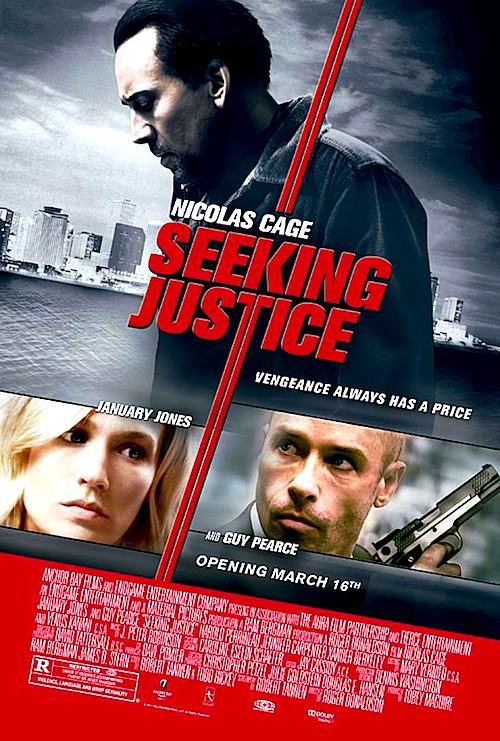
By Joe Bendel. In some evil alternate universe, “the hungry rabbit jumps” is about to become a massive catch-phrase. Thanks to a benevolent creator, we do not live in that world. In our reality, Nicolas Cage keeps sinking to lower lows with each new b-movie he appears in. The lowest yet is Roger Donaldson’s Seeking Justice, which opens today in New York.

Happily married Will Gerard’s life crumbles when his much smarter and more attractive wife Laura is attacked. While anxiously awaiting news in the hospital, Gerard is approached by a suspicious man. Simon, as he will be called, tells Gerard his associates know who did it and can “take care of him” if he agrees to do them a favor in the future. After an agonizing period of hand-wringing, Gerard agrees. The deed is done, his wife begins her recovery, and life appears to right itself. Then Gerard gets the call with those magic words: “the hungry rabbit jumps.” That means it is time to collect.

Evidently, the mystery man represents a shadowy cabal of vigilantes (encompassing just about everyone in the city of New Orleans) based on the principal of paying vengeance forward. It is now Gerard’s turn to off someone. However, his target is not who he was represented to be. It seems the conspiracy forgot about the private justice aspect of their business and became all about killing.

Only Cage would make a self-loathing vigilante movie. Face it, this is what he does. However, why a quality filmmaker would helm such depressing vehicle is a mystery. Roger Donaldson’s last film The Bank Job was smart, sophisticated, and lively. What happened? It is also baffling how January Jones’s management could let her squander her Mad Men capital in a Nic Cage picture. In truth, she is perfectly fine as Laura Gerard, but it is not exactly a part of great depth.

At least in Trespass, Cage’s previous blink-and-you-missed-it release, Ben Mendelsohn understood how to chew the scenery as a larger than life villain. In contrast, Guy Pearce looks physically uncomfortable as Simon, like he was suffering from a bad case of food poisoning during production. The only spark in the picture comes from Xander Berkeley, doing his shtick as the corrupt Lt. Durgan with a ridiculous New Orleans accent, presumably to help stave off boredom.

It’s great that Justice was shot in New Orleans, but it is frustrating that the production did not take advantage of the Crescent City’s richly diverse music scene. That would have at least helped offset some of the film’s blandness. Altogether, the film lacks character, energy, and conviction. Highly skippable, it opens today (3/16) in New York at the Village East and AMC Empire.

Posted on March 16th, 2012 at 10:39am.