By Joe Bendel. Maybe Edward Bulwer-Lytton and the hollow Earthers were not so wrong after all. There certainly seem to be mystical forces intruding up into the surface world around the Japanese countryside. One shy school girl discovers the fabled subterranean world of Agartha in Makoto Shinkai’s anime epic Children Who Chase Lost Voices from Down Below (trailer here), which screens during the 2012 New York International Children’s Film Festival.
Asuna Watase is a bright student, who works equally hard around the house, as well. After her father’s untimely death, her mother must put in long hours at the hospital to support them. In her mountainside refuge, Watase tunes the crystal radio her father left behind. One day she picks up an otherworldly melody, achingly sad and beautiful in equal measure. Soon thereafter, she is saved from a bizarre Gamera-esque monster by Shun, a mysterious boy roughly her age. He makes quite an impression, but it seems a tragic fate soon lies in store for him.
Though she only briefly knew him, Watase grieves him deeply. As a result, she finds particular resonance in her substitute teacher’s story of Izanago and Izanami, the Japanese variant on the Orpheus and Eurydice myth. Likewise, Mr. Morisaki is very interested in her when he realizes she has made contact with the world beneath. It turns out he has been working with the Arch Angels, a group of “empty-headed Gnostics” outfitted like S.H.I.E.L.D., who have sought the legendary power of Agartha. Unconcerned with such matters, Morisaki seeks to resurrect his late wife. Stranded on the other side with her fanatical sub, Watase accompanies him on his quest, for reasons that are not yet clear to her.
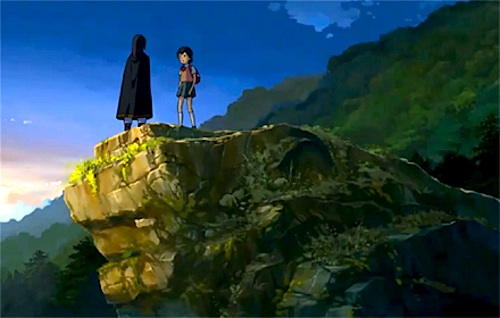
From "Children Who Chase Lost Voices."
There is a heck of a lot that transpires in Agartha, involving big time mythological archetypes. Highly literate by anime and wider animation standards, Chase is packed with allusions, including periodic nods to the grand old man himself, Hayao Miyazaki. Of course, the diverse mystical fantasyscapes play to Shinkai’s strength. His breathtaking vistas and richly detailed nature studies arguably surpass the recent Studio Ghibli productions.
NYICFF cautions parents that there are several potentially nightmare-inducing scenes in Chase, which is rather good news for grown-up anime fans. True to their billing, Shinkai has created some pretty creepy wraith-like shadow-dwelling creatures, as well as an ancient entity that looks as if it shambled out of a Salvador Dali painting. He also keeps the tension ratcheted up, preying on viewer emotions rather ruthlessly. Indeed, more than just another plucky kid who saves the world, there is something quite touching about the spiritually resilient Watase.
Chase is definitely high-end animation, in both visual and narrative terms. It largely skews towards older kids and general fantasy audiences, but should pay-off handsomely for both groups. Highly recommended, it screens again Saturday (3/10) and the following Sunday (3/18) at the IFC Center, as well as next Saturday (3/24) at the Asia Society, as this year’s NYCIFF continues at venues around the City.
Review: HBO’s Game Change is like Days of our Lives for Republicans
By Jason Apuzzo. It used to be that a politician had to be a Kennedy to get a juicy, tell-all movie made about them.
On the odd chance that you can’t get enough of this year’s colorful Republican primaries – if lurid accusations of Newt Gingrich’s ‘open marriage’ or saucy rumors of Herman Cain’s romantic conquests haven’t been enough for you – or if you think all the pizazz went out of the campaign once Michelle Bachman left the race (can anyone else say “Obama is a socialist” with such a winning smile?), then HBO’s frothy Game Change, which debuts this Saturday March 10th, may be the remedy for you.
Game Change is pure political soap opera, and in fleeting moments it even makes for compelling drama – though to be fair, Game Change is probably not an accurate view into the behind-the-scenes dynamics of the 2008 McCain campaign, or into the personality of its megawatt star, Sarah Palin.
Julianne Moore as Sarah Palin.
What the movie is, however, is a gossipy and occasionally colorful look at how much changed – at least in the world of Republican politics – when John McCain made the decision to select Sarah Palin as his running mate for the 2008 election.
And as the roiling 2012 campaign continues to make clear: a lot changed from that point forward.
There was an era, seemingly a lifetime ago, when the Republican Party appeared to be the quieter, more straight-laced of the two parties. Most people over 30 remember what that was like, back before Republican officeholders were expected to be celebrities.
Traditional Republican candidates were war veterans and businessmen, successful lawyers, sober Congressmen with dark suits and smiling families, genial chairmen of the local chamber of commerce. Think Mitch Daniels crossed with Phil Mickelson.
They were the type of person you’d want to buy real estate or aftershave from, or to lead your nephew into combat – but not necessarily build a Broadway show or rock opera around.
That, of course, was before the Palins came to town.
Game Change is HBO’s adaptation of the book of the same name about the 2008 Presidential election, penned by journalists John Heilemann and Mark Halperin. Crucially, that book depicted both sides of the 2008 campaign – dwelling mostly on the epic Democratic Party primary battle between Barack Obama and Hillary Clinton, something left out completely from HBO’s movie. Continue reading LFM’s Jason Apuzzo Reviews HBO’s Controversial Game Change at The Huffington Post and AOL-Moviefone
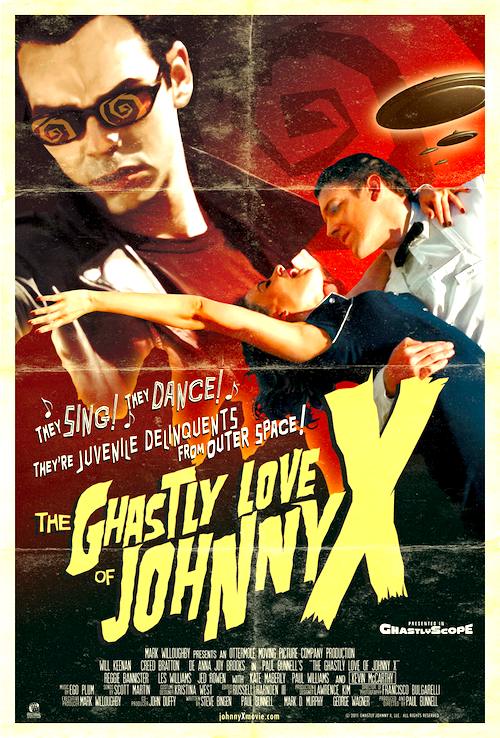
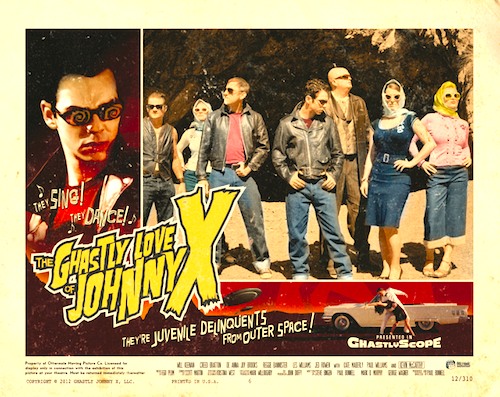
By Joe Bendel. Supposedly, 1950’s America was an era of stultifying conformity. Yet it represents a breath of freedom for a group of galactic delinquents “sentenced to Earth.” They can only return when their leader commits a truly selfless act. However, one or two have rather mixed feelings about leaving their new world in Paul Bunnell’s mash-up The Ghastly Love of Johnny X (trailer here), which has its world premiere this Saturday at the 2012 Cinequest Film Festival in San Jose (and hey look, free posters for the first 100 audience members).
Johnny Xavier is a bad kid, but when the stern Grand Inquisitor pronounces his banishment, it temporarily breaks his hardened tough guy exterior. He seems to acclimate just fine on Earth, though, leading his gang of Ghastlys as they rumble about dusty southwestern burgs. Gone are the Liberace outfits of their home planet. It is now strictly a Fonzy wardrobe for Xavier, a.k.a. Johnny X, with one exception. He is dead set on reclaiming a powerful telekinesis suit stolen by his ex-girlfriend, Bliss. Things get complicated as their quarrels sweep up a smitten soda-jerk (who will hear the “jerk” part emphasized many times over the course of the film) and an aging (or somewhat dead) rockabilly star.
There are also musical numbers that are necessarily goofy, but considerably better than one might expect from an aesthetic standpoint. Clearly, Bunnell and everyone else he convinced to appear in Ghastly have a real love for the B-movie alien invasion genre. Arguably most significant to fans is the final screen appearance of Kevin McCarthy (fondly remembered as the protagonist of the original 1956 Invasion of the Body Snatchers). Sadly, McCarthy passed away soon after completing his work as the Grand Inquisitor, but his commanding presence is undiminished in Ghastly. Clearly in on the joke, he plays it to the hilt, which is cool.
Frankly, Ghastly has a far more notable cast than viewers might expect. As local late night talk show host Cousin Quilty, Paul Williams is rather funny, while also proving he is indeed still alive. Creed Bratton of the Grass Roots (the band) and The Office (the television show) also gets to ham it up as the late but still rocking Mickey O’Flynn. On the other hand, Ghastly’s proper leads are not especially charismatic, but they can dance and carry a tune well enough.
Ghastly looks great, lovingly shot by cinematography Francisco Bulgarelli on the last surviving stock of Kodak Plus-X black-and-white film. The design team also nicely captures the appropriate ambiance of B-movie cheese for the sci-fi scenes, as well as the right frothy teeny-bopper look for the musical numbers.
Bunnell helms the retro goofiness with brisk clarity, but perhaps he has too much affection for the films he is sending up, treating his characters and their situations rather gently. Still, there is plenty of room for viewers to insert their own jokes, which may be the whole point. A nostalgic valentine to early Roger Corman and his contemporaries rendered with greater style than thematically related films like R.W. Goodwin’s Alien Trespass or Madeleine Olnek’s Codependent Lesbian Space Alien Seeks Same, Ghastly should find an appreciative genre audience when it premieres this Saturday (3/3) at the California Theatre. It also subsequently screens at the San Jose Repertory Theatre on Tuesday (3/6) and Saturday (3/10) as part of this year’s Cinequest Film Festival.
By Joe Bendel. Marked by denial, obstruction, and spin, the Chinese government’s response to the 2008 earthquake that rocked Sichuan Province bordered on the outright surreal. As a result, the experimental approach of Canadian-based native Chinese filmmaker Tao Gu’s On the Way to the Sea conveys the physical and spiritual enormity of the disaster quite aptly. The winner of the Special Jury Prize at last year’s Clermont-Ferrand International Short Film Festival, arguably the world’s most prestigious fest for shorts, OTWTTS (trailer here) screens tomorrow night in New York as part of a Clermont-Ferrand Highlights program at the 92Y Tribeca.
Unlike more conventional documentaries, OTWTTS does not rake the mock of the shoddy school construction practices that exacerbated the quake’s death toll or challenge the state’s dubious fatality statistics. Instead, Tao Gu gives a personal-impressionistic sense of the catastrophe and aftermath, through the eyes of his survivor parents. Bearing symptoms of post-traumatic shock, they do not sound merely displaced, but bereft of their sense of belonging in the world.
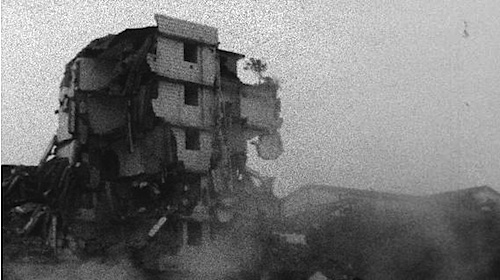
Through grainy black-and-white images, he captures a devastated Wenchuan that brings to mind London after the Blitz, coastal Japan after the tsunami, or even a post-Atomic Hiroshima. Despite their terrifying memories of the actual quake, it might even be more painful for his parents to watch the authorities raze the not inconsiderable extant remains of their home.
Ironically, Tao Gu’s visuals might arguably be too artistically composed, giving the disaster area a patina of scarred beauty. Clearly a talented eye, his contextual shots of the surrounding countryside could make striking covers for ECM Records.
Deeply felt and arrestingly rendered, OTWTTS is a haunting film. While it certainly eschews the standard techniques of traditional documentaries, viewers should not be scared away by the “experimental” label. Indeed, the nearly twenty minute short stirs audience emotions rather directly. Highly recommended, it is the highlight of the 92Y’s Clermont-Ferrand highlights, screening as part of program 2 tomorrow night (3/2).
[Editor’s Note: The article below appears in its entirety today at The Atlantic.]
Putin’s Kiss, Khodorkovsky, and Target question tyranny, capitalism, and their country’s future.
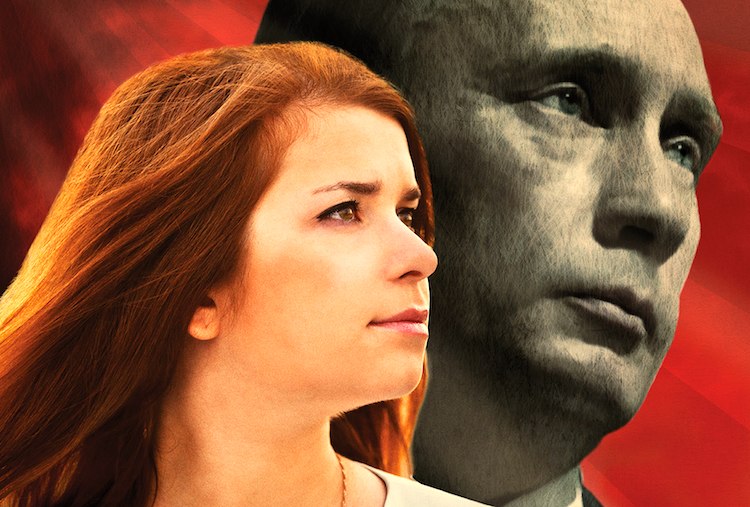
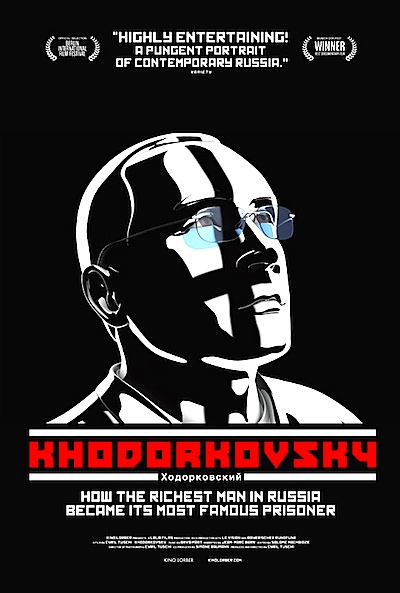
By Govindini Murty & Jason Apuzzo. As Russians head toward their presidential elections on March 4th, a trio of new films sheds light on a contemporary Russia veering between hope and cynicism, democracy and authoritarianism. The documentary Putin’s Kiss depicts a young Russian woman who becomes disillusioned with her role as a leader in Vladimir Putin’s nationalistic youth group Nashi in the wake of a brutal beating of a journalist. The chilling documentary Khodorkovsky examines the fate of the jailed Russian billionaire turned democracy activist Mikhail Khodorkovsky. And the science-fiction epic Target depicts the moral collapse of a wealthy elite in an authoritarian, near-future Russia.
On the brink of what may be another six years under Putin’s rule, these three films reveal a deep anxiety about Russia’s future—and a faint glimmer of hope for more genuine democratic freedom.
Masha Drokova is the young heroine of Danish director Lise Birk Pedersen’s documentary Putin’s Kiss (2012), a selection of the 2012 Sundance and Berlin Film Festivals and currently playing in limited release. Born in 1989, Masha is part of the first generation to grow up in the wake of the collapse of the Soviet Union. At the age of 16, Masha joins Putin’s nationalistic youth group Nashi; by age 19, she is already a spokesperson and leading commissar of the youth group, and Putin himself awards her a medal of honor. By age 21, the bright, ambitious Masha has everything thanks to Nashi: a prestigious spot in a top Moscow university, a new car, an apartment, her own TV talk show, and access to the highest echelons of Russia’s power elite.
As briefly mentioned in the film, Nashi itself was founded in 2005 by Putin supporters to counter the rise of pro-democracy youth groups in the wake of the Ukrainian Orange revolution. Although purportedly “democratic and anti-fascist,” Nashi bears a striking resemblance to the Soviet youth group Komsomol. Like Komsomol, the well-funded Nashi provides a route for many young people into official advancement.
In Putin’s Kiss, Nashi founder Vasily Yakemenko is shown exercising a Svengali-like control over his young charges, exhorting them to discipline and promising them a new life if they will dedicate themselves to Putin and the Russian motherland. As Yakemenko says to the Nashi faithful: “I want everybody to understand: There is no authority for the movement except for the policy of Putin and Medvedev … Being part of the movement means going out into the streets. It means to tell a villain he’s a villain.” As depicted in the film, a major part of Nashi’s efforts are directed toward vilifying Putin’s opponents as “enemies of Russia.” By way of example, the film shows some particularly crude attacks directed at opposition figures Boris Nemtsov, Ilya Yashin, and Garry Kasparov.
Masha is initially drawn to Nashi out of patriotism and ambition. She sees Nashi as a way for young people to get involved in helping advance Russia, and she considers Putin a force for strength and stability. Masha is such a fan of Putin that she becomes known as “the girl who kissed Putin” for impetuously pecking him on the cheek when he presented her with a medal.
Yet Masha’s curiosity about the larger world leads her to make friends with a group of opposition journalists. Masha’s chief friend in the group is the gregarious Oleg Kashin, a liberal journalist who writes for the Kommersant newspaper.
Things take a dark turn one night in 2010 when assailants brutally beat Oleg Kashin …
[For the remainder of this article, please visit The Atlantic.]
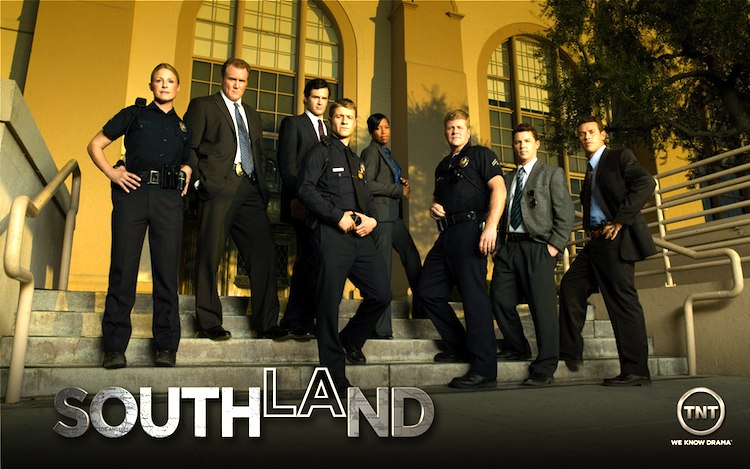
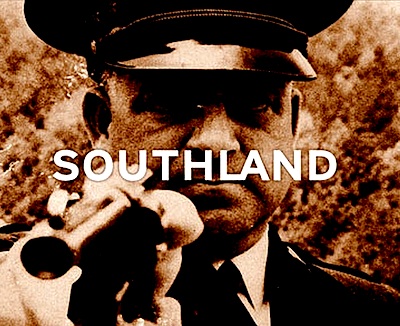
By Patricia Ducey. There’s a spot on L.A.’s 101 freeway near Vignes Street where, if you look up at the right time of day, you can see the silhouettes of a half dozen or so helicopters–the LAPD air support unit–on the roof of their headquarters on Ramirez Street. It’s an awe-inspiring, fearsome sight. I get the same vibe at Southland’s opening credit roll. A series of sepia-toned photos of local crime scenes scrolls by, starting with the muzzle of a very large gun aimed straight at you, buddy, by a grinning 1960s-era L.A. cop. Against the slideshow are the martial tones of Martin Davich’s theme music of thumping bass and staccato drumbeats, that telegraphs a clear message: bad guys beware. This is Los Angeles, the mythic Los Angeles of TNT’s ever improving and innovative Southland.
Yet, as unapologetically fierce as the opening sequence may be, Southland is more about the power of ideas than power for its own sake. The body count is remarkably low, and the cops spend as much time talking to their citizens as busting them. In contrast to the patricians of Law & Order who fought the forces of chaos in the rarified air of law courts, or the wonky CSI techs in sterile labs, Southland‘s cops attack cases and problems from the bottom up, at street level. These L.A. cops aim to restore character, as well as order, to the beat. Call it nation building in L.A., if you will. And thanks to rich, layered writing, non-PC characters and fresh production style, we come to believe – like these cops – that they might just pull it off.
From the opening credit sequence.
John Wells of ER tapped NYPD Blues veteran Ann Biderman to create the show and she rode along with the LAPD for several months to immerse herself in its culture. The resulting writing is so rich in detail that even the smallest scene is not wasted; each detail adds heft to the character or storyline. Her characters have mastered the nuances of every gang, every drug network, and every neighborhood from the West Side to Boyle Heights. As the detectives search an alley for evidence, for instance, a drug addict ambles by, listing from left to right in precarious fashion. “Don’t worry,” the veteran replies matter-of-factly to the rookie’s alarm, “they never fall down.” And he doesn’t, much to the surprise of the rookie. The officers eat lunch at real fast food joints or taco stands and chat endlessly about where to eat, to alleviate the monotony of an uneventful patrol. They solve a business dispute between a drug dealer and his buyer and defend a transvestite business owner from local bullies. They break up at least one marital fight per episode. They crack jokes—about each other, about the crazies they meet. And it’s all compelling—we are never sure what is going to happen next.
Southland’s characters defy neat types, as well. The centerpiece of this ensemble is the partnership between rookie Ben Sherman and his training officer, John Cooper, who spends the first couple of episodes training—hazing, really—the rookie from Beverly Hills. But Ben takes it, eventually winning Coop’s respect when he expertly guns down a gangbanger, saving fellow officer Dewey’s life. “Where did you learn to shoot like that,” they exclaim. “Beverly Hills Gun Club,” he coolly responds. And as the series progresses, Ben’s story unfolds. He is not just a rich kid engaging in cop tourism; his own family was terrorized by a criminal client of his criminal defense lawyer father. And Cooper is not the chubby-cheeked bully out to vent his angst on the mean streets, as he first appeared.
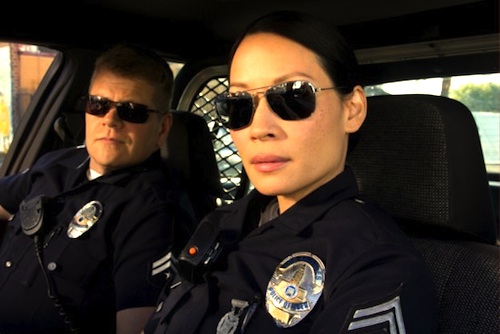
Michael Cudlitz & Lucy Liu in "Southland."
Now we are in Season 4 and Coop has overcome an addiction to pain pills that started with treatment for his aching back. He finally states that yes, he is gay, trying to calm a gay teen who has been viciously bullied. Ben registers no surprise, but at first we are not sure if this is just another story he tells to calm down a distraught victim. Thinking back, we realize of course that he’s gay but Southland has rolled out the story of his sexual identity in gradual hints, as they did with other characters, with no exploitation.
Southland pokes fun at overused or politically correct TV police tropes, as well; they even call Ben “Tori Spelling.” They tell nice, sweet stories to victims to comfort them—Detective Lydia Adam’s partner gets almost teary-eyed at one until she tells him that she just made it up. In another episode, a man is stabbed to death at a convenience market; the victim happens to be the witness whose testimony helped send man to prison for life. That man has just been released thanks to new DNA evidence, but the new partner resists Lydia’s notion that he is the killer. After all he’s suffered! After she doggedly interviews him and gets a search warrant she recovers bloody clothes and the murder weapon in the recently freed man’s house. Her new partner is stunned. “I’m not surprised,” she shrugs. More reversals of the trite include a watch commander opening roll call with the sardonic announcement that crime has gone up dramatically now that the courts have released so many prisoners. In another, a hipster in a Smart Car is made to look the fool against Cooper’s cool. Southland‘s stories seem real and original, against the grain of the usual police drama pieties.
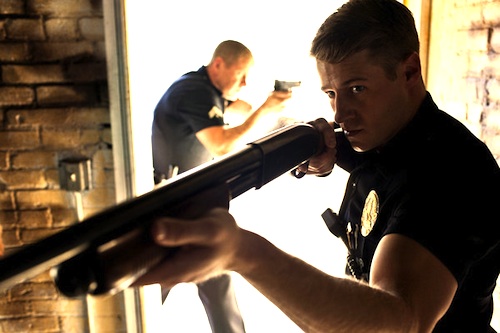
Michael Cudlitz & Ben McKenzie in "Southland."
But it’s Officer Sammy Bryant’s character that illustrates the “message” (if any) this LAPD is sending. Sammy is the voice that exhorts the people of L.A. to step up and take back their city from the thugs. As fearless and aggressive as he is, he knows that the police can’t keep the peace alone. In Season 1, he urges three teenage girls to testify in a gang murder case. Sweet naïve Janila, in the throes of LAPD hero worship, agrees – if they promise to get her into the Explorers. An irate citizen tells Sammy he is filing a complaint against him for insensitivity at the scene of a crime; Sammy shouts back that he ought to think about helping the police if he wants peace on his street. That stops the complainant short, as if he had never considered the idea. And so the citizen testifies. In the latest episode, though, Sammy may have gone too far: an anguished father curses and punches Sammy in the courthouse hall. Sammy had convinced his son to testify against a gang and the gang killed him. It will be interesting to see where Sammy’s character goes; up until now, his informants have escaped retaliation.
Despite the murder and mayhem, Southland’s L.A. is broken but unbowed. There’s something essentially noble and optimistic that the show communicates. One thinks of Sammy’s aggressive, passionate jeremiads about stepping up, or the constant jokes and pranks to leaven the deadly tension, or Cooper’s masterful techniques to calm domestic fights. These cops are parents in a family of a million children who have lost their way – raised by the wolves of permissiveness and family breakdown – and they do all they can to stand these citizens up and point them in the right direction.
Every series has an arc, and when the arc plays out, the series loses steam. Yet Southland is still in its ascendancy with many stories yet to be revealed. I hope we get to see Janila taking the LAPD cadet oath, which starts with the pledge: “I do solemnly declare upon my honor. . .” For all her naïveté, this call to honor – embodied by Sammy and his comrades – may yet save her from the cheap thrills of the streets. I for one will be watching.