LFM Reviews the 2012 Oscar Nominated Shorts: Live Action

By Joe Bendel. Last year, Luke Matheny won the best live action short Oscar for God of Love and delivered the best acceptance speech of the night. He had respectable competition for the former but practically none for the latter. This year’s field also looks relatively competitive, but viewers can judge for themselves when the Academy Award nominated live action shorts program opens this Friday in New York at the IFC Center.

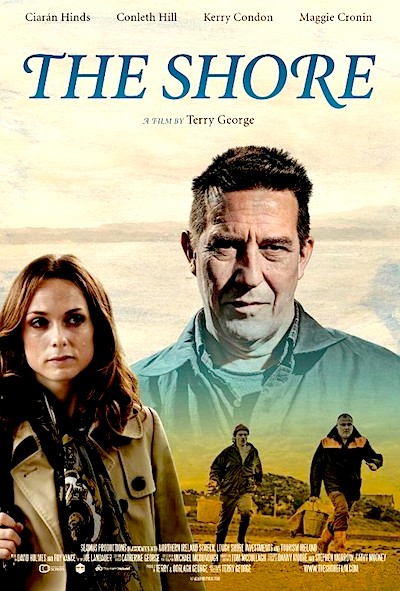
If this year’s Oscar nominated short form animation has a Canadian flavor, the live action shorts have a slight Irish disposition, at least according to some definitions. As it happens, one of the best contenders hails from North Ireland. Regardless of identity issues, Terry George’s The Shore (trailer here) is probably the film to beat. It hardly hurts that George is a highly regarded filmmaker, already twice nominated in screenplay categories. The Shore also stars an actor viewers will recognize: Ciarán Hinds, currently seen in finer theaters as “Soldier” in Tinker, Tailor, Soldier, Spy.

Yes, The Shore addresses the troubles, but not in a polarizing context. Twenty-five years ago, Jim Mahon’s grandfather was spooked by the escalating violence and trundled the young man off to the American relations. He has finally returned with his grown daughter to make peace with his former best friend and the woman he jilted. Although it is more of a drama than a comedy, Shore has a wry, knowing sensibility that should appeal to popular audiences. Rather than dwell on Belfast’s battle scars, George captures the picturesque landscape of Northern Ireland. One of the great actors of our day, Hinds is perfect as the conflicted Mahon and Kerry Condon is appealingly smart and down to earth as his daughter.

Unfortunately, the proper Irish contender is not nearly as rich. An incompetent choir boy is offered a chance to redeem himself in Peter McDonald’s slight Pentecost. However, the big mass plays out as a childish rebellion fantasy at the expense of the mean old Catholic Church.
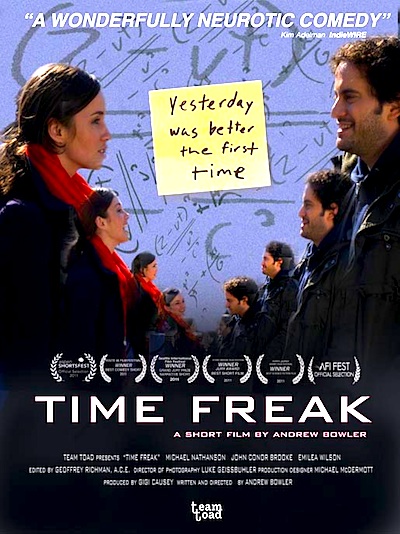
Though also relatively short, Andrew Bowler’s genre comedy Time Freak (trailer here) is easily the most entertaining live action nominee. An obsessive scientist has developed a time machine, but his regular guy best friend is alarmed by the self-defeating ways he has been applying his breakthrough. A very funny film, Freak is similar in tone to some of the original Twilight Zone episodes that played it strictly for laughs.

There are not a lot of laughs in Max Zähle’s Raju (trailer here). There are not a lot of surprises where this international adoption morality play is headed either, but it is executed quite well, especially for a student film. Shortly after Jan and Sarah Fischer adopt the title character, he disappears under mysterious circumstances. However, as the German would-be father searches for Raju, he learns troubling facts about Raju’s circumstances. Filmed on the streets of Kolkata (a.k.a. Calcutta), it conveys a sense of the city’s teeming poverty and sets up the protagonists’ ethical dilemma rather effectively.

Another international award winning student film, Hallvar Witzø’s Tuba Atlantic offers an Academy-friendly blend of quirk and heart-string pulling. Given exactly six days to live, grouchy old Oskar Svenning sets out to contact his estranged brother in America via the monster tuba they constructed on the shore. Although he stubbornly refuses help, a young Evangelical Christian insists on acting as his “angel of death.” While innocent Inger might sound like a hopeless caricature, Ingrid Viken plays her with a fair degree of innocent charm. Granted, it is unabashedly sentimental, but the unrestrained war Svenning wages against the pesky seagulls is frequently quite amusing.

Either Time Freak or The Shore would be deserving Oscar winners. Both are thoroughly engaging and satisfying films. If not at the same level of accomplishment, Raju and Tuba are certainly perfectly respectable, falling somewhere on the spectrum between good and nice. Altogether, the 2012 live action Oscar nominees are a strong group, mostly recommended as films in their own right as well as for their Academy Award interest. They open this Friday (2/10) in New York at the IFC Center as part of the annual showcase of nominated short films.

Posted on February 9th, 2012 at 10:55am.
LFM Reviews 2012 Oscar Nominated Shorts: Animation

By Joe Bendel. The Oscar field for best animated short film has a distinctly Canadian flavor this year. After Cordell Barker’s delightful short-listed Runaway fell short of a nomination in 2010, the National Film Board of Canada returned to Academy Award contention this year, netting two nominations for their short animated productions, bringing their grand total nominations to seventy-two in seventy-three years of operation. Both screen as part of the annual showcase of Academy Award nominated shorts, which opens this Friday in New York at the IFC Center.

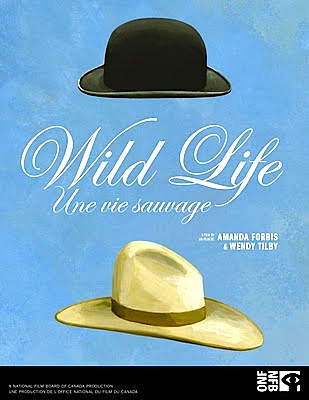
While nature plays a role in Amanda Forbis & Wendy Tilby’s Wild Life, as well as Patrick Doyon’s Diamanche (Sunday), they also share a weird, off-kilter sensibility. One of the strongest nominees, Wild Life is ostensibly a fish out of water tale about one of the many British ne’er do well gentleman who came to Western Canada to seek their fortunes as ranchers. Most of them made poor cowboys and Wild’s protagonist is no exception. While the culture clash themes are cleverly addressed, there is a subtle undercurrent of David Lynchian menace that really distinguishes the film.

Shifting regions, Quebecois Patrick Doyon tells a relatively simply tale of a young boy, once again enduring his family’s Sunday rituals in Dimanche (trailer here). However, it takes a trippy detour involving a bear. It is strange and somewhat sad, just like childhood.

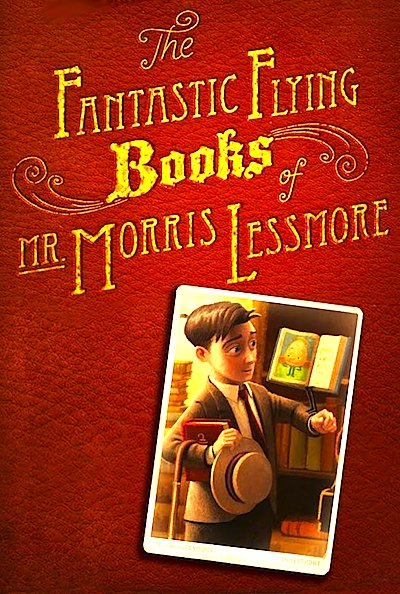
Perhaps the strongest nominee, coincidentally considered the frontrunner, also has a very strong sense of place, but in this case it is Louisiana. Produced entirely within the state, William Joyce & Brandon Oldenburg’s The Fantastic Flying Books of Mr. Morris Lessmore begins in New Orleans with a scene clearly inspired by the recent hurricanes that have wracked the state. Like many New Orleanians, Morris Lessmore takes refuge, finding a new home in a literal world of books. Employing inventive fairy tale imagery, Flying is a sophisticated paean to literature, offering the greatest depth of the animated program.

In contrast, Grant Orchard’s A Morning Stroll (trailer here) is essentially a bit of hipster playfulness, but it is rather funny, depicting the changes wrought on New York City when a chicken takes his titular promenade in 1959, 2009, and 2059. While pleasant, Enrico Casarosa’s La Luna, from Pixar, is a rather standard fable about a young’s boy’s discovery of the family’s fantastical business. Indeed, this just does not seem to be the animation studio’s best year.

Ranging from nice enough to very good, the nominated animated shorts are a solid slate overall, with Flying Books and Wild Life ranking as standouts. In the past, the animated program has been supplemented with several films that made the shortlist, but did not ultimately get one of the five nods. Strangely though, this year instead of shortlisted films, several environmentally themed shorts will play along with the nominees. Frankly, unless the relevant rights were impossible to secure, this dilutes the “Oscar-ness” of the program and diminishes the value of the shortlist status. It also means a visually striking (and viscerally anti-war) film like Damian Nenow’s Paths of Hate was passed over in favor of the clumsily didactic Skylight.

Regardless, films like Flying Books, Wild Life, and Morning Stroll are definitely well worth seeing, especially on a relatively big screen. Recommended for at least four of the real Oscar contenders, the 2012 Academy Award Nominated Short Films open this Friday (2/10) in New York at the IFC Center.

Posted on February 9th, 2012 at 10:51am.

LFM’s Govindini Murty at The Huffington Post and AOL-Moviefone: As Egypt Fights for Democracy, New Documentary 1/2 Revolution Goes to the Front Lines

[Editor’s Note: This post appears today at The Huffington Post and at AOL-Moviefone.]

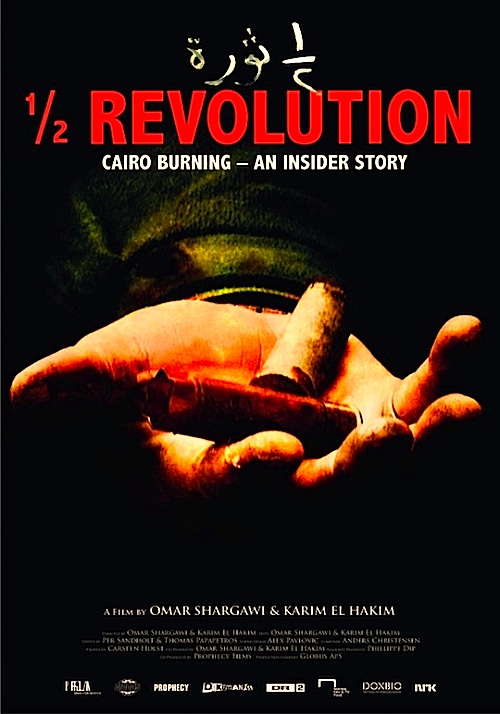
By Govindini Murty. As the Egyptian military government prepares to put nineteen American employees of pro-democracy NGOs on trial, and thousands of Egyptians continue to demonstrate over the stalling of democratic reforms, the new documentary 1/2 Revolution offers a striking look back at the Egyptian revolution of one year ago.

Premiering recently at the 2012 Sundance Film Festival, 1/2 Revolution depicts the revolution through the eyes of a group of Egyptian activists directly involved in it. Using cell phone cameras and hand-held camcorders, the filmmaker-activists capture dramatic footage of clashes between average Egyptians calling for freedom and the repressive government forces attempting to stop them.

As co-director Karim El Hakim said after the film’s recent Sundance screening, “You can’t get any more cinema verité than this.”

Danish-Palestinian director Omar Shargawi and Egyptian-American director Karim El Hakim live with their families just a few blocks from Tahrir Square in Cairo. When hundreds of thousands of Egyptians take to the streets on January 25th, 2011 to demand the ouster of dictator Hosni Mubarak, Omar and Karim head down from their apartments to record the events. Viewers are immediately thrown into the visceral experience of the revolution. Crowds of protesters run through the streets shouting “Egypt! Egypt! “Join us! Join us!” “Freedom! Freedom!” When gangs of government-paid thugs and police start beating and shooting the protesters, the protesters shout “No violence! No violence!” This call to non-violence is one of the early strong points of the documentary. To emphasize the theme, Shargawi points out a crowd of demonstrators who surround a group of police yet refrain from assaulting them.

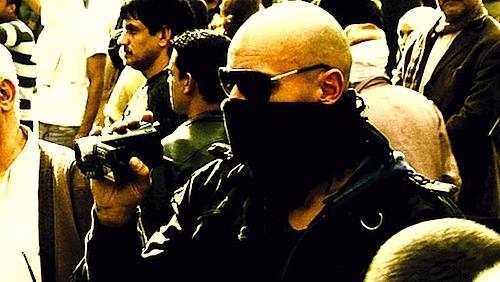
Over time, though, these commendable calls to non-violence are drowned out by the tide of chaos and bloodshed that overtakes the demonstrations when the government attacks. Police fire into the roiling crowds of protesters with live ammunition, loud booms announce the launching of tear gas canisters through the air, and demonstrators and counter-demonstrators fight back and forth with truncheons, rocks, and knives. Demanding to see their passports, secret police harass Karim and Omar as they attempt to film the events, and Omar pulls a scarf around his face to disguise his identity.

Later, Karim is gassed in the face and stumbles home partially blinded, while Omar is severally beaten in a dark alley, barely emerging alive. Government snipers start shooting people through the windows of their apartments in the blocks around Tahrir Square – making viewers fear for the safety of the filmmakers in their own homes, particularly as one of them has a baby who keeps wandering close to the windows. Late in the film, government thugs even take over the street below the apartment building and start harassing the residents, which is what finally forces the filmmakers to question staying in the country.

Omar Shargawi filming "1/2 Revolution."

In capturing the tumult of the Cairo protests, 1/2 Revolution depicts more violence than most Hollywood action movies – but tragically, the mayhem here is all too real.

The seemingly intractable rage captured in the film – both from democratic protesters righteously angry over the suppression of their human rights, and from entrenched government elites determined to hold on to power at any cost – highlights the central challenge facing the Egyptian people today. How will they overcome this bitterness and anger – these scars from decades of violence, repression, and authoritarian rule – in order to build a peaceful democracy?

In his seminal 1947 study of German film, From Caligari to Hitler, Siegfried Kracauer pointed out that the details of life captured in a film often reveal a country’s unconscious predilections. The details captured in 1/2 Revolution are ominous: activists repeatedly declare their willingness to die and become martyrs, the camera dwells on shattered heads and limbs, bodies on stretchers being rushed away, a man lifting up his shirt to show a bullet wound in his back, a pool of blood on the pavement with the word ‘Egypt’ traced in Arabic. Even more ominous are the anti-American and anti-Jewish symbols scrawled onto anti-Mubarak protest signs. One particularly ugly sign depicts Mubarak as the devil with pointy ears and a Star of David stamped on his forehead.

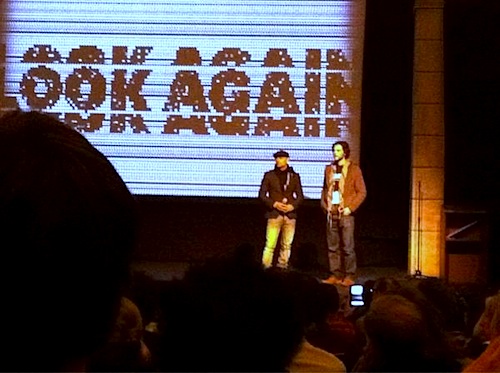
The filmmakers at the Sundance screening.

Sadly, the filmmakers and their friends engage in implicitly anti-Israeli rhetoric themselves. Co-director Omar Shargawi, whose father is Palestinian, says with pride of the demonstrations, “It was like being part of the intifada or something.” One of his friends, a woman also of Palestinian origin, expresses fears that “the Israeli army is massing at the border” and worries that the U.S. might invade. Given that Israel’s population of only 7.8 million is vastly outnumbered by Egypt’s population of 81 million, and given that the American government was generally supportive of the Egyptian revolution, these kind of fears come across as over the top. But this is the dark side of the revolution: the urge to look for blame in outside bogey-men – in this case, America and Israel – rather than look internally to ask why so many Arab states have failed to achieve lasting democracy. Continue reading LFM’s Govindini Murty at The Huffington Post and AOL-Moviefone: As Egypt Fights for Democracy, New Documentary 1/2 Revolution Goes to the Front Lines

Still the Baddest: LFM Reviews I Am Bruce Lee

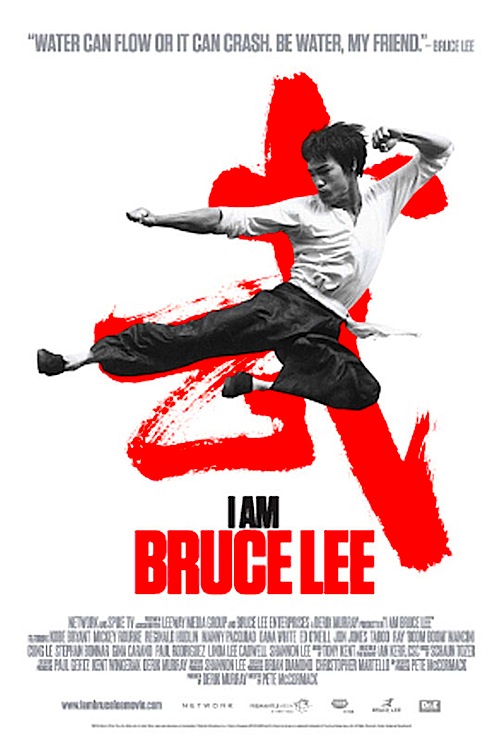
By Joe Bendel. Here’s a Chuck Norris fact: Bruce Lee laid a monster beat-down on him in Way of the Dragon. Frankly, it was a good thing for the then-reigning karate champion’s career. He was one of many world class martial artists who studied with Lee and were later recruited for roles in his films. There has only been one Bruce Lee, though. His friends and admirers pay tribute to the master in Pete McCormack’s I Am Bruce Lee, which has the first of two special screenings this Thursday throughout the country.

Lee was a man of destiny. A child star in Hong Kong, he learned the Wing Chun style of Kung Fu from master Ip (or Yip) Man, who has recently become the subject of a host of film treatments, including the internationally popular franchise starring Donnie Yen. Most viewers will know Lee’s story chapter and verse, but McCormack shoehorns in some interesting details. The 1957 Hong Kong cha-cha champion?  But, of course.

In terms of format, I Am is not all that different from Fuel-TV’s recent tribute series Bruce Lee Lives, mixing film excerpts with reminiscences from his family and colleagues, as well as commentary from contemporary mixed martial arts fighters, nearly all of whom revere Lee. However, the participation of Lee’s widow, Linda Lee Cadwell, and breakout martial arts movie star Gina Carano distinguish I Am. Nearly all of Lee’s films are discussed in length, but clips of Lee’s epic battle with Norris in the Roman Coliseum take pride of place.

While celebrating Lee’s mystique, I Am tries to put to rest many of the rumors surrounding his life, particularly notions that an ancient curse or the triads were responsible for his untimely death. It also attempts to minimize the non-dogmatic approach of Lee’s Jeet Kune Do as a forerunner to mixed martial arts, but apparently UFC founder Dana White did not get that memo.

Nonetheless, it certainly seems Lee inspired most of his fighters, including Cung Le, who also appears in the film. Yet perhaps the best advertisement for Lee’s Jeet Kune Do and related philosophy would be his friend and fellow teacher, seventy-something Dan Inosanto (the weapons master in Game of Death) who looks like he could be at least two decades younger in his I Am interview segments.

Built around Lee’s super cool “be like water” interview, I Am moves along at a quick pace, while emphasizing the spiritual aspects of his story. Just about every surviving figure in his life is heard from, except Norris. Granted, Lee fans have seen documentaries like this before, but we really cannot get enough of the icon. It might be hagiography, but it’s entertaining and appropriate. After all, this is Bruce Lee we are talking about. Proper respect must be paid. Recommended as a communal experience for fans (and isn’t that everyone?), I Am Bruce Lee screens this Thursday (2/9) and next Wednesday (2/15) nationwide, including the AMC Empire in New York and the AMC Metreon and 4 Star Theatre in San Francisco.

Posted on February 7th, 2012 at 11:35am.

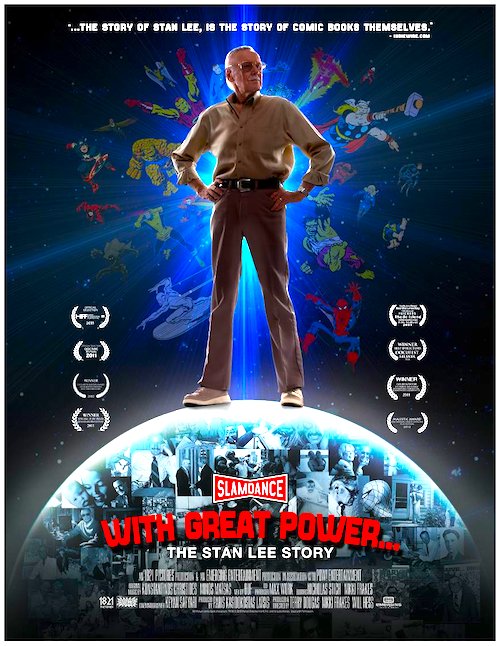
LFM’s Jason Apuzzo at The Huffington Post and AOL-Moviefone: With Great Power: A Conversation with Stan Lee at Slamdance 2012

[Editor’s Note: This post appears today on the front page of The Huffington Post and also at AOL-Moviefone.]

By Jason Apuzzo. He’s 89 years old, and his career is hotter than ever.

With hits like Thor, Captain America and X-Men: First Class dominating the box office in 2011, and upcoming films like The Avengers and The Amazing Spider-Man looking to light up the summer in 2012, you’d think that a man whose career in comic books began just prior to World War II might want to slow down.

Think again – because this 89 year-old dynamo is named Stan Lee.

This year’s Sundance Film Festival offered a smorgasbord of art-house delights, but its competitor across the street – the scrappy Slamdance Film Festival – presented one of Park City’s best events last week when it hosted comic book legend Stan Lee for a 2-hour master class associated with Slamdance’s screening of the new documentary, With Great Power: The Stan Lee Story. Just two days after receiving the Vanguard Award from the Producers Guild of America, Lee breezed into Park City to spend a special two hours with filmmakers and journalists prior to the With Great Power screening, discussing his extraordinary career as the creator of iconic characters like Spider-Man, Iron Man, the Hulk, Thor, the X-Men and the Fantastic Four.

And if anything was clear at the end of the master class and screening, it was this: the keys to Stan Lee’s ongoing success are his earthy humor, humanity, and incredible vitality. The man simply doesn’t know how to slow down. As Lee says in With Great Power about being the impresario of today’s comic book cinema: “I’m having fun! Don’t punish me by making me retire.”

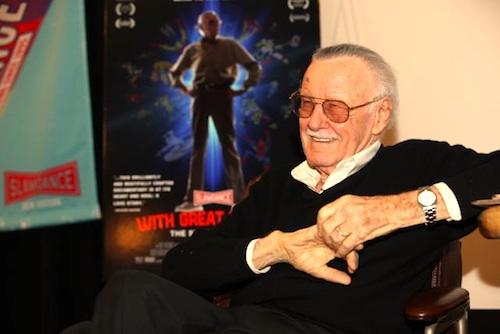
Stan Lee at the Slamdance Film Festival.

A flinty and funny raconteur with a baritone New York accent, Lee spent much of his time at the Slamdance master class describing his colorful early days in which he was alternately a rebellious office boy for a trouser manufacturer (he made a mess of his store after being fired two days before Christmas), an obituary writer (he found the job morbid), and even a Broadway theater usher (he once tripped and fell flat on his face while escorting Eleanor Roosevelt to her seat at the Rivoli Theater in New York).

Lee finally got his big break in late 1941 when he became interim editor at Timely Comics, which would eventually evolve under his leadership into Marvel Comics. Then known as ‘Stanley Lieber’ (his name at birth, as the son of Romanian-Jewish immigrants), Lee was first given the chance to provide text filler for a May 1941 edition of Captain America Comics – and he hasn’t looked back since.

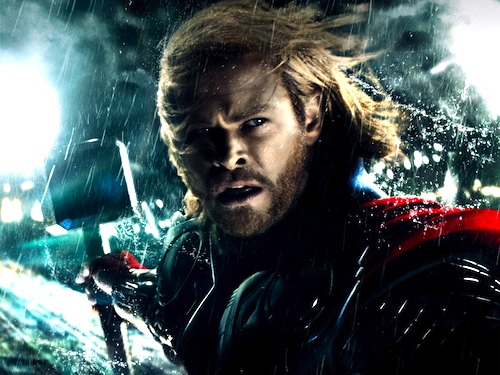
The language of "Thor" inspired by Shakespeare.

A passionate reader, Lee described in detail how literature fueled his imagination as a young person. “I read everybody when I was young – Charles Dickens, H.G. Wells, Arthur Conan Doyle, [Edgar Rice] Burroughs’ Tarzan. I read everything I could get my hands on.” Lee also cited Shakespeare as an influence on the style of language for Thor, drily noting that Thor “was supposed to be a Norse god – I couldn’t have him talk like a guy who was born in Brooklyn. I loved Shakespeare, and I read Shakespeare when I was young. I probably didn’t understand most of it, but I loved the sound of it.” Lee’s fascination with Shakespeare continues to this day, with Lee and 1821 Comics collaborating on the new graphic novel Romeo and Juliet: The War, a sci-fi retelling of Shakespeare’s classic love story which debuted last week.

Lee also developed an early love of the movies. When I asked Lee what movies had influenced him, he was quick to cite Errol Flynn’s adventure films of the 1930s and ’40s. Continue reading LFM’s Jason Apuzzo at The Huffington Post and AOL-Moviefone: With Great Power: A Conversation with Stan Lee at Slamdance 2012

Sundance 2012: LFM Reviews Grabbers

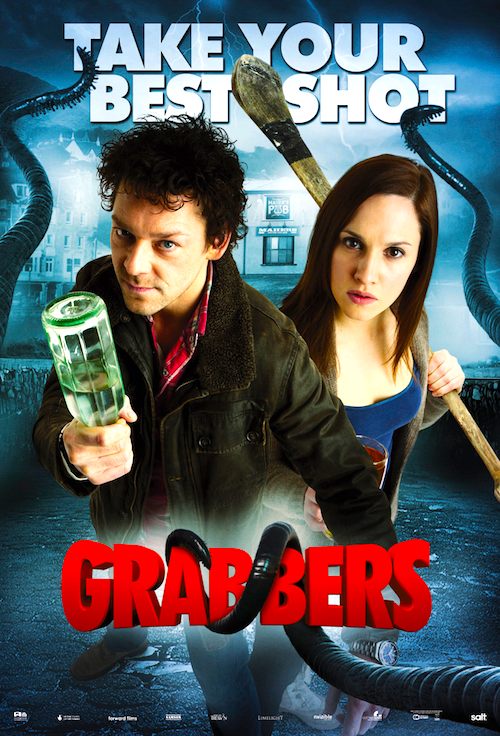
By Joe Bendel. Believe it or not, that last Guinness before you leave is the last best line of defense against alien invasion. Fortunately, the villagers of Erin Island are up to the demands of survival in Jon Wright’s Grabbers, which screened during the 2012 Sundance Film Festival.

Garda Lisa Nolan is a workaholic who spends her vacation temping for the sergeant on the tight little island. Busy drowning a broken heart, local Garda Ciarán O’Shea is not impressed, at least not by her ambition. Fortunately, nothing ever happens there, at least until the aliens invade. At first, the only one to see the blood-sucking mollusks – at least, the only one who lives to talk about it – is the town drunk (and he’s not even O’Shea). After a bit of investigation, it turns out the aliens do not have a taste for .2 alcohol levels. With a storm fast approaching, there is only one thing to do: lock everyone in the pub and get them hammered.

Frankly, Grabbers is a surprisingly mild midnight selection at Sundance (particularly considering this is the year they launched V/H/S). Gentler even than Tremors, it is quite similar in tone to R.W. Goodwin’s unapologetically nostalgic Alien Trespass. Considering the central role played by public inebriation, midnight audiences were probably expecting liberal helpings of gross-out humor that never materialized. Indeed, Grabbers is more about soft chuckles than big belly laughs.

Granted, this is not the sort of film one looks to for rigorous logic, but it makes no sense that the alcoholic would be the only one to stay sober, beyond providing O’Shea with an opportunity for redemption. Still, Richard Coyle is reasonably charismatic as the formerly degenerate Garda. In contrast, Ruth Bradley does not leave much of a mark as Nolan, but David Pearse scores some of the film’s funniest moments as Brian Maher, the short-tempered barkeep.

Wright keeps things moving along well enough and the monster effects are realized quite well (arguably better than they should be in an old school creature feature). The results are all very pleasant, but never quite live up to the promise of its clever premise. Nice, but not crazy, Grabbers should nonetheless find an appreciative genre audience following its midnight screenings at this year’s Sundance Film Festival.

SUNDANCE GRADE: B

Posted on January 30th, 2012 at 12:43pm.