Sundance 2012: LFM Reviews Madrid, 1987

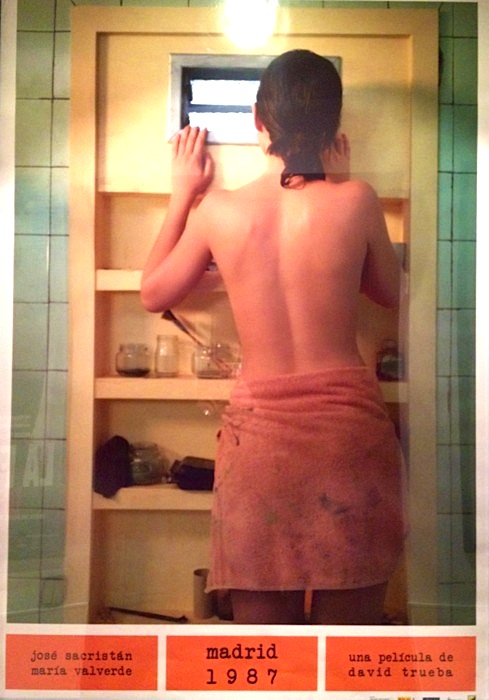
By Joe Bendel. It is a timeless question: which has the upper hand, age and guile or youth and vitality? It usually depends on how you score. One such Spanish generational tête-à-tête takes on a whiff of the zeitgeist, coming after the various coups and political circuses of the immediate post-Franco era. One curmudgeonly columnist has seen it all and has definite ideas about scoring during his encounter with an admiring journalism student in David Trueba’s Madrid, 1987 (trailer here), which screens during the 2012 Sundance Film Festival in Park City.

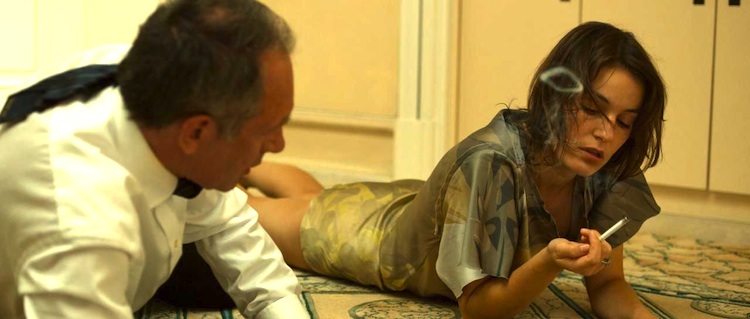
Miguel is so smugly self-satisfied, he can hardly stand himself. To Ángela, he is a legend. A Spanish Mencken who skewered generals and politicians for years in his daily column, it was something of a coup to land an interview with him. The old soldier has outlived his battles, though. Feeling like a relic, the columnist hopes to regain some youth by seducing the student. He is not exactly the smoothest of old foxes, but he gets an assist from fate when the two are inadvertently locked naked in the bathroom until Miguel’s artist friend returns to his flat. It is certainly awkward, but eventually they begin to talk about nearly everything – but particularly Spain, art, sex, and the passage of time.

Those who think of Madrid as a nude My Dinner with Andre might be right to an extent. Yet Trueba never lets his characters or viewers get too comfortable with the situation. Never completely hot or cold to the older man, Ángela’s emotional responses crest and fall with his near monologues. He can be charming, but he can also be insensitive. He certainly is pleased with the sound of his own voice, though, so he might not be one’s first choice to be locked in a bathroom with.

Yet for those who enjoy a talky movie, Madrid is quite sharply written and delivered. Trueba really digs into some meaty themes. Granted, some topics will have far more resonance for Spanish audiences, but there are plenty of universals any viewer can relate to.

Trueba’s two leads definitely deserve credit for their fearlessness, essentially appearing nude for the bulk of the film with only a handful of strategically placed towels for cover, while chewing on some heavy lines. Guys will surely notice María Valverde is quite healthy, but José Sacristán’s splotchy body is not likely to do much for the ladies. Still, he has a rare flair for pointed dialogue. In fact, it is rather fascinating to watch them play off each other.

Deftly helmed by Trueba (brother of Fernando Trueba, whose outstanding Chico & Rita opens in New York February 10th), the more-or-less two-hander never feels stagey, despite the necessarily claustrophobic setting. Ultimately, this dichotomy of a New Spain without experience or baggage vs. an Old Spain that jealously nurses its bitterness will appeal to a self-selecting audience. It is smartly realized by its two principals, so they will be satisfied with the results. Recommended at this year’s Sundance Film Festival for those who appreciate Spanish cinema or dialogue-driven films, Madrid, 1987 screens in Park City tomorrow (1/20), Saturday (1/21), Sunday (1/22), next Friday (1/27), and Saturday (1/28), as well as Tuesday (1/24) in Salt Lake.

SUNDANCE GRADE: B

Posted on January 19th, 2012 at 9:06am.
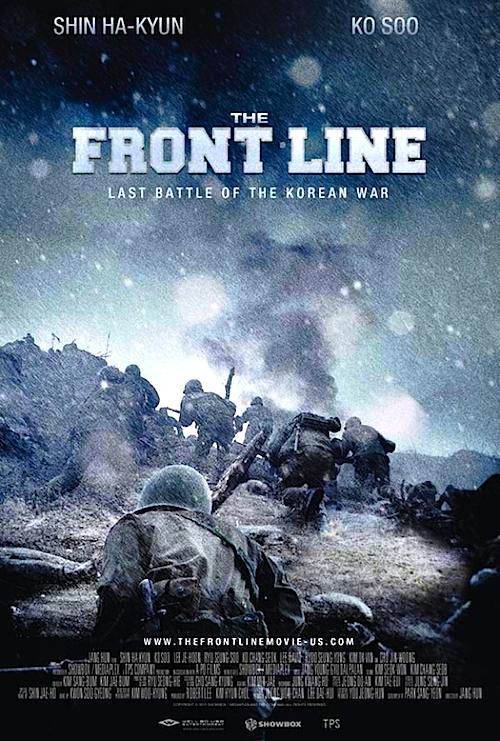
Submitted to the Oscars by South Korea: LFM Reviews The Front Line

By Joe Bendel. When a South Korean officer is killed with one of his troops’ weapons, someone has to investigate. It is also a convenient way to move a trouble-making lieutenant out of the way. Indeed, war is brutal, messy, and soul-deadening in Jang Hun’s The Front Line, Korea’s official best foreign language Oscar submission, which opens this Friday in New York.

A vocal critic of the drawn-out peace negotiating process, Kang Eun-pyo is assigned to investigate irregularities reported within the “Alligator Company” dug-in around the pedestrian looking but strategically prized Aero.K hill. In addition to the suspicious death of a despised commander, several letters from North Korean soldiers have been posted to family members in the south by someone in the company. A mole is suspected.

However, when Kang arrives, he discovers the situation is murkier than that. There has been a form of communication flowing between the two sides, but it is born of survivors’ fellowship rather than espionage. Still, he maintains suspicions regarding Kim Su-hyeok, a comrade from the early days of the war long presumed to be a POW, but evidently serving as the Company’s lieutenant.

Over the course of the film, Alligator Company will take, lose, and regain the fateful hill over and over again. It would get somewhat repetitive if not for the intense warfighting scenes, rendered by Jang in a take-no-prisoners style. Line’s sense of place is so strong, audiences will feel they know every inch of that crummy nub of a hill.

Do not get too attached to any characters in Line. Jang will call up their numbers at the most arbitrary of times, as befits the nature of war. Nonetheless, there are many strongly delineated characters. In fact, the self-medicating Captain Shin Il-yeong and the darkly brooding Lt. Kim, memorably played by Lee Je-hoon and Ko Soo respectively, clearly bear the spiritual scars of war. As the film’s only substantial female character, Kim Ok-bin also hints at a host of inner conflicts as the soon-to-be not so mysterious woman often seen foraging near the battlefield.

Like Jang’s previous film Secret Reunion (which screens February 15th in New York as part of the Korean Cultural Service’s regular cinema showcase), Line not very subtly advocates for reunification, arguing that divisions are merely an arbitrary matter of hills and parallels. Of course, it ignores the grim reality of the DPRK, in which famine is commonplace and the gulags are so extensive that they are the only features of the country that can be seen from space. While the soldiers could easily lose sight of it in the carnage surrounding Aero.K, there were indeed real stakes and consequences to the war. Whether it was also prosecuted competently, is an entirely fair and separate question.

Regardless, Jang masterly stages some of the most realistic, decidedly unheroic battle scenes viewers will see at the theater this year. It is a powerful, draining statement, recommended for connoisseurs of war movies, including the anti-war variety. Line opens this Friday (1/20) in New York at the AMC Empire and in the Bay Area at the AMC Cupertino.

Posted on January 19th, 2012 at 9:04am.

LFM Reviews: The Viral Factor

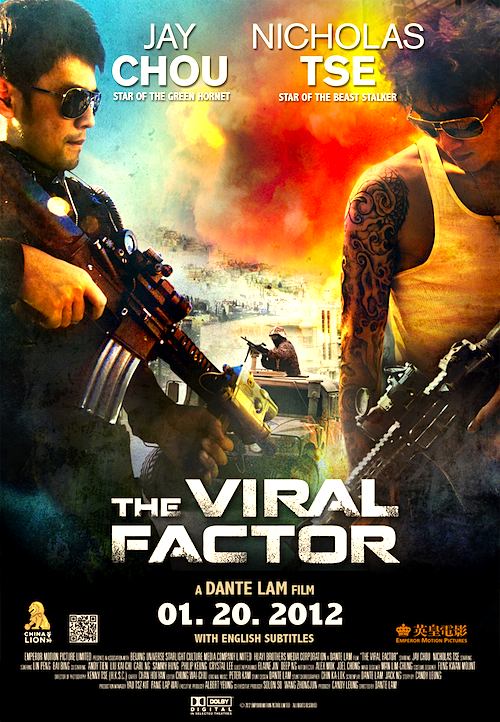
By Joe Bendel. Sure, it is more than 24 hours, but two weeks is not a lot of time for international counter-terrorism agent Jon Wan. That is about how much time he has left before the bullet lodged in his brain finishes the job. During those final days he will have to recover a killer mutant virus and reconcile some tricky family business in Dante Lam’s The Viral Factor (trailer here), which opens this Friday in New York and San Francisco.

The spectacular opening action sequence shows exactly how Wan became a dead man walking. He is part of an ambushed convoy escorting a mercenary germ warfare scientist looking to cut a deal. It was not the rpg’s that got him, but a traitor in his ranks. Unfortunately, the doctor of death and his new smallpox strain were lost to their attackers. Tragically, Wan has several more personal scores to settle with Sean the turncoat (and exposition mouthpiece). However, a brief visit to his ailing mother sends Wan on a detour to Malaysia. It seems he has long lost father and brother there, scratching out a meager living through dubious means.

In fact, Wan Yang is a notorious thug for hire, sub-contracted by Sean’s crooked cops to kidnap Dr. Rachel Kan, a specialist working for the Asian CDC. When the gangster brother is also betrayed by the gang, the two Wans team up to recover the virus, rescue assorted friends and loved ones, and do their best to patch up a fraternal relationship interrupted by their parents’ quarrels decades ago.

Somewhat like last year’s Legend of the Fist, Viral feels a bit unbalanced, because its most ambitious action sequence comes right up front. Of course, that also means viewers do not have to wait for it. Wisely shunning shaky cams, Lam’s action scenes have a refreshing precision and clarity, despite the frequent explosions and whizzing projectiles, so viewers can appreciate the mayhem. Jay (The Green Hornet and True Legend) Chou and Nicolas (Shaolin and Bodyguards and Assassins) Tse have all kinds of action cred, but also handle the familial drama well enough, as Jon and Yang, respectively.

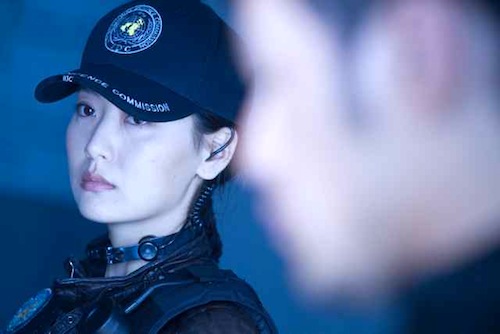
Bai Bing in "The Viral Factor."

While marinated in testosterone and lacking a conventional romantic subplot, Viral also features two strong female characters. Though she appears all too briefly, Bai Bing shows considerable screen presence and action chops as Wan’s former fiancé and fellow agent, Ice. In a somewhat more traditional damsel-in-distress role, Lin Peng at least brings a sense of intelligence and resiliency to Dr. Kan. Young Crystal Lee is also quite poised and endearing as Yang’s responsible daughter, Champ.

Though a big budgeted production, Viral is appealingly old school, with a slick, glossy look reminiscent of Tony Scott’s glory days of high concept action pictures, via the lens of cinematographer Kenny Tse. Lam blows stuff up really nicely and both Chou and Tse certainly know how to handle a fight scene. Add in the cinematically exotic locales of Jordan and Kuala Lumpur and the attractive support of Bai and Lin and you have a solidly entertaining action film. Definitely recommended for genre fans, Viral opens this Friday (1/20) in New York at the AMC Empire and Village 7 as well as in San Francisco at the AMC Metreon and Cupertino, courtesy of China Lion Entertainment.

Posted on January 17th, 2012 at 11:45am.

New York Jewish Film Festival 2012: LFM Reviews My Father Evgeni

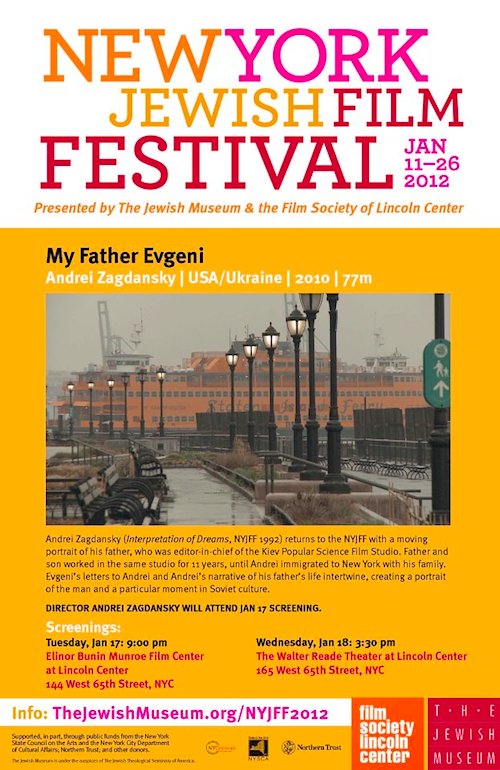
By Joe Bendel. Evidently, during the Stalinist era the term “Cosmopolitan” served as a euphemism for Jewish. It might sound relatively benign, but its usage was far from polite. It was an ugly fact of Soviet life that Ukrainian documentarian Andrei Zagdansky’s parents were all too aware of. The letters of his state filmmaker father provide a window into the history of his family and his country in My Father Evgeni (excerpt here), which screens during this year’s New York Jewish Film Festival.

Born two years after the Russian Revolution, Evgeni Zagdansky would outlive Communism as the official state ideology, only to bemoan Russia remaining under the rule of “criminal mediocrities.” The great Zagdansky family secret was his mother’s Jewish heritage, a dangerous inheritance during the time of Stalin’s Doctors’ Plot anti-Semitic show trials. It would be even worse for the Zagdansky family, considering his father’s bourgeoisie roots. Zagdansky’s grandfather Peter made women’s shoes in a modest storefront before the new regime confiscated his property and exiled him to the provinces.

Somehow during the war Evgeni Zagdansky cleared his record to the extent he could work with the state system. For eighteen years, Zagdansky père served as editor-in-chief of the Kiev Popular Science Film Studio, where he earned his spurs producing propaganda pictures about the triumph of scientific materialism over superstitious notions of God.

Clearly, filmmaking is a generation-bridging bond for Evgeni and Andrei Zagdansky. Drawing on home movies and film archives, the junior Zagdansky captures the sweep of Russian and Ukrainian history as well as documenting the ebb and flow of his family’s standing. Particularly valuable are the topics of furtive family conversations in each successive era. Oftentimes, these are well known figures and events, such as the Soviet invasion of Czechoslovakia or celebrated dissidents like Sakharov and Solzhenitsyn. However, he also includes important figures now largely faded from short-term Western memories, like dissident Ukrainian poet Vasil Stus and oppressed Armenian filmmaker Sergei Parajanov in the honor role of discussion subjects.

Father is a bit slow and unfocused out of the blocks, but once Zagdansky gets into the rhythm of it, the film is a parade of striking images. War, famine, and propaganda campaigns all factor prominently, but sometimes the little details are the most telling, like the frequently changing street names, ever reflecting the political tenor of the times. For film programmers, it would be a fitting companion film to either Mikhail Zheleznikov’s short For Home Viewing or Sergei Loznitsa’s Revue. Recommended for Cold War students and scholars, it screens this coming Tuesday (1/17) at the Francesca Beale Theater and Wednesday (1/18) at the Walter Reade Theater, as part of the 2012 NYJFF.

Posted on January 13th, 2012 at 5:24pm.

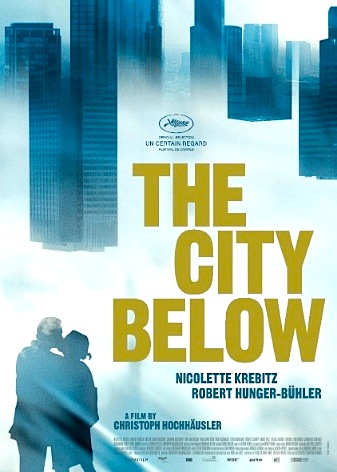
First Look 2012: LFM Reviews The City Below

Robert Hunger-Bühler and Nicolette Krebitz in "The City Below."

By Joe Bendel. It is almost like a modern-contemporary version of Metropolis. The financial titans rule the Frankfurt financial world high atop their glass and steel towers, while everyone else scurries about like ants on the sidewalk. However, very real dangers accompany their power games in Christoph Hochhäusler’s The City Below (trailer here), which screens during the Museum of the Moving Image’s inaugural First Look film series that has leapfrogged other festivals to kick-off 2012 for cineastes in earnest.

Roland Cordes is about to become the banker of the year and broker a blockbuster merger for his firm, because he is one of Tom Wolfe’s Masters of the Universe, who always gets what he wants. Then he meets Svenja Steve, the wife of a junior colleague. Finally, someone is willing to say “no” to Cordes, or at least “probably not.” While she refuses to immediately fall into bed with the banker, she does not exactly discourage his attention. In fact, she seems to enjoy sparring with the older man, at least on days when she is in the right frame of mind.

Meanwhile, the stakes are rising at Cordes’ Lobau Bank. The board is keeping the assassination of the head of their Indonesian office hush-hush. However, it leaves an opening for Cordes to move the ambitious Olli Steve up and out of the picture, despite the presence of more qualified candidates. Shrewdly he keeps his fingerprints off the decision, but there are still signs he might be losing his Midas touch.

Below is not a film for uninformed Occupy-This simpletons. Essentially, it is a cerebral character study with overtones of a Paul Erdman financial thriller that takes a slightly weird turn into Lars von Trier territory at the eleventh hour. The net effect is quite distinctive, if hard to categorize.

Part Shakespearean tragic hero and part moustache twisting financial villain (sans the facial hair), Robert Hunger-Bühler creates one of the most fascinating and confounding characters to ever stride through a cinematic boardroom. It is an open question whether there is a soul buried deep within him, but there is certainly a multiplicity of layers to peel back in search of it. Nicolette Krebitz matches him note for note as the seemingly fickle, but more complicated than we initial realize Svenja Steve. Watching their verbal fencing is a pleasure.

Cinematographer Bernhard Keller’s austere color palate and use of glassy, reflective surfaces creates a cold, eerie vibe that nicely enhances Hochhäusler’s sense of mounting dread. While hinting at much, he refrains from answering many questions. Indeed, this film is chocked full of odd little bafflements, yet everything seems to follow according to some strange logic. Smart and ambiguous in an intriguing (rather than smugly self-satisfied) way, Below is one of the highlights of the first First Look, screening once-and-only-once this Sunday (1/15) at the Museum of the Moving Image in Astoria, Queens.

Posted on January 12th, 2012 at 9:40am.

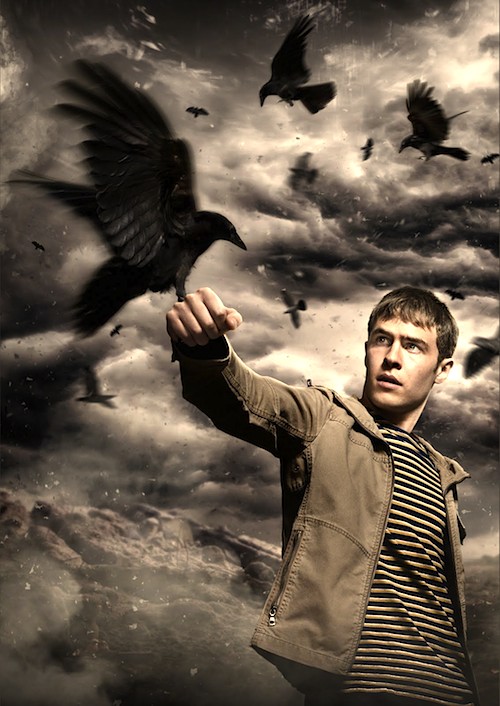
Geeks Get the Creeps: LFM Reviews The Fades

Iain de Caestecker in "The Fades."

By Joe Bendel. Paul Roberts and Mac Armstrong are obsessive Stars Wars fans. They claim to hate Twilight, but are far too familiar with the franchise mythology for that to hold water. It is just as well, though. They can use some uncanny insight when Roberts starts seeing ghosts. All is not right with the afterlife in Jack Thorne’s The Fades (promo here), which debuts for U.S. audiences this Saturday on BBC America.

Roberts and Armstrong are geeks with father issues. The former’s has absconded, while the latter is a less than nurturing workaholic copper. Girls scare them, but Roberts still has a monster crush on his popular sister’s best friend Jay (she’s a girl with a boyish name and bob). For a while, Roberts has been plagued by apocalyptic dreams, but recently he has started seeing apparitions.

After a rather nasty encounter with a so-called “Fade,” the wildly anti-social Neil Valentine explains the nature of the secret battle underway. The Fades are indeed spirits, terrestrially bound because of the inadvertent closure of their cosmic ascension points. Mortals like Valentine and Roberts who can see them are known as “Angelics.” Some of the brethren have special psychic abilities and Roberts might just be the most powerful of them all. That will be a curse, rather than a blessing. Some rogue Fades have developed an ability to touch the living, in a really bad way. It turns out they have plans and they know about Roberts.

At times, Fades risks overdoing its geek chic. The comedic weekly recap provided by Armstrong’s character at the top of each episode, complete with “nanu nanu” sign off, is a particular case in point. Yet considering how dark the series gets, the desire for some comic relief is understandable.

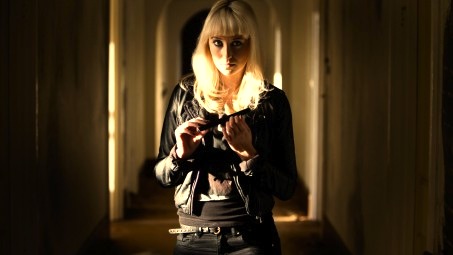
Lily Loveless in "The Fades."

As a paranormal thriller, Fades is pretty scary for television, creating a creepily convincing supernatural ecosystem.  Writer-creator Thorne nicely preys on viewers’ fears of unseen forces, while mostly respecting the show’s internal logic. Although there is quite a bit of teen angst, it is definitely not for youngsters, featuring some flesh-eating and the occasional spot of NYPD Blue style nudity.

While a bit sullen, Iain de Caestecker makes a passable enough rooting interest as Roberts. In contrast, Daniel Kaluuya’s Armstrong is too shticky for adult tastes. However, Sophie Wu (geek famous for Kick-Ass) brings a bright and engaging presence as Jay. Yet it is Johnny Harris who really steals the spotlight as the Byronic Valentine. It is the sort of twitchy character and brooding performance genre fans eat up with a big spoon.

Frustratingly, sometimes the wrong characters do not survive Fades’ first season. Still, given the nature of the show, viewers cannot rule out seeing them again. Tightly helmed by Farren Blackburn and Tom Shankland (at three episodes apiece), it is a polished production that should pull in fans of dark fantasy. Pretty good stuff overall, The Fades premieres this week (1/14) on BBC America’s “Supernatural Saturday.”

Posted on January 12th, 2012 at 9:39am.