New York Jewish Film Festival 2012: Remembrance

By Joe Bendel. The unfettered flow of information is a powerful thing. During the final days of WWII, Tomasz Limanowski smuggled shocking photographic evidence out of a Nazi concentration camp in Poland. Thirty-some years later, his former lover is shocked to discover he is still alive, thanks to a BBC interview. Based on historical events, their incredible story of love and survival is told in Anna Justice’s Remembrance, which screens at the upcoming 2012 New York Jewish Film Festival.

Limanowski is not Jewish, but the resistance fighter is quite resourceful, which makes him a natural scrounger in the camp. He is thought to stand the best chance of breaking out and rendezvousing with the Polish Homeland Army with his comrades’ negatives. However, his decision to bring Hannah Silberstein with him complicates their plans. She is Jewish, speaks German, and is very sick. In fact, unbeknownst to Limanowski, she is pregnant.

Somehow, Limanowski and Silberstein manage to escape (in a markedly well shot and edited sequence), but with her health failing, they are forced to take refuge at his former estate. Of course, it has been confiscated by the National Socialists, but his mother Stefania now lives in a servant’s cottage and Limanowski’s resistance colleague Janusz still tends to the stables. Unfortunately, his mother’s anti-Semitism comes as a rude surprise to her son. It will also be the cause of much future grief when the couple must separate.

Decades later, both lovers assume the other is dead. Silberstein is now Hannah Levine, married to a perfectly nice research doctor in Brooklyn. When she happens to see Limanowski’s British interview on her dry cleaner’s television, it all comes flooding back, inconveniently during an important dinner party.
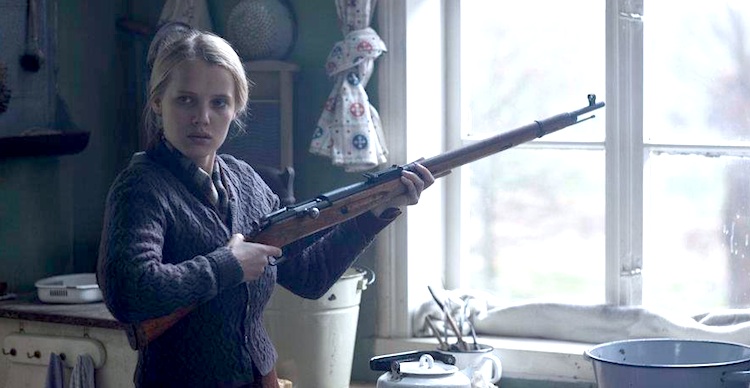
Alice Dwyer as Hanna Silberstein.

In a way, Remembrance shares a kinship with Sophie’s Choice, but it is a more forgiving, life affirming film. Levine née Silberstein suffers acute survivor’s guilt that viewers can well understand and easily pardon. Indeed, her complicated but loving relationship with her husband is just as important to the film’s dramatic structure.

The inherent decency of its three principles (this obviously does not include mother Limanowski) is what makes Remembrance such a touching film. It vividly portrays the personal consequences of two successive totalitarian ideologies that conspire to keep the star-crossed lovers apart. In addition to the horrors of the concentration camp, Justice also forthrightly depicts the terror of the post-war Communist regime. Years later, its attempts to excise the Homeland Army from the history books fittingly dovetails with the film’s themes of memory and documentation.

As young Limanowski, Mateusz Damiecki is viscerally intense and totally credibly as the scholarly-looking action hero. Alice Dwyer is also quite compelling depicting the young Silberstein’s drive to survive. Yet, there is something unusually honest and real about Dagmar Manzel and David Rasche’s scenes together as Hannah and Daniel Levine. (Though the Sledgehammer! star still apparently works round the clock in television, Rasche has also appeared in a handful of interesting international films recently – Remembrance being the most notable.)

Pam Katz’s literate screenplay (co-written with the perfectly named Justice) features one of the most moving letters ever heard on film via disembodied narration. Never ginning up phony drama, the sensitively rendered Remembrance consistently rings true. It is one of the best Holocaust-themed features in recent years, considerably superior to Sarah’s Key, Protektor, and Berlin ’36. Highly recommended, it screens this coming Monday (1/16) and Tuesday (1/17) at the Walter Reade Theater as part of the 2012 New York Jewish Film Festival.

Posted on January 10th, 2011 7:55pm.
New York Jewish Film Festival 2012: LFM Reviews Follow Me: The Yoni Netanyahu Story

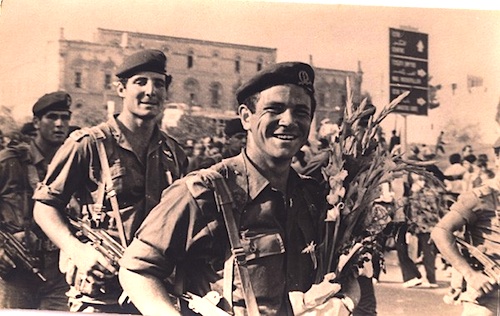
Jonathan “Yoni” Netanyahu.

By Joe Bendel. Jonathan “Yoni” Netanyahu is revered to an extent probably second only to Hannah Senesh amongst Israel’s fallen heroes. However, Netanyahu’s ultimate sacrifice came leading one of the most successful military operations in the history of the state of Israel. The life of the commander of the Raid on Entebbe is celebrated in Jonathan Gruber & Ari Daniel Pinchot’s Follow Me: The Yoni Netanyahu Story, which has its upcoming world premiere during the 2012 New York Jewish Film Festival, co-presented by the Film Society of Lincoln Center and the Jewish Museum.

Yoni Netanyahu was born to lead. An ardent Israeli patriot, he had the look of a man of action. Netanyahu was the oldest of three brothers, indeed including Benjamin “Bibi” Netanyahu, the current Israeli Prime Minister, whom Obama and Sarkozy consider so gauche for being, you know, so Israeli. The family was always quite close, frequently writing back and forth while the eldest brother of destiny studied in America.

Thanks to a wealth of surviving letters, Netanyahu’s voice comes through loud and clear in Follow. In fact, the film is most successful conveying a sense of what it was like to come of age and start a new life as a young man at a time when Israel was under constant threat of attack from her belligerent neighbors. Strangely, though, although the film steadily builds towards the moment of truth in Uganda, the actual boots-on-the-ground military operation is handled rather perfunctorily. (Perhaps the filmmakers assumed most interested audiences would already be well versed in the details of the operation, dramatized several times in the 1970s – including in Menahem Golan’s Operation Thunderbolt and Irvin Kershner’s Raid on Entebbe).

A hero of the Entebbe Raid.

In addition to brother Benjamin, two former Prime Ministers, Shimon Peres and Ehud Barak, also sat for on-camera interviews, which speaks volumes about Netanyahu’s significance to his countrymen. Yet, without question, some of the most insightful and moving remembrances come from his comrades-in-arms.

Unless viewers truly have hatred in their hearts, there are episodes in Follow that will definitely choke them up. Years later, Netanyahu’s family and loved ones still clearly feel his loss acutely. Some moments are quite beautiful, including Benjamin Netanyahu’s memories of his brother’s desert wedding, which he explains perfectly represented him as a rugged son of Israel. Others, of course, are deeply tragic. Altogether, they add up to an eventful but all too short life.

While Follow is very informative, it is really defined by its appropriately elegiac tenor. It is a film that documents the humanity and dedication of the IDF soldiers and officers (particularly but not exclusively Netanyahu) that American students (arguably more even than their Israeli counterparts) truly ought to see. It premieres this Thursday (1/12) with a subsequent screening on Monday (1/23) at the Walter Reade Theater, as part of the 2012 New York Jewish Film Festival.

Posted on January 9th, 2012 at 7:37pm.

First Look 2012: LFM Reviews That Summer

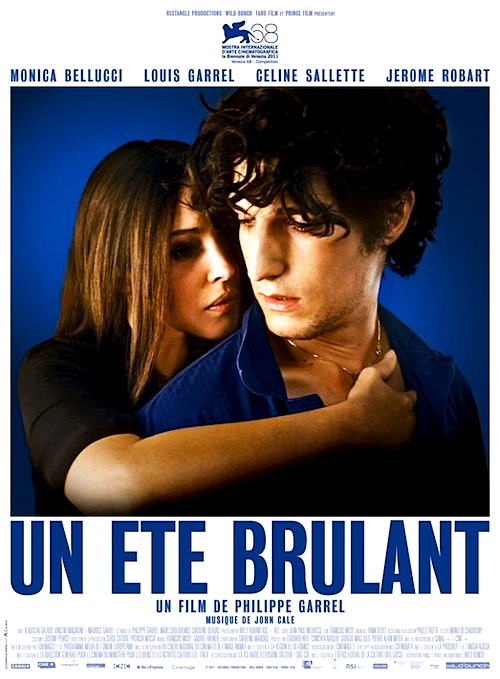
By Joe Bendel. If someone is said to have an artistic temperament, it usually means they are not just creative, but emotionally tempestuous. The term certainly applies to Frédéric and his wife Angèle. They will dazzle and disturb Frédéric’s hanger-on friend and his lover with the sort of emotional games that have become the hallmark of under-sung auteur Philippe Garrel’s work. Presumably his final collaboration with both his son Louis and late father Maurice (1923-2011), Philippe Garrel’s That Summer (trailer here) screens this weekend during the inaugural First Look at the Museum of the Moving Image in Astoria, Queens.

Frédéric is a wealthy and talented French painter, who never sells his work. Angèle is a major Italian movie star, garnering the best reviews of her career. They are everything the penniless and untalented Paul is not. Yet, for some reason the artistic couple befriends the dubious actor and his girlfriend Elisabeth, inviting them into their home in Rome. The needy Elisabeth has attempted suicide in the past, but she will be a model of stability compared to their hosts.

Initially, Frédéric and Angèle seem like a perfectly compatible and loving couple, but over the course of the summer, their mutual contempt degenerates into a repeating cycle of infidelity and petty cruelty. For the most part, Paul and Elisabeth are spectators rather than participants in the proceedings—an audience for the imploding marriage as performance art.

As is often the case with Philippe Garrel’s films, Summer is often uncomfortably intimate. However, it is never as squalid, lurid, or coyly obtuse as some of his previous films, including even (or especially) his arguably best known, I Can No Longer Hear the Guitar. The dolce vita environment of Rome certainly helps here.

Garrel’s son Louis also does some of his best work as Frédéric. More Byronic than petulant for a refreshing change, he is strangely engaging throughout. Unleashing her inner diva, Monica Bellucci radiates sexuality, while reveling in the melodrama of it all. Unfortunately, Jérôme Robart and Céline Sallette are rather dull as the sponging guests. Perhaps that is required of him to serve as the narrator. However, Elisabeth’s established psychological issues are never really conveyed or followed-up on in a substantive way.

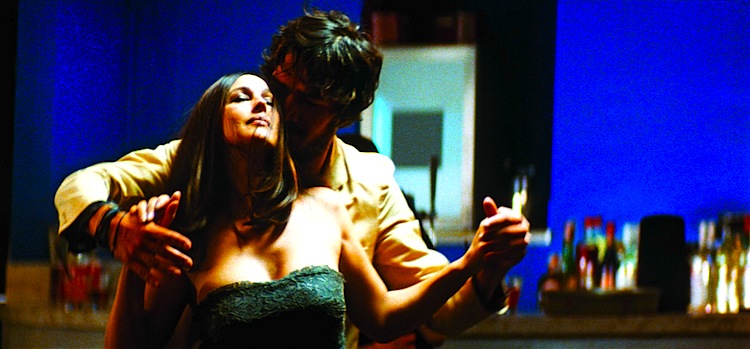
Monica Bellucci and Louis Garrel in "That Summer."

Appearing briefly as Frédéric’s long deceased grandfather, a frail looking Maurice Garrel adds a redemptive coda, bringing meaning to the film. Indeed, it is always interesting to see the son and grandfather interact in the middle Garrel’s films, starting with 1989’s Emergency Kisses, in which all three starred.

Nouvelle Vague veteran cinematographer Willy Kurant’s gives it all a pleasing look, basking in the vivid blues and greens of the couples’ photogenic abode, while John Cale’s piano soundtrack always sounds politely refined. Frankly, Summer might be a good entry point into Garrel’s filmography. Though hardly action driven, it moves along at a reasonable clip for such decidedly arthouse fare. (Bellucci also has an early nude scene, so for some viewers it pays off quickly). Considerably better the response at Toronto would suggest, That Summer is complex and intriguing film, definitely recommended to discriminating viewers when it screens this Friday (1/13) during First Look at the Museum of the Moving Image.

Posted on January 9th, 2012 at 7:36pm.

LFM Review: War Horse

By Patricia Ducey. War Horse opens with a rapturous aerial shot of the rolling Devon hills, dotted with neat farms and hedgerows and so achingly verdant that it takes one’s breath away. Soon that transcendent vision of the land as another Eden or demi-paradise gives way to the more intimate image of a mare giving birth in a meadow below, while young Albert Narricott (Jeremy Irvine) watches spellbound from just outside the fence. As the satin-coated foal finds his legs and gambols about, we realize that in one short minute we, like Albert, have fallen totally in love with the spirited youngster. And we know, sadly, something Albert doesn’t: that this idyll will soon be smashed to smithereens.

War Horse‘s story is set in England at the moment before World War I breaks out. In one prideful moment, lovable ne’er-do- well tenant farmer Ted Narricott bids against his hated landlord for the now mature horse at auction. His son Albert is thrilled that his father has brought home the object of his years’ affection and names the horse Joey, but mother Rose (Emily Watson) insists that the horse be sold; a horse as fine as this one must be worthless as a working animal. Albert insists he can train the noble half-thoroughbred to pull a plow; in those desperate economic times, they must plow and plant a rocky field to pay the rent on the farm. The horse soon learns his trade and earns his keep, but a storm later destroys the hard won crop. Thus, finally, Albert’s father Ted (Pete Mullan) is forced to sell the horse. War has broken out, and the British Army snaps up the beautiful animal for its officer corps. Albert bids farewell to his beloved horse – and, for the next hour, we see through Joey’s almond-colored eyes his wartime ordeal on the march to the front lines, all the way to the gut wrenching trench warfare and the terrible climax in No Man’s Land.

War Horse was adapted by British writers Lee Hall (Billy Elliott) and Richard Curtis from a young adult novel, and then Tony-winning play, by British author Michael Morpurgo, which told the story of the Great War through the eyes of a horse and the family that owns him and seemingly loses him. Reportedly, Spielberg saw the play and sewed up the movie deal the next day, even though the schedule interfered with his Tin Tin project.

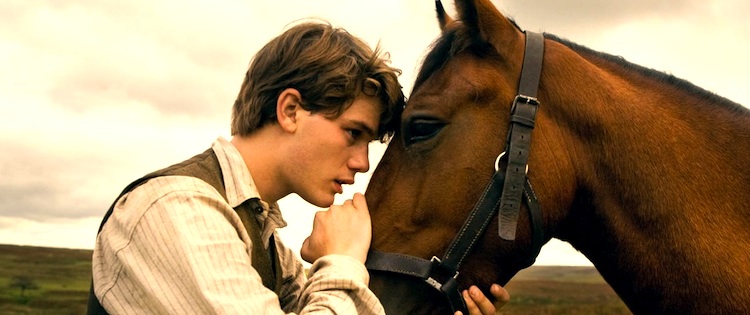
Jeremy Irvine as Albert, with Joey.

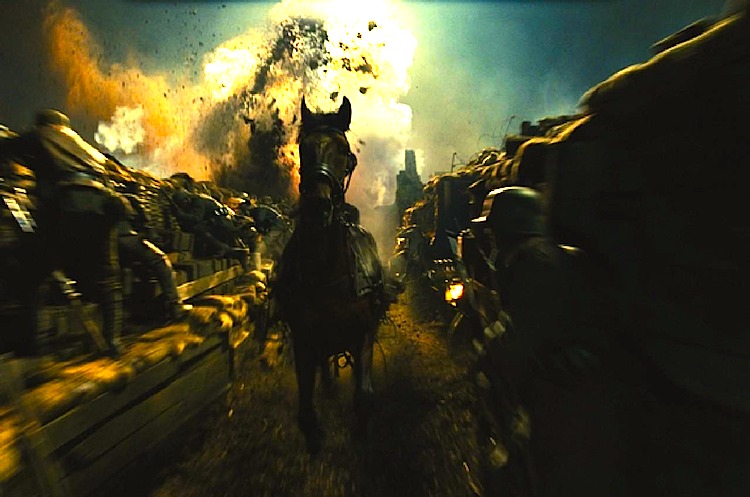
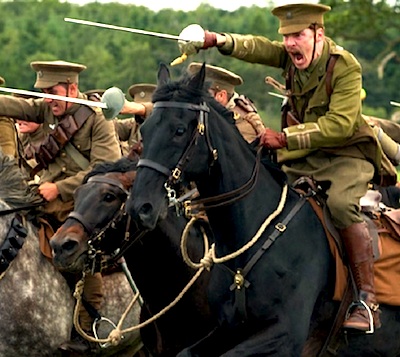
This being a Spielberg film, and a Young Adult offering, sometimes it claws at your heartstrings when a tug would do, and at 146 minutes, is far too long—a few subplots and scenes could be trimmed, to perhaps leave time to explore Albert’s emotional journey as well. The look and sound of the film experience, though, is flawless, thanks in part to Spielberg’s long-time collaborators, cinematographer Janusz Kaminski and production designer Rick Carter, who breathe fire into the director’s storyboards. Their War Horse must be seen as his team’s masterpiece–if 35 mm film is to give way totally to digital, as Kaminski believes, his work here will remain one of its crowning achievements. The magnificent landscapes of Devon, dwarfing its inhabitants, the shimmer of wind through a grove of trees in an eerie pre-battle silence, are but a few of many memorable shots. And special mention must be made of Spielberg’s initial battle scene, when the English mounted battalion charges a German camp. The visual and aural effects are simply spectacular, the sequence a harrowing reminder that men once rode into battle with sabers unleashed, atop steeds at a thundering gallop, straight into an enemy line, and then drew enemy blood in face-to-face combat. And like the classic films he emulates, Spielberg used thousands of extras and hundreds of horses in the battle scenes: no CGI shortcuts here.

Real battle re-enactments: no CGI shortcuts here.

The actors acquit themselves well, and Jeremy Irvine as Albert is affecting. The horse, though, is the star here. Joey is played by several horses, mostly by an American horse named Finder, who also played Seabiscuit. I hope there is an Oscar category for Finder and his trainer, because the horse’s ability to communicate with Albert and with an Army stallion he bonds with is enchanting.

Steven Spielberg delivers here a masterful coming-of-age story, in which the hero’s mettle is tested by war and privation in a world where character is all that remains and all that matters after everything else has been taken. So this is not a cynical or post-modern film; some people may even call the PG-13 War Horse sentimental.  The hipster in your life might insist his sniffles are sniffs of disdain, but in all of history, from the renderings in Chauvet Cave to the little girls (like me once) who sketched profiles of ponies in her notebook in history class, there has always been something about a human that loves a horse. War Horse rightfully earns top tier status in this genre.

So if you or your young adult plans to see War Horse, get thee to the multiplex. This is a film that must be seen in a proper theater, not in a  living room, to appreciate its many gifts.

Posted on January 5th, 2011 at 6:53pm.

Rage in Iran: LFM Reviews The Hunter

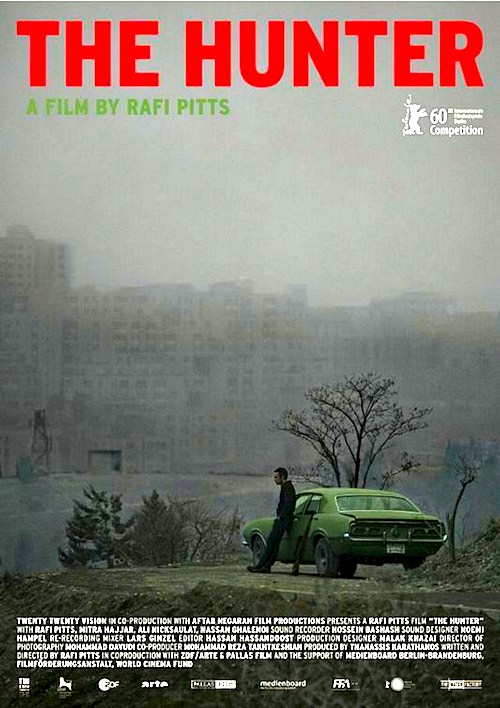
By Joe Bendel. To unwind, Ali Alavi spends his weekends in the forest, relying solely on his hunting rifle to provide sustenance. He is not the sort of man to be toyed with. Indeed, when the repressive Iranian state pushes him to his breaking point, he pushes back in the Iranian-born French-based Rafi Pitts’ quietly incendiary The Hunter (trailer here), which opens this Wednesday in New York at the IFC Center.

Alavi is an ex-con, convicted of an unnamed and therefore dubious crime. Forced to work as a late shift security guard, only his reputation as an expert hunter and marksmen affords him a measure of respect from his coworkers. One fateful day, he returns from his hunting trip to find his wife and daughter missing. Over the following weeks, Alavi endures a Kafkaesque nightmare, as the police and various bureaucrats callously keep him waiting hours on end with little or no information.

According to the official story, his wife was killed in the crossfire between the police and so-called “rebels,” as the government refers to the democratic Green movement protestors. It is clear to everyone with eyes that the despised police are responsible, but they refuse to acknowledge culpability. Only the distant hope of finding his daughter keeps the slow-burning Alavi in check. Once her fate is determined, he commits a shocking act of violence Pitts dares viewers to condone.

At this point, Hunter becomes something like a fugitive thriller with more than a touch of the absurd, as two bickering corrupt cops apprehend Alavi in the woods he knows so well, only to get thoroughly lost. It is actually a masterful third act that never goes where you quite expect it to, while remaining true to the grim realities of contemporary Iranian society.

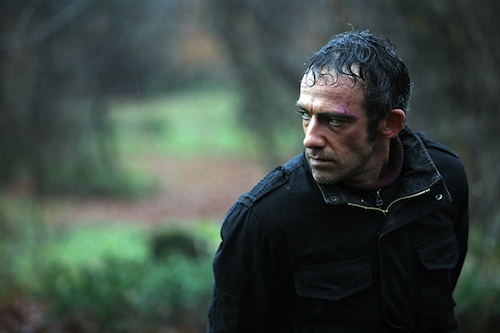
Director Rafi Pitts as Ali Alavi.

Clearly, Alavi’s hunting is a conscious strategy to maintain his masculine self-worth in an emasculating environment. It also makes him dangerous. With his close-cropped hair, wiry build, steely gaze, and 1970’s sports sedan, Pitts, serving as his lead actor, somewhat resembles an Iranian Steve McQueen (the star of 1980’s The Hunter). He is one bad cat, viscerally intense and totally credible in the action-oriented scenes.

Frankly, there is much we can assume about Alavi from what Pitts implies. The greenness of his car and the décor of his home may or may not be coincidental. Yet, unlike many people we observe on the street, he never seems very optimistic about the 2009 election. Perhaps he has seen this all before and suspects what is coming.

Neither a pure thriller nor strictly a naturalistic social protest film, The Hunter could be considered the Iranian version of the Falling Down (the high-water mark of Joel Schumacher’s career). If not an outright call for violent resistance, it explicitly suggests that the pent-up rage of average Iranians is deep and widespread. It ought to chill the Islamist mullahs to their cores. A genuinely powerful and challenging film, The Hunter marks an excellent start to the New Year. Highly recommended, it opens this Wednesday (1/4) in New York at the IFC Center.

Posted on January 3rd, 2011 at 2:42pm.

First Look 2012: LFM Reviews Almayer’s Folly

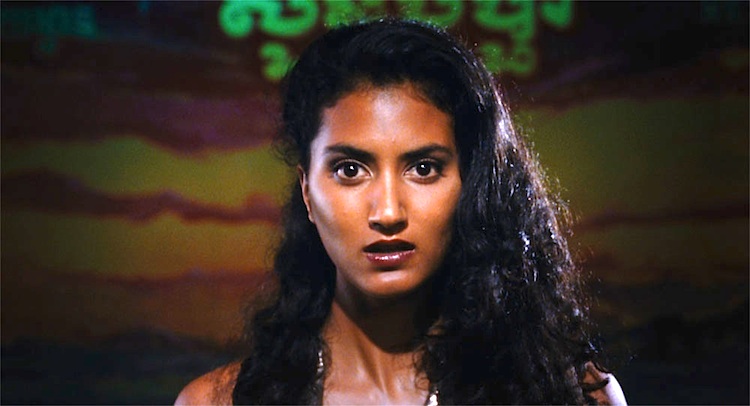
Aurora Marion as Nina.

By Joe Bendel. Festival season now starts a little earlier. An adaptation of Joseph Conrad’s first novel will be the opening night film of the inaugural edition of the first film fest of the year, and is sure to make critics and scholars sit up and take note. Of course, it is hardly Chantal Akerman’s first film, but it is something of a departure for the Jeanne Dielman, 23 quai du Commerce, 1800 Bruxelles auteur. Fittingly, Akerman’s foray into tropical malaise, Almayer’s Folly, kicks off the first annual First Look series at the Museum of the Moving Image in Astoria.

There is something elusive about Conrad that doggedly resists the transfer to the big screen. Yet his work has been a siren call to filmmakers, resulting in flawed masterworks like Apocalypse Now and Lord Jim. Such is the case with Akerman’s Folly, except less so.

As per Conrad, Kaspar Almayer is an unhappy man. He married the mixed race daughter of his adventurer mentor, Captain Lingard, in hopes of a prospective inheritance. Instead, Lingard has frittered away his fortune and sanity in search of a rumored treasure. Trapped in a loveless and impoverished marriage, Almayer’s only solace is his daughter Nina, but her resentment of westerners’ arrogant and abusive ways very definitely extends to her father.

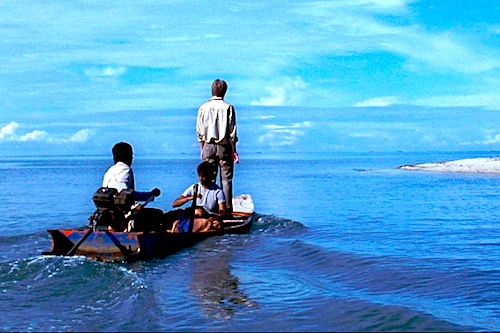
Set in Malaysia, filmed in Cambodia.

Frankly, learning of a new Conrad film adaptation is sort of like hearing an out of shape friend has entered a marathon. You admire their ambition and hope they pull it off, but remain skeptical. If nothing else, Akerman completely nails the atmosphere of exotic alienation. Watching Folly will make viewers feel like a corpulent western expatriate sweating profusely in a cream-colored suit. However, a little of that humid torpor goes a long way.

Clearly, Folly was conceived as a mood piece, but the narrative slack is awfully conspicuous. At times the cast seem more like props for Akerman to pose than actors interpreting characters. Still, Aurora Marion palpably radiates bitterness and contempt as Nina and Stanislas Merhar has some quietly forceful moments as Almayer.

Set in Malaysia but filmed in Cambodia, Folly is indeed something of a mixed bag. Yet it is undeniably intriguing to watch a filmmaker of Akerman’s stature take on the enigmatic Conrad. While it can certainly drag in-the-moment, it is a fascinating film to look back on as a whole. Of note to serious cineastes, Folly is an impressively high profile launch for the first ever First Look. It screens once and only once (second looks are up to somebody else) this Friday (1/6), with Akerman in attendance at the Museum of the Moving Image’s historic Paramount Studio home.

Posted on January 3rd, 2011 at 2:40pm.