LFM Review: Ralph Fiennes & Gerard Butler in Coriolanus

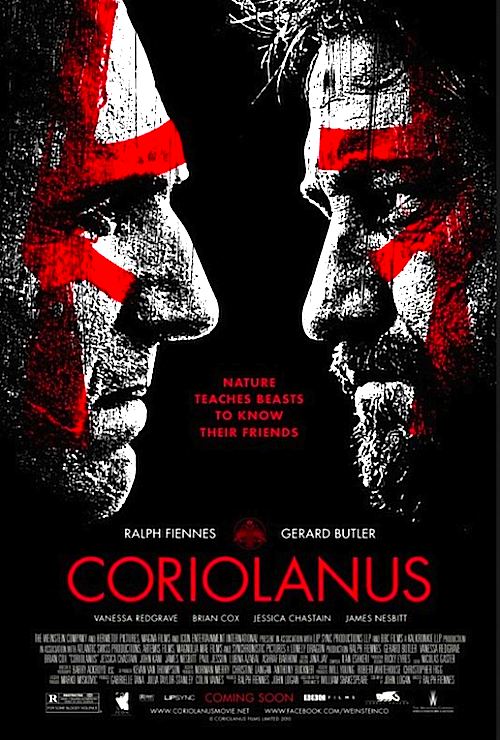
By Joe Bendel. It has long been considered one of Shakespeare’s most divisive tragedies. Though academic appraisals remain quite mixed, Coriolanus always had its champions, including poet T.S. Eliot. As a result, there are few cinematic predecessors against which actor Ralph Fiennes directorial debut might be compared. In the Olivier-Branagh tradition, Fiennes also stars in his contemporary retelling of Coriolanus (trailer here), which begins a one week Oscar qualifying engagement in New York this Friday.

In a Balkan city that “calls itself Rome,” Caius Martius has earned the honorific title “Coriolanus” for his victory over the city-state’s bitter rival, the Volsces. At the behest of his proud mother Volumnia and her ally Senator Menenius, the general consents to campaign for the office of Consul. The approval of the Senate is assured, but Coriolanus’s candidacy must also be accepted by the masses. This is a taller order, especially given the officer’s refusal to pander to the lowest common denominator.

Nonetheless, with Menenius’s help, Coriolanus appears to win over the people. Yet just as quickly, the deceitful senators Brutus and Sicinius turn the crowd against him, with the help of a cadre of professional activists. Venting his outrage, Corilanus’s contempt for the fickle masses leads to his banishment. It also drives him to Volsces, where he makes common cause with his old nemesis, Tullus Aufidius. Dead to everything except his rage, Coriolanus will have his revenge in a manner befitting Shakespearean tragedy.

Given his abruptly shifting loyalties and his un-Shakespearean lack of introspection, Coriolanus is a difficult figure for many to get their heads around. However, Fiennes’ portrayal really unlocks his character. We can understand how his rigid conception of honor compels each action he takes. Despite Corilanus’s reticence, it is a big, seething performance of great physicality that commands viewer attention. Clearly this is a man of action, not given to soliloquizing.

This is definitely Shakespeare at his manliest (no tights or sonnets here, thank you very much). Indeed, Gerard Butler matches Fiennes’ testosterone as Aufidius, while Vanessa Redgrave nearly outdoes them both as Volumnia, the motherly Lady Macbeth. Yet the real soul of the film comes from the great Brian Cox as Menenius, whose humanity leads inexorably to pathos. Though a relatively small part, it is also interesting to see South African actor John Kani, who projects a suitably stately presence as Coriolanus’s former superior officer, General Cominius.
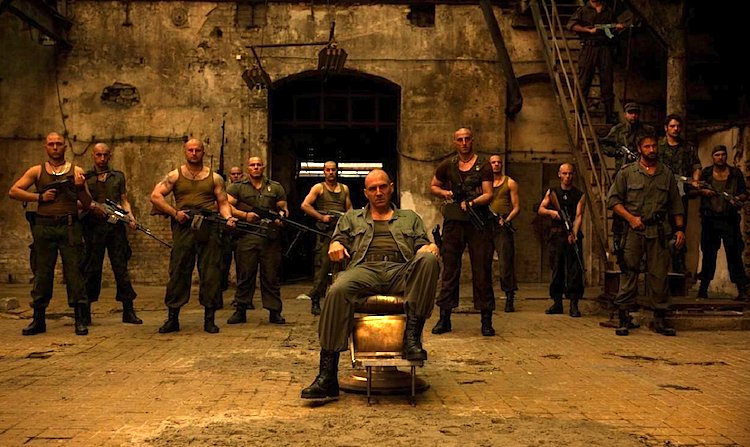
Shakespeare as exercise in machismo.

Though Fiennes’ effectively streamlined the film adaptation, it is also obvious why the original play troubles so many critics, given its scathing depiction of the Roman masses as no more than a weapon to be wielded by the unscrupulous. Frankly, in Coriolanus, “the people” get what they deserve. Indeed, the film comes at a time when it rather inconveniently begs comparison to uninformed masses occupying Zucotti Park.

An impressive directorial debut, Fiennes stages some vivid scenes of warfighting. His resetting of the story works more often than not, though the cable news flashes in Shakespearean English can be a bit jarring. Strikingly cinematic, the Belgrade locales also add the weight of contemporary historical tragedy, heightening the on-screen drama. One of the better recent Shakespearean films (considerably more satisfying than Taymor’s Tempest, for example), the unexpectedly timely Coriolanus is definitely worth seeing. It begins a special one week New York run for Academy Award consideration today (Friday, 12/2) and then opens more widely on January 20th.

Posted on December 2nd, 2011 at 10:56am.

LFM Review: Page One, The New York Times & Modern Media Bias

By David Ross. Andrew Rossi’s Page One (2011), a sleek, self-important infomercial for The New York Times, largely involves Times partisans whining that the dinosaur carcass of the Gray Lady is being picked clean by the mammalian swarms of the new media. There are cursory nods to the Jayson Blair and Judith Miller scandals, but essentially nothing in the way of real introspection or self-criticism. The Times‘ complaint largely goes like this: “What kind of world fails to recognize the inherent nobility of our enterprise! O fallen mankind, repent your shallowness!”

Do these apologists have a point? To some extent, yes. As numerous interviewees stress, aggregators, bloggers, and citizen journalists cannot cover certain kinds of news. War zone coverage, international political coverage, and intensive daily coverage of the political process require expertise and institutional funding. These are not part-time callings, nor activities that can be undertaken on the cheap. Those who bay for the demise of the mainstream media have to take seriously that news does not coalesce out of the internet ether, as it seems to. It must be dug up, run down, and eye-witnessed as mortar rounds collapse the available ground cover. This ferreting process is crucially enabled by the kind institutional pressure that only billion-dollar media entities can exert. Foreign potentates and corporate barons do not return phone calls placed by self-proclaimed smart guys in their pajamas (e.g., us). Eliciting a response requires the veiled threat intrinsic to newspapers that are in their own way players on the world stage. News depends on credentialed news people in the traditional sense: this is reality, like it or not.

Michiko Kakutani.

On the other hand, the mainstream media, and the Times in particular, has done everything conceivable to hasten its own demise. The postmodern Times is a cavalcade of inaccuracy, omission, myopia, flagrant political bias, outrageously lousy writing, latent snobbery, and superficial urban sophistication. All the shallowness of the modern elite university has come home to roost at the Times. The worst offenders are surely the editorial sections (prose sinkhole) and the culture sections (lapdog of everything transgressive), but I reserve special ire for fellow Yalie Michiko Kakutani, the Pulitzer-winning book reviewer who’s done much to instantiate a self-important middle-browism as the default mode of the literary culture. The novelist Jonathan Franzen, for one, calls her “the “stupidest person in New York” and an “international embarrassment.” He continues, “Everyone in Europe says to me, “How can The New York Times let a person who is so patently tone deaf, who is so screechy rhetorically, so clearly unequipped to appreciate interesting books or even to enjoy them — how can that person be the lead reviewer?'” Kakutani had the chance to rise to a historical occasion following the suicide of Franzen’s friend David Foster Wallace in 2008. Her ‘appreciation’ (here) is pat and rote by turns, utterly nerveless, utterly unmoved or inspired by the circumstances. “Laugh-out-loud funny”? “Both brainy and visceral”? An opening quote from Robert Plant! Are these sophomoric clichés what the mighty New York Times has come to? Was ever an era’s chief writer so lazily eulogized by an era’s chief reviewer?

Basic points first. The Times is no longer dependable in terms of fact, grammar, or idiom (“whipping post” for “whipping boy” just this past week, as I happened to notice at the supermarket – and on the front page no less). Ponder the Onionesque aspect of this correction from July 22, 2009:

An appraisal on Saturday about Walter Cronkite’s career included a number of errors. In some copies, it misstated the date that the Rev. Dr. Martin Luther King Jr. was killed and referred incorrectly to Mr. Cronkite’s coverage of D-Day. Dr. King was killed on April 4, 1968, not April 30.

Mr. Cronkite covered the D-Day landing from a warplane; he did not storm the beaches. In addition, Neil Armstrong set foot on the moon on July 20, 1969, not July 26. “The CBS Evening News” overtook “The Huntley-Brinkley Report” on NBC in the ratings during the 1967-68 television season, not after Chet Huntley retired in 1970.

A communications satellite used to relay correspondents’ reports from around the world was Telstar, not Telestar. Howard K. Smith was not one of the CBS correspondents Mr. Cronkite would turn to for reports from the field after he became anchor of “The CBS Evening News” in 1962; he left CBS before Mr. Cronkite was the anchor. Because of an editing error, the appraisal also misstated the name of the news agency for which Mr. Cronkite was Moscow bureau chief after World War II. At that time it was United Press, not United Press International.

How do you misstate the dates of the moon landing and MLK’s assassination in a single article? Don’t Times reporters have access to Wikipedia? Was the reporter in a condition of drunken mania? Were the editors? At The New Haven Register, where I spent four years as a cub reporter, three corrections within memory were enough to get one fired. Five-plus corrections in a single article would have been beyond anybody’s worst nightmare. The night desk’s sleepiest, rummiest old coot would have caught at least some of the above errata (MLK, moon landing, Telstar). I had to acknowledge perhaps three or four factual mistakes in my four-year career. Each was a humiliation, entailing a stern lecture and a day or two of frowns.

Continue reading LFM Review: Page One, The New York Times & Modern Media Bias

Romanian Film Festival 2011: LFM Reviews Red Gloves, Danube Waves, Silent River & Strung Love

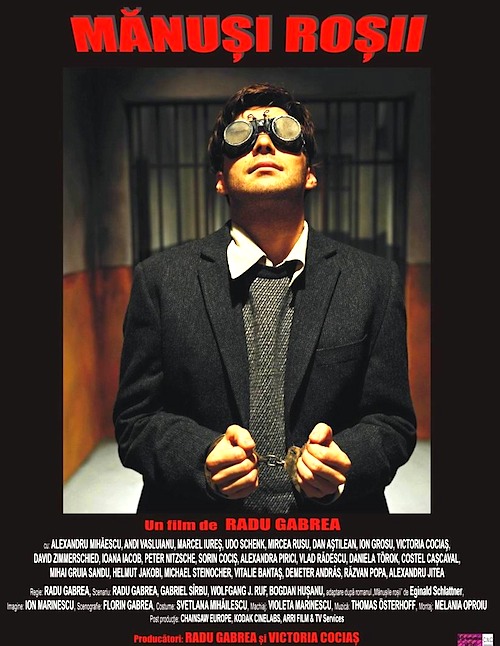
By Joe Bendel. It was hard being part of Romania’s Saxon minority, particularly in the immediate post-war years. Emboldened by the Soviet suppression of the Hungarian Revolution, the Romanian Communists began targeting the German-speaking minority. Though as a group they were disproportionately anti-Communist (and for good reason), this was not the case for young leftwing student Felix Goldschmidt. His lengthy imprisonment, interrogation, and trial testimony are dramatized in Radu Gabrea’s Red Gloves (trailer here), which screens today (Thursday, 12/1) during the 2011 Romanian Film Festival, presented by the Film Society of Lincoln Center and the Romanian Cultural Institute.

Goldschmidt tried to believe the excesses of Romania’s so-called “obsessive decade” were an aberration that would soon give way to true socialism. He also craved acceptance. That would be more than enough for his interrogators to work with. In truth, Goldschmidt’s politics were a little slippery. He had associated with several nonconformist elements, but his relationship with them was somewhat ambiguous. In particular, he claims to resent the now banned author Hugo Huegel for stealing his girlfriend, but viewers witness decidedly intimate scenes shared by the two men.

Frankly, Goldschmidt is fairly wishy-washy, which makes him more vulnerable to the tactics of his captors. He seems especially eager to please the German speaking Major Blau, yet for a time he resists denouncing his friends and colleagues. Still, even a strong personality can only hold out for so long—and Goldschmidt is not such a man.

Based on fact, but adapted from the novel by Enginald Schlattner, a Saxon-Romanian Lutheran pastor, Gloves is a deeply and pervasively tragic film. Arguably, Gabrea has become something akin to Romania’s cinematic conscience, having helmed a adaptation of a previous Schlattner Saxon-Romanian novel – as well as the Holocaust-themed drama Gruber’s Journey – and documentaries about Romania’s Yiddish cultural legacy.

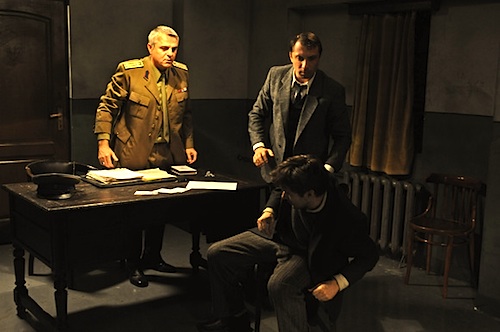
From "Red Gloves."

With Gloves, Gabrea focuses squarely on the interrogation process, vividly portraying the breakdown of Goldschmidt’s soul. Though there are frequent subsidiary flashbacks within the main narrative flashback, it is all a bit stage-like, featuring its cast of characters in a confined setting. Yet it is an effective arena to explore the terrors of Romania’s communist past, particularly through the hard insights offered by a former judge and a priest who briefly share Goldschmidt’s cell.

Though it is essentially by design, Goldschmidt is still a rather hollow figure nonetheless, never really brought to life by Alexandru Mihaescu. In contrast, Udo Schenk is absolutely electric as Blau. He deserves to be an internationally star, but the SS and Communist officers he has played for Gabrea are difficult to embrace, despite the screen charisma he brings to them.

Bitterly ironic and brutally honest, Gabrea’s film is—to use a loaded term from Gloves—a “cathartic” work. It is also a high quality period production that might come as a welcome respite to patrons tiring of the Romanian New Wave aesthetic, even with its grim subject matter. Respectfully recommended, it screens Thursday night (12/1) during the 2011 Romanian Film Festival at the Walter Reade Theater.

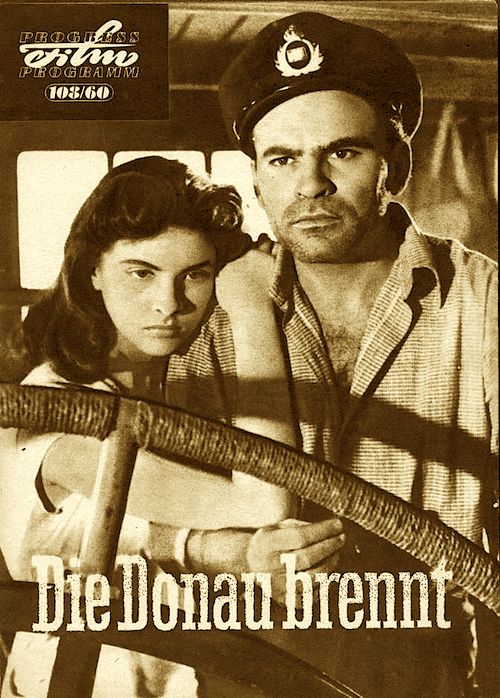
German poster for "Danube Waves."

Given Romania’s shifting positions during WWII, it was a bit tricky setting a Communist-era propaganda film during that time, but the recently deceased Liviu Ciulei managed to do just that. For his second feature, the renowned theater director combined Casablanca with Wages of Fear, adding a pinch of Party propaganda for seasoning. A ripping tale of war and intrigue, Ciulei’s Danube Waves screens as part of the sidebar tribute to the filmmaker at the 2011 Romanian Film Festival, presented by the Film Society of Lincoln Center and the Romanian Cultural Institute.

Mihai is barge captain who does not trouble himself over politics. Nor is he much concerned about the poor substitutes for sailors he forces to sweep for mines. He just wants to get home to his young wife Ana. Though expendable crewmen are getting harder to recruit, the Germans are willing to provide a prisoner for his use. He chooses Toma, because the supposed criminal is certainly able-bodied and claims to have served on a ship before.

However, Ana can tell right away Toma does not know port from starboard, but he is a quick enough study to fool Mihai.  Suspecting he is more than a common thief, a conspicuous sexual tension develops between Toma and Ana that Mihai deals with through heavy drinking as the barge loaded with German arms approaches a known minefield. Continue reading Romanian Film Festival 2011: LFM Reviews Red Gloves, Danube Waves, Silent River & Strung Love

LFM Review: The Descendants

From "The Descendants."

By Patricia Ducey. Early on in The Descendants, the camera sweeps lovingly over the old family portraits that line the walls of Matt King’s Oahu den. His forebearers, among them a landed Hawaiian princess and her Caucasian husband – along with their many ambitious, high achieving progeny – stare back at us radiating a self-possession and grandness we soon realize is sorely missing from Matt’s present day world.

Matt King (George Clooney) practices law and lives a middle class existence on Oahu with his family, a wife and two daughters, whom he barely relates to. He and his many cousins are heirs to the huge coastline land grant left to them by their royal and self-made ancestors – but the law mandates that they must now dissolve the trust, so they must sell the huge estate to who they decide as a family is the best buyer. The meeting will take place soon. Oh yes, I think hopefully, this will be grand: a large, wealthy family in conflict as they grapple with the meaning of legacy and of the land in this last piece of American wilderness.

But then Payne switches to Matt’s domestic crisis; his wife Elizabeth after a boating accident lies in a coma, and weak, ineffectual Matt must rise to the role of father and husband –because the one parent who made the family work is unconscious. As the family story takes over, Payne, the visual poet of Middle America and middle age, goes a bit sideways; his excursion into the tropical Eden and Matt’s discontent is not as successful as his previous films. In Election, About Schmidt, and Sideways his Midwestern protagonists feel the dissatisfactions of less than fully lived lives out there in flyover country, but they eventually claw their way out of despair through action or love.

Matt King is not so lucky, or perhaps not so brave. He retrieves his wanton teenage daughter Alexandra (Shailene Woodley) from the boarding school that is attempting, unsuccessfully, to reform her. Matt is determined that he and Alexandra, and younger girl Scottie (Amara Miller), will face the end of Elizabeth’s life together as a family. The doctor has informed him her coma is hopeless; they will remove the breathing tube per Elizabeth’s prior instructions. Both girls are bratty and foul mouthed; they humiliate and disobey their father just for the pure sport of it — because in his bumbling immaturity he allows them to, playing the ineffectual father to their faux maturity. In short, they represent the now clichéd American family, Hollywood version.

From "The Descendants."

Alexandra is particularly angry with her mother, and she finally tells her father why: her mother was having an affair — something Matt, in his detachment, never even remotely suspected. Finally, Matt is furious; he confronts Elizabeth’s friends and they reveal his identity. He knows this is his chance to step up as man of action. Instead, he enlists daughter Alexandra’s help to find the man and confront him! This is something a teenager would do — and why would a man involve his daughter in the pathetic exercise of stalking her mother’s lover? Surely all hell will break loose, I surmise, and Matt will see his errors and grow up. Alas, when he and Alexandra find the hapless lover, Matt instead gives him a good talking to and then invites him to visit his dying wife in the hospital, despite the fact that the lover admits that for him the affair was not serious. At this point, I emotionally checked out. Even the plain spoken eloquence of Robert Forster as Elizabeth’s father, and the crackling life force of Woodley’s Alexandra were not enough to sustain this movie. Continue reading LFM Review: The Descendants

LFM Review: Chico & Rita

By Joe Bendel. In the late 1940’s and early 1950’s, scores of Cuban musicians found success playing in American. Chico and Rita were two of them—almost. Their Afro-Cuban musical romance is told in Fernando Trueba, Javier Mariscal, and Tono Errando’s Chico & Rita, one of eighteen officially submitted films in best animated feature Oscar race and a 2011 European Film Awards nominee, which screened at this year’s African Diaspora International Film Festival.

Chico is a Bebop influenced piano player and something of ladies man. Rita is a stunning vocalist and all woman. During their first auspicious meeting, sparks fly and maybe a few faces are slapped. However, when Rita reluctantly sings Chico’s newest song in a radio competition, it is magical. Suddenly, Chico & Rita are the band to book. They also start to admit their mutual attraction, but circumstances keep getting in the way.

Before long, Rita is signed by an American producer, who whisks her away to New York. Chico eventually follows her, hoping to gain entree into the jazz scene through his old compatriot, Chano Pozo, whose tenure in Dizzy Gillespie’s band led to the creation of the so-called Cu-bop fusion of Bebop and Afro-Latin Jazz. Of course, those who are familiar with their jazz history know Pozo is not long for this Earth. Likewise, Chico & Rita’s rekindled romance appears equally ill-fated.

As the director of Calle 54, the best musical performance film frankly ever, Trueba’s participation inspires confidence and he does not disappoint.  C&R is an instant jazz classic, featuring infectious and sophisticated original music by Bebo Valdés, whose life sort-of-kind-of inspired Chico’s story. But wait, there’s more, including the classic music of Bud Powell, Dizzy Gillespie, Thelonius Monk, and Woody Herman’s Four Brothers band, performing Igor Stravinsky’s Ebony Concerto (which Chico sight-reads early in the film). Still not convinced? How about Freddy Cole performing one of Chico’s songs as his famous brother Nat, tenor saxophonist Jimmy Heath channeling Ben Webster, flamenco singer Estrella Morente appearing as herself, and a whole lot of Afro-Cuban percussion interspersed throughout the proceedings.

From "Chico & Rita."

Continue reading LFM Review: Chico & Rita

LFM Review: Africa, Blood & Beauty

From "Africa, Blood & Beauty."

By Joe Bendel. Sergey Yastzhembsky has surely seen a lot of savagery, but not in Africa. A former high ranking official in the Yeltsin and Putin governments, Yastzhembsky served as the Kremlin’s chief spokesperson during the Chechen “troubles.” Since then, he has preferred the company of Africa’s indigenous tribes, capturing their traditional ways of life, perhaps for posterity, in Africa, Blood & Beauty, which screened this past Sunday as part of the 2011 African Diaspora Film Festival.

Implying an unmistakable hierarchy, Beauty is organized into four sections, explaining the rituals and customs pertaining to children, women, men, and spirits, in that order. It quickly becomes clear spirits might be duly venerated, but tradition favors men over women. In nearly all of the surveyed tribes, the women bear the burden of nearly all the real work, except for hunting and sometimes fishing. Still, the Himba of Namibia have something of a safety valve in place, requiring a man who murders his wife to pay restitution of forty-five cows to her family – but mandating nothing from a woman killing her husband.

Indeed, Beauty is at is best when it explains the practical applications of painful-looking rites – though even with a compelling explanation, those endured by children might very well distress sensitive viewers. For instance, Pygmies sharpening their children’s teeth has obvious survival applications. However, as presented in the film, the Himba ceremony of knocking out young boys’ bottom teeth makes little sense from a pragmatic standpoint. Continue reading LFM Review: Africa, Blood & Beauty