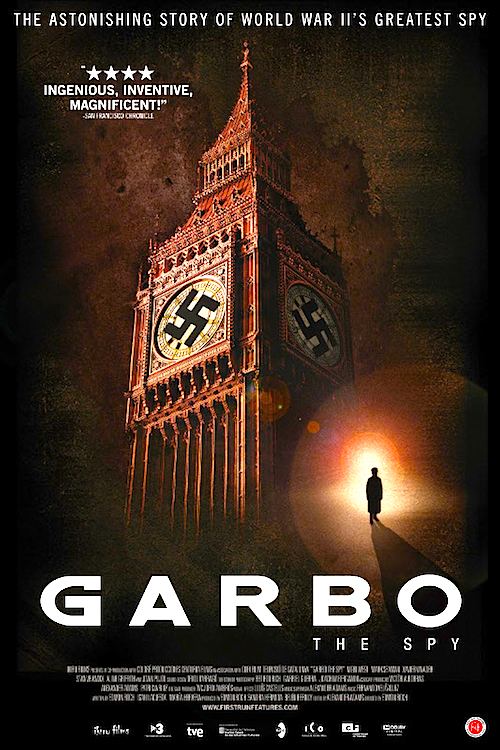
By Joe Bendel. Juan Pujol was the all-time greatest writer of spy fiction, but he wrote for a very select audience: German intelligence. Supposedly based in England, the Spanish double agent wrote incredibly verbose reports to his unsuspecting German handlers, riddled with disinformation and imaginary sub-agents, but it all boiled down to one word: Calais. Misdirecting the National Socialist war machine was the intrigue of a lifetime in Pujol’s life of intrigue, idiosyncratically documented in Edmon Roch’s Garbo the Spy (trailer above), which opens this Friday in New York.
The Germans knew him as Alaric, but the British code-named him Garbo. A deserter during the Spanish Civil War, Pujol’s story is so unlikely it would be difficult to believe without documentation. In fact, MI-5 did not believe him when the unprepossessing man came cold-calling. Rebuffed but undeterred, Pujol next approached the Germans, who immediately recruited him as an agent.
Pujol fed the Germans a steady diet of information largely culled from old newspapers that nonetheless built up his controllers’ trust. Eventually, after several further overtures, the British realized Pujol was legit and began directing his work. While he passed along a great deal of misleading intel, his most important assignment was Operation Fortitude, a concerted campaign to convince the Germans the D-Day invasion would land at Calais rather than Normandy.
Eventually, the war ends satisfactorily for Pujol. A bit of time passes, he disappears, and at some point is reported dead. Obviously though, there will be more to the master of the deception’s story. Military historian Nigel West (and former conservative MP under his given name, Rupert Allason) would tell the full tale when he literally wrote the book on Pujol, finally giving the remarkable spy his proper due.
Roch’s film is incredibly cinematic, employing extensive archival footage and clips from vintage war and espionage films as illustrative devices. In fact, the video sampling strategy often threatens to overwhelm the deadly serious subject matter, giving Garbo a vibe somewhat akin to a Jay Rosenblatt short film collage. Frankly, it occasionally borders on the inappropriately ironic. Still, the substance of Pujol’s story consistently rises above any stylistic excesses.
Garbo the film also boasts a relatively small but highly specialized cast of interview subjects, including West (as he is billed) and Aline Griffith, Countess of Romanones, a contemporary of Pujol’s working clandestinely for the OSS. Everything they have to say is quite noteworthy. It also interviews members from both of Pujol’s families, neither of whom knew of the other until West discovered his fate.
There is no question Pujol saved many Allied lives. Perhaps hundreds of thousands of servicemen survived the European theater because the Germans were dug in at Calais. The strange details and anecdotes surrounding Operation Fortitude by themselves are well worth the price of admission. Totally fascinating history, briskly if somewhat distractingly rendered on-screen by Roch, Garbo is definitely worth seeing, particularly for history buffs and espionage junkies, when it opens today (11/18) in New York at the Quad Cinema.
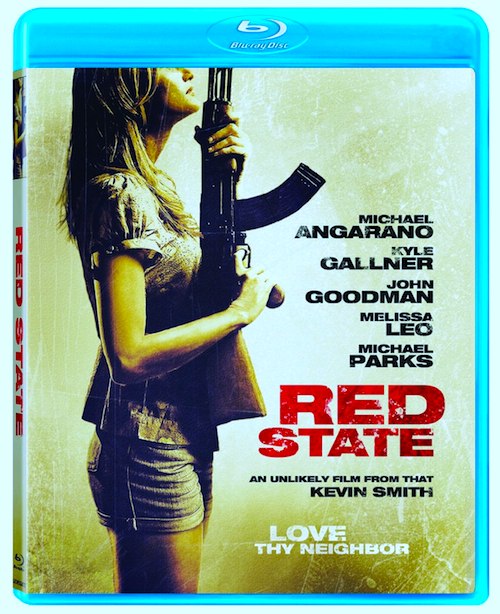
By David Ross. I’ve always considered myself on Kevin Smith’s side. I love salty and unguarded talk. As a spigot of quotable material, Kevin Smith (see here) rivals John Mayer and Tarantino, whose brains likewise seem not to have evolved the internal p.c. censors the rest of us are equipped with. Though it may involve the lowest kind of potty humor, such talk is always close to literature in its impulse to amuse itself and flout any interfering proprieties. At the same time, I could bear only a few minutes of Smith’s stand-up film Too Fat for Forty (2010). I didn’t mind the anti-Bush jabs in concept, but I very much minded their pandering obviousness and staleness. When Red State came along soon after, I girded myself for the worst. I expected a muddle of hysterical smears: a Garafalo-meets-Tarantino gorefest.
As advertised, Red State tears into both evangelicalism and the post-9/11 security apparatus. The Reverend Abin Cooper is the leader of a small Branch Davidian-like flock whose services incorporate ritual murder of kidnapped sinners. The ATF and FBI careerists who raid his compound on trumped up terrorist charges are little better. Arguably they’re worse. Their own brand of murder is bureaucratic and amoral. They murder on behalf of their resumes and pensions. No surprises so far. Evangelicals – evil. Patriot Act and its enforcers – equally evil.
The weird swerve involves Smith’s sneaking admiration for Cooper, who’s suavely played by Tarantino veteran Michael Parks. Smith rejects the trustiest cliché in the anti-evangelical arsenal by declining to portray Cooper as a hypocrite. I was sure Cooper was going to be unveiled in an unsurprising ‘surprise’ ending as a homosexual, child molester, cross-dresser, or sex-crazed bigamist. But no! He practices what he preaches. Nor is Cooper a coward, a fool, or a monster, though of course he commits terrible crimes in the name of God. Against all odds and expectations, he emerges as a seductive anti-hero who recalls no less a figure than Francis Marion Tarwater, the backwoods prophet of Flannery O’Connor’s masterpiece The Violent Bear it Away. Cooper is impossible not to like, even as he’s impossible not to abhor. Continue reading LFM Review: Kevin Smith’s Red State
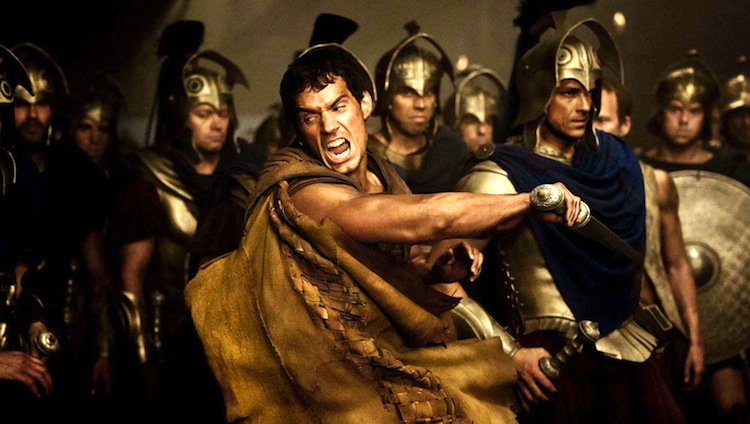
By Jason Apuzzo. THE PITCH: Commercial and music video director Tarsem reinvents the ancient Greek Theseus myth in Immortals, featuring rugged Brit star Henry Cavill (the new Superman) and coming from the same producer, Mark Canton, who revitalized the Sword & Sandal genre with 300.
THE SKINNY: Jettisoning any actual Greek mythology from his story, Tarsem repurposes Theseus’ ancient heroics into a violent, vacuous cross-cultural mash-up for the video game/UFC generation – a stylized ballet of severed limbs, senseless plot devices and wild costuming. Immortals – which likely deserved an X rating – is a film neither for the faint of heart, nor the lively of mind.
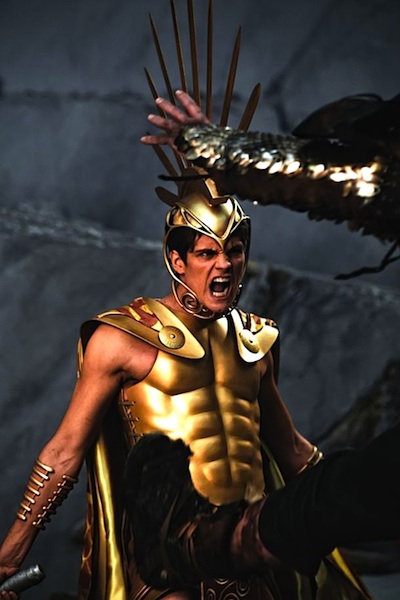
"No, John Galliano didn't design my helmet!"
WHAT WORKS: • Although the film’s costumes and production design – which extravagantly blend North African, Indian, Persian and occasionally even some Greek influences – make little sense in the context of the story, they bring a visual novelty to the film that grabs one’s attention. The garb of the Olympian gods, and the armor of the Titans, deserve special praise.
• Years of bizarre behavior and dissipated living have made Mickey Rourke into a good hire to play a wicked tyrant. His King Hyperion, who bears no connection to any Theseus myth I’m aware of, is nonetheless a formidable and interesting villain – a kind of Colonel Kurtz of the ancient world, decked out in bronze bunny ears. As an interesting side note, the disjointed terrain of Rourke’s face has begun to resemble a Paul Klee painting – fascinating to look at (particularly in 3D), even for long spells of time.
WHAT DOESN’T WORK: • Having drained the story of any meaningful connection to Greek mythology or history (which, one assumes, he finds dull), Tarsem has nowhere to go with the Theseus story excerpt to turn it into a generic, head-chopping ‘hero’s journey’ like a thousand similar films before it. Immortals, trite in the extreme, shows less respect to the core cannon of Greek myth than your average comic book movie shows toward comic book lore.
• Outside of Mickey Rourke, Immortals features not a single noteworthy performance – including those of Henry Cavill and Freida Pinto, who make for a handsome but pitifully dull couple. And although Luke Evans is passable as a young Zeus, the rest of the Olympian gods are almost laughable, like something out of a high school performance of Godspell. Continue reading Labyrinth of Woe: LFM Mini-Review of Immortals
[Editor’s Note: the post below appears today on the front page of The Huffington Post.]
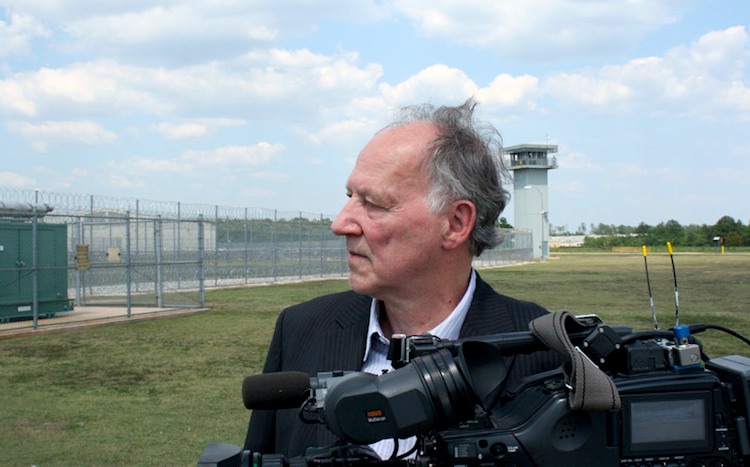
By Govindini Murty. Few directors are as willing to venture into the abyss as Werner Herzog. His prolific body of work has ranged from intense dramas like Aguirre: The Wrath of God and Woyzeck that plumb the depths of the human soul to documentaries like Encounters at the End of the World and Grizzly Man that examine humanity’s fragile place in the miraculous and terrifying world of nature. The astonishing breadth of Herzog’s filmmaking conveys the humanist’s sense of wonder at the world – what he describes as the “ecstasy of observation.”
Herzog’s latest film, Into the Abyss: A Tale of Death, A Tale of Life (opening this Friday, November 11th) is a compelling look at the contentious issue of the death penalty. Producer Erik Nelson has stated that the film is intended to inform the current Republican presidential debate over the death penalty, in particular with regard to the candidacy of Texas Governor Rick Perry. Herzog himself has issued a Director’s Statement expressing his opposition to capital punishment – though in keeping with his lifelong aversion to political interpretations of his work, he has also asserted that Into the Abyss is not a political film. These apparent contradictions point to the enigma of Werner Herzog himself – on the one hand a sensitive humanist with strong moral convictions, yet on the other hand an artist who resists being defined by political activism or party ideology.
Into the Abyss embodies these contradictions. The film tells the true story of a brutal triple murder committed in Conroe, Texas. Michael Perry and Jason Burkett, intending to steal two cars owned by Sandra Stotler, killed Stotler in her home and then lured her son Adam and his friend Jeremy Richardson into the woods and executed them. Perry and Burkett subsequently went on a joy ride in the cars, before winding up in a bloody shoot-out with the police. Perry and Burkett were convicted of the murders, with Perry receiving the death penalty, and Burkett receiving a life sentence.
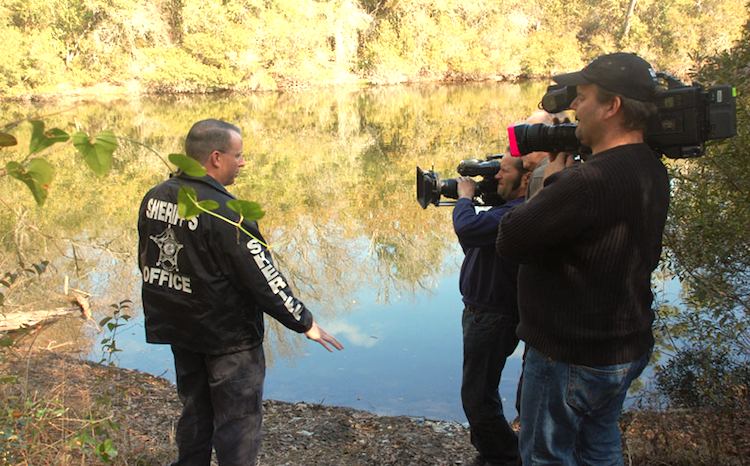
Herzog interviewed Michael Perry just eight days before his execution, and also interviewed Jason Burkett in prison. Other interviews include those with Burkett’s wife Melyssa Thompson-Burkett, who contacted Burkett while he was in prison and subsequently married him; Fred Allen, a prison captain who worked in the execution chamber and who assisted in over 125 executions before resigning in moral crisis; and most significantly, the relatives of the victims themselves: Lisa Stotler-Balloun, the daughter of Sandra Stotler and sister of Adam Stotler, and Charles Richardson, the brother of Jeremy Richardson. Stotler-Balloun and Richardson in particular provide the most heartbreaking testimony of the film, as Herzog does not shy away from depicting the shattering effect of the murders on their lives. As a result, Into the Abyss exists in a complex tension between Herzog’s avowed position against capital punishment and his impulse as a storyteller to depict both sides of the story and allow readers to make up their own minds.
I had the opportunity to meet with Werner Herzog in Los Angeles recently and discuss with him Into the Abyss and his extraordinary body of work. Part I of this interview appears below.
Documenting the crime.
GM: I’d like to ask you about the title of your movie, Into the Abyss, because I’ve seen you refer to the concept of ‘the abyss’ quite a few times in your work. In Woyzeck you have a line “Every man is an abyss, you get dizzy looking in,” and in Nosferatu you have a line “Time is an abyss profound as a thousand nights.” This is a concept you keep referring to – what does ‘the abyss’ mean to you?
WH: It’s a good observation, and when I came up with the title Into the Abyss – it dawned on me that it could have been the title of quite a few other films. Like Woyzeck could have had that title, or The Great Ecstasy of Woodcarver Steiner or even the cave film, Cave of Forgotten Dreams, because I’ve always tried to look deep inside of what we are – deep into the recesses of our existence, of our prehistory – like in Cave of Forgotten Dreams. So it is some sort of a theme that runs through quite a few of my films.
GM: I want to ask you about the relationship between humanity and the universe. There was a wonderful quote at the end of Encounters at the End of the World where Dr. Gorham asks, and I paraphrase, “are we the means through which the universe becomes conscious of itself?” This reminded me of a quote from Blaise Pascal’s Pensées:
“A reed only is man, the frailest in the world, but a reed that thinks. Unnecessary that the universe arm itself to destroy him: a breath of air, a drop of water are enough to kill him. Yet, if the All should crush him, man would still be nobler than that which destroys him: for he knows that he dies, and he knows that the universe is stronger than he; but the universe knows nothing of it.” (Trans. A.J. Krailsheimer)
This seems to apply to Into the Abyss and its depiction of human beings within this world. In the film you go driving down country roads and you show the trailer parks, the run-down stores, the boarded up gas stations, the bars. It looks like a wasteland that God is somehow absent from, and there are these people in the midst of it who are in a terrible state of pain and confusion – in an apparently indifferent universe.
WH: Let me address Pascal first. Yes, I like him very much. I even invented a quote for the film Lessons of Darkness. It starts with a Pascal quote “The collapse of the universe will occur like the creation in grandiose splendor,” and underneath it says Blaise Pascal, but I invented it – and of course Pascal couldn’t have said it better. [Laughs.]
But, it’s interesting. The wasteland, this forlorn landscape, has become fascinating for me – this lost kind of Americana. And one of the death row inmates with whom I spoke – not in this film but in another film I’m already finishing – he said to me how he saw on his very last trip forty-three miles between death row and the death house where they are being executed in Huntsville. And in this cage in the van he sees a little bit of an abandoned gas station, he sees a cow in the field, and all of a sudden for him, everything is magnificent, and he says: “It looked like Israel to me, it all looked like the Holy Land.” And I immediately grabbed my camera and I did this voyage of the forty-three miles and indeed the most forlorn landscapes all of a sudden look like the Holy Land. So I look at these forlorn landscapes all of a sudden with fresh and different eyes. Continue reading LFM’s Govindini Murty at The Huffington Post: A Conversation With Werner Herzog, Part I: Into the Abyss
By Joe Bendel. They are singing about revolution. They are not really doing anything about it, but that was still more than enough for the Communist government. Considered by many the first Chinese indie film, Zhang Yuan’s Beijing Bastards has been censored, banned, and roundly condemned – but thanks to Fortissimo Films, the international independent film production and distribution company – it reached a global audience. Still gritty and subversive after nearly twenty years, Bastards screens this Saturday in New York as part of MoMA’s new retrospective series, In Focus: Fortissimo Films.
Cui Jian is one of China’s most famous underground rockers. In Bastards, he plays himself or a thinly fictionalized version. He has fans but no gigs, because he cannot secure a venue for a prospective concert. He also lost the lease on his rehearsal space for no apparent reason. Though never outright stated, it is clear that the powers that be want to close him down.
Karzi owns a venue, but his rock bar is no great shakes. Neither is he. His pregnant girlfriend Maomao disappeared after he insisted she have an abortion. He doggedly hunts for her, subjecting her friends to outright harassment, but more for reasons of ego than love. Morally ambiguous, Karzi is not the image of Chinese youth the government likes to project, but in 1993, he was the shape of go-go me-me things to come.
A contemporary of Jia Zhangke, Zhang is considered one of the godfathers of the Chinese independent film movement and a forefather of the Digital Generation. In fact, Bastards bears a strong aesthetic affinity to the subsequent dGeneration films. Shot guerilla-style with most of the director’s friends serving as the ensemble cast, the film follows its roundabout narrative from a fly-on-the-wall perspective. This is a street level film, unvarnished and unsentimental. Continue reading The Birth of Chinese Indie Cinema: LFM Reviews Beijing Bastards @ MoMA
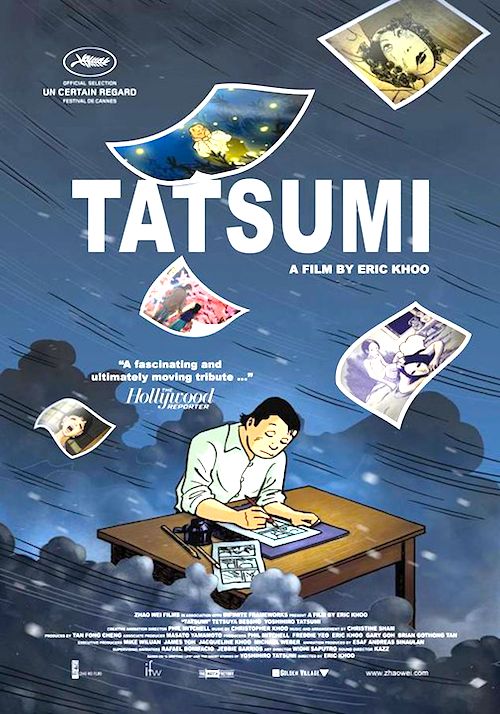
By Joe Bendel. Yoshihiro Tatsumi could be called the Japanese Will Eisner. Tatsumi was the leading exponent of Gekiga, or serious manga that tackled adult story lines. Americans who are very hip or awfully geeky will already know Tatsumi’s work, particularly his Eisner winning graphic novel-autobiography, A Drifting Life. For the rest of us, Singaporean Eric Khoo’s Tatsumi (trailer here) serves as a compelling introduction to his career and stories. Singapore’s official submission for best foreign language Academy Award consideration, Khoo’s animated tribute-biography screens at the San Francisco Film Society’s upcoming 2011 San Francisco International Animation Festival.
Tatsumi was ten when World War II ended. Somewhat logically, the American occupation and economic revival of Japan would factor prominently in his life and that of his characters. Khoo intersperses five notable Tatsumi stories, mostly in black-and-white, amid his vivid color adaption of the Gekiga pioneer’s memoir. Psychologically complex and deeply flawed, it is clear how Tatsumi’s characters were shaped by their creator’s experiences. In fact, it is easy to conflate them with Tatsumi, particularly the unfortunate artist in Occupied.
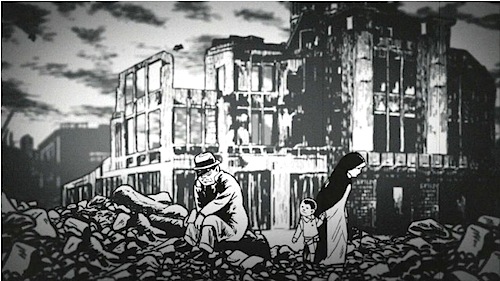
Each of the five would stand alone as satisfying self-contained short films. However, the most powerful of the collected stories comes first, by virtue of chronology. Hell forthrightly addresses the horrors of Hiroshima and its aftermath, but it takes viewers to some unexpectedly dark places, undercutting simplistic moral judgments. Throughout all five stories, there is a profound sense of alienation, often prodding the protagonists to commit shockingly anti-social acts out of existential compulsion, but their actions are always understandable, in a sadly human way.
From "Tatsumi."
Though his life was never as lurid as that of his marginalized characters, Tatsumi’s early years were marked by considerable pain and want. Khoo structures the film in a way that really emphasizes how these struggles instilled a humanistic empathy in Tatsumi, embracing those who were downtrodden and even grotesque. Ultimately, it is rather inspiring to see the artist rise from such mean circumstances to become an acknowledged leader of his field. Continue reading SF International Animation Fest: LFM Reviews Tatsumi & Fullmetal Alchemist: The Sacred Star of Milos
 Pujol fed the Germans a steady diet of information largely culled from old newspapers that nonetheless built up his controllers’ trust. Eventually, after several further overtures, the British realized Pujol was legit and began directing his work. While he passed along a great deal of misleading intel, his most important assignment was Operation Fortitude, a concerted campaign to convince the Germans the D-Day invasion would land at Calais rather than Normandy.