
Libertas @ The 2011 New York Film Festival: Mud and Soldiers (Nikkatsu Centennial)

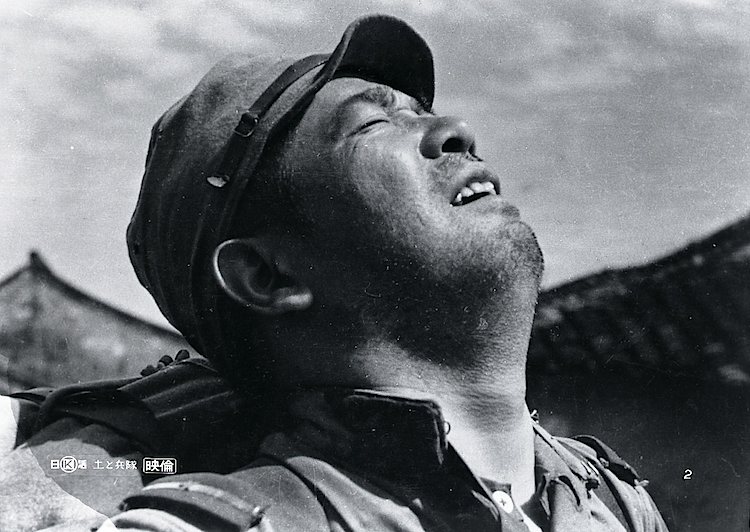
By Joe Bendel. It is sort of like being immersed in the flipside of Saving Private Ryan. You might feel like invading Manchuria after watching Tomotaka Tasaka’s 1939 Mud and Soldiers, because that is exactly what it was designed to do. Though the Nikkatsu studio is best known for its classic yakuza films, it clearly took a sojourn through militarism in the 1930’s. In celebration of Nikkatsu’s centennial, the 49th New York Film Festival has programmed a wildly diverse 37 film retrospective, including Tasaka’s wartime propaganda picture.

If nothing else, Mud constitutes truth in titling. It is not called “Romance and Comic Relief” for a very good reason. Rather, the film documents a successful incursion into China, made possible by the selfless dedication of the Imperial Army’s rank-and-file. By design, there is virtually no character development, because Mud explicitly extols the virtue of soldiers submerging their individuality into the collective core. Granted, all military forces depend on their soldiers acting as a cohesive unit, but Mud’s esprit de corps is almost Borg-like in its relentlessness. Even the practice of censoring their letters home is presented as an act of team-building.

Throughout Mud, there is a surfeit of marching and warfighting in the muck. It is so realistic, it even features a fair amount of the hurry-up-and-waiting that every veteran remembers with frustration. In fact, Mud was such an accurate depiction of the combat experience, the U.S. military reportedly re-cut a confiscated print to use as a training film, in effect censoring a film glorifying censorship. As befits the Imperial Army, none of the cast stands out, but to a man, they all blend into the frontline milieu.

To give due credit, Mud is well made, blowing up stuff nicely and portraying a private’s perspective on warfare with scrupulous honesty, including the frequent boredom. However, the agenda behind it is transparently obvious. Naturally, there is absolutely no hint of the Japanese atrocities committed in China, which makes programming Mud without a counterbalancing selection a bit of a tricky proposition. Still, at least in America, the Imperial Army’s conduct in places like Nanjing is a settled question.

Though one can take issue with Mud on a host of aesthetic and ideological grounds, it is unlikely New Yorkers will have an opportunity to see it on the big screen anytime soon beyond this Nikkatsu sidebar. A historically important but highly problematic film, Mud screens Tuesday and Wednesday (10/4 & 10/5) at the Howard Gillman Theater as part of the Velvet Bullets and Steel Kisses Masterworks retrospective celebrating Japan’s oldest movie studio at the 2011 New York Film Festival.

Posted on October 4th, 2011 at 1:59pm.
Libertas @ The 2011 New York Film Festival: Once Upon a Time in Anatolia

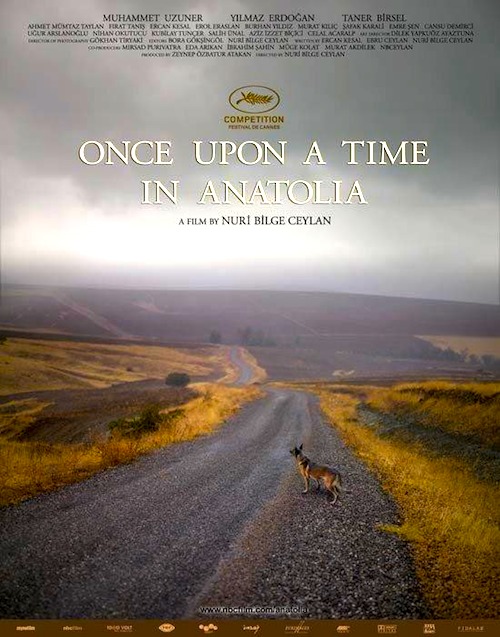
By Joe Bendel. If Beckett and Mamet collaborated on a Turkish police procedural, it might have been similar in tone to Nuri Bilge Ceylan’s latest festival favorite. Yet the lush pastoral imagery is a distinct hallmark of the Turkish auteur’s style. Do not expect to be spoon-fed a conventional action-driven narrative. Ceylan makes viewers work for it in his obliquely focused Once Upon a Time in Anatolia (trailer here), which screens during the 49th New York Film Festival.

As the film opens, Kenan is trying to show Police Chief Naci and three carloads of officers where he buried the body of his former friend Yasar. Unfortunately he was drunk at the time and cannot remember the exact location. This will take a while—all night in fact. While they blunder across the deserted Anatolian steppe, Chief Naci, Dr. Cemal, and Prosecutor Nusret, banter about this and that, which might later prove to be more revealing than viewers first realize.

Eventually, Kenan finally finds the body, at which point Ceylan throws his first curve ball, taking the film on a detour into absurdist black comedy. Indeed, the film almost plays like a spoof of long slow pretentious art films, though one has to have a lot of long slow pretentious art films under their belt to really appreciate it as such.

Finally, the keystone kops get the body back to the station, where Ceylan shifts gears once again. We start to pick up clues the nature of the crime is not precisely what we were led to believe. We also learn (with as much certainty as Ceylan ever allows) about one character’s very painful private life.

Throughout Anatolia, truth is decidedly slippery. Ceylan provides clues to raise suspicions, but never enough to form rock-solid conclusions. It is hard to say what over two and a half hours of this elusiveness adds up to, but at least the audience has had a lovely driving tour of the Turkish countryside.

Mostly shot in long takes, framing the characters as tiny figures set against the verdant landscape, Anatolia is a film that really has to be broken down into manageable parts. The three leads who emerge from the ensemble are all excellent, each looking appropriately haggard and weathered. Yilmaz Erdoğan seems to be the standard issue tough cop, yet he hints at something unexpectedly compassionate in Naci. Conversely, Muhammet Uzuner’s Cemal seems like a reassuringly earnest provincial doctor, but he performs the film’s only true interrogation, one so riveting viewers do not realize it is happening until it is already over. However, it is Taner Birsel who really takes his character to unexpected places, exposing the torment beneath the prosecutor’s bluff and polish.

All three actors have some really fine moments in Anatolia, but you have to drive a long way to get to each one. Of course, compared to the three hour forced march of Cristi Puiu’s Aurora, which played at last year’s NYFF, Anatolia is a walk in the park that offers the additional added attraction of actually getting somewhere in the end. It is a hard film to fully wrap one’s head around, but it stays with you (particularly Birsel’s final scene), which certainly proves it works on some level. Often arresting to look at (through cinematographer Gökhan Tiryaki’s artful lens) and occasionally wickedly droll, it is recommended for the highest of high-end cineastes. It screens this Saturday (10/8) at the Alice Tully Hall as a Main Slate selection of the 2011 New York Film Festival.

Posted on October 4th, 2011 at 1:58pm.

Libertas @ The 2011 New York Film Festival: You Are Not I

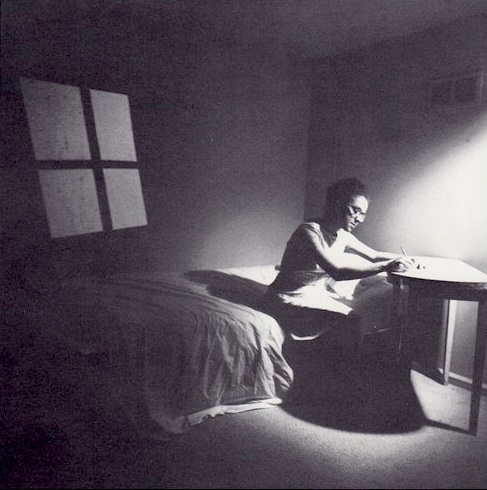
From "You Are Not I."

By Joe Bendel. A substance called kif represented a potentially unusual challenge for film restorers. It is a mixture of pot and tobacco that American expatriate novelist Paul Bowles smoked an awful lot of. Yet providentially, a copy of Sara Driver’s presumed lost short film You Are Not I safely resided in his stuffy, kif-infused Tangier flat for years. Driver’s newly restored adaptation of Bowles’ short story of the same title screens this Thursday as a Masterworks selection of the 49th New York Film Festival.

Ethel is mentally unsound. Institutionalized by her family, she literally walks away from her sanitarium amid the confusion of a tragic accident (originally a train derailment in the Bowles story, but downgraded here to a highway pile-up due to Driver’s budget constraints). Mistaking her catatonia for shock, two rescue workers drive the eerie woman back to her family’s home, which agitates her sister to no end. As delusional thoughts race through Ethel’s mind, YANI takes a weird turn at the expense of objective notions of reality.

Frankly, the circumstances surrounding YANI are more intriguing than the film itself. Considered irretrievably lost after Driver’s negatives and prints were destroyed in a warehouse fire, a courtesy print sent to Bowles was unearthed amongst his long undisturbed effects in 2008. Indeed, the image of a film canister hiding with the Beat relics of the author’s exotic chambers gives YANI a greater mystique than is probably warranted.

Driver became something of a phantom herself after the release of her 1993 ghost movie, When Pigs Fly. However, her co-writer and cinematographer Jim Jarmusch became one the biggest, if not the only, pseudo-mainstream crossover success of the so-called No Wave East Village-based filmmaking scene. Yet YANI really is not a representative film of the movement, because it is never obscene and provides a readily identifiable narrative thread, regardless of the cosmic twist.

The cast, including Luc Sante as one of the relief workers, definitely come across as an unprofessional lower Manhattan ensemble. However, Driver handles the tricky conclusion quite deftly, suggesting it is really real, despite the hallucinatory vibe. It definitely reaches an unsettling place, even if the early scenes keep viewers at arm’s length.

Given its fascinating history, cineastes will certainly welcome the opportunity to final watch YANI. Though quite accessible by the standards of experimental filmmaking, it will still bewilder the less adventurous. Interesting but perhaps not a “masterwork” per se, YANI screens this Thursday (10/6) at the Walter Reade Theater as part of the 2011 NYFF.

Posted on October 3rd, 2011 at 1:33pm.

Libertas @ The 2011 New York Film Festival: Miss Bala

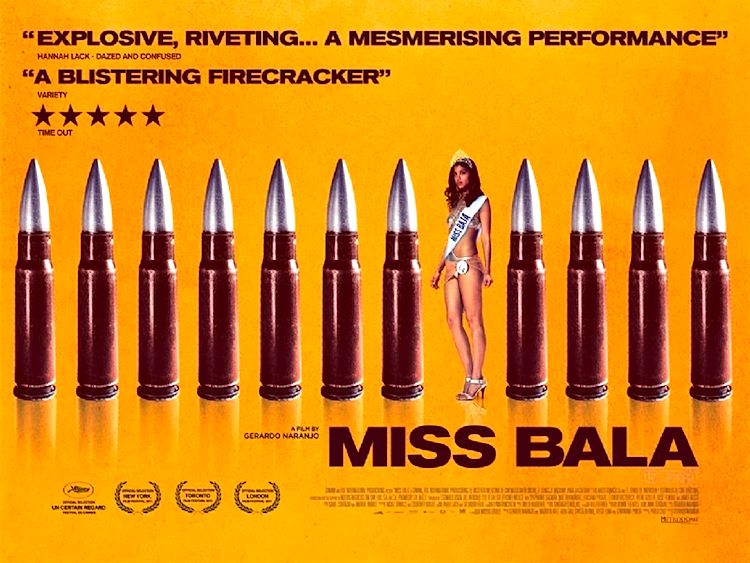
By Joe Bendel. Drug cartels are worse than the most controlling stage mothers. One long-shot Mexican beauty pageant contestant learns this the hard way when an embattled drug kingpin champions her cause in Gerardo Naranjo’s Miss Bala (trailer here), which screens this weekend at the 49th New York Film Festival.

There are few opportunities for young people in the city of Baja, even if they are attractive like Laura Guerrero and her friend “Suzu.” That is why they want to take a shot at the upcoming Miss Baja California contest. Looking to pull a few strings with the judges, Suzu drags Guerrero to a sketchy club to party with some crooked DEA agents she knows. Unfortunately, Lino Valdez and his crew arrive to make a bloody statement. Though Guerrero escapes with her life, Valdez comes looking for her when she starts asking questions about Suzu.

Stephanie Sigman in "Miss Bala."

Rather than killing her, Valdez decides to take Guerrero for himself, using her as a mule and clearly signaling what other services she will be expected to perform. He also puts in the fix with the Miss Baja contest, while engaging in open warfare with the police.

Bala (as in bullet) is the sort of film that viewers would need a clicker to keep track of the body count. Yet Naranjo shows very little violence directly on-screen. Instead, it mostly plays out just beyond Guerrero’s POV, as she cowers under beds and in dark corners, listening to the barrage of gunshots and blood curdling shrieks. Still, there is never any question as to the horrific nature of the carnage unfolding around her.

As in many contemporary Mexican films, it is not worth bothering to distinguish the police and government officials from the gangsters like Valdez. It also portrays the local media in rather cynical terms, while depicting U.S. border security as what might charitably be termed porous. In short, it is a work of unremitting realism, but Guerrero’s inspired-by-a-true-story misadventure gives the film the feeling of an urban legend.

As Guerrero, Stephanie Sigman (who has been doing media to promote Bala at NYFF) is on course for international stardom. Watching her sinking deeper into the moral anarchy of Baja is absolutely exhausting, but completely riveting. Noe Hernandez is also pretty scarily convincing as Valdez, projecting all kinds of menace, but romanticizing nothing about his thuggish existence. Though little more than a cameo, American actor James Russo (the ill-fated Mikey Tandino in Beverly Hills Cop) also makes a strong impression as Jimmy, Valdez’s DEA agent on the take.

Bala is an intense film, but not really a thriller per se. Nor is it an effective PR film for the Baja Chamber of Commerce, yet it has been selected as Mexico’s official submission for the best foreign language Academy Award. Rather, it is a bold, gritty look at the narcoterrorism enveloping Mexico and periodically spilling across our border. Recommended for those who take their cinema black, without a chaser, Bala screens this Saturday (10/2) and Sunday (10/3) at Alice Tully Hall, as a Main Slate selection of the 2011 New York Film Festival.

Posted on October 1st, 2011 at 11:38am.

Absurdist Visions of Russia: LFM Reviews My Joy

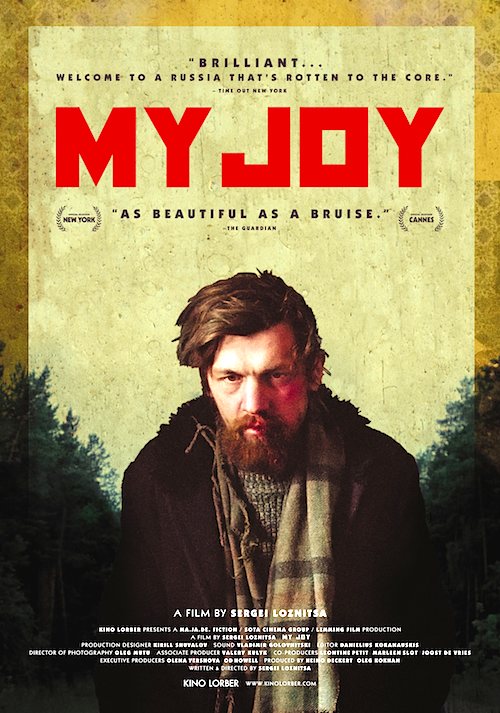
By Joe Bendel. Like any place, Russia has its share of urban legends, but Russia’s seem to carry the oppressive weight of the country’s tragic history. At least, such seems to be the case with the stories that inspired documentarian Sergei Loznitsa’s narrative feature debut, My Joy (trailer here), which opened yesterday in New York.

Having spent considerable time on the road, truck driver Georgy is no babe in the woods. He is hardly shocked by the venal cops who hassle him or the teenaged (if that) prostitute hustling business when a major accident closes the highway. Still, he tries to help her, but like contemporary Russia, she will have none of it. However, his trip goes seriously awry when he tries to take a detour around the backed-up traffic.

Though not overtly supernatural, the fateful back road takes the driver into a very malevolent place, somewhat in the spirit of Conrad’s Heart of Darkness. Like a horror film written by Beckett, Georgy is sucked into an absurdist village, where predatory behavior is the norm. Time becomes indeterminate in this twilight world, with the tragic past echoing strongly in the corrupt present day.

This is particularly true of an old hitchhiker’s story, easily the film’s strongest mini-arc. According to the mysterious stranger, he had been a heroic Lieutenant during WWII, but when a crooked local Commander robbed and humiliated him, his response permanently relegated the man to the nameless margins of Russian society. One of many discursive interludes, the Lieutenant’s flashback is rather bold because it directly challenges the great patriotic mythos built around the Soviet war years, as do the mutterings of a quite possibly mad veteran, apparently boasting of a Katyn Forest style massacre, heard later in the film.

Loznitsa presents a vision of a country sick in psyche, where those who have served it best are victimized the worst. He does not exactly tell this story in a straight line, bouncing off characters and subplots like a pinball. Frankly, Joy can be a little tricky to follow, but the heavy parts are hard to miss. Continue reading Absurdist Visions of Russia: LFM Reviews My Joy

Libertas @ The 2011 New York Film Festival: Carnage

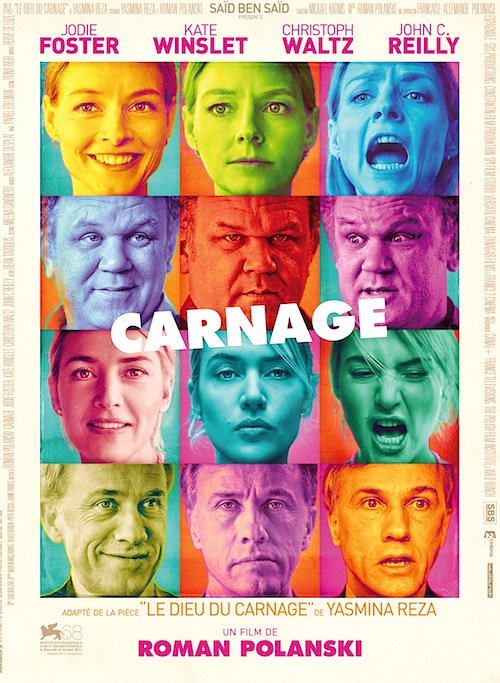
By Joe Bendel. For obvious reasons, Roman Polanski did not appear at the festival press conference, nor will he be participating in post-screening Q&As. However, Carnage (trailer here), the 49th New York Film Festival’s opening night film, was still one of the most eagerly anticipated selections for New York cineastes, who have been packing to capacity the recently concluded Polanski retrospective at the MoMA. A nearly instant sell-out at the NYFF, the film otherwise has its scheduled theatrical opening on December 16th via Sony Pictures Classics.

Penelope and Michael Longstreet are liberals, or at least she is. Alan and Nancy Cowan are conservative, or at least he is. There is no question who wears the pants in each family, but that does not mean Michael and Nancy do not resent their subordinate positions. They have gathered in the Longstreets’ remarkably spacious and stylish Manhattan apartment to address a violent quarrel between their young sons. The Cowan boy (or thug as his father calls him) picked up a handy stick and knocked Master Longstreet alongside the head.

Both sets of parents want to resolve the incident, but clearly differ in their approaches. The Longstreets, meaning Penelope, want to bring the kids together for a healing moment, whereas the Cowans (both of them really) are more down-to-business and practical. At first, everyone wants to show how civilized and rational they can be, but the longer the Cowans reluctantly tarry in that apartment, the more nerves are frayed and simmering hostilities are bluntly expressed.

Cleaving first along family lines and then turning on each other, Carnage spares nobody. Yet arguably the PC hypocrisy of the Longstreets takes it harder on the chin than Alan Cowan’s self-aware social Darwinism. Indeed, the whole premise of the film largely validates his world view.

Adapting Yasmina Reza’s hit Broadway play God of Carnage for the screen, Polanski embraces the staginess of the one-set four character verbal battle royale. Indeed, it is easy to see why it was such a successful star vehicle on stage. All four cast members get a chance to behave badly in the spotlight and chew on some scathing dialogue. Once again, Christopher Waltz does Oscar caliber work as Cowan, making condescending arrogance enormously entertaining. Since John C. Reilly still does not have his own little gold statue, though, he might be the focus of the film’s Academy campaign, even though it is the least showy performance. As for their better halves, Jodie Foster loses her cool outrageously as Penelope-not-Pen, while Kate Winslet is a bit more grounded, slowly breaking through Nancy Cowan’s icy reserve, eventually reaching a virtuoso state of manic aggravation.

In many ways, Polanski is undeniably an appalling human being. In a more just world, he would be sharing a cell with O.J. Simpson in California’s scuzziest prison. Those who want nothing to do with his films have every right to their contempt. However, they will miss a really darn funny film in Carnage. Though smaller in scope and talkier than most of his films, it is pointedly witty, performed with considerable flair by its all-star cast. There were four sold-out screenings last night, divided between the Walter Reade and Alice Tully Hall.

Posted on October 1st, 2011 at 11:35am.