Opening Night @ The San Francisco Film Society’s 2011 Taiwan Film Days: Formosa Mambo

Chen Yi-wen in "Formosa Mambo."

By Joe Bendel. Toro’s business is one of the few not feeling the pinch of the financial crisis. He runs a boiler room for telephone and internet fraud. He does it well. It is a much different story for the amateur kidnappers he targets in Wang Chi-tsai’s zeitgeisty dramedy Formosa Mambo (trailer here), the opening night film of the San Francisco Film Society’s 2011 Taiwan Film Days.

A well educated loser, A-kang was amongst the first wave of layoffs at his former company. A terrible interviewee, he cannot even make of go of it as a street vendor, much to his wife’s frustration. However, he gets something of a dubious break when his childhood friend Toro, a.k.a. “Mosquito,” stops at his food cart. He needs a new employee for his scam operations, and has a big deal brewing. He is scheming to intercept the ransom payment demanded by a trio of unemployed migrant workers, who have kidnapped the son of Huang Shu-li, a friend of A-kang’s wife.

Initially, Mambo appears to be one of those slice-of-urban-life films with braided storylines and characters who keep crossing paths but never significantly interacting. Refreshingly though, Wang and co-writer Cai Deng-ciao draw their motley crew together rather quickly and tightly. In fact, after the first act set-up, they no longer rely on coincidence, but karma is definitely knocking on the door.
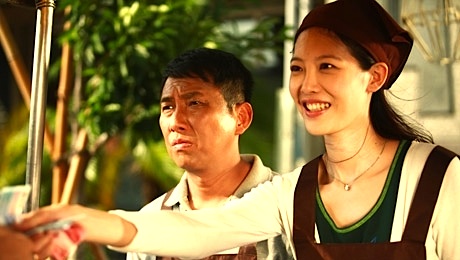
From "Formosa Mambo."

Mambo is a surprisingly slippery film to get a handle on. At times, it seems to be going for a breezy cynicism, while borrowing elements from disparate films, like Jimmy the Kid and High and Low. Never abandoning the black comedy, it eventually takes a detour through class-conscious naturalism on its way to an ironic punchline. Yet, the way Wang keeps viewers off balance while maintaining the brisk pace is strangely effective.

Chen Yi-wen (a well established filmmaker, not to be confused with the lovely Miss Chinese Taipei), is masterfully roguish as Toro, appropriately delighting in skullduggery, even as he hints at the stirring remnants of a conscience. By contrast, as A-kang, Chu Chung-heng’s guilt-ridden angst routine gets a bit old after a while. Still, he has some nice quiet moments with Jin Siao-man’s Sha-sha, the gang’s staff seductress and computer hacker.

In a way, Mambo is a morality play that forgets to end with a neat and tidy morale. Frankly, it breaks a lot of rules of canned screenwriting, but that is a good thing. Quite clever in an admittedly idiosyncratic way, Mambo is definitely an interesting choice to kick-off this year’s Taiwan Film Days, which has quickly become the top showcase for contemporary Chinese cinema in America (including New York). It screens twice this Friday (10/14) at the New Peoples Cinema, the new home for SFFS programming.

Posted on October 11th, 2011 at 11:34am.
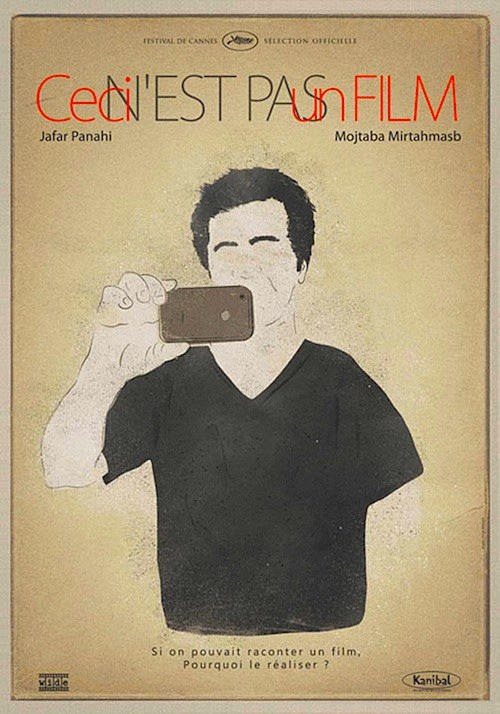
Libertas @ The 2011 New York Film Festival: Jafar Panahi’s This is Not a Film

By Joe Bendel. Jafar Panahi will not be appearing at the 49th New York Film Festival. He was never expected. However, it was hoped Mojtaba Mirtahmasb would be able to promote his recent collaboration with Panahi on the international festival circuit. Ominously though, Mirtahmasb’s passport was confiscated just as he was leaving to attend Toronto and he was subsequently arrested, along with five other Iranian filmmakers. At least Mirtahmasb will have a good idea of what to expect. With Panahi, he co-directed This is Not a Film (trailer here), a documentary record of a day in life of the award winning filmmaker chafing under house arrest and a prospective twenty year ban on movie-making, which screens at this year’s NYFF.

For those unfamiliar with his story, Panahi and fellow filmmaker Mohammad Rasoulof were sentenced to six years in Iranian prison (a.k.a. Hell on Earth) and prohibited from practicing their art for two decades. With his appeal pending, Panahi is confined to his relatively upscale but not all that spacious Tehran flat on the eve of Persian New Year. Since he cannot make a film, he makes This is Not a Film, with the furtive assistance of Mirtahmasb, a digital video camera, and the odd handheld device.

Considering we are simply watching a man putter about his apartment (with Igi, the scene stealing pet iguana), Not a Film is surprisingly engaging. Even under extreme stress, Panahi is clearly a man of considerable wit and charm. We watch as he blocks out a film that might never be produced and listen as he cryptically discusses projects with Mirtahmasb in an effort to shield him from presumed eavesdroppers. These are the small, grimly fascinating day-to-day realities of artistic repression in Iran. Just in case any of the significance is lost on viewers, the blank closing credits ought to bring it all home.

Not a Film is a quiet film that resolutely avoids anything that might be deemed provocation. Frankly, the circumstances that gave rise to the not-film should never have happened. Yet, since it is here, in its way Not a Film is an inspiring example of the creative impulse as it flows like water through the cracks of an oppressive state. Indeed, it is already renowned as the film that was smuggled out of Iran in a cake.

To give credit where it is due, the international film festival network has done good work keeping attention focused on Panahi’s plight. The 2010 Cannes Film Festival pointedly reserved an empty chair for the filmmaker when he was not allowed to attend, even though he was chosen to serve on the jury. Earlier this year in New York, the Asia Society hosted a Panahi retrospective to further publicize his case. However, it is important to remember Rasoulof and now Mirtahmasb as well, who are also prisoners of artistic conscience, but might not have the same name recognition on the world stage. Highly recommended, Not a Film screens this Thursday (10/13) at Alice Tully Hall, as a Main Slate selection of the 2011 New York Film Festival.

Posted on October 10th, 2011 at 6:58pm.

Libertas @ The 2011 New York Film Festival: Pedro Almodóvar’s The Skin I Live In

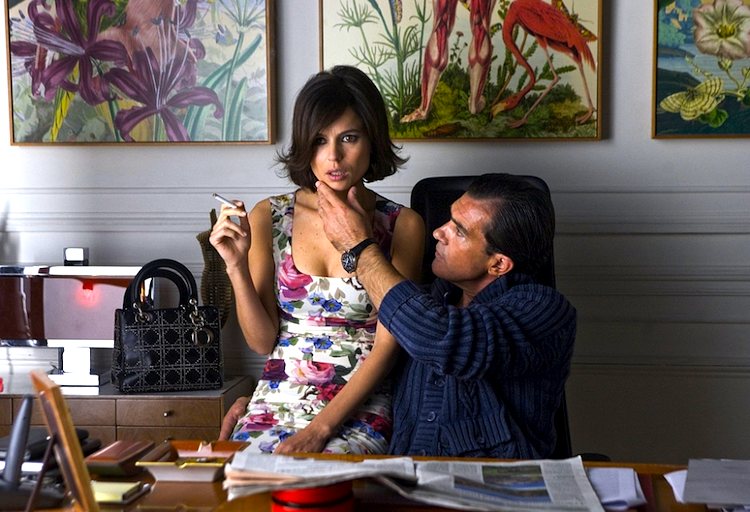
Elena Anaya & Antonio Banderas in "The Skin I Live In."

By Joe Bendel. Call it facial determinism. In Hiroshi Teshigahara’s Face of Another, a new “life-mask” countenance fundamentally alters the personality of a scarred businessman. With his latest film, Pedro Almodóvar addresses similar themes of appearance and identity, but dramatically raises the stakes for his experimental subject in The Skin I Live In (trailer here), which opens this Friday in New York, following Wednesday’s gala screening at the 49th New York Film Festival.

Dr. Robert Ledgard gave his mysterious “patient” Vera the face of his late wife, who was severely burned and disfigured in a fateful car crash. As a result, Marilia, his motherly housekeeper, worries the plastic surgeon is developing an unhealthy emotional attachment to his unwilling test-case. As flashbacks explain the chain of events that brought Vera to his isolated villa, we learn just how twisted their potential relationship would be.

Elena Anaya as Vera.

Though billed as Almodóvar’s horror movie, Skin really constitutes a continuation of his noir-esque period begun with his previous film, the underappreciated Broken Embraces. Indeed, it is structured around a big twist, which makes it challenging to discuss its themes and motifs without getting spoilery. Frankly, just a few details are probably sufficient to give the game away. However, it is probably safe to say Ledgard nurses some serious grievances, while initial appearances are deliberately deceptive.

Though also undeniably restrained compared to the films that made Almodóvar’s reputation, Broken Embraces had a slow-burning undercurrent of dark passion. By contrast, Skin is a decidedly chilly film. Overtly voyeuristic, Almodóvar avoids delving beneath the surface of his characters, consciously concentrating his focus on the surface level instead. Still, he adeptly uses the Hitchcockian cinematic vocabulary as well as the claustrophobic setting to create a fairly creepy genre film.

Although he never truly unleashes his inner mad doctor, Antonio Banderas is certainly a severe presence as Dr. Ledgard. However, Elena Anaya is quite remarkable as the suicidal Vera, convincingly handling her character revelations, which are considerable. A tricky role to approach, she fully commits to it, providing the film’s only emotional center.

Skin is an intriguing film, but were it not for the vulnerability and immediacy of Anaya’s work, we would simply feel as though we were being played, rather than pulled inexorably into a dark morality drama. While the implications of Almodóvar’s screenplay (adapted from Thierry Jonquet’s novel Mygale), will stay with viewers, his execution will most likely leave them cold. A mixed bag, Skin is largely distinguished by Anaya’s performance. For Almodóvar fans, it screens twice this Wednesday (10/12) as a gala selection of the 2011 NYFF. Though only standby tickets are still available, it also opens theatrically this Friday (10/14) in New York at the Landmark Sunshine.

Posted on October 10th, 2011 at 6:57pm.

Libertas @ The 2011 New York Film Festival: Sodankylä Forever

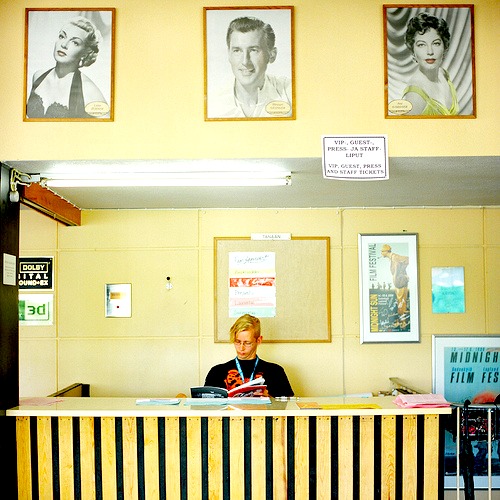
Ticket booth at The Sodankylä Film Festival.

By Joe Bendel. A film festival must be pretty secure in itself to program a four and a half hour documentary tribute to another festival. Such is the case with the 49th New York Film Festival. Though not exactly an international launching pad, like Toronto or Cannes, the Midnight Sun Film Festival in Sodankylä, Finland has drawn some of the most admired names in the history of cinema. Festival director Peter von Bagh interviewed many of them on-stage, eventually editing some of their most provocative recollections and insights into the four part documentary, Sodankylä Forever, which has a special two-night screening at this year’s NYFF.

Held in June when the Midsummer sun never sets, the festival might be patrons only opportunity for a brief respite of darkness. However, each day’s line-up begins with an in-depth discussion with a prominent filmmaker. In a way, von Bagh’s Sodankylä is particularly timely and appropriate for this year’s NYFF, because it includes several excerpts of interviews with Iranian filmmaker Jafar Panahi, who obviously will not have the opportunity to participate in Q&A sessions after the screening of his latest film, This Is Not a Film.

Indeed, many world class auteurs sat down with von Bagh, including Wim Wenders and Roger Corman, who are also represented at NYFF, as filmmaker and subject, respectively. Yet, for pure movie fans, the highlight of Sodankylä will be hearing Empire Strikes Back director Irvin Kershner discus his initial reaction to a sneak peak at Star Wars (or A New Hope as we are now supposed to call it).

Arguably though, the best material comes from filmmakers who labored under the yoke of Communism. Most notably, Krzysztof Zanussi pointedly criticizes the festival’s special screening of Eisenstein’s Battleship Potemkin, explaining how the ideology it sought to promote caused such profound pain for his country. By the same token, von Bagh deserves credit for putting his comments into the film.

Although an entire segment is essentially devoted to picking desert island films, most of Sodankylä proceeds in a rather idiosyncratic fashion. Von Bagh frequently uses something an interview subject said (or almost nearly said) as a transitional hook into the next auteur, like a game of free association featuring the likes of Sam Fuller, Miloš Forman, Abbas Kiarostami, Claude Chabrol, Jacques Demy, Andrei Konchalovsky, Jerzy Skolimoski (who probably has the best one-liner), and John Boorman (who probably offers the funniest anecdotes).

It is important audiences understand Sodankylä is not That’s Entertainment. Throughout the film, the only film clips von Bagh shows are part of wider audience shots.  However, (aside from some rather superficial axe-grinding from John Sayles) the collected reminiscences and commentary are all quite perceptive and engaging. One of the more ambitious screening events at the 49th New York Film Festival, Sodankylä is respectfully recommended for earnest students of cinema. It screens in two installments this coming Tuesday (10/11) and Wednesday (10/12) at the Francesca Beale Theater.

Posted on October 7th, 2011 at 12:40m.

Libertas @ The 2011 New York Film Festival: A Dangerous Method

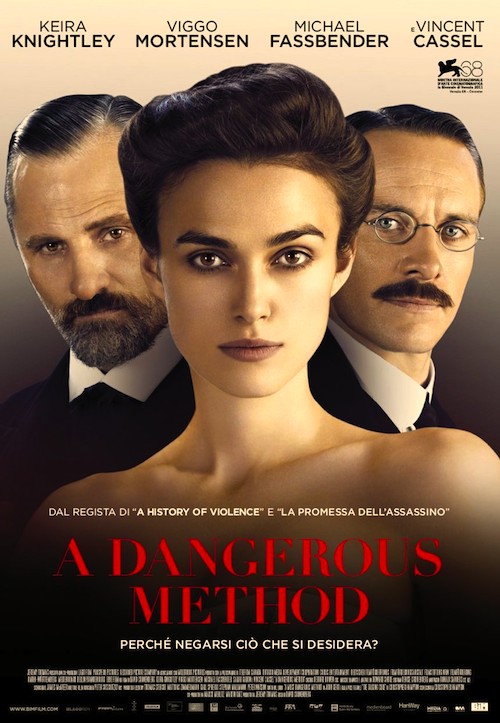
By Joe Bendel. Jungians consider Freud to be unnaturally sex-obsessed. Conversely, Freudians argue Jung debased the science with his superstitious mumbo-jumbo. Probably they are both more right than wrong. The birth of this great and enduring rivalry is dramatized in David Cronenberg’s A Dangerous Method (a trailer here), which screens tonight as a gala selection of the 49th New York Film Festival.

Carl Jung married well and lives an upright life. A leading practitioner in a controversial new field of study, he is eager to apply the methods of psychoanalysis advocated by Sigmund Freud. Sabina Spielrein represents the perfect opportunity. Though possessing a rather sharp intellect, she is so profoundly disturbed she cannot function in society. Yet, when Jung gets her talking, the roots of her mental torment become clear. While the word “cured” might be too strong a term, she is able to study medicine, with the intent of becoming of psychiatrist herself. Everything might have ended happily at this point, were it not for the libido’s self-destructive drive.

After giving into temptation once or a couple dozen times, the guilt wracked Jung breaks things off with his sort-of former patient rather precipitously. This drives the newly agitated Spielrein to seek the treatment of Jung’s new mentor, Dr. Sigmund Freud. As a result, Freud becomes somewhat disappointed in his younger colleague, while Spielrein increasingly aligns herself with the Freudian in her academic writings. Not surprisingly, this exacerbates the philosophical division between Freud and Jung.

Though clearly not nearly as renowned as her male colleagues, Spielrein arguably led the more cinematic life. A Russian Jew who tragically returned to her Soviet era homeland, much of Spielrein’s family perished during Stalin’s reign of terror, while she was eventually killed by the National Socialists. Not just a beautiful woman, her scholarship is thought to have possibly influenced both Jung and Freud. (Jung also spanks her quite a bit in Method, if that happens to be your thing.)

Kiera Knightley really goes for broke as Spielrein, laying on the accent a tad thick, but bringing a remarkable physicality to the role. She makes neurotic twitchiness rather hot. Despite having the screen time of a supporting player instead of a lead, Viggo Mortensen is convincingly smart and compulsively watchable as Freud, avoiding all the shticky goatee-stroking clichés associated with the iconic figure. Whereas the always tightly-wound Michael Fassbender is appropriately intense depicting Jung’s deeply rooted tension-and-release behavioral patterns.

Adapted by Christopher Hampton from his stage play, which in turn was adapted from John Kerr’s book, Method’s greatest problem is its flattening narrative arc. Had it followed Spielrein through her demise in WWII it would have ended on a more significant, if tragic note. As it stands though, Method just appears to run out of story.

Throughout Method, Cronenberg adroitly handles both the rigorous intellectual debates and the provocative sexuality, largely rendering the latter with wise restraint. Probably more highbrow than old school Cronenberg fans might expect, he and Hampton clearly seem to want to present this critical period in the development of psychological study for its own sake rather than as a vehicle for lurid melodrama. It just lacks that epiphany moment. Frequently fascinating nonetheless, the overall solid Method screens twice tonight (10/5) at Alice Tully Hall as part of the 2011 New York Film Festival.

Posted on October 5th, 2011 at 12:o4pm.

Libertas @ The NYFF: Martin Scorsese’s George Harrison Living in the Material World; Film Debuts on HBO Oct. 5th & 6th

By Joe Bendel. He was frequently dubbed “the Quiet Beatle,” but George Harrison could also be called the cineaste Beatle. One of his first solo projects was the original soundtrack for Joe Massot’s psychedelic Wonderwall, completed while the Fab Four were still together. After the band broke up, he eventually founded Handmade Films, providing a jolt of capitol for independent British filmmakers. Harrison himself gets a full 208 minutes of screen-time in Martin Scorsese’s definitive documentary, George Harrison: Living in the Material World, which screens this Tuesday at the 49th New York Film Festival, just ahead of its HBO premiere.

Yes, George Harrison was a lad from Liverpool. The youngest Beatle, he was initially recruited because he could actually play. The general gist of the Beatles story will be generally familiar to just about everybody: initially, Lennon and McCartney were front-and-center, carrying the songwriting load, but slowly Harrison asserted himself, introducing the sitars and tablas into their later, trippier recordings. Since Yoko Ono consented to an on-camera interview, their eventual break-up is presented solely in terms of the stress of working so closely together for such a long time. Still, it is hard not to get sucked into Scorsese’s Harrison-centric retelling of the Beatles mythos.

However, it is something of a surprise how eventful Harrison’s post-Beatle years were, despite his often deliberately low profile (essentially constituting the second half of Material). Of course, his spiritual quest continued, which is a major focus for his widow, co-producer Olivia Harrison. Those who saw the IFC Channel’s behind-the-scenes history of Monty Python will already be well aware of Harrison’s close personal relationship to the comedy troupe, but who knew he was a Formula One Racing fan? In fact, one of the most touching interview segments features his friend Jackie Stewart, the “Flying Scotsman.”

If Ono gets a pass, at least Eric Clapton is forthright enough to address on-camera the whole business of how he romanced Harrison’s first wife while they were still married, albeit rather gingerly. Yet, for personal drama, the events surrounding the violent home invasion Harrison survived late in life effectively serves as a rather stark climax.

Harrison’s friends and family make a compelling case he just might have been the most interesting Beatle. Scorsese calls in some major star power, including both surviving Beatles as well as fellow Traveling Wilbury Tom Petty. It is also a pleasure to see Jane Birkin (from Wonderwall) on-screen in any context, but it is just plain creepy when his one-time producer Phil Spector shows up.

Material is a very good rock doc, but the nearly three and a half hour running time is pushing the limit. According to IMDB, it is almost half an hour longer than Ken Burns’ Thomas Jefferson—and Jefferson was the first to do just about everything. Nonetheless, it is consistently more engaging than the Lennon documentary that screened at last year’s NYFF. As a further point in Material’s favor, Scorsese, Olivia Harrison, and their collaborators almost entirely avoid politics, focusing squarely on the musical, spiritual, and personal aspects of his life, essentially in that order of concentration. Informative and entertaining, Material screens this Tuesday (10/4) at Alice Tully Hall as a Main Slate selection of the 2011 New York Film Festival and airs on HBO in two parts this Wednesday and Thursday (10/5 & 10/6).

Posted on October 4th, 2011 at 2:00pm.