Cold War Double-Feature: 3 Seasons in Hell, At the Edge of Russia

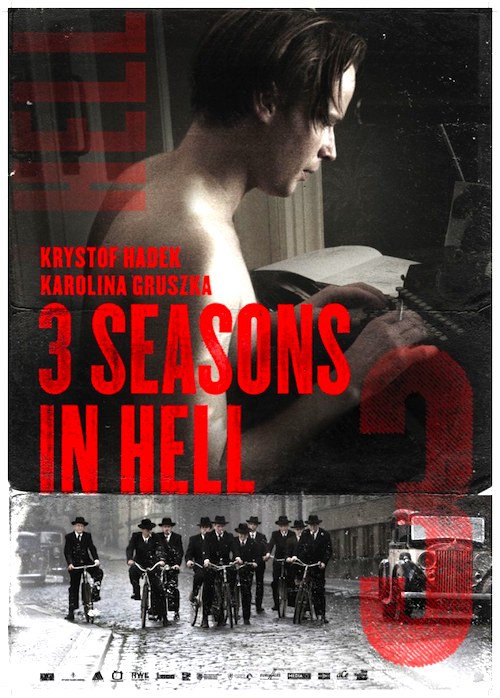
By Joe Bendel. Ivan Heinz is the anti-Zhivago, a terrible poet who naively welcomes the Communist takeover of post-war Czechoslovakia. He soon learns the harsh truth about the Marxist regime. His poetry also dramatically improves over the course of three tumultuous years in Tomás Masín’s 3 Seasons in Hell (trailer here), which screens tonight in D.C. as part of the Avalon Theatre’s Lions of Czech Cinema film series.

Young Heinz has imbibed way too much dada. He harbors idealistic notions of the artist as an absurdist troublemaker that wins him few friends. His avowed Communism also strains his relationship with his painfully middle class father. Heinz is determined to suffer for his art, like his hero Rimbaud. Unfortunately, he will get his chance following the Communist coup.

At first, Heinz is surprised the masses are not celebrating the dawn of socialism on the streets of Prague. Of course, he is even more shocked to learn that the new regime has little use for a parasitic poet of bourgeoisie lineage with a record of anti-social behavior. His notoriously hedonistic lover Jana has scarcely any better standing. Eventually they come to the realization that this worker’s paradise is no place for their unborn child to live. Naturally though, his plans for emigration involve a dangerously dodgy criminal scheme.

Loosely based on the memoirs of Czech writer Egon Bondy, 3 Seasons hardly idealizes Heinz. Frankly, he is rather a petulant pill much of the time, but that never excuses any of the degradations he suffers and witnesses. Likewise, Jana would be quite a problematic figure as well, but together they seem the perfect pair, who deserve (and want) each other. Yet, should viewers ever doubt the film’s sympathies, the exquisite dignity and integrity of Heinz, Sr. serves a pointed corrective to the cruel madness unfolding around him. Continue reading Cold War Double-Feature: 3 Seasons in Hell, At the Edge of Russia
LFM Review: The Whistleblower

The Whistleblower, which stars Rachel Weisz, Vanessa Redgrave, David Strathairn and Monica Bellucci and deals with UN corruption in Bosnia, opens in select theaters today. We wanted Libertas readers to know that our own Patricia Ducey reviewed the film during the Newport Beach Film Festival back in May, so be sure to check her review out!

Posted on August 5th, 2011 at 10:09am.

DIY Run Amok: LFM Reviews Bellflower

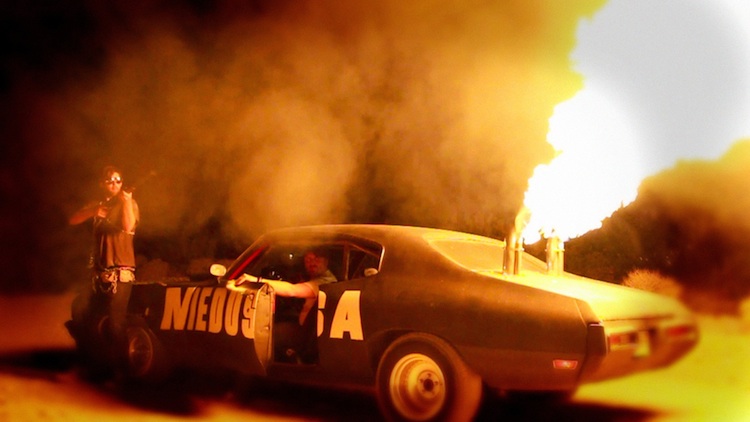
Firing up Medusa in "Bellflower."

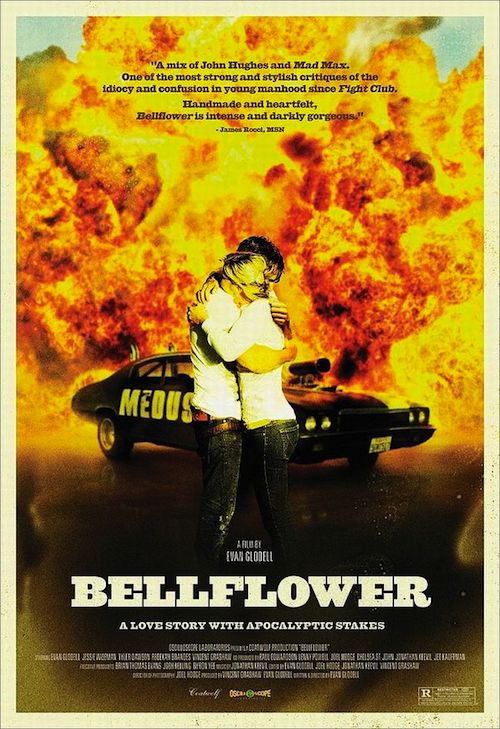
By Joe Bendel. It’s either the apocalypse or an average day on the outskirts of Los Angeles. Who’s to say which? Whatever the case might be, there is a palpable sense of menace in the air, but at least nobody has to hold down a regular job in Evan Glodell’s extreme DIY indie production Bellflower (trailer here), which opens this Friday in New York and elsewhere.

Woodrow and Aiden moved to LA more or less out of aimlessness. They drink a lot and speculate about the fall of civilization, which happened in LA around 1978. As part of their fantasy wish-fulfillment, they begin building a flame-thrower and pimping-out Medusa, a Mad Max style set of wheels. To put it more accurately, Aiden constructs all their hardcore hardware. Woodrow, by contrast, does not seem to be especially handy – but to be fair, he is a bit distracted by his love life.

If you consider a bug-eating contest at a downscale Coyote Ugly an endearing ice-breaker, then Woodrow and Milly do indeed meet cute.  She pretty much tells him straight out she is a problem chick, but he falls for her anyway. The fact that she is still sharing a crash-pad with her ex is of no never mind, until he inevitably walks in on them. From there things get really heavy, but Aiden has the flame-thrower operational, so they can set fire to stuff, which is always a good release.

Evidently a guerilla production of epic proportions, the behind-the-scenes story of Bellflower is probably more interesting than what made it onto the screen. Reportedly plagued with long involuntary shooting hiatuses, one would have thought Glodell could have used the time to tighten up the script. Frankly, his story is a real shrug-inducer, not in an obscure postmodern sense, but just for the baffling way it strings together scenes.

Yet, for all its deliberate eccentricity, there is something effectively eerie about the atmosphere Glodell crafts on his blue light special budget. While cinematographer Joel Hodge was probably forced to shoot on cast-off film-stock salvaged from dumpsters, Bellflower’s grainy look is appropriately suggestive of its apocalyptic themes, while evoking glorious exploitation movies past. Likewise, there is no denying the inventive design work that went into the creation of Medusa.

Not surprisingly, the performances in Bellflower are rather scattershot. Still, there is an interesting dynamic going on between Glodell and Tyler Dawson, as Woodrow and Aiden, respectively. While there are host of dark undercurrents at play, they still convey a sense of unconditional friendship that is surprisingly redemptive.

The term “rough around the edges” does not say the half of it for Bellflower. Yet, the craziest thing is the sense one gets that Glodell made exactly the film he intended. He definitely has a strange knack for establishing mood, but he probably ought to work from someone else’s scripts in the future. A decidedly mixed bag, but admirable nonetheless for its scrappiness, Bellflower opens this Friday (8/5) in New York at the Angelika Film Center.

Posted on August 4th, 2011 at 3:07pm.

Maya Indie’s Without Men: Fantasies of a Latin American Feminist Utopia?

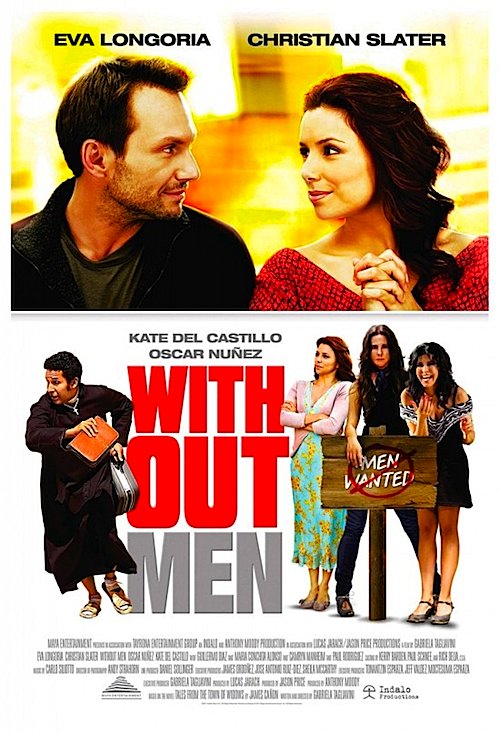
By Joe Bendel. In the sleepy Latin American village of Mariquita, the battle of the sexes is over. Essentially, the women have won by default. A win is still a win though. Indeed, it allows the new mayor to institute some radical changes in Gabriela Tagliavini’s Without Men (trailer here), which screens for a week in New York as part of the traveling Maya Indie Film Series.

One fateful day, a band of Marxist guerillas arrive to liberate Mariquita. This entails shooting the mayor and forcibly impressing the rest of the village’s males into their ranks. Only the horndog priest is left behind in this village of supermodels. Rosalba should be the most distraught, since it was her husband who was executed. However, he was an unfaithful dog of a man, so good riddance. As she was always the brains behind his administration, she wastes no time in assuming office. Unfortunately, the rest of the village is at loose ends.

The first half of Without Men is likely to cause apoplexy among any women vaguely identifying as feminists. Incapable of even changing a light bulb on their own, the women of Mariquita basically sit around pining for some sexual healing. Naturally, to offend the Catholics in the audience, Father Rafael cons them all into believing the Holy Spirit has called him to ensure procreation continues unabated. Yet, once they boot him out of town (for running out of mojo), they start building a feminist utopia. This all sounds like a good story to the gonzo reporter who supplies the film’s framing device.

About ten seconds of internet research will reveal Eva Longoria makes out with another woman in Without Men. In fact, lesbianism becomes a major theme of the film. Even the great Maria Conchita Alonso gets in on the act. Frankly, her presence alone makes one far more predisposed to like the film. A truth-teller who has criticized the oppressive Chavez regime in her native Venezuela and its Hollywood cheerleaders, the film’s anti-Communist prologue must have appealed to her. However, aside from the general helpings of naughtiness (but nothing explicit), Without Men is fairly insubstantial.

Eva Longoria in "Without Men."

In fact, Oscar Nuñez’s shtick as Father Rafael really is pretty offensive. Eva Longoria is game enough as the type-A Rosalba, but Kate del Castillo is rather pedestrian as her butchy new love interest. Frankly, they are both outshined by the dazzling Yvette Yates and Fernanda Romero, who have little to do except look hot, but they do that well. Christian Slater recycles his familiar slickster screen persona as the reporter likably enough, but Camryn Manheim is just embarrassing as his potty-mouthed boss.

Given all the teasing going on, the net result is certainly watchable. Tagliavini keeps everything bright and colorful, always showing her cast at the most flattering light. Ideologically, it is something of a mish-mash, which in itself is not necessarily a bad thing. There just is not much to it though, aside from Longoria’s scenes of you-know-what. One of the weaker installments of the Maya Indie Series, Without Men screens at the Quad Cinema in New York, once a day for a week, 7/29 through 8/4.

Posted on August 1st, 2011 at 3:15pm.

LFM Review: Cowboys & Aliens

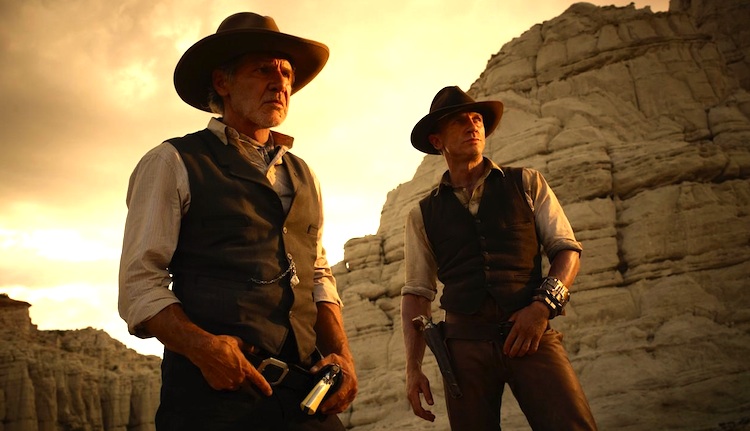
By Jason Apuzzo. Cowboys & Aliens is one of those movies that probably looked great on paper – like a development executive’s dream. Take a popular graphic novel that combines two of America’s most durable genres (the Western and sci-fi), cast Indiana Jones and the current James Bond, add the Iron Man director and current It-girl from Tron, plus Steven Spielberg and Ron Howard as producers – and you’ve got a sure-fire hit, right?

Right?

Alas, we all know that movies don’t work exactly that way. There’s actually something rather mysterious about what makes one film work – and a different film made by the same people, even on the same subject, fall flat. It’s a matter of what we usually call ‘chemistry’ or ‘inspiration.’

Cowboys & Aliens is not a bad film. It’s entertaining at times and works reasonably well as light summer entertainment – but it’s the cinematic equivalent of the ‘superteam’ Miami Heat, or the Lakers back when they had a roster that included Kobe, Shaq, Karl Malone and Gary Payton … and lost the title. It’s a film that doesn’t know what it wants to be, so it ends up being almost nothing. Unsatisfying as a Western, and clichéd as sci-fi – insufficient as a star vehicle, and thin as an action film – Cowboys & Aliens is a genre mash-up that never really settles on being any one thing, and left me bored and disinterested as a result.

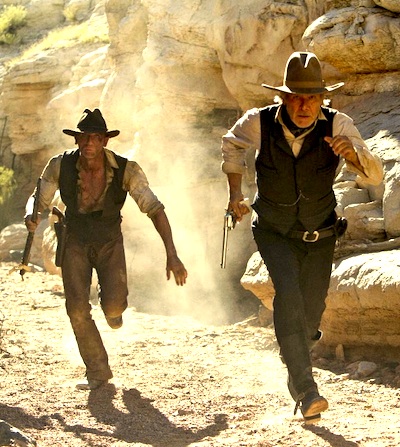
Reluctant allies, covered in dust.

Although Cowboys boasts two big leads, it’s mostly carried by Daniel Craig as Jake Lonergan – a man who, as the film opens, awakens in the desert in Jason Bourne-like fashion, having lost his memory but not his ability to kick peoples’ teeth in. Although he fights like a UFC mixed martial artist and shoots like Wyatt Earp, Jake can’t remember who he is, or why he has a strangely cauterized wound on his side, or why a bizarre slab of metal is wrapped around his wrist – like some sort of Stone Age Casio watch.

This is where the film makes its first mistake, in the casting of Daniel Craig. It’s time we acknowledge what has become obvious: which is that Craig, for what limited ability he’s shown in playing James Bond – limited, that is, to fight scenes – has neither the charisma, nor the warmth, nor the subtlety of person to really make a compelling, big-time movie star. It’s simply not there. Daniel Craig looks and acts like a rugby player, or maybe a bouncer – the sort of person who isn’t called upon on a regular basis to show vulnerability, or a sense of humor. (Qualities, incidentally, that his co-star Harrison Ford has specialized in over the past 35 years.) Think back to what Bruce Willis or Mel Gibson were like in their prime  – and you’ll realize how dull Craig’s performances are these days. He’s Cowboys’ first and biggest problem.

Eventually Craig heads into the town of ‘Absolution’ (which is probably the sister city of ‘Obvious Metaphor’), one of those typical Western-movie towns in which everyone speaks in parables, and nobody seems to have bathed during the past year. (Was the West really like that? I doubt it.) After a series of brief fistfights and shoot-outs, none of which are especially electrifying, we learn that the town is basically run by cattle baron and former Confederate Army Colonel Woodrow Dolarhyde (get it? he sells cattle!), played by Harrison Ford at his most grizzled. Ford seems to be channelling John Wayne’s character Thom Dunson from Red River here, as in vengeful fits he rides roughshod over the local sheriff, his men, and most particularly his worthless son. And of everyone involved in this film – and that includes the director, and the film’s eight writers – Ford is the only one who seems at home in this material, like he’s been itching to cut loose in a Western for decades. He’s ornery and authoritative, but always with a cracked smile and a twinkle in his eye. He’s trail boss, father figure and old coot all in one – and he’s good. You’ll be wishing this wasn’t his first Western since the bizarre The Frisco Kid (with Gene Wilder?!) back in 1979. Continue reading LFM Review: Cowboys & Aliens

Invasion Brixton: LFM Reviews Attack the Block

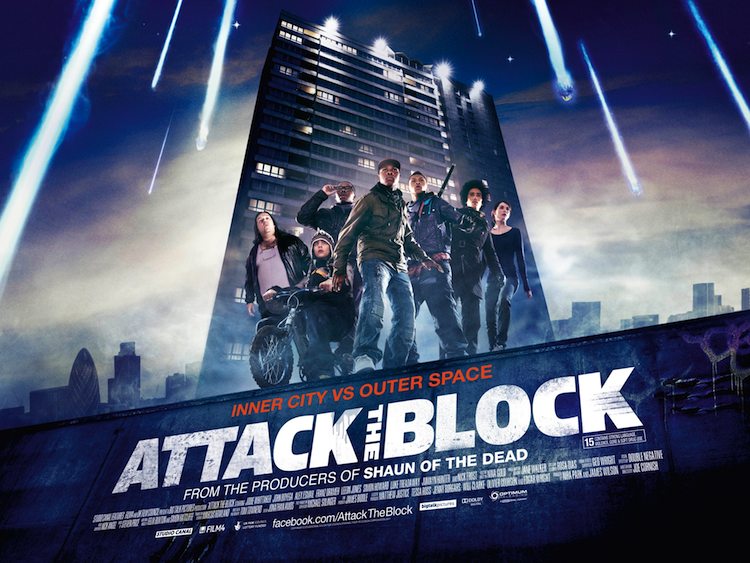
By Joe Bendel. These kids from South London do not have much of a sense of wonder. That’s okay, though, because the aliens they stumble across are not exactly cuddly E.T.’s. A juvie street gang and a marauding pack of aliens take it to each other real good in writer-director John Cornish’s sci-fi invasion mash-up Attack the Block (trailer here), which opens this Friday in New York.

Council estates (a.k.a. the projects) are not a fun place to live. Just ask Sam. The over-worked, under-paid nurse is mugged by Moses and his cronies on her way home from work. Much to everyone’s surprise, a crash-landed alien distracts the delinquents, allowing her to give them the slip. After a few tussles with the critter, Moses draws first blood, but there are plenty more on the way from who knows where. Before long, the kids will need the services of a nurse, even if she did finger them to the coppers. It is a reluctant alliance, but screaming balls of alien teeth are a strong motivation.

Some parts of London aren't easy to invade.

As a mere fifteen year-old, Moses is the oldest amongst his mates. Though poised to become a junior drug dealer for High Hatz, the estate’s top dog, he still has limited access to weaponry. Fortunately, they have well developed survival instincts and killer attitude.  Some might see all this as an allegory for the inner city’s ever-repeating cycle of violence, but it is definitely game-on regardless.

Cornish has a great ear for dialogue (when Yankee audiences can discern it), keeping the super cool banter flying fast and furious. Frankly, Block has the sort of the knowing genre edge overly broad spoofs like Black Dynamite sorely lack. Yet the film works rather well as an invading horde movie in its own right, capitalizing on the specifics of the council estate environment, like the notoriously slow elevators and winding hallways, for some cleverly staged thrills.

Sam the nurse is also a refreshing surprise, showing some backbone rather than merely assuming the role of passive victim. Indeed, Jodie Whittaker clearly plays her smart rather than dumb, which helps keep viewers rooted in the story. The young cast also bounces off her rather well in their scenes together, particularly the intense John Boyega, who is Block’s real find as Moses. He convincingly portrays the young tough growing up and coming to terms with his life choices, which is almost as hard to do in character as it is for real.

Wisely, Block largely eschews explicit politics, trusting those inclined to find class-consciousness in the council estate setting will duly find it. What is on the celluloid is an energetic, consistently inventive space alien smack-down. Definitely recommended as a high-end summer roller coaster, Block opens today (7/29) in New York at the AMC Empire and Regal Union Square 14.

Posted on July 29th, 2011 at 9:20am.