Van Damme vs. Adkins: LFM Reviews Assassination Games

By Joe Bendel. In 2010, former Interpol President Jackie Selebi of South Africa was convicted on corruption charges. Two hired killers will learn there is considerably more illegal skullduggery going on at that international law enforcement agency in Ernie Barbarash’s Assassination Games, which opens this today in regions of the country that can get behind a straight forward action beat-down.

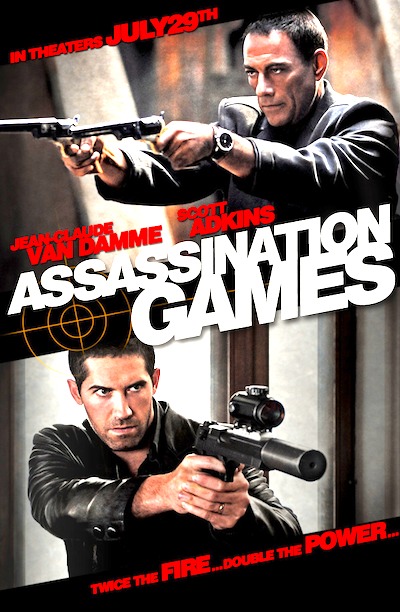
Assassins do not often forge friendly rivalries. Taciturn Vincent Brazil does not have friends, period. However, he finds himself working with the highly motivated Roland Flint to take out Eastern European mobster Polo Yakur. Brazil only wants to fulfill the million dollar contract Interpol secretly put on his head. Flint wants revenge for his wife Anna, who suffered severe brain damage at the hands of Yakur and his thugs.
It is not that simple though. Interpol released Yakur from prison to deliberately flush out Flint, their former contract killer of choice, who now knows too much. The international bureaucrats are even willing to team-up with the Euro Jabba the Hutt to take out their former man Flint. Further complicating matters, Brazil’s aborted first attempt claims the life of Yakur’s brother, leaving the gangster somewhat out of sorts. As a result, there will be a lot of double-crossing and revenge taking in AG.

At one point, Flint and Brazil engage in some absolutely brutal hand-to-hand combat, yet walk away unfazed as reluctant partners. Frankly, it is rather cool to see a film like this again. AG is much like the relatively ambitious action B-movies Van Damme made on his way up (who can resist Bloodsport when it pops up on cable?). In fact, Barbarash and cinematographer Phil Parmet give it a legitimately stylish look, nicely exploiting the faded grandeur of their Bucharest locations.

Playing to his strength, the Belgian Van Damme portrays Brazil with ice cold detachment up until the very end. Conversely, British martial arts star Scott Adkins seethes like a madman as Flint, often looking like he could fry an egg on his forehead. Indeed, it is rather a good pairing. For the hardcore fan, Adkins might have more street cred these days – but regardless, the two action stars certainly know how acquit themselves in a fight scene. (They are both rumored to be in the running for the prospective Expendables 2, as well.) Perhaps AG’s coolest turn though comes from Andrew French as Brazil’s suavely duplicitous business agent, Nalbandian. The film is also something of a family affair for Van Damme, with his daughter Bianca Van Varenberg in the thankless role of comatose Anna Flint and his son Kristopher Van Varenberg trying to kill the old man as one of the crooked Interpol henchmen.

If not revolutionary, AG is a super-slick retro-action blast. However, depicting an intergovernmental agency like Interpol in such villainous terms is somewhat bold. Even the upcoming UN peacekeeping drama The Whistleblower largely cops out, shifting its outrage to a fictional Blackwater-like security contractor in a feat of cinematic jujitsu. Of course, AG is really just about beating the snot out of bad guys, which Adkins and Van Damme do quite well. Recommended for nostalgic action movie viewers and Adkins’ fans, AG opens today (7/29) in Miami, Charlotte, the Mall of America, and cities across Texas.

Posted on July 29th, 2011 at 8:56am.
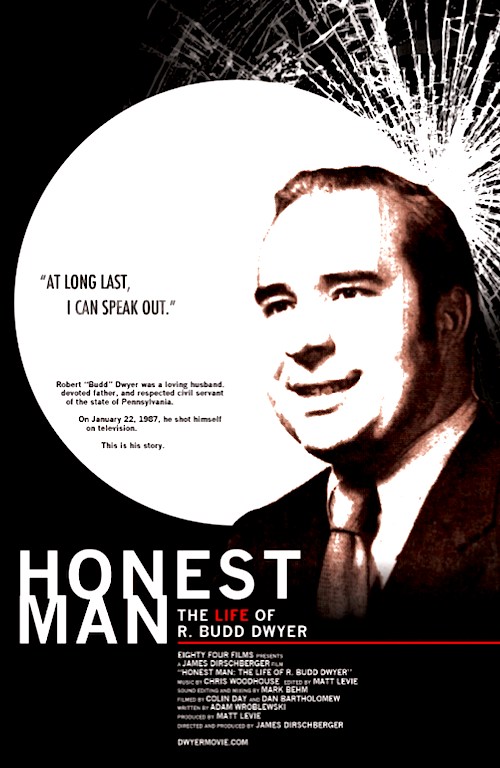
LFM Review: The American Tragedy of An Honest Man

By Joe Bendel. When acquitted by a Bronx jury of a specious political prosecution, former Secretary of Labor Ray Donovan famously asked “which office do I go to get my reputation back?” Former Pennsylvania State Treasurer R. Budd Dwyer understood the sentiment. At least Donovan survived with his life and liberty relatively intact, whereas Dwyer took his own life during a press conference. While the media has always preferred to dwell on those final shocking images, James Dirschberger shines a light on Dwyer’s record of public service and the controversial prosecution that precipitated his suicide in the new documentary, Honest Man: The Life of R. Budd Dwyer (see the trailer), which screens in Los Angeles this Friday.

The media assumed Dwyer’s fateful presser would be their gloat session, where the recently convicted Dwyer would announce his resignation. Instead, they stood by watching as a man shot himself and then ran the video over and over again. Thanks to dubious testimony extracted under a plea bargain agreement, Dwyer had just been convicted of bribery, even though he never received any money from the government witness in question. He had not been sentenced yet, which proved to be the tragically significant impetus for his final act. Once that would occur, his family would lose all his pensions, while stuck with his mounting legal bills.

The refrain frequently heard in Honest Man is if this could happen to Dwyer, it could happen to anyone. There is no question John Torquato intended to bribe Dwyer for a state contract he was already best qualified to win. However, the prosecution conceded no money ever changed hands. Instead, acting U.S. Attorney James West offered the reputedly mobbed-up Torquato and his attorney William Smith a deal if they would establish Dwyer’s intention to accept. Continue reading LFM Review: The American Tragedy of An Honest Man

LFM Reviews Trigun: Badlands Rumble, the Feature Prequel

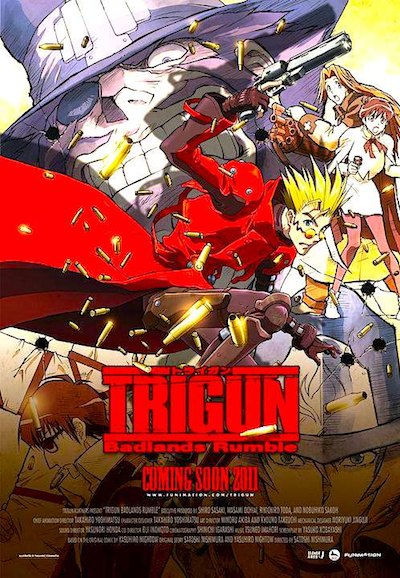
By Joe Bendel. The steely Wolfwood puts Paul Bettany’s Priest to shame. This bodyguard for hire brandishes an impressive cross-shaped weapon, but still maintains his priestly scruples, at least to an extent. While not exactly his origin story, fans of Yasuhiro Naito’s manga and anime series will at least learn how he first hooked up with his future compatriots in Satoshi Nishimura’s feature prequel, Trigun: Badlands Rumble, which has a special two-day theatrical run this Friday and Saturday in New York.

Trigun’s strange desert world (combining elements of steampunk and spaghetti westerns) is a dangerous environment, but insurance is available. Not surprisingly though, the Bernardelli insurance company is in a rather shaky financial position. As a result, adjusters Meryl Stryfe and Milly Thompson mostly work to find ways not to pay claims. They have come to Macca City to assess the safety of the gaudy bronze statue the mayor ensured for five billion dollars.

It is hard to imagine anyone stealing the grandly ostentatious thing, but feared outlaw Gasback has targeted it as part of his vengeance against the mayor, a double-crossing former henchman. Gasback also has the protection of his reluctant bodyguard, Wolfwood, whose services he acquired in a moment of life-and-death desperation. Gasback also seems to have the reckless outlaw Vash the Stampede looking out for him, for perversely pacifistic reasons. However, he will have to contend with the mysterious Amelia, a resourceful young woman who seems to hold a bit of a grudge against Gasback.

Considering all the heavy films landing (sometimes face-first) into art-house theaters recently, Badlands comes as a welcome palate cleanser (at least for some of us). For cinema studies types, one can certainly find a host of symbolism in Wolfwood’s axe—especially in the way he carries it. Also quite notable is the borderline socialist resource-scarcity rhetoric Gasback often uses to justify his crimes—sort of like getting held up by Henry George. Of course, he is the villain. Conversely, Stryfe and Thompson would seem to be craven corporate lackeys, but they are clearly meant to be cute and funny in an anime kind of way.

More than anything though, Badlands is about shooting up the joint and blowing stuff up, all of which is badly needed during a stifling summer heat wave. By anime standards, Trigun’s characters are quite well delineated, with the superbad Wolfwood being particularly cinematic. As a prequel, Badlands is by definition only the beginning of the characters’ stories. However, anime newcomers can at least be assured of getting a complete and self-contained storyline. Heartily recommended for its energy (and the thimble of grist for those so inclined to analyze), Trigun: Badlands Rumble screens this Friday (7/29) and Saturday (7/30) at the Big Cinemas Manhattan in both dubbed and subtitled versions.

Posted on July 26th, 2011 at 7:43am.

Winning Yesterday’s Battles: LFM Mini-Review of Captain America: The First Avenger

By Jason Apuzzo. THE PITCH: Marvel Comics rolls out an old-school take on the Captain America comic book series, bringing the revered character to life by way of depicting his origins fighting Nazis in World War II … all as a set up for next summer’s mega-superhero go-round, The Avengers.

THE SKINNY: Captain America makes for reasonably pleasant, unstressful summer entertainment, but Marvel takes no chances here – literally, none whatsoever – in picking the  hardy Captain’s enemies, so as to guarantee that absolutely nobody gets offended by this film … not even Germans. Although Captain America has been around for some 70 years, fighting everything from Russian communists to terrorists to mad supercomputers, Marvel has him back fighting Nazis again – technically, rogue Nazis (the usual ones weren’t good enough?) – as if America hasn’t had any new enemies since that time. Origin-story purists will be thrilled; everyone else will likely yawn.

WHAT WORKS: • From leads Chris Evans as Steve Rogers/Captain America and Hayley Atwell as Peggy Carter, to veteran stars like Tommy Lee Jones, Hugo Weaving and Stanley Tucci in supporting roles, the cast here creates characters who believably inhabit the World War II milieu – even if their roles rarely rise above cliché.

• The production design and visual FX are sumptuous, presenting a highly romanticized vision of the World War II era – not unlike something out of Raiders of the Lost Ark, The Rocketeer or Sky Captain and the World of Tomorrow.

• Much effort is taken to distinguish Captain America’s regular-guy, shrimpy-kid-from-Brooklyn origins from the usual ‘Chosen One’/supernatural boy-toy so common in comic book fare. This lends the film an unmistakably old-fashioned American vibe.

Nazi-Hydra goons chase Captain America.

Continue reading Winning Yesterday’s Battles: LFM Mini-Review of Captain America: The First Avenger

LFM Review: Another Earth

The indie sci-fi drama Another Earth opens this week in select theaters, and this is just a quick reminder to Libertas readers that our own Joe Bendel reviewed Another Earth earlier this year at Sundance – so be sure to check his review out, along with the film’s trailer. Special thanks again to Joe for his great Sundance coverage.

Posted on July 22nd, 2011 at 4:53pm.

LFM Review: Harry Potter and the Deathly Hallows, Part II & The Western Cultural Tradition

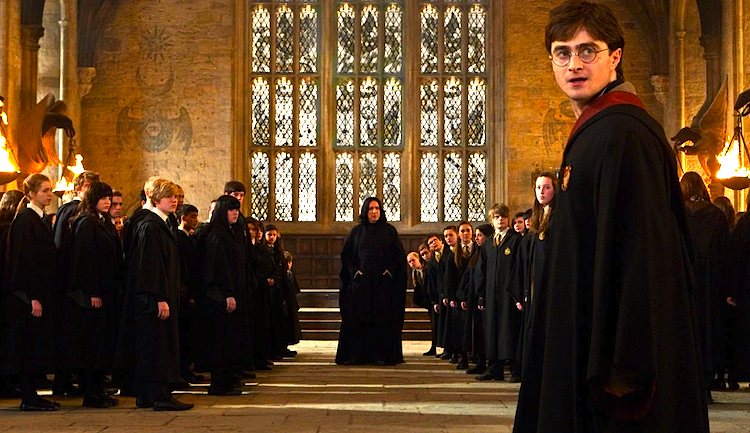
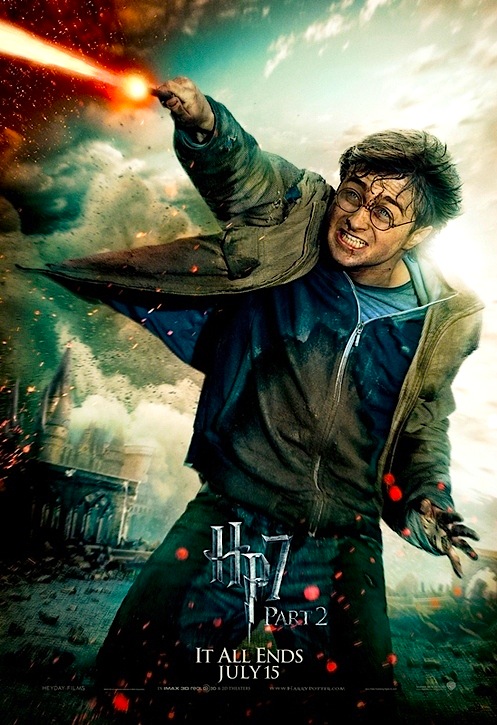
By Govindini Murty. The final film in the Harry Potter series is a pleasant surprise. Directed by David Yates, Harry Potter and the Deathly Hallows Part II offers a satisfying conclusion to the eight-film Harry Potter saga, finally allowing some light into the dark and providing a rousing depiction of the forces of good fighting back against the forces of evil.  Deathly Hallows Part II moves along at a brisk pace, keeping things to a lean 2 hours and five minutes. The film provides a number of well-crafted action and suspense sequences, while not short-changing key emotional moments in which the characters reveal themselves in manners that are both dramatic and affecting.

This is all welcome because the prior installment, Harry Potter and the Deathly Hallows Part I, had been a rather melancholy affair. In Part I, the evil reign of the villainous Lord Voldemort had extended itself over all of England – with the forces of good apparently unable to fight back. Albus Dumbledore, the kindly and wise Headmaster of the Hogwarts School of Witchcraft and Wizardry had been killed by the treacherous Professor Severus Snape. Teen wizard Harry Potter and his best friends Hermione Granger and Ron Weasley had dropped out of Hogwarts in order to hide from Voldermort’s forces while hunting down the “horcruxes” or splintered pieces of Voldemort’s soul that Voldemort had hidden away in order to evade death. Voldemort himself was on his way to possessing the “Deathly Hallows” – a set of three magical objects consisting of the all-powerful elder wand, the cloak of invisibility, and the stone of resurrection – that would make him immortal and invincible. The film’s bleak coloration, air of inescapable doom, and depiction of Voldemort as an all-powerful Hitlerian figure who installs a racist, Nazi-style regime that massacres non-magical human beings (known as “Muggles”), had made  for rather depressing viewing.

Fortunately, in Part II things start to turn around as Harry Potter and his allies finally rally and fight back against Voldemort. A series of long-laid plans start to come to fruition, and we finally see revealed the full details of Harry Potter’s destiny. After a number of sequences that include a dramatic infiltration of a goblin bank, an escape on a white dragon, and the hunting and destruction of more horcruxes, the action culminates in the Battle of Hogwarts. A fantastic array of good witches and wizards, plucky Hogwarts faculty and students, animated stone statues, magical shields, swords, and spells are used to defend Hogwarts against Voldemort’s supernatural army of evil witches, wizards, ghouls, giant ogres, enchanted snakes, and shape-shifters. This could all make for rather busy and frenetic action, but director David Yates has managed to weave all these disparate characters and thematic strands into sequences that are coherent and compelling.

In doing so, this last Harry Potter film illustrates what may be the key achievement of the entire series, which is to create a complex fantasy world that fuses mythological and cultural symbols from a number of traditions, while still maintaining a forward-moving momentum and narrative clarity.

My Libertas co-editor Jason Apuzzo commented recently on the information-dense, “palimpsestic” quality of Michael Bay’s Transformers films, and I have to say that that quality very much characterizes the Harry Potter films, as well. In fact, it may be the defining characteristic of the major fantasy/sci-fi film series of the modern era. This trend most notably began with George Lucas’ mythologically-rich Star Wars films, continued through the Lord of the Rings and Harry Potter films, and is now fanning out into innumerable other fantasy and sci-fi novels and movies. Continue reading LFM Review: Harry Potter and the Deathly Hallows, Part II & The Western Cultural Tradition