LFM Review: Horrible Bosses

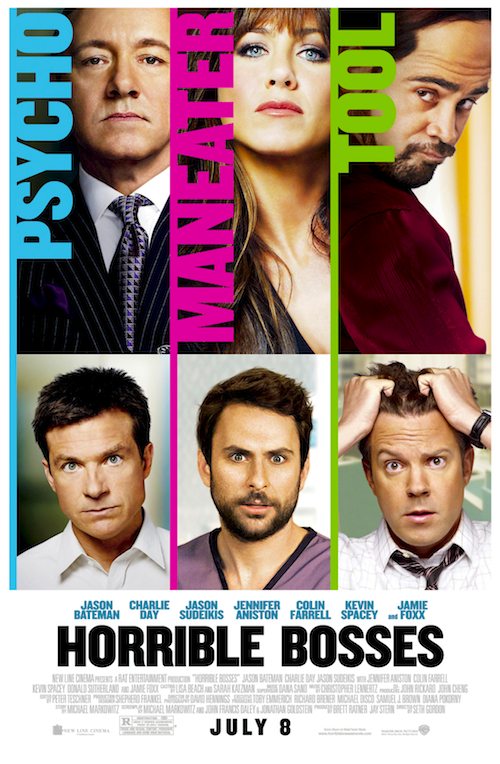
By Patricia Ducey. Horrible Bosses, is not, well, horrible – it’s what I call a Friday Night Movie, one best seen, if at all, after Happy Hour with your work chums in a theater filled with other people who have done the same. Laughter is infectious, and a slight buzz often helps that along. A way-too-serious and gross first half gives way to some real laughs in the second half, and the ingenious script does at times truly surprise and delight. But Bosses never does rise above a grade of ‘C,’ due to its 3-4 rating on the Apatow Scale (zero being no F-bombs or raunchiness; 5 being F-bombs/raunchiness equal to an Apatow movie). Most of the time, the raunchiness here is just a distraction from dumb writing, as becomes apparent.

Hapless, harried office workers Nick (Jason Bateman), Kurt (Jason Sudeikis) and Dale (Charlie Day) work in their own private hells, victims of their unbearable bosses: Kevin Spacey as Nick’s manipulative, Machiavellian boss at a financial firm, Colin Farrell (whose physical transformation from sexy Irishman to cheeseball cokehead is astounding) as Kurt’s bete noir manager at a chemical company, and Jennifer Aniston as Dale’s sex-obsessed, harassing boss/dentist.

After a few beers one night, the trio decides that a well planned murder of these three villains is the answer to their problems, so they head downtown to the nastiest bar they can find to hire a hit man. There they find Jamie Foxx, a “murder consultant” who gives them a general outline of a plan (cribbed from movie plots) in exchange for five grand. Later, after discussion and soul searching, they hit upon a variation of the consultant’s plan and decide to forge ahead. After all, they have watched enough movies and Law & Order episodes to guarantee they can concoct a foolproof crime … or crimes! In other words, they are idiots – and with reasoning like theirs, you can guess that all does not proceed smoothly. Soon the guys are running into and from cops, killers, and overly amorous women. Hilarity occasionally ensues. Continue reading LFM Review: Horrible Bosses
Laotong Story: LFM Reviews Snow Flower and the Secret Fan

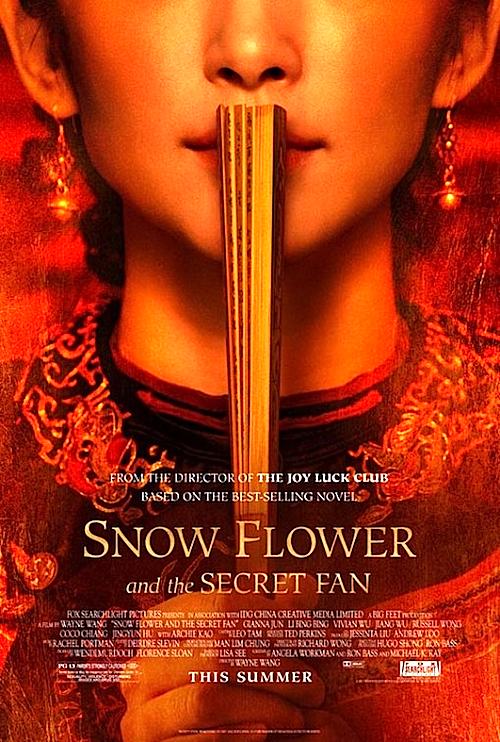
By Joe Bendel. In today’s China, girls are an endangered species. Largely due to the government’s one-child policy, sex-specific abortions and abandonments have sky-rocketed. It was not much easier for Chinese girls during the early Nineteenth Century, either. However, the Laotong (roughly translated as “Old Same”) oath of friendship helped sustain many young women. Yet the turbulence of the time will test two women’s Laotong bond in Wayne Wang’s Snow Flower and the Secret Fan (trailer here), which opens today in New York.

Snow Flower and Lily were born under the same sign and had their feet bound on the same day. Even though Wang waters down the literally bone-crunching reality of this practice, what the film shows is still enough to make a brawny man cringe. Unfortunately, this was considered necessary to strike a suitable marriage bargain.

Despite her family’s mean circumstances, Snow Flower’s dainty feet earn her a prestigious match. In contrast, Lily experiences the reverse social mobility, winding up betrothed to a lowly butcher after her father’s opium addiction ruins her family. Though separated by events obviously beyond their control, the two women exchange messages written within the folds of a fan, employing Nüshu, the secret script used by many Chinese women up until the Twentieth Century. (One hopes there is now an internet equivalent in widespread use today).

In parallel lives, Faye Wong Canto-pop listening high school students Nina and Sophia become a late Twentieth Century Laotong pair. Nina excels academically, while Sophia struggles emotionally in the wake of her bankrupted father’s suicide. Despite their recent estrangement, Nina puts her career on hold when a traffic accident renders Sophia comatose. As it happens, Sophia was carrying on her person a copy of her manuscript, which tells the story of Snow Flower and Lily.

Based on Lisa See’s bestselling novel, Secret Fan’s screenplay (credited to Angela Workman, Ron Bass, and Michael K. Ray) adds the contemporary story arc, allowing them to write in a part for Hugh Jackman as Arthur, Sophia’s sketchy night club impresario love interest. He even has a musical number, a novelty love song probably not designed to showcase his Broadway chops. Continue reading Laotong Story: LFM Reviews Snow Flower and the Secret Fan

LFM Mini-Review: Cars 2

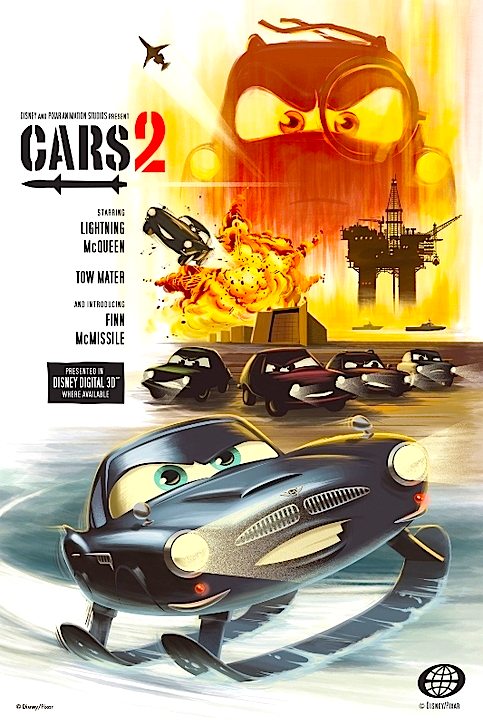
By David Ross. THE PITCH: Hayseed tow-truck gets mixed up in international espionage. Strange alternate universe in which cars behave like people. No explanation. Kind of creepy.

THE SKINNY: Cars 2 brings Pixar’s exuberant twenty-five-year spree to a grinding halt. Call it a mid-life crisis. The problem is not moral – the usual descent into greed, cynicism, and indifference – but conceptual. The plot is a confused and hyperactive whirlwind of genre elements and action sequences, perhaps amenable to the ADHD generation, but constantly preventing the film from taking emotional or moral root. Monsters Inc., The Incredibles, and Toy Story 3 – Pixar’s three incontestable masterpieces – are likewise action oriented, but they have a certain organic rhythm, a pattern of pause and eddy. They feel human, in short, while Cars 2 rushes in unremitting machine rhythm, much like a NASCAR race.

WHAT WORKS:

• Pixar’s technical genius has reached new and incredible heights. In the opening sequence, Finn McMissile – a 007-style Aston Martin played by Michael Caine – plunges off an oil derrick into a stormy ocean. The rolling, frothing, thoroughly natural wave dynamics are pure geek showboating. Pixar has evidently conquered all the primary technical challenges of computer animation: water, fire, wind, hair.

• Larry the Cable Guy is full of hillbilly fun as the loyal bumpkin Mater. Olivier he’s not, but then again he’s playing a buck-toothed tow-truck. Apprenticeship with the Royal Shakespeare Company not required.

WHAT DOESN’T WORK:

• In my un-American, dubiously male opinion, cars have ruined the world with their noise, pollution, and facilitation of urban-suburban sprawl. Imagine a time when it was possible to open one’s front door, pick a direction, and walk for twenty miles without fear of being flattened or suffocated in toxic fumes. In light of which, a world consisting entirely of cars – a world that is already ours in some sense – is intrinsically obnoxious and unsettling. How about a world consisting of humanoid retroviruses? Anthropomorphized Iranian centrifuges? Continue reading LFM Mini-Review: Cars 2

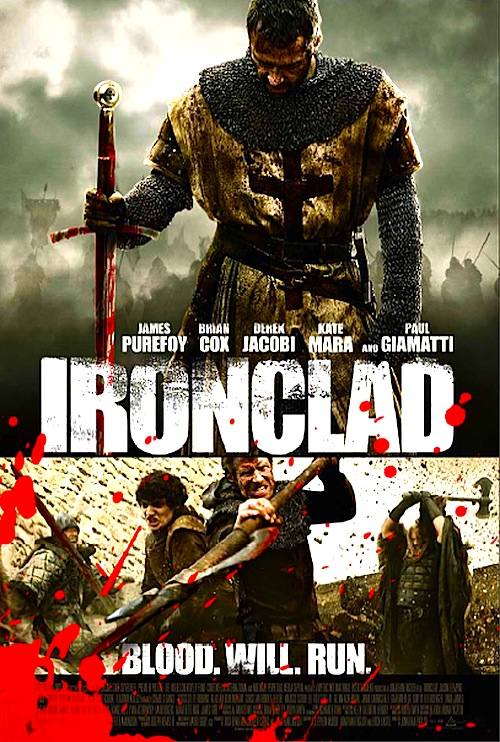
The Price of Liberty: LFM Reviews Ironclad

By Joe Bendel. The price of liberty has always been high, in both blood and treasure. It was true during the revolution we just celebrated on the Fourth of July and it was true during the Baron’s Revolt against King John, which led to the Magna Carta – a flawed but important document that informed our founding fathers’ conception of constitutional rights. Preferring the divine right of kings to the rights of man, John tried to reassert his absolute rule and nullify the Magna Carta, but an intrepid band of warriors will defy him, to their last breaths, in Jonathan English’s rip-roaring Ironclad (trailer here), which opens this Friday in New York.

Tired of his cruel and erratic rule, England’s barons rose up against John the First (and only), but for political reasons, they left the weakened despot on the throne after securing his signature on their revolutionary document. Unfortunately, many were lulled into a false sense of security. When John makes his play, assembling a mercenary army and securing Rome’s support, he catches most of his foes unawares. Only Rochester Castle stands between him and London. However, twenty men assembled by Baron Albany are determined to hold it at all costs, in hopes that the French will arrive to install a proper monarch.

One of those men is William Marshal, a Knight Templar recently returned from the Crusades. Like the Twelfth Century equivalent of the IDF, the Templars are well accustomed to facing numerically superior enemies. Granted twenty against one thousand is a tall order, but thanks to its construction, Rochester can be ably defended by a small force. Yes indeed, the siege is on.

Ironclad delivers plenty of old school hack-and-slash action for Game of Thrones fans jonesing for a fix. However, equally striking are its scenes of the aftermath of battle, conveying the pain and bone-weariness of the warriors. The film also presents the best depiction of medieval siege techniques yet captured on film.

While the action is thoroughly satisfying, Ironclad proves to be a film of unexpected substance. The screenplay by Jonathan English and co-writer Erick Kastel (based on a first go-round by Stephen McDool) takes notions of faith and freedom deadly seriously. Marshal explicitly states that there is nothing noble about war, ever, yet some things are still worth fighting for—in nearly those exact words. Continue reading The Price of Liberty: LFM Reviews Ironclad

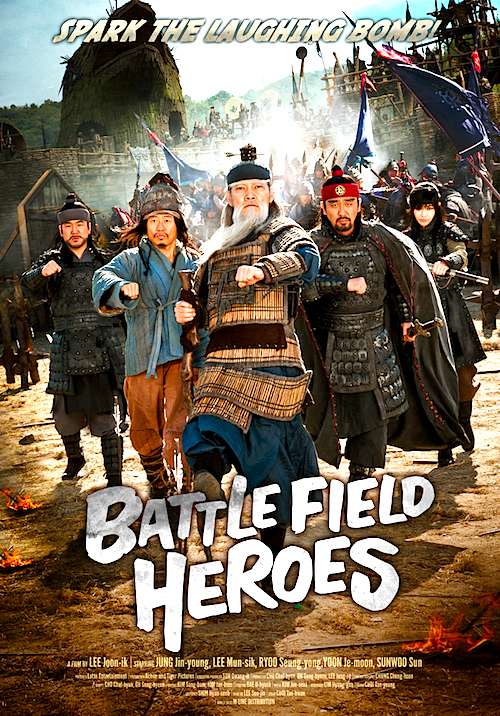
LFM Review: Battlefield Heroes

By Joe Bendel. War, what is it good for? The conscripts from Baekje have absolutely no idea. They perfectly demonstrate the superiority of a volunteer army. The men (and at least one woman) of the still independent (just barely) Goguryeo Kingdom are hardly there by their own free choice, but they have a stronger motivation to fight. Yet they will still do all the dying while the glory will be reserved solely for the officers in Lee Joon-ik’s caustic farce Battlefield Heroes (trailer here), which screens during the 2011 New York Asian Film Festival.

Prepare to get muddy, bloody, and absurd. If Brecht recast Braveheart in the Seventh Century Korea, it would look a lot Battlefield. Of the Three Kingdoms of Korea, Baekje has fallen to the Chinese-aligned Silla. The Tang Dynasty has enlisted the wary Silla in its campaign against the weakened Goguryeo. However, the crafty Silla general Kim Yu-sin is only biding his time.  He might look like an addled old coot, but he’s crazy like a fox.

None of these grand macro schemes matter to “Thingy,” a dirt poor disrespected serf from former Baekje. In fact, when he accidentally defects to Goguryeo, it would only mean switching from a besieger to the besieged, were it not for Gap-sun. Meeting the ardent Goguryeo lady warrior makes quite an impression on Thingy. Needless to say, it is not mutual.

Frankly, even as a medieval keep under attack, Pyongyang was probably more livable then than now. However, Battlefield is seen as something of an allegory, with the plucky but riceless Goguryeos signifying the North, the devious Sillas serving as the South, and the Chinese Tangs functioning as stand-ins for the good old USA. Yet, as Lee must understand, North Korea is not starving because of a Southern blockade, but through the deliberate policies of its government. Not to sound churlish, but good luck making veiled political commentary in the tightly regimented DPRK. As for the imperialist Chinese, perhaps they better represent, you know, China. Continue reading LFM Review: Battlefield Heroes

LFM Review: Osamu Tezuka’s Buddha: The Great Departure

By Joe Bendel. People think religion is all about sermonizing and casting judgment, but not Osamu Tezuka. His Eisner Award winning manga serialization of Gautama Buddha’s life emphasizes all the good parts, particularly the violence and passion of India circa 500-600 BC. Check your peaceful coexistence t-shirts and bumper stickers at the door when Kozo Morishita’s anime adaptation, Osamu Tezuka’s Buddha: The Great Departure, the first installment of projected feature trilogy, screens as a joint presentation of the 2011 New York Asian Film Festival and the 2011 Japan Cuts Festival of Contemporary Japanese Cinema.

Of course, Buddha was born Siddhartha Gautama, the privileged son of the king of the Shakya Kingdom. Shakya’s bounteous natural resources are coveted by the more Spartan Kosala kingdom, but providence has protected somewhat more peaceful Shakya, so far. As the Kosalan Army masses for an invasion, providence gets a bit of help from Tatta, an untouchable Oliver Twist with a supernatural power to possess nature’s creatures. Much to Tatta’s surprise, his new running mate Chapra takes advantage of the fog of war to save the Kosalan general, earning his protection and patronage as a supposed warrior class orphan.

None of this really has anything to do with Siddhartha. His path will only tangentially cross that of Tatta and his compatriots, at least in this film. However, as untouchables, they act as an effective counterpoint to the insular upper-class life Siddhartha will eventually reject. Indeed, Departure is a pointed critique of the caste system, largely driven by the story of Chapra’s forbidden attempt at social mobility. Naturally, combat will play a significant role in his efforts. Continue reading LFM Review: Osamu Tezuka’s Buddha: The Great Departure