LFM Reviews A Brilliant Young Mind

By Joe Bendel. G.H. Hardy said mathematics is a young man’s game and the world still believes him. This should therefore be Nathan Ellis’s time to shine. However, the young math whiz will always feel out of place in the world, even if he lands a spot on the UK International Mathematics Olympiad (IMO) team in Morgan Matthews’ A Brilliant Young Mind, which opens this Friday in New York.

Ellis is “on the spectrum” to use the film’s preferred term for autism. He has a savant like talent for recognizing patterns, but human relationships are almost beyond his grasp. His father Michael was the only one the lad ever opened up to. Unfortunately, he was killed well before his time in an auto accident (it kind of looks like it was his fault, if that mitigates the tragedy for you). Regardless, his grieving mother Julie is now stuck raising a temperamental son, who refuses to let her touch him.

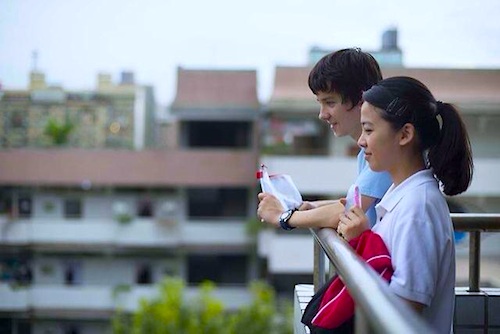
Despite the cold shoulder he is oblivious of, Julie Ellis devotes herself to Nathan and his math-based obsessive compulsions. She finally gets a break when Martin Humphreys agrees to tutor Ellis, with an eye towards the IMO. He too once competed at the Olympiad, but was undone by his self-sabotage and the onset of his MS. Somehow, Humphreys maybe gets through to Ellis just a little bit. There is also a burgeoning attraction between him and Julie Ellis, but he does not feel he can pursue it. Eventually, Ellis will join the other prospective UK team members to train in Taipei with other national teams. It is there that he will meet the charming young Zhang Mei from the Chinese team, who will get past even more of his defenses, much to his arrested adolescent confusion.

A Brilliant Young Mind is inspired by Matthews’ IMO documentary Beautiful Young Minds, which explicitly invokes the Oscar winning A Beautiful Mind. Clearly, title originality was not a priority. Regardless, there is plenty of room for another film that takes maths (as they say in Britain) seriously.

Yet, building a film around a confoundedly reserved character like Ellis is a challenge Matthews never fully licks. Asa Butterfield (a.k.a. Ender Wiggins, who arguably might be a tad on the spectrum himself) is actually quite convincing as Ellis, but it is mostly a one-note give-you-nothing performance. That’s a reality the film scrupulously observes, but it makes it feel wildly unbalanced, because everyone around him is so much more interesting.
From "A Brilliant Young Mind."

Jo Yang is wonderfully smart and sensitive as Zhang Mei, somehow developing chemistry with someone who hasn’t any of his own. However, Rafe Spall really lowers the emotional boom during the scenes in which he wrestles with the indignities of his progressively worsening condition. Sally Hawkins also makes you ache for Julie Ellis, to the point that you would forgive her for resorting to a murder-suicide pact. Eddie Marsan also does his thing as the slightly obnoxious, but rather shrewd UK coach.

There are some truly fine performances in ABYM, but James Graham’s screenplay trots out way too many clichés. Let’s be honest, everyone is doing great if we can believe Zhang Mei is interested in Ellis. Adding another jealous UK team member is really pushing it, but it presents an easy way to advance the action. Still, the scenes in Taipei look great and take Ellis out of his comfort zone in a way that we can believe will be healthy for him. Mostly recommended for those who appreciate watching a cast of fine British character actors, A Brilliant Young Mind opens this Friday (9/11) in New York, at the Angelika Film Center.

LFM GRADE: B-

Posted on September 10th, 2015 at 11:14pm.

LFM Reviews Spark @ Cinema on the Edge

By Joe Bendel. It is largely assumed the Samizdat tradition that fueled intellectual dissent behind the Iron Curtain was entirely nonexistent in Maoist China. That was mostly, but not one hundred percent entirely true. There was one journal that accurately reported the world as it truly was. Its print runs totaled somewhere around the twenty copy range—as in two-zero—but that was still more than sufficient for the Communist Party to crackdown hard on its editorial staff. Their remarkable stories of dissent are documented in Hu Jie’s Spark, which screens as part of Cinema on the Edge, the retrospective tribute to the Beijing Independent Film Festival.

The four primary writer-editors were all students, mostly from different cities, who had been labeled “Rightists” during the last bout of state-sanctioned insanity. They were all therefore highly vulnerable to whatever punitive measures the Party might unleash, but they were not planning to hand out Spark on street corners. They envisioned sending it to an elite, enlightened few within the Party bureaucracy, who might be in a position to foster reform. Alas, their naivety contributed to their sad fate.

Spark really did start with “innocent” intentions, with respects to Party authority. Shocked by the bodies literally piling up in the streets as a result of famine induced by the Great Leap Forward, the Spark core group assumed their local officials were merely applying national policy in an incompetent manner. However, as they ventured to other provinces and made contacts, they discovered the situation was just as dire everywhere else. Nevertheless, the Party and its flunkies insisted there was nothing wrong. Spark called them out on it and they paid a fearful price. They were not alone though. The sympathetic local headman and suspected “Rightist” Du Yinghua, a Party member since before 1949, was also fatally purged.

From "Spark."

The story of Spark is truly bombshell material, but Hu, China’s underground Claude Lanzmann, makes no concessions to style. It can be dry and slow-going at times, but then there will be scenes that make your hair stand on end. We see live-on-tape as one of Hu’s interviews is cut short by a call from the local Party bosses. We also hear surviving Spark staffer Xiang Chengjian admit he thought he was essentially sacrificing his life for the sake of the truth.

Hu demonstrates how dangerous it is to preserve history when you live under a tyrannical regime. Yet, he has made it his calling with films like Spark and the more accessible and grabbier Though I Am Gone. Of course, his work is all connected, chronicling interrelated historical incidents. Clearly, he must work outside the system and faces opposition from the Party apparatus, so the Beijing Independent Film Festival deserves tremendous credit for programming his documentaries. Very highly recommended, Spark screens this Saturday (9/12) at UnionDocs, as part of Cinema on the Edge.

LFM GRADE: A-

Posted on September 10th, 2015 at 11:14pm.
LFM Reviews Stratum 1: the Visitors @ Cinema on the Edge

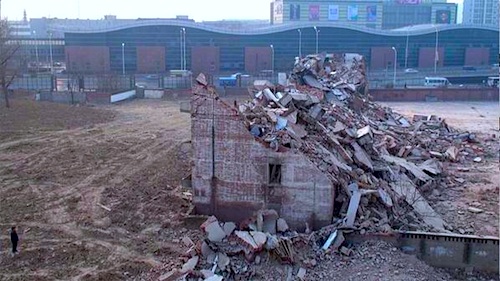
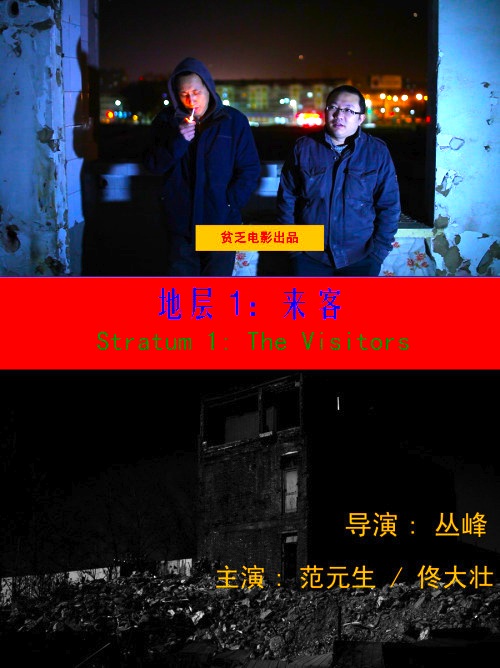
By Joe Bendel. Poet Cong Feng invites you to take a tour of Beijing suburb Tongzhou, a city of debris. As he sees it, the municipality is constantly in the act of tearing down. Lives and memories can be measured like sedimentary rock layers in Cong’s Stratum 1: the Visitors, which screens as part of Cinema on the Edge, the retrospective tribute to the Beijing Independent Film Festival.

What started out as a more traditional documentary on the wholesale razing of neighborhoods became something more experimental when Cong faced the overwhelming wreckage of it all. Throughout the film, he and his actor-narrators Fan Yuansheng and Tian Dazhuang remind us that the ruined buildings also represent damaged lives.

Without question, the film’s strongest sequence is the hushed telling of an episode that would be worthy of its own narrative film treatment. One of Cong’s colleagues remembers how injuries sustained during the Cultural Revolution caused long term psychosis in his mother. He recalls how the family dog would follow her during her impulsive flights into the nearby woods, returning home to lead the family back to her location. It is easy to see its crossover potential, like Coming Home crossed with Lassie.

However, the story of the loyal canine is easily the most accessible aspect of Stratum. Cong takes a self-consciously avant-garde approach, but he is clearly mindful of the tradition. By the standards of the genre, he maintains a comparatively high energy level and at times seems to deliberately parody, or at least twist the conventions of experimental filmmaking, most notably with his use of video rewinds and peppy pop music. Most importantly, Cong, Fan, and Tian have real screen presence and a clear sense of purpose as they clamber over the ever growing mountains of rubble.

From "Stratum 1: the Visitors."

If you have two or three dozen experimental film essays under your belt, you will likely appreciate Stratum for its archaeological metaphors and its powerful commentaries. If you are not well steeped in non-narrative, aesthetically challenging essayistic filmmaking, this will be a seriously tough slog. It is very good when judged according to its own standards, but it is absolutely not a starter film. One can only imagine the response Cong got if he ever showed it to a literal-minded censorship bureaucrat. Recommended for connoisseurs of the avant-garde, Stratum 1: the Visitors screens this Saturday (9/12) at UnionDocs, as part of Cinema on the Edge.

LFM GRADE: B

Posted on September 10th, 2015 at 11:13pm.

LFM Reviews Goodnight Mommy

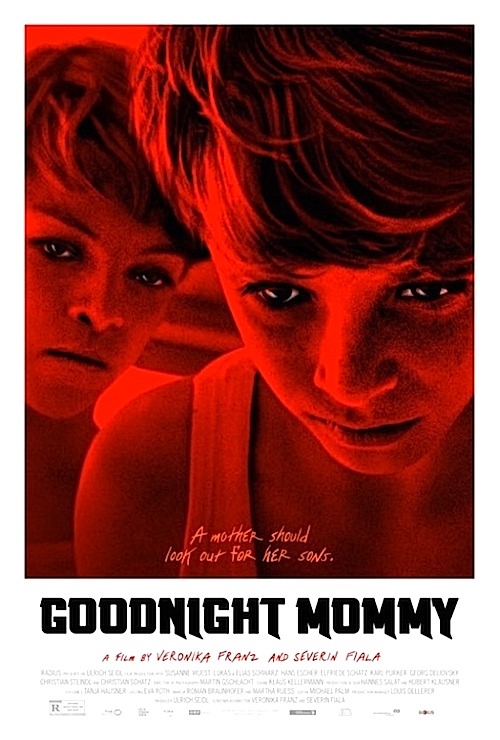
By Joe Bendel. By now, when we see twins in cinema, we assume at least one is evil—maybe both (as in The Shining, The Krays, and Full House). Evil is probably too strong a word for Lukas and Elias. It might be fairer to say they are intense. They are also rather confused by their mother’s seemingly arbitrary behavior following her countenance-changing surgery. Their family drama will take a decidedly macabre turn in Veronika Franz & Severin Fiala’s Goodnight Mommy, Austria’s recently announced foreign language Oscar submission, which opens tomorrow in New York.

This is the sort of film that is dashed difficult to review because Franz and Fiala build it around some audacious misdirection. They either keep you looking in the wrong direction, or they don’t. Regardless, it is probably safe to say this family is massively dysfunctional. For some reason, the mother seems to prefer Lukas over Elias, whom she is currently giving the silent treatment. Of course, her behavior makes no sense to the brothers. Since they are inseparable, they would both be equally culpable for whatever triggered her annoyance.

Her strange comportment coupled with her unrecognizable new features lead the lads to conclude the bandaged woman in the house is not really there mother. At this point, they commit to an antagonistic course of action that will often be difficult to watch. Unfortunately for the woman, their house is quite remote and apparently sound-proof.

Produced by festival favorite Ulrich Seidl, Goodnight Mommy is the sort of horror film that explores corrosive psychological pathologies in the much the same manner as Polanski in his prime. There is also a big third act revelation that changes viewers’ perspective on everything that came before. Whether you see it coming or not, it is impressive how slyly the film is cut together leading up to that point.

Lukas and Elias Schwarz are frighteningly believable as the extreme twins. They are all kinds of twitchy, yet they keep us consistently off-balance and hesitant to pass judgement. If they have seen their own movie, they should probably be in therapy now. Susanne Wuest also maintains the ambiguity, while playing some truly harrowing scenes. (Wuest also made a strong impression in Marco Kalantari’s The Shaman, proving critics ignore short films at their peril.)

Even with Seidl’s imprimatur, it is somewhat surprising Austria has submitted a genre film for Oscar consideration, albeit one that is quite polished and rather challenging. After all, within the last ten years, they have won twice with The Counterfeiters and Amour, garnering a third nomination for Revanche. However, what really baffles is the decision not to release Goodnight Mommy in time for Mother’s Day. Seriously, it’s a natural tie-in. Recommended for fans of horror and dark psychological thrillers revolving around children, Goodnight Mommy opens tomorrow (9/11) in New York, at the East 86th Street Cinema.

LFM GRADE: B

Posted on September 10th, 2015 at 11:12pm.

LFM Reviews Coming Home

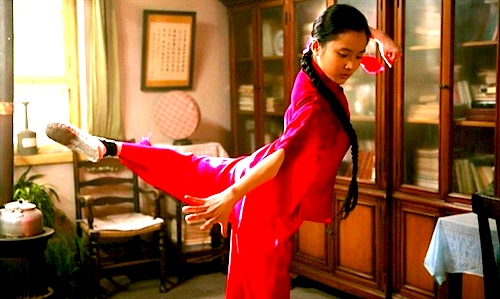
By Joe Bendel. Most ballets tell tragic stories, but the Maoist-era Red Detachment of Women caused them. It certainly contributed to the woes of Lu Yanshi’s family during the Cultural Revolution. Their wounds will never fully heal, even when he is finally “rehabilitated” and released from his prison camp in Zhang Yimou’s straight-up masterpiece Coming Home, which opens this Wednesday in New York.

Lu Yanshi was a college professor—and therefore a class enemy during the Gang of Four’s reign of terror. Further compounding his guilt, Lu escaped from his labor camp, finding the half-starved life of a fugitive more bearable. Naturally, the Communist Party responded by pressuring his family. Lu’s wife Feng Wanyu will bear any risk to protect him, but their daughter, Dan Dan, has absorbed too much of the omnipresent propaganda. She is a gifted ballet dancer, but she could very well lose the lead role in Red Detachment of Women she has worked so hard to win. Convinced to inform on her father, she learns the hard way what sort of opportunities are available to the children of traitors.

Gaining nothing, Dan Dan’s relationship with her mother is nearly irreparably poisoned. Unfortunately, the years Feng spends separated from Lu are not kind to her. By the time he is released, Feng is already suffering from mild dementia. Due to some cruel form of amnesia, she is unable to recognize Lu. Worse still, she sometimes mistakes her distraught husband for the predatory Officer Fang, who used Lu’s safety to extort sexual favors from Feng, like any good Communist would. However, Lu quickly reconciles with his deeply remorseful daughter.

From "Coming Home."

If you think there is a better performance to be seen in a film this year than Gong Li’s turn-for-the-ages as Feng, you either have profoundly faulty aesthetic judgement or were simply even more struck by the achingly poignant dignity of Chen Daoming’s Lu. Watching Lu as Feng unknowingly tells him about himself is more devastating than a thousand Old Yellers getting shot. What they are doing is actually very complicated. They are playing scenes with each other in the moment, but also with each characters’ ghosts from the past. Yet they pull it off brilliantly. It is their work that leaves a lump in your throat, but Zhang Huiwen is still quite touching as the disillusioned Dan Dan—and also convincingly graceful in her dance scenes.

Frankly, Coming Home is not trying to be a political film, because the terrible implications of the Cultural Revolution need no belaboring. They are ever-present and inescapable. Instead, it is an exquisite tragedy, rendered with incredible sensitivity and humanism. Zhang has gone big with epics like House of Flying Daggers and made Fifth Generation-defining classics with Gong Li, like Red Sorgum and The Story of Qiu Ju, but with the perfectly balanced Coming Home he expresses the pain and confusion of hundreds of thousands of families on a painfully intimate canvas. If you only see one film this year, you want it to be Coming Home. Very highly recommended, it opens this Wednesday (9/9) in New York, at the Angelica Film Center downtown and the Lincoln Plaza uptown.

LFM GRADE: A+

Posted on September 9th, 2015 at 5:29pm.

LFM Reviews Wolf Totem

By Joe Bendel. The land will be befouled and God’s creatures will be senselessly slaughtered. This is China in the full throes of the Cultural Revolution. As they witness the consequences first-hand, two formerly eager volunteers will be deeply disillusioned by the Party’s ruinous policies in Jean-Jacques Annaud’s Wolf Totem, which opens this Friday in New York.

When they first arrive, cadres Chen Zhen and Yang Ke really believe they will be making a difference for the hardscrabble herders of Inner Mongolia. However, they quickly learn to respect the power of nature, especially the danger and beauty of the regions’ wolves. They also cannot miss the bad vibes radiating off the local party boss, Bao Shunghi. However, they manage to settle in with their ethnic Mongolian hosts rather nicely, especially considering the condescending nature of their assignment.

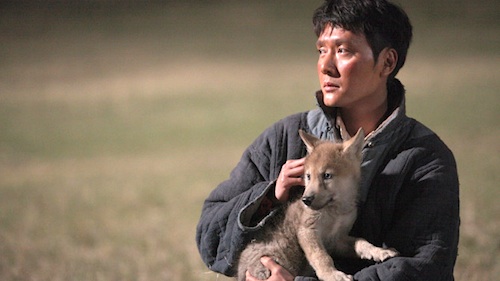
Frankly, they learn more from the herders than vice versa. After a too-close-for-comfort encounter with a wolf pack, Chen Zhen becomes increasingly fascinated with the Eurasian wolves. He cannot shake the idea that they deliberately spared him. Therefore, he is increasingly appalled by Bao’s cruel bounties on wolves, to pave the way for the locust-like settlers. He is also threatening the nomadic herders’ traditional way of life by despoiling their grassland for his developments. Seeing the wolves’ numbers dwindling, Chen Zhen does something rash. He secretly adopts an orphaned wolf cub. Yet, it is immediately clear the young wolf will always be too wild to live among people, but might become too domesticated to survive in nature.

Do not take this as a joke: it is frankly amazing what expressive performers these wolves are on the big screen. Lead training Andrew Simpson raised 35 region-appropriate wolves especially for the film—and the camera absolutely loves them. Even with extensive safety measures in place, Feng Shaofeng did not escape injury working closely with the wolves, but it was probably worth it. The co-star of White Vengeance and The Golden Era gives probably his career best performance as Chen Zhen. Once again, Shawn Dou is stuck playing second banana, but he keenly expresses the bitter nature of their hard lessons learned. Yin Zhusheng also makes a perfectly odious yet charismatic villain as Bao. Regardless, nobody will ever upstage those wolves.

From "Wolf Totem."

It is a not-so minor miracle this adaptation of Lu Liamin’s autobiographical novel (written as Jiang Rong) was ever made, especially considering Annaud was banned from China for years following Seven Years in Tibet. The explicit environmental themes and only slightly more muted critiques of the Cultural Revolution are also third-rail kind of subjects for the state film authorities. Nevertheless, they not only lifted Annaud’s ban and helped underwrite the production, they also chose Totem as China’s official foreign language Academy Award submission. Clearly, they are playing to win rather than score PR points with a non-existent international audience, as they often have in the past. Big and sprawling, with a green conscience, Totem is an Academy-friendly film, in nearly every way.

It also happens to be a very good film, which is a nice bonus for the rest of us. Totem offers more striking proof of why Annaud is considered the best contemporary narrative filmmaker working with animal and natural subjects. Cinematographer Jean-Marie Dreujou captures all the wolves’ twitchy power as well as the stunning beauty of the surrounding vistas. The late great James Horner’s reputation will also be further burnished by what is sadly one of his final scores. Few composers could produce such sweeping themes that are still so distinctive and evocative of a film’s time and place. It is an aesthetic marvel and one of the best environmental films in decades, precisely because it makes deeply compelling spiritual and cultural connections to the threatened Mongolian ecosystem. Very highly recommended, Wolf Totem opens this Friday (9/11) in New York, at the AMC Empire.

LFM GRADE: A

Posted on September 9th, 2015 at 5:29pm.