LFM Reviews The Beauty Inside

By Joe Bendel. Kim Woo-jin is a furniture designer, a sensitive hipster job if ever there was one. However, viewers will not envy his cool sounding gig. It is, after all, lonely work and Kim has some peculiarly unique issues that makes it feel ever more so. Shape-shifting romance gets a fresh spin in BAIK’s The Beauty Inside, which opens this Friday in New York.

Ever since he was eighteen, Kim wakes up from each slumber in a different body. He has the same consciousness, but he could be man or woman, young or old, Korean or a foreigner. Naturally he dropped out of school and has never had a relationship past a one-night stand. Refusing to forget his high school friend, Sang-baek discovered Kim’s secret and now manages his exclusive custom-made furniture business. His otherwise lonely world is about to be rocked by Hong E-soo, the beautiful and knowledgeable sales associate at his favorite limited edition furniture store.

Falling hard, Kim will wait until he finally has another handsome face to ask her out. When she says yes, he presses his advantage as best he can, resisting sleep for several days, he manages to make quite an impression, but a crash is inevitable. Despite his disappearing act, Kim cannot make a clean break of it. Eventually he will try to explain himself when he is hired as a sales trainee while outwardly appearing to be a fragile young woman.

Up to a point, BAIK and co-screenwriters Kim Sun-jung and Park Jung-ye adapt Drake Doremus’s corporate-sponsored social-media produced film that you probably haven’t seen in the first place. However, they take the story far deeper, exploring the day-to-day issues that plague Kim’s relationship with the understanding Hong. Some challenges are obvious and comparatively pedestrian, but the overall stress on Hong is more serious than the cloistered Kim initially understands.

Beauty Inside sort of compares to the honestly not so bad Adam Sandler vehicle 50 First Dates, but it is more fantastical and more serious in the treatment of its premise. Some real thought went into the implications of Kim’s condition. BAIK also stays faithful to the conceit, by never using a consistent Kim Prime for voiceovers or scenes reflecting how he sees himself. Instead, we have to adapt to a new Kim right along with Hong.

From "The Beauty Inside."

As a result, Beauty Inside is like the Korean It’s a Mad, Mad, Mad, Mad World of intimate romantic fantasies. Not only do some of South Korea’s top stars play Kims, their agents were also press-ganged into service, along with most of the crew. Somehow, everyone seems to connect with the pathos of Kim’s unusual state. Even those appearing briefly manage to express deep angst and loneliness. Yet, none of the leading men Kims can hold a candle to Chun Woo-hee’s delicate vulnerability as the sales trainee Kim. It is also pretty impressive watching Han Hyo-joo’s smart and sophisticated Hong play off dozens of radically different Kims.

Beauty Inside would be one of the best rom-coms of the year, but it is much more rom than com. There are some slightly absurd situations, but what humor there is can never be described as low or broad. For what its worth, the film also seems to be genuinely interested in fine furniture, which is kind of nice. Highly recommended for those who enjoy romantic fantasies that come with surprising substance, The Beauty Inside opens this Friday (9/11) in New York, at the AMC Empire.

LFM GRADE: A

Posted on September 9th, 2015 at 5:28pm.
LFM Reviews Generation Maidan @ The 2015 Portland Film Festival

By Joe Bendel. After being kidnapped from Ukraine and illegally imprisoned in Russia, Oleg Sentsov was just sentenced to twenty years, even after his accusers in Putin’s kangaroo court recanted their testimony. Sentsov is famous, so just think what is happening to the less well-known Ukrainian civic leaders rounded-up Gestapo-style by Russia. Pavel Yurov does not have to imagine. The Euromaidan-supporting playwright was tortured and imprisoned by Russian-backed separatists for seventy days. Yurov is one of many young Ukrainians who tell their stories in Andrew Tkach’s Generation Maidan: a Year of Revolution and War, produced in conjunction with the Ukrainian Babylon’13 filmmaking cooperative, which screens during the 2015 Portland Film Festival.

In late 2013, Ukrainians of all walks of life finally tired of the corrupt Yanukovych regime when the elected autocrat pulled out of negotiations with the EU to curry favor with his Russian patrons. Initially, a small group of protestors gathered in Maidan Square, but the outrage caused Yanukovych’s harsh response would ultimately attract hundreds of thousands of peaceful protestors. This process would repeat. Tragically, Yanukovych would use every dirty trick in the book against the movement, before settling on undisguised brute force.

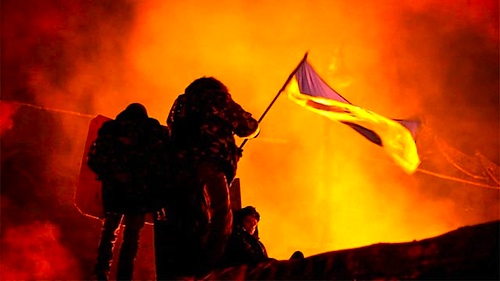
There is no question the Maidan protests were a confusing time, but Tkach does an excellent job of establishing the historical timeline, step by step, while also capturing a visceral sense of what it was like to be under fire from Yanukovych’s notorious riot police, the Berkut. Some footage is absolutely jaw-dropping, such as the incident in which a genuine Maidan protestor placed himself between the armored Berkut line and a gang a balaclava donning agent provocateurs, “attacking” the police to provide them a phony justification for a full scale crack-down.

Sadly, the Western media has been too prone to accept these crude manipulations peddled by the Russian state media, but such video helps set the record straight. Unfortunately, the subsequent war precipitated by Russia and its separatist clients constitute even murkier waters for media, due to the nature of civil wars. However, anyone should be able to understand the implications of Yurov’s harrowing experiences.

From "Generation Maidan."

Like Dmitriy Khavin’s Quiet in Odessa, Generation Maidan constitutes real reporting from Ukraine at a time when it is in short supply. It also captures the spirit of the Maidan movement, on personal, cultural, and generational levels. Perhaps the character of Maidan is best represented by Alexandra Morozova, who tirelessly played piano to raise the morale of Maidan activists. Fittingly, her music also serves as the film’s soundtrack, giving it a great deal more class than your typical battlefield dispatches.

Clearly, Tkach and his crew put themselves in harm’s way to tell these stories. In fact, his cameraman recorded the first Maidan death while he himself was receiving medical treatment. (Of course, it is much easier to just repurpose a Russian press release from the hotel bar.) Their images of state-sanctioned brutality and military aggression will make your blood run cold, but the resolution of young, idealist Ukrainians is inspiring. It is also worth noting all proceeds from the documentary will go to the Ukrainian Prosthetic Assistant Project. Highly recommended, Generation Maidan screened at this year’s Portland Film Festival, where it just had its American fest debut.

LFM GRADE: A-

Posted on September 6th, 2015 at 8:00pm.

LFM Reviews Animated Shorts @ Cinema on the Edge

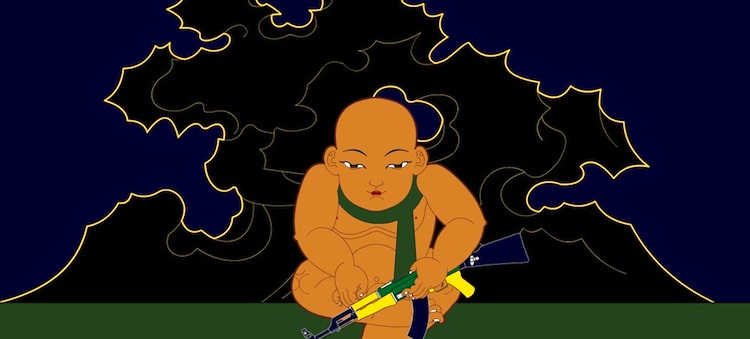
By Joe Bendel. Over the years, the CCP has been overtly hostile to many expressions of regional and national cultural tradition, but nowhere more so than in occupied Tibet. Therefore, programming shorts that bring Tibetan folktales to life through animation inspired by Thangka painting would not endear a film festival to the Party authorities. Not surprisingly, the Beijing Independent Film Festival did so anyway. Fittingly, two of Bai Bin’s Tibetan films anchor a program of animated shorts, which screens as part of the Cinema on the Edge retrospective to the fearlessly indie fest.

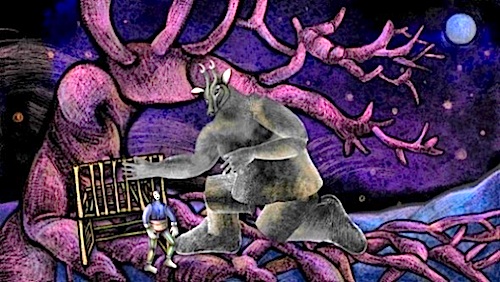
There is no question Bai Bin’s The Hunter and the Skeleton is the head-and-shoulders high point of the animated block. In this ancient tale, a hunter rashly heads off in search of game, despite the shaman’s warning. It turns out, this is an inauspicious time for such pursuits, because a demonic skeleton has been hunting hunters. Yet, for some reason, the fiend likes this hunter. First he gives the man a seven day extension before eating him. Then he offers the man a deal—he will be spared if he leads the skeleton to his village. Stalling for time, the man will have to defeat his new “friend” with only the help of his talisman and his trusty hunting dog.

There are real stakes in Skeleton, as well as a rather macabre sensibility, which is why it is even grabbier than Bai Bin’s environmentally-themed An Apple Tree. In both films, the vibrant Thangka colors and stylized figures are unlike anything you have seen in animation before. These are unusually striking films that tap into centuries-old mojo. Any self-respecting animation fan needs to check them out.

In contrast, several of the other animated selections are much less accessible to mainstream animation fans. Zhong Su’s Perfect Conjugal Bliss and Ding Shiwei’s Double Act play a double game, contrasting and conflating images of the authoritarian state with post-industrial decay and class stratification, respectively. Visually, they are often surreal, which helps confuse the censors and maintain plausible deniability.

This is even more the case with Zhang Yipin’s How, a sort of distaff, dystopian Little Nemo, and Qiu Anxiong’s abstract, avant-garde environmental apocalyptic fable, The New Book of Mountains and Seas Part 2. While Zhou Xiaohu’s Mirror Room holds considerably fewer political implications, the sexualized gender-bending imagery is even more likely to provoke the Puritanical authorities’ wrath.

From "Family Reunion."

After Bai Bin’s film, the next most aesthetically and emotionally engaging selection is easily Chen Li-hua’s Family Reunion. Following the trials and tribulations of A-mei, an aboriginal migrant worker, it too celebrates regional cultural traditions, while dramatizing the challenges faced by itinerant laborers.

While somewhat uneven, the collected independent animated shorts are often challenging both in terms of visual style and thematic substance. However, the preponderance of ambiguous narrative forms eventually blurs the constituent films together. Still, the program is well worth seeing for the wonderfully rich and distinctive work of Bai Bin and Chen Li-hua. Recommended for connoisseurs of animation and experimental film, Cinema on the Edge’s animated film program screens this Thursday (9/10) at the Museum of Chinese in America (MoCA).

Posted on September 6th, 2015 at 8:00pm.

LFM Reviews 9/11: the Lost Hero

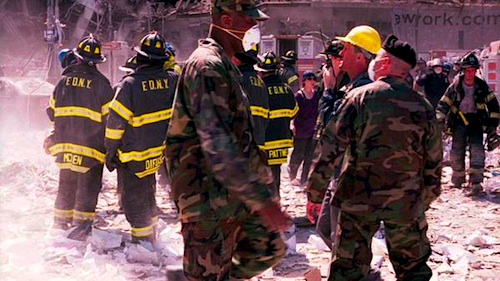
By Joe Bendel. On September 11, 2001 Jason Thomas only thought of himself as a U.S. Marine called to serve. That meant he did not hand out a lot of business cards and he certainly did not negotiate any back-end deals. As a result, Thomas’s identity remained a mystery for years after he spear-headed the dramatic rescue of two Port Authority Police Officers trapped in the rubble with another former Marine. His long untold story gets the right treatment in Steve Humphries’ British-produced 9/11: the Lost Hero, which premieres this coming Tuesday on Discovery’s Destination America.

Sgt. Thomas was no longer on active duty, but he still had his uniform in his trunk. When dropping his daughter at his mother’s house (as previously planned), Thomas heard the news of the terrorist attacks. Without hesitating, he donned his uniform and headed into the city, like a very human superhero.

Through happenstance, there is some rather remarkable primary-source video of Thomas rushing towards the World Trade Center site. There is no question he was there. For hours, he helped first responders tend to the wounded, but he really wanted to search for survivors amid the wreckage. Eventually, he and former Staff Sgt. Dave Karnes did exactly that, ignoring all warnings to avoid the unstable debris. Tragically, there did not seem to be any survivors to rescue, only remains to secure, until they heard a faint cry for help. That was Will Jimeno buried deep beneath them, with fellow officer John McLoughlin trapped well below him.

Talking at great length in Lost Hero, Jimeno unreservedly credits Thomas and Karnes for their survival. It was indeed quite the tense operation, chronicled by Humphries with step-by-step precision. Yet, for years Jimeno was unable to properly thank Thomas—though not from a lack of trying.

From "9/11: the Lost Hero."

Thomas might be the only man to draw breath that was ever able to get Oliver Stone to make an apology. In retrospect, it must be rather embarrassing for him to have cast a white actor to play Thomas in World Trade Center, which largely focused on their rescue efforts. However, the release of the film became the catalyst for Thomas finally receiving proper recognition. Although Humphries is rather circumspect addressing the issue, it is also pretty clear Thomas wrestled with post-traumatic stress during the years immediately following 9/11, until he finally started discussing his experiences with his family. Indeed, his story is helpful, instructive, and inspiring in a number of ways.

The vivid, visceral recollections of Thomas and Jimeno really give viewers a tactile sense of their fateful encounter. There is also quite a satisfactorily uplifting conclusion to it all. Somehow, September 11th has gone back to being just another day for a lot of people, so Lost Hero is a necessary reminder of the enormity of the attack and the heroism of the response. Highly recommended, 9/11: the Lost Hero airs this coming Tuesday (9/8) on Destination America.

LFM GRADE: A

Posted on September 4th, 2015 at 8:47pm.

LFM Reviews The Transporter Refueled

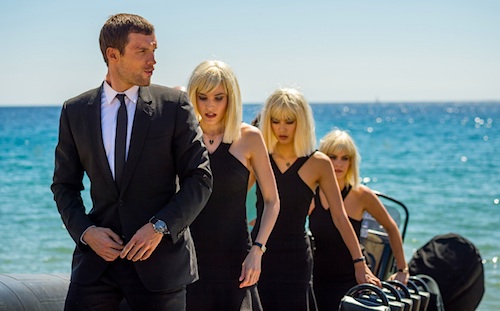
By Joe Bendel. They look like they stepped out of a Robert Palmer video. Frank Martin’s latest clients are highly synchronized and they need a driver. They will repeatedly break his rules, but their desperation makes them quite persuasive. Of course, Martin always keeps his cool in the latest re-configuration of Luc Besson’s strangely resilient franchise. Deliveries will be made in Camille Delamarre’s The Transporter Refueled, which opens today nationwide.

Clearly, Martin got his keenness for punctuality from his chop-busting father, who has just retired from an ambiguous government career that came with a cover job as a salesman for Evian (it’s “naïve” spelled backwards). He ought to be a little more resourceful, but somehow Frank Senior allows himself to be taken hostage by four women trafficked into prostitution by a Russian vice lord. Anna, Gina, Maria, and Qiao know they cannot simply run away from Arkady Karasov. They will have to hit his network where it counts—in the wallet. Thus, Martin reluctantly serves as their wheelman for a series of clever heists, while his father jolly well enjoys being a hostage.

When it comes to films set in Monaco, Refueled beats the stuffing out of the justly infamous Grace of Monaco. Delamarre understands what Transporter movies are supposed to be and executes accordingly. There are at least two action sequences that are ludicrously over the top, but what of it? It is not like the film slows down long enough for us to analyze the aerodynamics of any given scene. Cinematographer Christophe Collette also makes the Principality backdrops sparkle quite alluringly.

Ed Skrein has a strange look. It’s like you can see the exact shape of his skull because there is only a thin layer of skin stretched over it. He also has an odd screen presence, coming across as intense, but somehow simultaneously disdainfully disinterested in everything around him. Yet, that sort of works for Frank Junior. He has all kinds of cred in the fight scenes, but Ray Stevenson gets all the laughs as his cooler, funnier dad. His shameless scenery chewing is a major reason why the film is such deliriously guilty pleasure.

From "The Transporter Refueled."

Loan Chabanol, who attracted notice with her short but memorable appearance in Fading Gigolo, can’t project the same élan as Anna, but it is hard to compete with all the black Audis flying through the air. It is also a shame former Miss World Yu Wenxia does not have more screen time, because she seems to have a bit of a spark, but most of the time Anna’s three amigos just strut about in the background, to raise our awareness of human trafficking. What did you expect, really? Frankly, the film’s real shortcoming is its interchangeably generic villain. We have seen plenty of cats like Radivoje Bukvic’s Karasov done before and done better (Michael Nyqvist in John Wick springs readily to mind).

Refueled does not want to hear any whining about messages or characterization. It is a self-aware meathead movie that delights in its own shallowness. Style and energy are all that matter in a Besson-produced action joint, but Delamarre brings more than enough to keep the boss happy. Sort of a weird early 2000’s nostalgia trip for franchise fans that will also resonate for the original MTV generation, The Transporter Refueled is recommended for those who want a shiny object to distract them. It opens across the country today (9/4), including the AMC Empire in New York.

LFM GRADE: B-/C+

Posted on September 4th, 2015 at 8:47pm.

LFM Reviews Arthur & George

By Joe Bendel. For Sherlock Holmes fans, Sir Arthur Conan Doyle’s embrace of spiritualism has always been an embarrassment. However, in the days following his first wife’s death, the great mystery writer also distinguished himself by exposing at least two grave miscarriages of justice, notably including the George Edalji case. The premise is completely true, but Julian Barnes’ fictionalized treatment cranked up the mystery and intrigue, as Doyle had done from time to time in his own historical fiction. Following in the tradition of two popular incarnations of Sherlock Holmes and the Murder Rooms series featuring Doyle and his mentor Dr. Joseph Bell, the television adaptation of Barnes’ Arthur & George premieres this coming Sunday as part of the current season of Masterpiece on PBS.

Doyle was always technically faithful to his first wife, even though appearances often suggested otherwise. He was indeed attracted to a Miss Jean Leckie, but still scrupulously respected his marriage vows. Nonetheless, when his wife succumbs to tuberculosis, guilt drags him into a deep funk. Somewhat ironically, the prospect of championing George Edalji’s cause rouses his spirits.

At one time Edalji was an aspiring solicitor, but his life was derailed when he was convicted of a rash of animal mutilations that shocked the provincial village of Great Wyrley. The crimes seemed to be related to a nasty spate of poison-pen letters, whose vitriol were primarily directed at the mixed-race Edalji family. Yet, the constabulary hastily concluded they were all the work of Edalji’s deranged, attention-seeking mind. Although Edalji has already served his sentence in full, he still seeks to clear his name, so he can once again pursue a legal career. Doyle is immediately convinced of the man’s innocence, but his Watsonish personal secretary Alfred Wood is not so sure. Unfortunately, Edalji’s squirrely behavior seems to justify his skepticism.

From "Arthur & George."

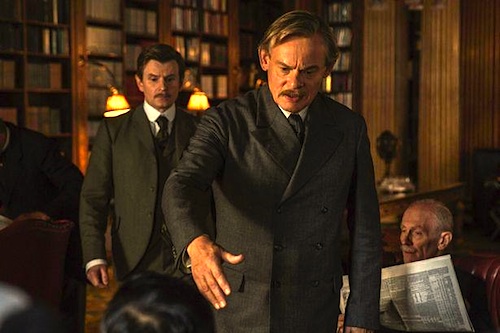
Martin Clunes is absolutely perfect as Doyle. He is blustery and larger than life, but in a way that suggests confidence and joie de vivre rather than the bumbling shtick of a Bertie Wooster. We can believe he created Holmes and is capable of conducting his own investigations. He also shares some rather earnest and engaging romantically-complicated chemistry with Hattie Morahan’s Leckie. In fact, their relationship subplot is not the empty dead weight you might expect. As Edalji, Arsher Ali is all kinds of awkward and standoffish, contrasting with his sociable benefactor quite effectively.

Veteran television director Stuart Orme realizes several impressively atmospheric sequences and maintains a healthy energy level, but it is a little embarrassing how long it takes Doyle to figure out who really did it, despite said villain’s compulsively suspicious behavior. Nonetheless, watching him apply his Sherlockian principles in practice is good clean fun. The three-part series is a reliably classy period piece with enough social conscience to give it some edge, but not so much that it gets preachy. Recommended for fans of all things Holmesian and Clunes (from Doc Watson), Masterpiece’s Arthur & George airs over the next three Sundays (9/6-9/20) on most PBS stations.

LFM GRADE: B

Posted on September 3rd, 2015 at 5:14pm.