LFM Reviews Made in Japan @ The 2015 Portland Film Festival

By Joe Bendel. For many Country Music isn’t what it used to be. Sales might be stronger than ever, but the new breed of blow-dried pop acts simply lack authenticity. However, Tomi Fujiyama is the real deal. She was Country before Country was cool—in Japan. She even played the Grand Ole Opry in 1964, when it was still broadcast from the hallowed Ryman Auditorium. She would love to have a return engagement, but the current group of squares in charge apparently lack vision. Nevertheless, she continues to pursue her Country dreams in Josh Bishop’s Made in Japan, which screened during the 2015 Portland Film Festival.

Tomi Fujiyama has had more than her share of career setbacks, yet remains astonishingly upbeat and energetic. She initially cut her teeth playing American music in U.S. military base clubs, quickly figuring out what styles generated the most tips. Although there were plenty of folks in the music industry only too happy to take advantage of her, at least one American cat was willing to take the time to work on her pronunciations. As a result, her singing voice is something else. When carrying a tune, she has almost perfect diction and a surprisingly deep and resonant tone. Frankly, she owns “Tennessee Waltz,” pure and simple.

Returning to America with her quietly indulgent husband, Fujiyama revisits the sites of her eventful days playing Nashville and Vegas, while campaigning for another Opry gig. Not to be spoilery, but the Opry Entertainment management just didn’t get it. Instead, Fujiyama is embraced by a younger, hipper new traditionalist movement thriving outside the Opry establishment.

From "Made in Japan."

Bishop’s experts cogently explain the fractures in contemporary Country music, while also providing full historical context, way back to the music’s roots in English sea shanties and murder ballads. Elijah Wood also handles the narrator duties with clarity and what sounds like affection. However, there is no question Fujiyama is the engine that makes the film go. Her charm and charisma are undeniable, but it is her voice that will get you. She can hold a room full of No Depression-reading music snobs absolutely transfixed with her renditions of traditional Japanese folk songs.

Even if Made did not quite have the ending Bishop and Fujiyama’s friends hoped for, it will still give you a nice warm feeling. (Nevertheless, if you think its lame the Opry has not booked her yet, drop them a line here and ask them why. They would definitely like to hear from you. That’s why they provide a method to give feedback.) Sweet and entertaining, Made in Japan would make an intriguing double bill with Banjo Romantika. Very highly recommended, Made in Japan screens next at the Calgary International Film Festival, following its West Coast premiere at this year’s Portland Film Festival.

LFM GRADE: A-

Posted on September 3rd, 2015 at 5:14pm.

LFM Reviews Dragon Blade

By Joe Bendel. The ambitions of a corrupt Roman consul would belittle Alexander’s conquests if he could realize them. He intends to assert control over the entire Silk Road, starting with the sleepiest stretch in western China. However, the impossibly upbeat captain of the Silk Road Protection Squad and a band of maverick centurions will stand against him in Daniel Lee’s Dragon Blade, which opens this Friday in New York.

Huo An always tries to avoid physical violence. Yet, despite his status as a heroically departed general’s only true protégé, he has been banished to the provincial Wild Geese Gate due to trumped-up corruption charges. Apparently he is quickly rehabilitated, because he has already re-assumed command of the Silk Road forces when a Roman remnant arrives in all their glorious belligerence. First they fight, but they quickly forge a wary truce. Real camaraderie between the Han Silk Road forces and Roman soldiers follows soon after.

When word arrives Huo An’s men must rebuild the crumbling city in fifteen days, the Romans agree to help in exchange for assistance reaching the legitimate Roman authorities in Parthia. Combining Roman engineering with good old fashioned Chinese slave labor, they do indeed rebuild a shining city on a hill, throwing in a few extra aqueducts just because they enjoy building them. Unfortunately, the villainous Tiberius does not appreciate Han do-gooders aiding his enemies. After all, he has a young brother to kill in the astonishingly annoying Publius, who has thus far been protected by the world weary Lucius and his band of brothers, which now includes the honorary centurion Huo An.

Dragon Blade is not terrible, even though it has nearly all of the shortcomings you would fear. Of course, it starts with casting of John Cusack and Adrien Brody as Lucius and Tiberius. Probably no actors have looked or sounded more out of place in a classical antiquity setting since Edward G. Robinson appeared in the Ten Commandments. While Cusack seems to be trying to slouch through the film unnoticed, Brody is conspicuously dull in role that requires serious flamboyance.

Chan is hardly blameless either. Although he thankfully reins in the shticky comedy, Dragon Blade is a perfect example of his burgeoning martyr complex, which he shamelessly indulges. It also reflects his increasingly problematic Mainland-centric China chauvinism. According to Huo An, Westerners are trained to kill people, whereas Chinese soldiers serve to protect. Okay, while you’re at it, why don’t you explain to the emperor how the common people would like more say in issues of governance—or try telling it to Beijing today. Tens of thousands of Hong Kongers came to the Admiralty to do exactly that, but Chan didn’t want to hear it.

From "Dragon Blade."

Yet, one of the coolest things about Dragon Blade is the democratic idealism represented by Wild Geese Gate, as well as the massive CGI awe of the place. There are also some pretty spectacular warfighting scenes that inventively combine the styles of the two rag-tag forces united against Tiberius’s armies. Old Man Chan can still handle himself in a hand-to-hand scene, when he is not lecturing his audience and Lin Peng similarly makes the most of her limited screen time as the Hun warrior princess Lengyue. Costume designer Thomas Chong also takes full advantage of the opportunity to create costumes in the traditional styles of at least a dozen distinctive nationalities.

Regardless of Chan’s ideological baggage, director-co-screenwriter Lee takes viewers on a rough narrative ride. There are more conspicuous gaps in Dragon Blade than Hillary Clinton’s email archives. Reportedly, twenty-some minutes were cut from the Chinese version for the American theatrical print, including a modern day framing device featuring Karena Lam. That was probably one of the easiest parts to lose, but as it is currently cut, characters’ allegiances will change drastically and considerable geographic distances will be traveled all quite suddenly without anyone taking any notice. That is just life on the Silk Road.

A chaotic mixed bag, Dragon Blade lacks the mature and engaging heft of Chan’s work in the unfairly dismissed Police Story: Lockdown and The Shinjuku Incident. For diehard fans, it opens tomorrow (9/4) in New York, at the AMC Empire.

LFM GRADE: C-

Posted on September 3rd, 2015 at 5:13pm.

LFM Reviews Lords of London

By Joe Bendel. For London loan shark Tony Lord, Italy is light years away from the world he knows. He is in Abruzzo, not Naples. How he got there is a mystery to him. Frankly, he sort of has an inkling but he would prefer to ignore the dramatic implications in Antonio Simoncini’s Lords of London, which releases today on DVD from Lionsgate.

Essentially, Lord inherited his father’s trade, even though the old troglodyte never took much interest in him. We will witness his dysfunctional formative years through Lords, fils’ many flashbacks. He will have some time for meditation whether he wants it or not. After getting shot by one of the many people he did wrong, Lord wakes up soaked in blood, but otherwise none the worse for wear in a dilapidated villa outside a ridiculously picturesque Abruzzo village apparently stuck in the 1950s.

Much to his consternation, the entire village ignores him, except for the twinkly-eyed Francesco. The café owner is concerned the English punk his daughter has been seeing is no good, so he asks Lord to keep an eye on him. Unfortunately, the displaced gangster more than confirms Francesco’s suspicions.

By now you probably have a good guess just who everyone really is and what their relationships to each other are. That means you are exponentially quicker on the up-take than Lord. Yet, for some reason Simoncini insists on nursing his transparent secrets until an anti-climactic third act reveal. Arguably, the film might have been more effective if it had laid all those cards on the table rather than pretending to fool us.

Frankly, as director and screenwriter, Simoncini somewhat bungles the light fantastical elements, inadvertently creating a scenario where Ray Winstone’s Lord Sr. presumably ages about three or four decades in the span of five or six years. Maybe that would be possible during Callaghan’s Winter of Discontent, but not the swinging Macmillan years when he appears to be prowling about.

From "Lords of London."

On the other hand, the ancient village and surrounding countryside look amazing thanks to cinematographer James Friend, who gives it all a classy chiaroscuro-like glow worthy of the Old Masters. Similarly, Giovanni Capalbo (whose wildly diverse credits include both Mel Gibson’s The Passion of the Christ and Abel Ferrara’s Napoli, Napoli, Napoli) is quite the old Zen charmer as Francesco. He also manages to maintain some sense of mystery regarding what his character is up to. Glen Murphy is also pretty solid as the rather dense Lord, the sort of hardnosed role one could easily imagine Craig Fairbrass assuming. However, Ray Winstone is a surprising let-down as the elder Lord. All snarl and no swagger, he just doesn’t seem to be having fun with it.

Simoncini is going for the vibe of warmer, fuzzier Richard Matheson, like Somewhere in Time and What Dreams May Come. He doesn’t consistently pull it off, but earns credit for trying. At least it always looks great. Recommended for anyone considering an Italian vacation, Lords of London releases today (9/1) on DVD and digital from Lionsgate.

LFM GRADE: B-

Posted on September 1st, 2015 at 2:55pm.

LFM Reviews Brave Men’s Blood

By Joe Bendel. On the fateful day of December 2, 2013, the Icelandic Police finally shot and killed someone dead for the first time in their two hundred twenty-five-plus year history. Instead of congratulations, they ordered a round of counseling all around. Typically, the rank-and-file do not carry firearms, relying instead on plenty of optimism. That arrangement suits the new Serbian kingpin in town just fine. However, an Internal Affairs cop with a chip on his shoulder will try launch a secret operation against the gangster and the high level officer protecting him in Olaf de Fleur’s Brave Men’s Blood, which launches today on VOD from Oscilloscope Laboratories.

Hannes Ámason’s old man was a legend on the force, but their relationship was always rather frosty. It becomes even more so when he washes out of the elite training program for the SWAT-like Armed Police division. Frankly, it is easy to read plenty of resentment into his decision to subsequently take an Internal Affairs posting. However, a major case with implications beyond the force drops in his lap when old school gangster Gunnar Gunnarson requests a jailhouse meeting. Having been pushed out by Sergej, the Serbian upstart, Gunnarson is slightly out of sorts. As a last resort, he is willing to funnel information to Ámason that will help him take down his rival and his chief protector, Narcotics Squad chief Margeir, one of his dad’s old cronies.

Playing it close to the vest, Ámason only recruits two allies: Ívar, the Armed Police squad leader who formerly thought so little of him and Andreas, Margeir’s former protégé, who has been assigned to desk duties following a violent assault. Yet, the bad guys still catch wind of his operation, which puts his family directly in harm’s way.

Somehow de Fleur makes Twenty-First Century Reykjavik look like Chicago in the 1920s. For such a violence-averse force, he manages to get the Armed coppers into a heck of a lot of fire-fights (they’re going to need some serious counseling after all this). He gives the super-slick Miami Vice tradition a cool Nordic makeover, but he is a little too enamored with the flashback as a narrative device. There are an awful lot of them in Blood, but some are much more effective than others.

From "Brave Men’s Blood."

Darri Ingolfsson slow burns perfectly well as the annoyingly moralistic Ámason, but as is often the case in genre cinema, the colorful supporting cast really helps make the film. Ingvar E. Sigurdsson is clearly having a blast as the devious Gunnarson, while Sigurður Sigurjónsson oozes rodent-like oiliness. J.J. Field also does his best Jude Law impression in his brief appearances as Sergej’s British money man, chewing on as much scenery as time will allow.

Technically, Blood is a sequel to de Fleur’s City State, but no previous familiarity is required to enjoy the follow-up. It doesn’t even feel like it is calling back to a previous film, but presumably it is even richer if you have that background in your mental DVR. Frankly, nobody does these sorts of films better than Hong Kong auteurs like Johnnie To and Andrew Lau, but de Fleur makes a real go of it. Recommended for fans of stylishly cynical crooked cops-and-gangster movies, Brave Men’s Blood launches today (9/1) on VOD, from Oscilloscope Laboratories.

LFM GRADE: B+

Posted on September 1st, 2015 at 2:49pm.

LFM Reviews Para Elisa

By Joe Bendel. It is a bad idea to constantly spoil tantrum prone children. Nevertheless, whenever Elisa breaks a doll, her mother simply replaces it, with another living being. Ana will be the next victim lured into their macabre doll’s house, but at least her stoner-dealer boyfriend is not taking her disappearance for granted in Juanra Fernández’s Para Elisa, which releases today on DVD and VOD from Dark Sky Films.

Poor entitled Ana needs 1,000 Euros for her graduation trip, so she takes the drastic step of looking for a job. Diamantina is supposedly looking for a nanny and her tony flat is right on the town square. (It turns out the walls sure are thick though.) Kids are fine with Ana, but she balks when she learns Elisa is a developmentally challenged woman roughly her own age. Too late, Diamantina has already slipped her a mickey.

When she comes to, her vocal chords and muscles are still paralyzed by whatever eucalyptus cocktail the old woman brewed up. Much to her horror, Ana is expected to become Elisa’s latest living doll. Diamantina grimly cautions Ana to cooperate, lest she provoke Ana’s violent temper.

Granted, some might find the portrayal of Elisa problematically exploitative, but you do not review as many horror films as we have by being overly sensitive. Elisa is a handful—deal with it. Arguably, it is sort of a necessary pre-condition for a massively creepy premise. In fact, Ana’s state of pawed immobility taps into some deeply held anxieties, ranging from the sleep paralysis documented in Rodney Ascher’s The Nightmare to the cast-bound Jimmy Stewart getting defenestrated in Rear Window.

From "Para Elisa."

Para Elisa does indeed incorporate Für Elise into its soundtrack, so give it credit for musical literacy. However, the final climax is a bit perfunctory, which is especially problematic considering it really is a shorty, barely hitting the seventy-five minute marker.

Nevertheless, Fernández’s execution is unflaggingly stylish. For some reason, Spanish horror films all seem to share a similarly eerie but distinctive look and vibe. It is hard to pin down, but you will recognize it every time. Maybe they are all burning ceremonial effigies of Franco off-screen. Regardless, Para Elisa maintains an unceasing atmosphere of dread, while the architecture and surrounding countryside of Cuenca in Castilla-La Mancha looks breathtaking. Recommended for fans of Spanish horror, Para Elisa is now available on DVD and VOD from Dark Sky Films.

LFM GRADE: B-

Posted on September 1st, 2015 at 2:44pm.

LFM Reviews Lawless Kingdom

By Joe Bendel. Considering the Divine Constabulary gets to investigate all the cool supernatural crimes, while Department Six is stuck with the boring human cases, inter-agency rivalry is probably inevitable. However, it becomes quite pitched when the leader of the former is accused of murdering the commander of the latter. Everyone should probably know better, but they have to admit the evidence looks pretty bad. Some kind of scheme is afoot involving crimes from the past in Gordon Chan & Janet Chun’s Lawless Kingdom, their sequel to The Four, which releases today on DVD from Lionsgate.

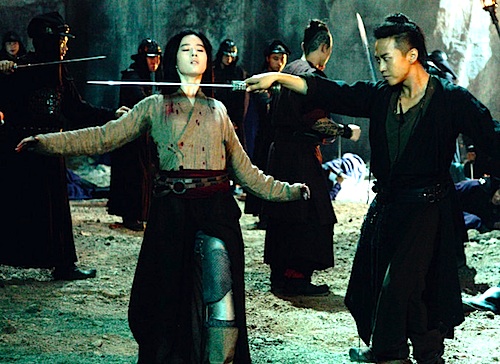
Based on the 1970s wuxia novels, The Four are like Song Dynasty Avengers, whose powers are derived from chi. When it comes to that chi, their leader Zhuge Zhengwo and the wheelchair-bound Emotionless have levels that give them Professor X-worthy mental and telekinetic powers. Iron Hands is the muscle, Life Snatcher is their Flash, and it is just a bad idea to anger the lycanthropic Cold Blood. Yet, for some reason Zhuge does exactly that when he appears to fire a steampunkish firearm at the werewolf.

When Cold Blood recovers, he demands answers from his boss, who promises them in two days. Unfortunately, he is arrested for the murder of Department Six’s Sheriff King before the allotted deadline is up. To make matters even more awkward, another soon-to-be dead man claims to be one of the Gang of Twelve, who murdered Emotionless’s family and irreparably damaged her legs. Supposedly, Zhuge dispatched them all to their eternal judgment at the time, so what gives?

Watching Lawless Kingdom (a.k.a. The Four II), it seems strange that the disability community has not vocally embraced this series. Emotionless might have been the victim of a crime, but she is no passive object of sympathy. In fact, it is arguably empowering and certainly cool to watch her laying down martial arts beatdowns with the aid of Iron Hands’ prosthetics. She is particularly assertive in Kingdom, contributing some series highlights and compensating for its conspicuous status as a middle bridge film, between the relatively self-contained first installment and the conclusion that has already opened in China.

From "Lawless Kingdom."

Regardless, if you like The Four (and we did), Kingdom gives you more, while exploring the characters in greater depth. Anthony Wong and Crystal Liu Lifei have some particular fine moments as Zhuge and Emotionless, whose surrogate father-daughter relationship will be strained by deceit as well as the truth.

Although Sheng Taishen’s Sheriff King is presumably dead for good, he is wonderfully sly and slippery in his limited screen time. Deng Chao and Collin Chou also solidly perform Iron Hands and Cold Blood’s action roles, but Ronald Cheng’s Life Snatcher is inexplicably stuck on the sidelines for much of the film. While the major villains stay behind the Wizard’s curtain, former newscaster Liu Yan makes a memorable femme fatale as Ru Yan, a rather insidious colleague of Ji Yaohua, Emotionless’s rival at Department Six.

Considering how much spectacle Chan and Chun put up on screen, it is rather impressive how directly they keep it all connected to the human element. They create some terrifically fantastical set pieces, including a Mordoresque prison specifically designed for those blessed with superhuman chi. For wuxia and superhero fans, it is all good stuff. Recommended especially for those intrigued by the Emotionless character, Lawless Kingdom releases today (9/1) on DVD from Lionsgate.

LFM GRADE: A-

Posted on September 1st, 2015 at 2:38pm.