LFM Reviews Blood Moon

By Joe Bendel. During the early days of Hollywood, Poverty Row studios like Republic, Monogram, and PRC relied on western oaters to pay the bills. These days, horror films are the low budget staple genre, so you could consider this a case of something old and something new. The fact that yonder werewolf western is also a British production makes it all the more eccentric, but we appreciate that. The bodies will pile up when a skinwalker hunts its prey in Jeremy Wooding’s Blood Moon (trailer here), which launches today on DVD and VOD from Uncork’d Entertainment.

Mud Flats was a stagecoach stopover already well on its way to being a ghost town, but the skinwalker hastened the process. Unfortunately, when the next stage pulls in for chow, they are taken hostage by the twitchy outlaw Norton Brothers (half-brothers technically). Amongst the passengers are Jake Norman, the new Marshal for the next town over, Sarah, his new wife with a checkered past, and Calhoun, the mysterious bad ass. There was also a priest, but the Nortons killed him almost immediately.

Even the profoundly unintuitive Nortons soon accept the idea something big and bad is prowling around outside, but they are still determined to have their fun inside. Meanwhile, the sheriff and Black Deer, his hard-drinking Native American frienemy and potential hook-up, follow the trail of the Nortons and the beast.
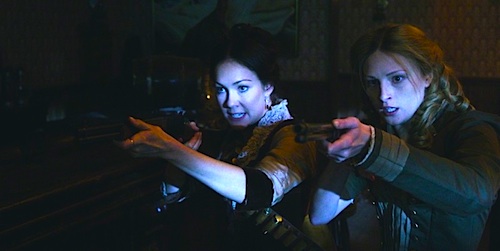
From "Blood Moon."

Like so many westerns before it, Blood Moon looks a little cheap, but it was filmed in Kent, so cut it some slack (after all, it is the first UK western since Carry On Cowboy). While the premise sounds like a dubious mash-up concept, it kind of works thanks to the strength of the characters. Frankly, Shaun Dooley is pretty darned awesome as the steely, super-together Calhoun. Yet, Anna Skellern is even more awesome as Marie, the franchise-minded, derringer-packing Miss Kitty. Wearing the black hat, American ringer Corey Johnson is charismatically loathsome and contemptuous as the more stable Norton. Eleanor Matsuura’s Black Deer also nicely provides the film’s required mysticism and defiance of authority.

Blood Moon is definitely a low budget wonder, but it deserves props for its energy and attitude. According to the laws of nature it should be a complete train wreck, but if you enjoy B-movies, this is the sort that will remind you why you developed such idiosyncratic tastes in the first place. Regardless, if you want to see a British werewolf western, Blood Moon is the only game in town, when it hits VOD platforms today (9/1), via Uncork’d Entertainment.

LFM GRADE: B

Posted on September 1st, 2015 at 2:32pm.

LFM Reviews Wolf Warrior

By Joe Bendel. Get ready for a steady diet of metaphors telling us that lone wolves are most successful traveling in packs, or some such thing. They would be referring to Leng Feng. He is a loose cannon maverick type, but whenever he goes off the reservation, he is doing it for the team. Of course, he makes plenty of enemies that way, including a vengeful drug lord who can afford the best mercenaries money can buy. Their values compare poorly with those of the idealistic Feng, but they still manage to get the drop on his elite commando unit in Wu Jing’s Wolf Warrior, which releases today on DVD, Blu-ray, and digital platforms from Well Go USA.

Just when a Southeast Asian drug raid seems hopelessly lost, Feng takes a spectacular shot (three of them really) to save the day. In the process, he kills the impetuous brother of shadowy crime boss and aspiring global megalomaniac, Min Peng. He should be happy to be rid of such a pathetic tool, but Min Peng rather holds a grunge. Having eluded Chinese forces, the old criminal mastermind hires a team of western mercs, led by the highly skilled Tom Cat, to take out Leng. He also has some conventional world domination business for them to tend, but that is really just a tangent to a tangent.

Arguably, the plan to attack while Leng’s squad is engaged in war-games is sort of clever, since it necessarily means the Wolves will be strictly packing blanks. Unfortunately, that is about the only part of the film that works. Even though the Mainland born Wu rose to prominence in HK film like City Under Siege, Wolf Warrior was clearly conceived as feature length tribute to the PLA. To a man, the Wolves are invariably pure of heart, but also stiflingly dull. Its like the un-self-aware Chinese version of “America, Blank Yeah,” the anthem of Team America World Police, except irony is strictly forbidden.

As a director, Wu gives us a herky-jerky ride, but his martial arts skills remain undiminished. The film is kind of watchable when it shuts up and lets everyone get down to business. When he finally gets to his long anticipated face-off with Scott Adkins’ Tom Cat (a mercenary named after a celebrity couple), it is pretty satisfying. Yet, it is rather strange how much of the film’s action revolves around fire-fights and marksmanship, considering two of the world’s top big screen martial artists are present and accounted for.

From "Wolf Warrior."

At least they have stuff to do. For most of the film, Adkins’ Expendables 2 co-star Yu Nan is stuck wearing an earpiece and biting her lip as she gives tactical advice from the command center. On the other hand, Ni Dahong’s stone cold coolness as the villainous Min Peng is one of the film’s saving graces, even though his transformation from Pablo Escobar to Dr. Evil makes no sense. It also seems slightly odd that he would want to develop a super-virus that only kills Chinese people.

There are rumors floating about online that PLA personnel were required to see Wolf Warriors in theaters, which would explain its success. If so, Wu delivered everything his PLA patrons could have hoped for, often reducing the film to an old school Soviet May Day parade of shiny new military hardware and platitudinous dialogue. Disappointing for anyone who is not a member of the Young Pioneers, Wolf Warriors is strictly for Wu and Adkins completists when it releases today (9/1), from Well Go USA.

LFM GRADE: D

Posted on September 1st, 2015 at 2:26pm.

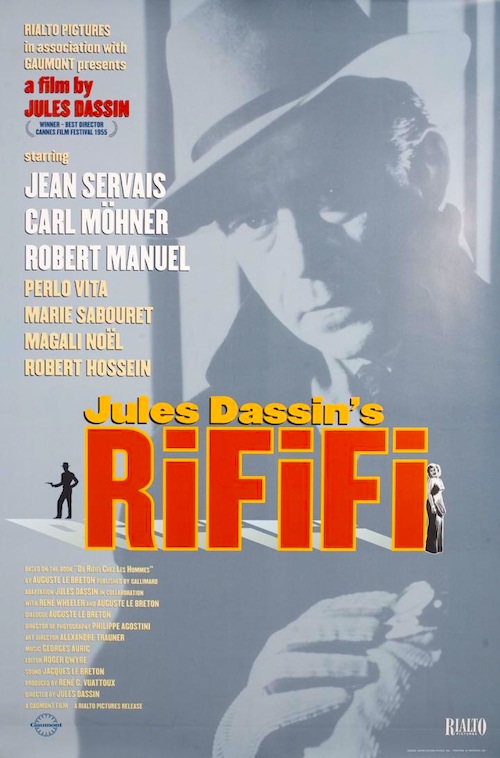
LFM Reviews Rififi @ Film Forum

By Joe Bendel. Many think writer Auguste Le Breton joined the French Resistance out of opposition to Vichy’s gambling prohibition. He would survive to become a French Elmore Leonard, known for his gritty action and affinity for slang. As it happened, his source novel was too coarse for genteel American blacklisted director Jules Dassin, who joined the Communist Party in the mid-1930s, right around the time of the Great Purge and the Moscow Show Trials. In order to lose the parts that offended his sensibilities, Dassin expanded the heist scene into half an hour’s worth of wordless action. At one time banned by several countries for its purported criminal instructional value, Dassin’s French noir classic Rififi returns to New York for a special one-week engagement starting this Wednesday at Film Forum.

Tony “le Stéphanois” (from Saint-Étienne) is decidedly the worse for wear after his recent prison stint. He willingly took the rap for Jo “le Suédois (the Swede), whose son Tonio (Tony’s godson and namesake) he dotes on, but his health and finances are in sad shape. To make matters worse, his ex-lover Mado took up with his nemesis, gangster-night club owner Pierre Grutter. After explaining his disappointment to her, Tony will commence planning his next and potentially last big score.

Jo and their mutual crony Mario Ferrati originally conceived of the jewelry store job as a simple smash-and-grab, but Tony wants the prime cuts in the safe. Recruiting Italian safecracker César “le Milanais,” they methodically case the joint and craft their elaborate timetable. The actual half-hour of heist operations is indeed a masterwork of noir filmmaking. However, it somewhat unbalances the film. While there is plenty of good hardboiled stuff in the third act, as the Grutter gang schemes to appropriate the hot ice for themselves, but it necessarily lacks the same hushed intensity of the celebrated centerpiece.

Regardless, Rififi (which very roughly translates as “trouble”) has long been recognized as a noir classic for good reason. Like Le Breton’s books, it has a street smart persona and a street level perspective. It captures the workaday milieu of postwar Paris, especially during the odd hours of the day and night when respectable folks were off the streets. Jean Servais also creates the template for the older, world-weary noir mentor, dealing with the business end of his bad karma. He slow burns like a crock pot with dangerously faulty wiring. Just looking at his lined face makes you want to pop an Advil.

Carl Möhner (probably next most often remembered for She Devils of the SS, which is pretty much what it sounds like), is rather under-heralded for his steady, proletarian work as Jo. However, Dassin himself (billed as Perlo Vita) indulges in a bit of broad ethnic stereotyping, for supposed comic effect, as César.

On heist movie listicals with any sense of history, Rififi inevitably ranks somewhere around number one. It is a film any noir fan has to see to consider themselves literate in the genre. Very highly recommended, Rififi opens this Wednesday (9/2) at Film Forum.

LFM GRADE: A

Posted on August 31st, 2015 at 9:38pm.

LFM Reviews Carmen Comes Home @ The Japan Society

By Joe Bendel. It will be a clash of small town and big city values—and boy, will the small town enjoy it. The prodigal daughter once known as Kin Aoyama apparently found fame and fortune dancing in Tokyo under the name Lily Carmen. She is an artiste, but her art involves G-strings. That does not mean she and her comrade Maya Akemi can’t be scrupulously serious about their dance. They are indomitably upbeat, but their visit might be more than her staid father can handle in Keisuke Kinoshita’s big screen musical Carmen Comes Home, the very first Japanese color feature, which screens this Friday at the Japan Society, as part of their newly re-launched Monthly Classics series.

Even if Carmen/Aoyama has not amassed a fortune per se, she has made enough of a go of it to periodically send money and gifts home to her family. Her loyal sister Yuki is in awe of her, but old man Shoichi Aoyama instinctively distrusts the modern western influences she has no doubt absorbed. However, thanks to the intercession of the school principal, an ardent advocate for Japanese culture, he reluctantly consents to her visit. Nobody could miss Lily Carmen when she arrives. She is the one wearing the bright red dress. Clearly, Kinoshita was going to get his color film’s worth from the wardrobe and spectacular mountain scenery.

Naturally, Carmen and Akemi attract all kinds of attention in town, including the leering local mogul. Yet, the two women are more drawn to more plebeian townsmen, like the young school teacher Akemi impulsively falls for. Similarly, Carmen admits she still carries a torch for the now married Haruo Taguchi, who was blinded during the war. As the composer of dirge like odes to his small town, Taguchi is more in line with the Principal’s idea of a real Japanese artist. Unfortunately, Carmen and Akemi’s va-va-voom will inadvertently disrupt Haruo’s grand premiere performance, causing no end of angst.

From "Carmen Comes Home."

Hideko Takamine was one the greatest screen actresses in the history of cinema, but she is best known for achingly tragic films like Mikio Naruse’s When a Woman Ascends the Stairs and Yearning, as well as Kobayshi’s The Human Condition, so it is nice to see her get the chance to kick up her heels a little. She is utterly charming as the bizarrely naïve Lily Carmen. Yet, underneath the goofy joy, she gives the subtlest hints of sadness. Nobody else could have pulled that off.

In a way, Carmen Comes Home is like a cross between Oklahoma and Gypsy, with all their slow or maudlin parts discarded. Still, it is clear Carmen and Akemi can never really go home again. The men will only see them as sex objects and the women will fear them as rivals. Despite their pluck and verve, it is ultimately quite a bittersweet film, but that is what makes it so distinctive, along with Takamine’s endearing performance. Recommended for fans of Takamine and movie musicals, the freshly restored Carmen Comes Home screens this Friday (9/4) and look for Go Takamine’s Paradise View in early October (10/2), as part of the Japan Society’s Monthly Classics series.

LFM GRADE: A

Posted on August 31st, 2015 at 9:37pm.

LFM Reviews North by Northeast @ The 2015 Montreal World Film Festival

By Joe Bendel. Cai Bing is sort of like a Chinese Miss Marple, but in addition to her fellow villagers’ business, she also knows a heck of a lot about breeding hogs. It was not always so. The former university professor was sent down to the provincial breeding station during the height of the Cultural Revolution, but she adapted to her new environment remarkably well. She has just been rehabilitated, but before she returns to her old life she will help the local bumbling police captain hunt down a mysterious sex offender in Zhang Bingjian’s North by Northeast, which screens during the 2015 Montreal World Film Festival.

By applying Chinese medicine to pig husbandry, Cai produced some big hogs. She also found more personal contentment than she expected, even “adopting” Xiao Cui as her granddaughter. Frankly, she has made the best of the Cultural Revolution, all things considered, but she still does not suffer fools gladly. According to her withering judgement, Li Zhanshan, the village constable, is one such idiot.

Li and his tiny militia have been chasing the serial rapist known as “Liumang,” a loaded colloquial term meaning thug, pervert, or something in between. Unfortunately, the case gets personal for Cai when Xiao is raped by Liumang. Using Chinese medicine and deductive reasoning, Cai will try to guide “Footprints” Li’s investigation in more promising directions. Yet despite her wisdom, the mystery will outlast the waning Cultural Revolution.

While Northeast boldly invokes Hitchcock right there in its title, it is a bizarre tonal mishmash. It is probably safe to say you will never find a sunnier, more upbeat film about sex fiends and the Cultural Revolution. Seriously, do not try this at home, but somehow Zhang pulls it off. Of course, it all starts with Li Bin’s wildly charismatic and wonderfully acerbic performance as Cai. Acidic on the outside, but sweet and sentimental deep down, like Marianas Trench deep, she raises the cozy sleuth bar well above anything Margaret Rutherford or Angela Lansbury ever did. If you were ever a victim of a crime, you would want her giving the cops what-for on your behalf.

From "North by Northeast."

It is a tall order hanging with Li, but Ban Zan grows into the job, playing “Footprints” Li with far less shtick than his character’s pear shape and general level of incompetence would suggest. In fact, he gets as serious as the plague during the masterfully dark third act. He is indeed a major reason why this film will surprise you.

Where Xin Yukun’s A Coffin in the Mountain feels like a twisty top tier Coen Brothers’ movie as exemplified by a Fargo, Northeast is more closely akin to their bold but uneven mid-level films, like Hudsucker or O Brother. Still, that means there is more to recommend it than ninety-five percent of films can lay claim to. Li Bin is unquestionably the X-factor. Her turn as Cai is a thing of beauty and a force of nature. Recommended for her vinegary power and Zhang’s considerable style, North by Northeast screens this coming Tuesday (9/1) and Friday (9/4), as part of this year’s Montreal World Film Festival.

LFM GRADE: B+

Posted on August 28th, 2015 at 2:28pm.

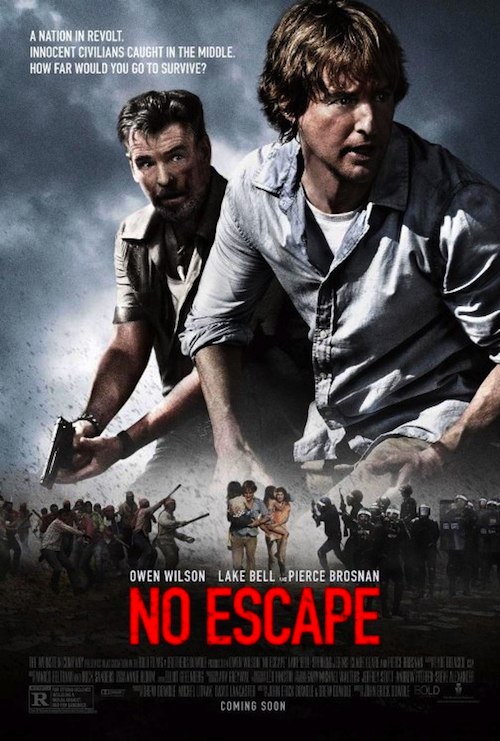
LFM Reviews No Escape

By Joe Bendel. It looks a lot like Thailand, but the use of Khmer lettering somewhat upset Cambodia. The anarchy and mass killings engulfing the fictional Southeast Asian city also rather parallel the brutal fall of Phnom Penh, which could be the real reason for the Cambodian government’s censorship decision. On the other hand, the head of state’s official garb bears a vague resemblance to that of the King of Thailand. Unfortunately, we will not have time to learn if he is also jazz lover and amateur musician, like Bhumibol Adulyadej. The dear leader is about to become the dearly departed, unleashing murderous bedlam in John Erick Dowdle’s No Escape, which opens this week in wide release.

After his tech start-up crashed and burned, Jack Dwyer accepted a middle-manager position with Talbott, an international engineering firm. He is in the process of relocating his family to a country that is one hundred percent not Cambodia but happens to border Vietnam, where he will help construct a water plant. For this he should die, according to the ninety-nine percenters that are about to launch an insurrection. It’s nothing personal, just ideology.

As the terrorists work their way through the Dwyer’s hotel, summarily executing guests room-by-room, Dwyer scrambles with wife Annie and two daughters to safety. He will get some heads-up assistance from Hammond, a suspiciously cool-under-fire Brit. However, things start to get truly desperate when the leftist guerillas call in the helicopter gunships to strafe their presumed safe haven on the roof.

No Escape would be a nifty thriller (sort of like Bayona’s The Impossible, if the tsunami came packing an AK-47), had it not felt compelled to periodically bring the action to a screeching stop in order to blame everything on western imperialism, or is it globalism in this case? In any event, we are responsible, please chastise us. That would be Pierce Brosnan’s job as Hammond, who assures Dwyer the men who just murdered scores of innocent bellhops and office workers are only trying to protect their families, like you Jack. Of course, such moral equivalency is simply farcical.

Believe it or not, Owen Wilson shows some real action cred as the super-motivated everyman. Brosnan also takes visible delight in Hammond’s dissipated tendencies, providing some much needed shtick-free comic relief. Sahajak Boonthanakit also compliments him rather nicely as “Kenny Rogers,” Hammond’s country music loving local crony. However, the film suffers from the lack of a focal villain—a Robespierre to incite the mob.

Despite the shortcomings of the script co-written with his brother Drew, Dowdle certainly has a knack for filming riot scenes. In fact, the first act is quite impressively stage-managed, as we see the Dwyers cut off from contact with the outside world, reacting to dangerously incomplete information. At times, No Escape is a very scary film, but it is frequently undermined by its inclination to lecture. As a result, it falls short of the visceral intensity and unrepentant black humor of the Eli Roth-produced Aftershock. No Escape very nearly could have been great, but instead it is marked by stop-and-start inconsistencies. Still, Brosnan fans will be happy to hear No Escape represents a return to form for the Bond alumnus after a half dozen or so B-level movies, when it opens nationwide this week, including at the Regal Union Square in New York, but not in undemocratic Cambodia.

LFM GRADE: C+

Posted on August 27th, 2015 at 9:15pm.