LFM Reviews Deutschland ’83

By Joe Bendel. It must be a weird full circle experience for an East German defector like Sylvester Groth to now play a Stasi agent, but it is a role he would understand better than most. Groth’s Walter Schweppenstette is in fact the sort of spymaster who can dislodge poor Martin Rauch’s finger with perfect casualness. As a result, the shocked East German will now have an excuse for avoiding the piano while impersonating a West German General’s new aide-de-camp. Rauch did not ask for this assignment, but he will obey as best he can during the course of Deutschland ‘83, which premieres this Wednesday on SundanceTV.

Rauch was a loyal Communist border guard serving on the Wall that President Reagan will soon challenge Gorbachev to tear down. His aunt Lenora is a high-ranking Stasi strategist, who is pretty freaked out by Reagan’s “Evil Empire” speech and his decision to deploy Pershing missiles in West Germany. Rather cold-bloodedly, she picks her nephew to impersonate Moritz Stamm, an orphaned junior officer loner who will soon report for duty under Gen. Wolfgang Edel, a prominent NATO liaison. Of course, Rauch is reluctant to leave his almost-fiancée Annett and his ailing mother Ingrid, but Lenora promises to arrange a transplant for her if he agrees, not that he has a choice.
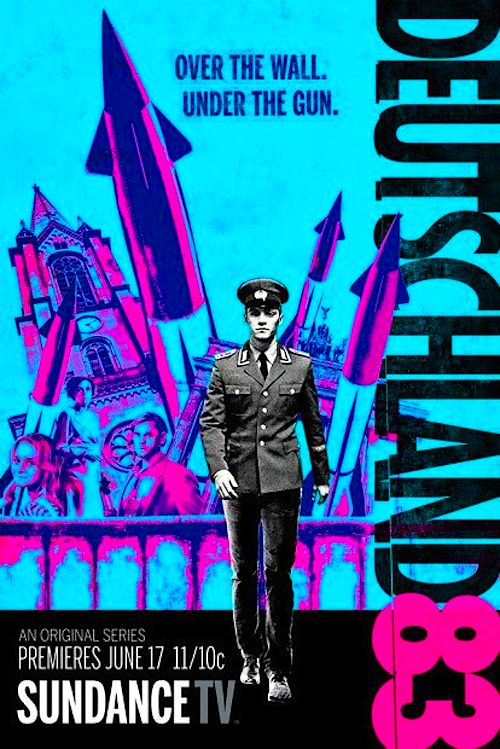
The first two episodes of D83 screened at the Berlin Film Festival and they hang together as an initial arc pretty well. We can see perhaps hints of doubt being sown when Rauch, the ardent Marxist, first encounters a western supermarket. His superiors and colleagues are not exactly the reassuring types either, especially Aunt Lenora. However, it might be the freedom exercised by young West Germans that ultimately shakes Rauch’s convictions. After all, the peacenik chart-topper “99 Luftballoons” is a constant presence throughout the first two episodes.

As Lenora Rauch, Maria Schrader could well surpass Kevin Spacey’s Frank Underwood for stone cold Machiavellian villainy. Right from the start, she makes the show. Jonas Nay also shows promise as Rauch/Stamm, convincingly portraying his early overwhelmed naivety, while hinting at the resourcefulness and moral confliction to come. As Schweppenstette, Groth (best known for playing Goebbels not once, but twice in Inglorious Basterds and My Fuhrer) appropriately exudes malevolence and Ulrich Noethen quickly establishes Gen. Edel’s contradictory human dimensions. Unfortunately, Errol Trotman-Harewood seems to be trying for the cringiest ugly American stereotypes as blustery Gen. Arnold Jackson.

The period details of D83 are spot on, extending far beyond the music. Even in the early going, helmer Edward Berger keeps it tight and tense. The limited series also boasts a wealth of memorable performances from smaller but key supporting players, such as Lena Lauzemis as Rauch’s shadowy hotel contact. However, it is unclear how writer-co-creator Anna Winger will ultimately treat President Reagan. There do seem to be indications we are supposed to sympathize with the resistance to his Pershing deployment. Still, there is no denying he shook things up.

Overall, Deutschland ’83 shows considerable potential judging from the first two episodes. It must be the first German programming to air directly in America since the History Channel broadcast Dresden so it is nice to see SundanceTV taking chances. Espionage fans should be advised, it commences this Wednesday (6/17) on SundanceTV.

LFM GRADE: B+

Posted on June 15th, 2015 at 10:12pm.
LFM Reviews In Football We Trust @ The 2015 Los Angeles Film Festival

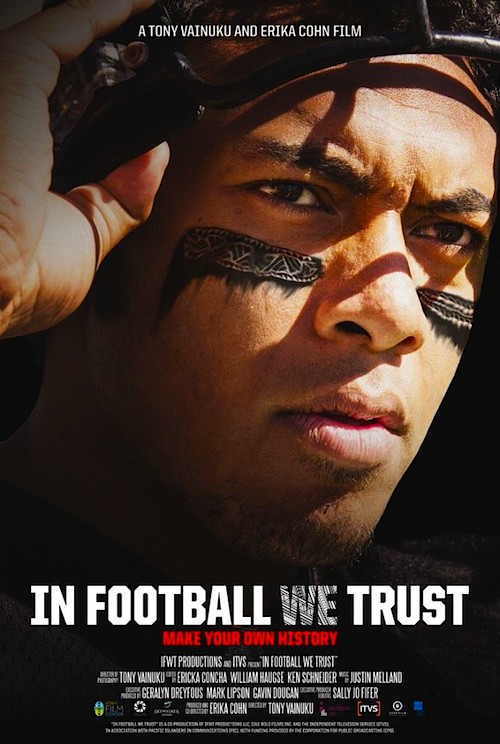
By Joe Bendel. This is not the Utah we know from coming to Park City for Sundance, Slamdance or maybe skiing. This is Salt Lake City, home to the nation’s largest Polynesian immigrant community. Yes, many of them are Mormon, why do you ask?  Their faith is with the Latter Day Saints, but their hopes and passion are in football all the way. Tony Vainuku (the first Tongan filmmaker accepted at Sundance) & Erika Cohn follow four top high school seniors throughout In Football We Trust, which screens during the 2015 Los Angeles Film Festival.

According to Trust, Polynesian prospects are twenty-eight times more likely to make the NFL than any other demographic group. The film also acknowledges the same is not true for Ivy League medical and law schools. This is a problem, but Vainuku & Cohn will primarily focus on other issues, like religion and crime. The former is clearly a positive force for the families profiled in the film, often credited for providing direct assistance, as well as a social network and structure. The latter is never a good thing, but the intrusion of gang violence could well jeopardize at least one player’s future.

For obvious reasons, the filmmakers spend a great deal of time with the brothers Bloomfeld, Leva and Vita, whose reformed father was one of the founders of the Baby Regulators, a notorious Polynesian street gang. Their father might be out of the life, but the life will still come looking for at least one of the brothers.

In intriguing ways, Trust confirms some of our possible preconceptions, while contradicting others. All four POV players seem to be reasonably well accepted in high school (they are jocks, after all) and at one least has a popular, apparently Anglo girlfriend. It also seems like the Mormon mission call can be a rather handy escape hatch during challenging times.

Unfortunately, through Fihi Kaufusi’s experiences, Trust also raises timely issues of football safety. Kaufusi actually played on both sides of the ball, which is a practice many would have assumed went the way of leather helmets. He will suffer an injury that the team doctor “under-diagnoses,” so you can probably guess what happens next.

There is only so much Vainuku & Cohn can coherently address in a film of reasonable length. As it is, Trust is like a tighter, more disciplined Hoop Dreams, featuring more proactive, self-aware subjects. Yet, football fans will not shake the feeling the ghost of Junior Seau hovers over the film. The NFL’s inability to deal with concussions and brain trauma becomes especially problematic when we consider how many Polynesian families look to football as their means of economic advancement. Still, these high school players’ ambitions are real and compelling. Recommended for fans of beyond-the-field sports reporting, In Football We Trust screens this Wednesday (6/17) as part of LAFF ’15.

LFM GRADE: B

Posted on June 15th, 2015 at 10:11pm.

LFM Reviews The Tribe

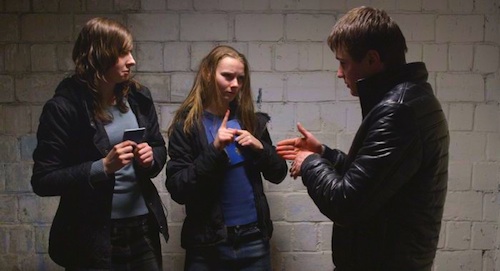
By Joe Bendel. The industrial district of Kiev still known as “Stalinka” is so soulless and depressed, its nickname is probably more fitting than ever. It is here that Sergey will attend a state run boarding school for the deaf. He will learn the school’s lessons quickly, despite hardly attending any classes in Myroslav Slaboshpytkiy’s The Tribe, which opens this Wednesday at Film Forum.

Perhaps more than any previous film, Slaboshpytkiy’s Tribe was conceived as means of putting the shoe on the other foot and forcing us to walk a while with it. Following a bold and already celebrated/notorious strategy, Slaboshpytkiy shot Tribe entirely in Ukrainian sign language, without offering any subtitles or narration to guide us through. Frankly, we will get lost from time to time (that’s sort of the point), but we can follow the broad strokes fairly well. After all, these kids are not exactly chatty.

Sergey soon learns the school is run by a very real high school mafia, led by King and “advised” by the shop teacher. Their primary illicit business involves pimping out classmates to drivers at the nearby truck-stop, like the apparently willing Anya and Svetka. After some initial hazing, Sergey quickly rises through the ranks, taking over the day-to-day operations following King’s jarring death by misadventure. However, he breaks the unspoken rule when he falls for Anya.

The overall effect of Slaboshpytkiy’s silent treatment is a mixed bag, but there are two scenes in Tribe that are so viscerally shocking, they will make you audibly gasp. A good deal of their power is indeed derived from the silence. They are also masterly blocked out by Slaboshpytkiy, causing us to wonder if his non-professional actors (who are also deaf in real life) walked away from their scenes unscathed, while underscoring the dangers of deafness in the wider, unaccommodating world. Of course, the school is supposed to be a shelter, but it is anything but.

Disturbingly, viewing The Tribe feels like watching a cold, violent documentary unfold. The young cast is so utterly convincing and free of mannerisms or artifice, they never seem to be performing. Still, it is worth noting the chemistry developed by Grigoriy Fesenko and Yana Novikova, as well as the gutsiness of their explicit but decidedly non-erotic sex scenes.

From "The Tribe."

In a way, The Tribe is the anti-boarding school movie. Usually, the audience is invited to vicariously share the student camaraderie and sense of belonging, whereas Slaboshpytkiy deliberately keeps us on the outside looking in. Many times, we might actually wish we could join the pupils at Hogwarts or wherever, but in the case of The Tribe, no thanks. Yet, the self-contained nature of their environment makes it such an effective analog for the pre-revolutionary, Russian-backed Ukrainian regime.

Regardless, The Tribe’s vibe is totally distinctive and completely uncompromising. Timid patrons should be warned of its style, content, and pretty much everything else, but it is a truly immersive cinematic experience that edgier cineastes will appreciate. Recommended highly but selectively, The Tribe opens this Wednesday (6/17) in New York at Film Forum.

LFM GRADE: A-

Posted on June 15th, 2015 at 10:11pm.

LFM Reviews That Thing Called Tadhana @ New Filipino Cinema 2015

By Joe Bendel. It is a film that inspired a children’s book for adults in the Philippines. Mace has an old romantic story about a heart and an arrow, while Anthony is a talented illustrator. These kids are probably perfect for each other, but fate or karma is not necessarily so accommodating in Antoinette Jadaone’s box office hit That Thing Called Tadhana, which screens during the 2015 edition of New Filipino Cinema at the Yerba Buena Center for the Arts.

They do not exactly meet cute, but Mace and Anthony first encounter each other on the flight back from Rome. Mace had scrimped and saved to surprise her guest-worker boyfriend Marco—and did she ever. The trip also had emotional significance for Anthony, who made a point of seeing all the sights his beloved late mother dreamed of seeing for herself.

At first, Anthony gives the distraught Mace a bit of help, countryman to countryman. However, when they start to talk, they really begin to listen to each other. Instead of plunging back into their lives, they take a Linklater-style daytrip to Bagiuo that turns into a day-and-night-into-the-next-morning trip. As you might expect, Mace is still hung-up on her ex, whereas Anthony is hung up on being hung-up. Obviously, they are meant to be with each other, but Jadaone is not exactly setting us up to expect a tidy rom-com ending.

Tadhana roughly translates from Tagalog as destiny or fate. It is often sealed pretty early and sometimes even worse than death, but it always has a fickle finger. Frankly, it is a little surprising how bittersweet and reserved Tadhana actually is, considering what a monster hit it was domestically. There are no fireworks scenes, but since it is in the Philippines, there is a good deal of rain, but it is not cheesy rom-com rain.

It should also be noted the co-leads are enormously winning. As Mace and Anthony, Angelica Panganiban and JM de Guzman are cute, but hardly inapproachable super-model waif-types. They really look like they fit together. They also have a good handle on the dialogue (some of it reportedly improvised) that often sounds deceptively casual but deep down is really kind of heavy. When that sort of discourse doesn’t connect, it can be painful, but they mostly pull it off.

Granted, we have seen these sorts of film before, besides the Before trilogy. Recent Korean films like A Midsummer’s Fantasia and Gyeongju evoke a similar vibe, but are far deeper and richer. Nevertheless, the charm of Panganiban and Guzman is undeniable. Jadaone also deserves credit for avoiding cheap sentiment and manipulation. It is a pleasant, nicely turned little film that should be a crowd-pleaser when it screens this Saturday (6/20) as part of  New Filipino Cinema 2015 at the Yerba Buena Center for the Arts in San Francisco.

LFM GRADE: B-

Posted on June 15th, 2015 at 10:10pm.

Bringing Color to Soviet Drabness: LFM Reviews Chagall-Malevich

By Joe Bendel. In 1942, Marc Chagall became one of the last Jewish refugees ferried to safety by Varian Frye’s clandestine network. However, to survive National Socialism Chagall would first have to survive Soviet Communism. Initially, the post-revolutionary days were a time of opportunity for artists (and Russian Jews had little reason to mourn the Romanovs), but Chagall was never very astute when it came to the macro political forces in play, unlike his rival Kazimir Malevich. Eventually, this will become a problem for him and his beloved wife Bella in Aleksandr Mitta’s Chagall-Malevich, which opened this Friday in New York.

Chagall’s Left Bank friends and colleagues all recognized the Russian expat’s talent, but they were a bit puzzled by his unwavering fidelity to his fiancée, Bella Rosenfeld. With his star ascending, Chagall made what he intended to be a brief trip home to Vitebsk, where he would marry Rosenfeld and whisk her back to Paris. The outbreak of WWI scuttled those plans, but at least the wedding still happens, much to the distress of Naum, a rival suitor with socialist sympathies. Instead of Rosenfeld, he will embrace the revolution, returning to Vitebsk as its political commissar.

Despite his resentment, Naum humors Chagall, building his state-sanctioned art school. Thanks to Chagall’s reputation, the Vitebsk academy quickly draws scores of eager students. Space in Chagall’s classes is eagerly sought after, but the rest of the faculty is dismissed as rather sorry substitutes, until the arrival of Malevich. Both politically and artistically ambitious, Malevich champions Suprematism as the quintessentially Soviet art movement. Although the bold colors and geometric shapes impress the school’s mediocre rank-and-file, Malevich still has trouble managing Naum and the local Party apparatus, despite his political acumen.

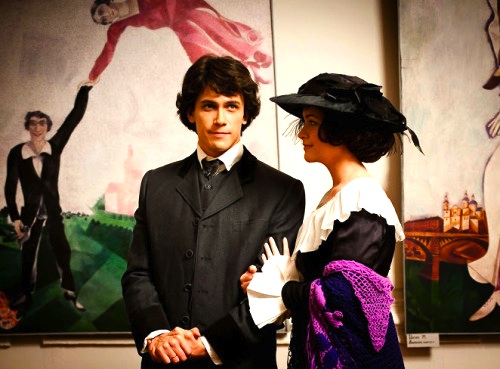
In all honesty, the events in Vitebsk did not precisely unfold in this fashion, but Mitta’s film is true in spirit. Although C-M is somewhat adapted from Chagall’s memoirs, it is really more of an adaptation of his paintings (140 of which are incorporated into the film). In many ways it is a throwback fabulist fable or a cinematic exploration of folklore and historical mythology, sort of like Alexey Fedorchenko’s Angels of Revolution and Celestial Wives of the Meadow Mari, but with a stronger narrative drive.

C-M deliberately attempts to render Chagall canvases on the big screen, striving but falling short of a look reminiscent of What Dreams May Come. In fact, the first half of the film suffers from an over reliance on whimsy, but the energy level kicks up appreciably when Malevich finally blows into town. Mitta along with Leonid Bichevin and Anatoliy Beliy, as Chagall and Malevich respectively, capture the intriguing ambiguities to their evolving rivalry. After all, Chagall recruited Malevich for the sake of stylistic diversity and intercedes with Naum on the Suprematist’s behalf at a critical juncture. Yet, Malevich had a far greater understanding of their new masters. (In subsequent real life, Malevich even anticipated he would fall out of favor with Stalin and accordingly took steps to protect his work for posterity.)

From "Chagall-Malevich."

When not playing off Beliy, Bichevin’s Chagall is basically an exuberant shaggy dog. In contrast, Beliy always conveys a sense of the wheels moving within Malevich’s head. Kristina Scheidermann is a good likeness of Rosenfeld and brings a refreshingly dry wit to the otherwise loyal and sacrificing wife. Yakov Levda and Nona Buylgina are also quite compelling as Chagall’s ardent followers, even if their subplots remain half-baked.

Frankly, it is rather impressive how Mitta remains true to his idiosyncratic vision throughout C-M. He directly addresses the mounting fear and oppression of the early Soviet state, but the film never feels heavy-handed or didactic. Of course, he has been making films since the 1960s, including the USSR’s first disaster movie, Air Crew, in 1979. Having only sixteen prior directorial credits (per imdb) after navigating the Soviet and Russian film bureaucracies for six decades, one can see how Chagall and Malevich’s stories would resonate for him. Regardless of its rough edges, it is a wistful and wise film, recommended rather fondly for connoisseurs of modern art and Russian cinema when it opens this Friday (6/12) in New York, at the Cinema Village.

LFM GRADE: B+

Posted on June 13th, 2015 at 11:57am.

LFM Reviews Peter Greenaway’s Restored The Pillow Book; Now on DVD/Blu-ray

By Joe Bendel. Think of it as a Lady Snowblood style payback drama set within the delicate serenity of a rock garden. Born to a Japanese father and a Chinese mother, Nagiko is a fashion model who enjoys the grace of fine literature and calligraphy just as much as the pleasures of the flesh. She also appreciates the satisfaction of revenge served stone-cold. As sensual, transgressive, and erudite as it was when it was initially released nineteen years ago (nearly to the day), Peter Greenaway’s The Pillow Book has now been freshly restored and reissued on DVD and Blu-ray by Film Movement Classics.

As a cherubic young girl, Nagiko always delighted in her father’s birthday face-writing ritual. Since she idolized her novelist father, literature will always play a critical role in her life. However, it is her aunt who first introduces her to the most significant book in her life, Sei Shōnagon’s Pillow Book. Throughout the film, Greenaway incorporates scenes of the Heian-era lady-in-waiting reading her timeless meditations, usually in compartmentalized windows that become part of Greenaway’s wider visual composition.

While Nagiko was still too young to fully understand, she witnesses her father’s publisher sexually exploiting him, as a clear quid pro quo for publishing his work. As she becomes older and more experienced, her father’s humiliation haunts her. Years later, Nagiko will also be published by the same lecher, but he is not the least bit interested in her. To sell the first of her unconventional pillow books, Nagiko paints it on the body of their mutual lover, Jerome, a bisexual British translator. For a while, this method of delivery is quite effective, but love triangles always engender jealousy. In this case, it also leads to tragedy, desecration, and retribution.

From "The Pillow Book."

Greenaway has always been a distinctive stylist, but Pillow is an especially rich feast for the eyes. He engages in plenty of his characteristic boxing and tiling, but he also channels the look and vibe of Kabuki and Noh theater. It is a gorgeous film, made even more so by Vivian Wu in her breakout, career-defining role. Yet, there is substance underneath Greenaway’s lush surface beauty. Arguably, Pillow Book represents a milestone in experimental storytelling in that it tells a distinct, compelling, and easily followed narrative, within a boldly avant-garde framework.

Quiet but fierce as a lion, Wu commands the screen while steaming it up. A young Ewan McGregor also gives viewers the Full Monty as the immature but passionate Jerome (Obi-Wan, oh behave). Their scenes together explain why the film was never rated. Still, it is important to remember Pillow is not all about sex. In fact, Chizuru Ohnishi and Ken Ogata are quite memorable and engaging as young Nagiko and her father, thereby setting up everything that follows.

With Pillow, Greenaway taps into some deep archetypes, while celebrating Japanese and Chinese culture with the obsessive devotion of a western expatriate. It might just be the greatest Gaijin film ever. Exquisitely crafted, Pillow could still be too scandalous for the timid (arguably, the Lord’s Prayer body painting scene might be needlessly vexing some, since it is not really intended as a provocation), but it is an eerily beautiful film. Highly recommended for fans of challenging auterist cinema, The Pillow Book released this week on DVD and Blu-ray, from Film Movement Classics.

LFM GRADE: A

Posted on June 13th, 2015 at 11:56am.