LFM Reviews Random 11

By Joe Bendel. Mitsuko Unagi was a detective prodigy, like a Japanese Nancy Drew, but her latest adult case would turn the hair of the various Carolyn Keene ghostwriters ghastly white. A serial killer has been running circles around the Tokyo police, including Unagi. Thus far, she has been the only copper able to discern his patterns, but she is always a step behind the sinister mastermind throughout Tony Sebastian Ukpo’s Random 11, which releases today on DVD from Fenix Pictures.

On significance dates (Leap Year February 29ths, ironic holidays), an unknown mass murderer somehow orchestrates the simultaneous deaths of eleven victims. Ten are chosen at random, but the eleventh is specifically chosen for some reason. At least that is Unagi’s current working hypothesis. Unfortunately, the killer seems to know she knows. He apparently deviated from the pattern during his latest horror show, leaving Unagi back at square one.

Rather embarrassed by the lack of progress, the political establishment perversely cuts the funding for Unagi’s task force, leaving only her and her trusty junior Junichi Otomo to work the case. It might not be farsighted, but it ironically gives Unagi greater flexibility. When she and Otomo discover the eleventh victim was murdered eleven thousand miles away in London, she duly picks up the trail there.

Random 11 features one of the creepier opening credit sequences in years. It is not wholly unprecedented in conception, but the execution is quite effective, setting the tone for what follows. In fact, that is true for the whole film. Although Random 11 was likely produced under severe budget constraints, its sparsely severe mise-en-scène is altogether chilling. This is a textbook case where less really is more.

From "Random 11."

Ukpo also has the advantage of a dynamite lead. If you liked the concept of the gothy wunderkind sleuth, but thought L. from the Death Note franchise was too chipper, than you have to meet Unagi. As the detective, Haruka Abe is convincingly brilliant in a social awkward kind of way. She maintains a sense of mystery and vulnerability that keeps us locked in right from the start.

In fact, Death Note is a decent comparison for Random 11, since Unagi and her Scotland Yard colleague seem to be fighting an almost omniscient foe. There is an intricate system to killings in both films, elevating them both well beyond standard issue serial killer thrillers.

Not exactly a spoiler per se, but the only real drawback to Random 11 is that it offers absolutely no closure whatsoever, trumpeting the coming of part two as the final credits roll. Otherwise, Random 11 is a genuinely suspenseful, hugely atmospheric micro-budget surprise. Highly recommended for genre fans, it is now available on DVD from Fenix Pictures.

LFM GRADE: A-

Posted on June 13th, 2015 at 11:56am.
Marko Zaror Smites Bad Guys: LFM Reviews Redeemer

By Joe Bendel. You could say this former hitman runs a particularly effective faith-based initiative. He will seek out the unjustly victimized that are pure of heart, to rain down payback on those who wronged them. In many cases, the faithful do not even know he has taken on their causes. He simply hears their prayers and answers them in Ernesto Díaz Espinoza’s Redeemer, which opened this Friday in New York.

He was once a happily married killer by the name of Nicky Pardo, but he is now known simply as “The Redeemer.” He starts each morning with a refreshing round of Russian roulette. Every time he survives, he interprets it as sign the man upstairs still wants him to continue administering retribution in his name. Some really heavy business went down in his past, involving his nemesis, “The Scorpion.” Unbeknownst to the Redeemer, the Scorpion trails along after him, killing the innocent people the Redeemer set out to avenge, in elaborately Biblical fashion. That might sound terribly cruel, but he is not called the Scorpion because he likes to play patty-cake.

The Redeemer will have his work cut out for him when he blows into a seaside village dominated by a drug cartel. When he saves a sad sack fisherman from his drug trafficking tormentors, the syndicate essentially declares war on the vigilante. It will not work out so well for them, but it gives the Scorpion time to catch up with his prey.

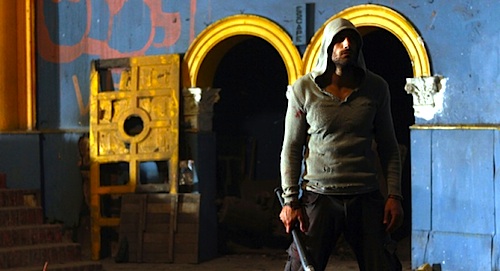
When someone as hardnosed as the Redeemer offers you a chance to repent, you should probably take it. Conversely, taking him on is not such a hot idea, even you are part of a pack of six or seven thugs. Let’s face it, Redeemer is not the most sophisticated action film to strut into theaters, but holy cats, can Zaror fight. He has weird grappling style MMA moves like you have never seen before, all of which look awesome on screen. Frankly, Zaror never talks much, but he does not need to say a lot when his piercing eyes glower out from under his hoodie.

From "Redeemer."

In many ways, Redeemer is like a throwback to the grittily effective but not exactly over-ambitious films that launched the careers of butt-kicking superstars like JCVD and even Bruce Lee. The narrative is a rather simplistic affair, intentionally designed to keep out of the way of the action showcases (yet, somehow Espinoza manages to have three credit co-screenwriters. Seriously, how many scribes did it take to write “they squint at each other and then start fighting?”) It doesn’t matter. The martial arts is the thing in Redeemer, spectacularly choreographed by Zaror. In fact, there is a show-stopping one-on-one with a no-name henchman midway through the film that could easily stand as the climax of most action releases.

This is Zaror’s show, but José Luís Mósca is all kinds bad ass as the Scorpion, while American Noah Segan provides some legitimate, non-cringey comic relief as Bradock, the new Yankee cartel boss. It might be too unpolished for casual viewers, but for genre fans there is something refreshingly honest about a film like Redeemer. It is also one of the rare Chilean films old man Pinochet would probably have approved of. After all, what’s not to like about an ultra-devout vigilante? Recommended for action fans hungry for red meat, Redeemer opened Friday (6/12) in New York, at the Cinema Village.

LFM GRADE: B

Posted on June 13th, 2015 at 11:56am.

LFM Reviews Maiko: Dancing Child @ The 2015 Los Angeles Film Festival

By Joe Bendel. For a prima ballerina, Tchaikovsky’s Swan Lake is one of the most demanding ballets to perform. You’ve seen Black Swan, right? Well, try dancing the featured role a few months after pregnancy. Maiko Neshino set out to do exactly that. The question is not whether she has the drive or the talent, but whether she has enough time to rebound physically. Åse Svenheim Drivenes follows Neshino through rehab and rehearsals in the intimate documentary Maiko: Dancing Child, which screens during the 2015 Los Angeles Film Festival.

It is almost too much, but the name Maiko really means “Dancing Child.” As is the case with truly elite dancers, her talent was indeed discovered at an early age. Neshino’s family made substantial lifestyle-effecting sacrifices to send her abroad to study. Consequently, she understood quite clearly failure was not an option. At the point the film picks up, she has been remarkably successful, maintaining her position as a principal dancer with the Norwegian National Ballet well into her thirties—and then she finally gets pregnant.

This was something she and her husband always wanted but never knew how to schedule, so they do the best they can. Most importantly, they have a happy and healthy baby. However, Drivenes is far more interested in the comeback process than the pregnancy. Swan Lake is the last significant role Neshino has yet to play, so she intends to honor her commitment, but it would be tough even under the best of circumstances.

Ballet is a graceful form of artistic expression, but those who are not part of its exclusive world will be a bit taken aback by the punishing nature of her training regimen. This is not for the faint of heart. Viewers might also get sick of hearing the same musical passage over and over again.

Frankly, it is a minor miracle the dancers never snap from the mind-torturing repetition.

Of course, the camera absolutely loves Neshino. She is elegance personified, so we can well understand why she has become the face of the Norwegian company, while her Horatio Alger-esque background makes her an even more compelling figure to root for. Drivenes also gives the audience an inside peak into to the training and rehearsal process, sort of in the spirit of Wiseman’s La Danse, but in more economical and contextualized servings.

Throughout the film, everyone makes it acutely plain nothing is guaranteed when it comes to ballet. Although it clocks in at a relatively concise seventy minutes, viewers will walk away feeling they have a good understanding of who Neshino is and what sort of professional and artistic challenges she faces. Recommended for patrons of dance and performing art docs, Maiko: Dancing Child screens this Sunday (6/14) and Tuesday (6/16) as part of this year’s LAFF.

LFM GRADE: B+

Posted on June 13th, 2015 at 11:55am.

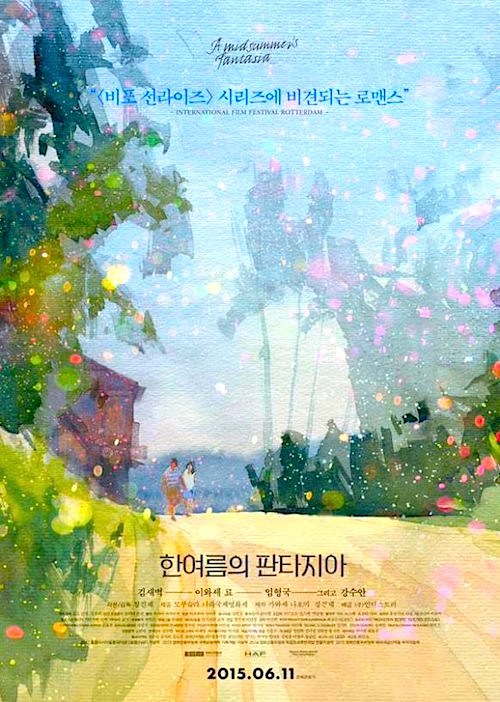
LFM Reviews A Midsummer’s Fantasia @ The 2015 Los Angeles Film Festival

By Joe Bendel. Japan and Korea share a lot of complicated history, but recent films too often reduce it all to wartime rebellion and revenge dramas. However, the sleepy village of Gojo is delighted to have Korean visitors and the Korean filmmakers are quite charmed by their hosts. Frankly, they are not precisely sure what they are looking or whether they find it, but they still find their trip rewarding in Jang Kun-jae’s A Midsummer’s Fantasia, which screened during the 2015 Los Angeles Film Festival.

A filmmaker has come to the provincial mountain village of Gojo to research his next film, bringing along his assistant director Mijung to translate. They definitely stand out, but not because they are Korean. Due to economic and demographic factors, nearly all of Gojo’s younger generations have migrated to the big cities, leaving a dwindling elderly population behind. While their stories are somewhat commonplace, the director and Mijung still find them compelling. Perhaps it is just something about their interview subjects’ presence.

Soon, they meet up with Gojo’s most eligible bachelor: a city official who was once an aspiring actor. He will take them on a special guided tour, impressing the Koreans with his choice of more telling, off-the-beaten-path locales. In fact, it might provide the inspiration the filmmaker is hoping for. The resulting film will probably be Well of Sakura, which also constitutes the second half of Jang’s Fantasia, rendered in color, as a change up from the elegant black-and-white of the first segment.

Mijung is now a scuffling Korean actress, who has come to Gojo as a tourist, seeking some sort of spiritual detox. A local persimmon farmer offers to serve as her guide after a chance meeting near the station. As they revisit the sites the film director visited, he becomes rather smitten. Unfortunately, despite their undeniable chemistry, Mijung does not feel free to reciprocate his romantic interest. Yet, she does feel something.

With its parallel structure and ships-passing-in-the-night themes, it is easy to liken Fantasia to Hong Sang-soo’s Hill of Freedom. In a way, they are inverse films, with Hong following a Japanese visitor to Korea desperately searching for the ex-girlfriend he never got over. Hill is one of Hong’s better films, so it is a rather apt comparison, regardless of his rep for mannered and precious filmmaking.

It is hard to describe, but Jang completely captures the sense of summer laziness morphing into something more serious. It is a carefully constructed film, but Jang privileges vibe and atmosphere over narrative, which provides quite a supportive platform for his small cast. As Mijung and Mijung, Kim Sae-byuk is simply incredible, managing to be simultaneously sad and seductive, as well as flirty and wise. Ryo Iwase is nearly unrecognizable as her two very different guides, cranking up the romantic yearning in the second half. Although he only appears in the black-and-white sequences, the distinctive maturity and humanism of Lim Hyeong-gook’s director also wears well on viewers.

In a way, Fantasia gives a slightly postmodern twist to the gentle, bittersweet Local Hero style of comedy, in which city folk take the time to smell the roses while temporarily ensconced in a picturesque provincial community. Yet, even with its gamesmanship, Fantasia is unusually fragile and fragrant, lingering pleasantly as a hazy memory after the initial viewing. Recommended for fans of summer breezes and brief but significant romances, A Midsummer’s Fantasia next screens this Sunday (6/14) during the Korean Film Festival at the Freer Gallery in DC (following Hong’s Hill).

LFM GRADE: A-

Posted on June 13th, 2015 at 11:54am.

LFM Reviews Reptilia in Suburbia @ New Filipino Cinema 2015

By Joe Bendel. In the 1990s, there were no suburbs per se, where upper middle class residents of Metro Manila could retreat from crime. Instead, affluent gated enclaves sprung within the urban sprawl. In most cases, the gates kept the criminal element out, but in the case of Eden Homes, the insanity is fenced in. Words fail to describe the madness that is Timmy Harn’s Reptilia in Suburbia, which screens as part of the 2015 edition of New Filipino Cinema at the Yerba Buena Center for the Arts.

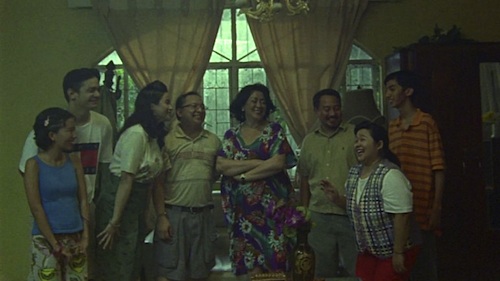
Dr. Dimalanta is a Satanic mad scientist who keeps Jake, a serial killer “gimp” chained up in his living room. Jake is mostly likely responsible for a rash of canine murders that have recently terrorized Eden Homes, but what really has some of the Borromeos distressed is Alan the underachiever’s decision to move back in with his mother. Her favored grown son Greg is openly contemptuous of his brother, but at least the Borromeo cousins get along reasonably well. Greg’s son and daughter even introduce the eczema suffering Jasper to weed, but he is more interested in helping Brook Lyn, the girl next door, find her missing lap dog. At least, that is an attempt to impose some narrative structure on Reptilia’s unruly tripppiness.

Frankly, Reptilia just might be a work of demented genius. The demented part is certainly beyond question. Harn deliberately gives it the look of a hacked-up grade-Z DIY flick, as if seen on an old school UHF channel, received through a coat-hanger wrapped in tin foil. You can tell extraordinary effort was expanded to craft such a consistently dingy look, because any other ultra-grubby indie would try to find some way to look more polished than its budget constraints would allow. In fact, the unity of Harn’s vision is strangely impressive.

From "Reptilia in Suburbia."

Despite the lack of continuity and structural logic, Harn’s game cast takes their roles quite seriously, including trailblazing Filipino animator and independent filmmaker Roxlee unleashing his inner Angus Scrimm as “Waldo” Dimalanta. There are a lot of whacked out things happening throughout the film, but the chemistry shared by the young cast members is actually rather winning.

Cinematographer Danilo Salas III, editor Sandra Santiago, and Harn’s post team make Reptilia look like it is on scratchy, crackly film stock that barely survives the decay of age and neglect. It feels more like an artifact of a mad outsider artist than a proper film. Yet, it is much more watchable than it sounds, once viewers acclimate themselves to Harn’s idiosyncratic aesthetic.

In all honesty, anyone whose tastes are remotely conventional should skip Reptilia, or risk having their heads explode. On the other hand, anyone who seriously follows cult cinema should see it, just so they can say they have seen it. Defying all sense of reason and good taste, Reptilia in Suburbia is required viewing for those who are still reading when it screens this Sunday (6/21) as part of New Filipino Cinema 2015 at the Yerba Buena Center for the Arts in San Francisco.

LFM GRADE: B+

Posted on June 13th, 2015 at 11:54am.

LFM Reviews Der Samurai; Now on DVD/Blu-ray

By Joe Bendel. Could Brian De Palma still make a film like Dressed to Kill today? Maybe in Germany. You will find more than wolves terrorizing this quaint little German village. There is also a cross-dressing, samurai sword-wielding psychopath running amok in the woods. Have no fear, plenty of homophobes will get their bloody comeuppance during his violent spree, so that ought to make it okay to enjoy Till Kleinert’s Der Samurai, which releases today on DVD and Blu-ray.

Jakob Wolski represents the Barney Fife tradition of nebbish provincial lawmen. None of his contemporaries respect his authority and his commander is not exactly encouraging. The crusty copper is particularly skeptical of Wolski’s plan for dealing with the wolf that has been preying on the town’s animals. Rather than killing it, Wolski wants to lead it away with butcher-fresh meat. However, he will have to back-burner the wolf when a mysterious squatter calls him out to an abandoned farm house. Somehow, the violent man bearing the vintage sword seems to know quite a bit about Wolski. He may or may not have some sort of connection to the wolf as well. Regardless, when the Samurai unleashes his fury on the town, Wolski will be hard pressed to stop him.

From "Der Samurai."

Frankly, it is hard to say in today’s hyper-sensitive world whether Der Samurai is politically incorrect or a sly consciousness-raiser—and why should we even care? What’s important here is the generous helpings of gore and the eerie moodiness Kleinert offers up. While it is not as deliberate an homage as It Follows, the unsettling electronic score and stifling small town setting feel like a postmodern synthesis of old school John Carpenter.

Although Der Samurai is an indie production bordering on outright DIY, it is surprisingly polished looking. Kleinert builds a strong atmosphere of mystery (albeit through devices that are never fully explained), while steadily cranking up the tension. Michel Diercks also sells the madness quite credibly, while looking so obviously repressed, his head might explode. Likewise, Pit Bukowski pretty much goes unrestrainedly nuts as the feral Samurai.

Despite getting a tad heavy handed with the sexual identity games down the stretch, Kleinert has crafted a distinctive genre picture with a strong sense of place. Even with its excesses, it is tightly paced and generally grabby. Recommended for cult cinema connoisseurs, Der Samurai is now available for home viewing on DVD and Blu-ray.

LFM GRADE: B

Posted on June 13th, 2015 at 11:53am.