By Joe Bendel. He is like an Old West daguerrotypist capturing the faces of the vanishing frontier, except this barnstorming photographer travels through Tibet. Viewers will watch him work in Hu Wei’s Butter Lamp, which screens during Shorts Program 2 at the 51st New York Film Festival.
At first it looks rather surreal. A quick succession of Tibetan nomads assembles for family photos shot in front of the photographer’s wildly anachronistic fake backdrops, such as Disneyland and the Great Wall of China. Every time the shutter clicks Hu skips ahead to the next family. The older nomads still don traditional formal dress and wield their prayer wheels, but in each subsequent photo sessions, the younger, impatient generation more frequently wears blue jeans and western sportswear.
While the format is simple, Butter offers a shrewd commentary on globalization and the deliberate marginalization of Tibetan culture. While an elderly woman will prostrate herself before the image of Potala Palace, most of the photographer’s customers chose something reflecting a more consumerist lifestyle. Yet, some customs are still observed.
Straddling the boundaries between dramatic narratives, documentaries, and cinematic essays, Butter Lamp is visually inventive and decidedly zeitgeisty (particularly at a time when the Tibetan language is struggling for survival, per government policy). Patrons on a New York budget may not feel Hu’s fifteen minute film alone justifies the price of a ticket, but it is an accomplished production, well worth acknowledging. It screens this Sunday (10/6) and next Thursday (10/10) as part of the 2013 NYFF’s Shorts Program 2.
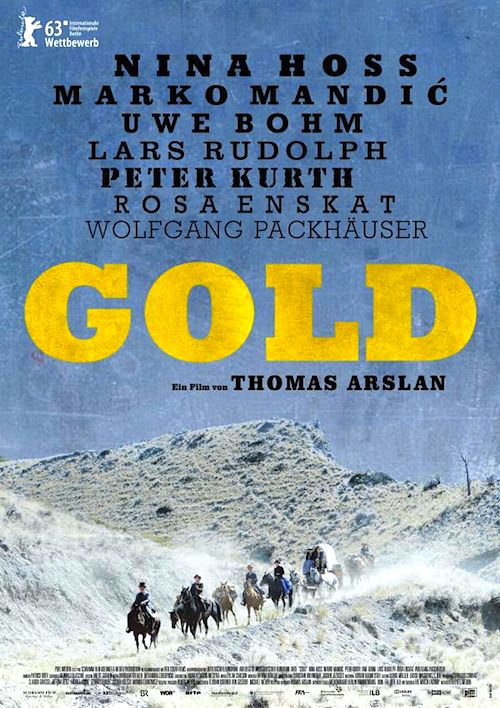
By Joe Bendel. Is it worth risking life and limb for the chance to go bust in the Klondike goldfields? A party of German immigrants believes so. They will endure exploitation and the elements for their dreams of precious metal in Thomas Arslan’s Gold (trailer here), which screens as part of the Goethe Institut’s German Currents: Festival of German Film in Los Angeles.
There is gold in those hills some place. Unfortunately, Laser, a German promising to take a ragtag group of prospective prospectors up to the remote gold-crazed town of Dawson, is a total phony. Although Emily Meyer has few illusions about their guide’s reliability, she continues on the journey. Like the rest of her group, the divorced former domestic servant has no life to go back to.
At least Laser hired a dependable packer. Carl Boehmer has never been so far north either, but he has cause to make himself scarce. As the harsh conditions take a toll on the travelers, a quiet mutual attraction percolates between Meyer and Boehmer, but it is a halting flirtation, due to reasons of privacy and privation.
Gold certainly demonstrates how ugly survival can get. There is at least one scene that will surely have audience members talking afterward and may unfairly come to define the film. Following in the tradition of revisionist westerns, Gold is pensive but never pokey. In fact, it observes western conventions when you least expect it.
Nina Hoss is a brilliant choice to play the reticent but resilient Meyer. Following up remarkable work in Barbaraand A Woman in Berlin, she once again delivers a tightly controlled but infinitely suggestive performance. She finds a fitting partner in Slovenian actor Marko Mandić, who has a real Viggo Mortensen vibe going on as Boehmer.
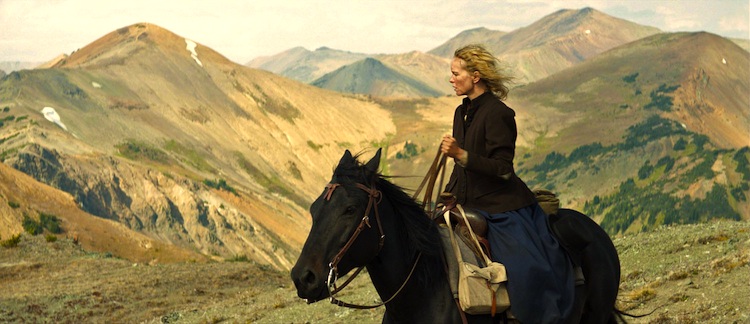
Gold is rather fascinating as an example of the Old World engaging with the New World. It looks terrific, thanks to cinematographer Patrick Orth’s John Ford-worthy vistas. Dylan Carson’s reverb-heavy electric guitar score also evokes the haunted past, while sounding ultra-retro-contemporary. Finely crafted and gritty as trail dust, Gold is a good film as well as a curiosity piece. Recommended for fans of naturalistic westerns and German cinema (two sub-sets that do not often overlap), Gold screens this Sunday (10/6) at the Egyptian Theatre as part of this year’s German Currents.
By Joe Bendel. In its heart of hearts, baseball is a neurotic sport. The best games, decided in the late innings, all come down to a simple question—who will choke, the pitcher or the batter? The statistics always favor the pitcher, but fans live in constant hope of that dramatic walk-off home run. We have been conditioned to it after seeing so many of them over the years. None is as indelible in sports fans’ collective memory as the ninth inning game-winner Bobby Thomson hit off Ralph Branca to secure the 1951 National League pennant for the New York Giants—the so-called “Shot Heard ‘Round the World.” However, Branca had not cracked. He made his pitch: high and inside, a terrible home run ball. Thomson just knocked it out anyway.
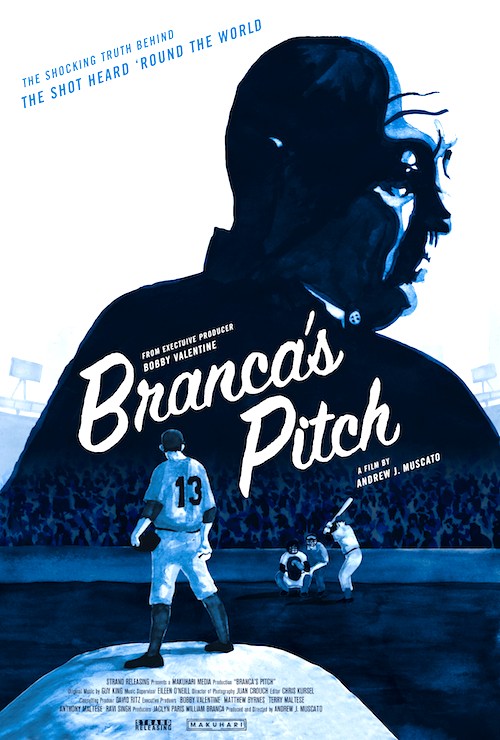
There is more to this story than fans realized, but Branca had to live with the results just the same. Viewers will learn the truth behind baseball’s most iconic game and how it changed the three-time All-Star’s life in Andrew J. Muscato’s documentary profile, Branca’s Pitch, now available on DVD from Strand Releasing.
For years, every time Thomson’s home run was replayed on television, Branca grinned and bore it, like a good soldier. A family man with a prosperous life insurance business, Branca’s post-baseball career was considerably more successful than most of his contemporaries, but that one moment in 1951 dogged him nonetheless. Finally, Branca decided to tell his story, enlisting the help of prolific ghostwriter David Ritz.
You might very well have some of Ritz’s work on your shelf. Originally inspired by Billie Holiday’s Lady Sings the Blues, Ritz has somewhat specialized in co-writing the memoirs of jazz, blues, and R&B artists like Jimmy Scott, Ray Charles, Buddy Guy, Nathalie Cole, and B.B. King. Ritz also happens to be a Brooklyn guy, so he and Branca get along famously.
In addition to a sports doc, Pitch also explores the largely overlooked relationship between a famous memoirist and their ghostwriter (or credited co-writer in Ritz’s case). Cynically, we often assume this is a rather cold-bloodedly commercial relationship, but a genuine friendship blossoms between Branca and Ritz. At one point, Ritz describes Branca’s voice as quite intelligent and well educated, but still a little bit “street,” which seems to fit the co-writer’s sensibilities like a mitt.
Ritz and Muscato both convey a sense that Branca can go days or even months without thinking of the fateful pitch, but as the macro years pass, he still bitterly resents being defined by that one pitch, especially since facts have since come to light suggesting that the Giants late season surge just wasn’t cricket. (Well reported in numerous sources, readers can reference Joshua Prager’s The Echoing Green for specific details, or wait for Pitch to reveal all in due course.) He is both at peace with the past and deeply outraged—a contradiction Ritz argues he is wholly entitled to.
Executive produced by oh-so former Mets manager Bobby Valentine, Pitch nicely captures baseball’s influence on American culture and the cathartic relief Branca experiences when his side of the story finally enters the public discourse. It is a sports doc, but also a publishing story. Recommended for baseball fans and New Yorkers of all stripes, Branca’s Pitch is now available for home viewing from Strand Releasing.
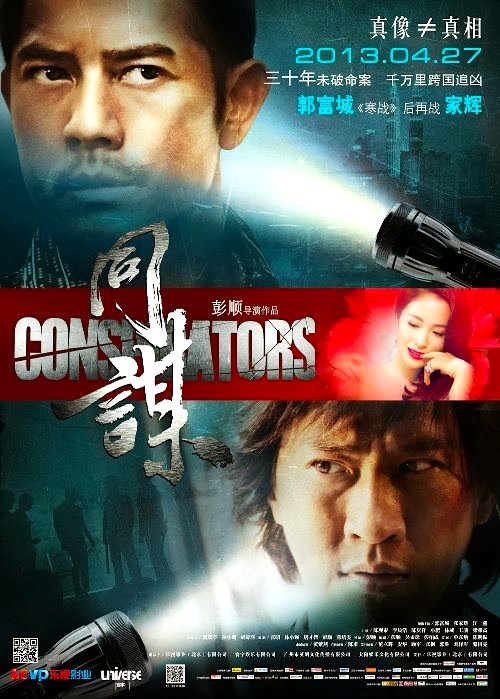
By Joe Bendel. They say lawyers who represent themselves have fools for clients. Evidently, the same holds true for private detectives. This is especially true of Chan Tam, the so-called “C+ Detective,” who has never inspired much confidence with his sleuthing skills. He will enlist a local gumshoe in Malaysia for a highly personal case in Oxide Pang’s The Conspirators (a.k.a. The Detective 3), which screens during the San Francisco Film Society’s annual Hong Kong Cinema film series.
As the dubious hero of Pang’s Detective franchise, Tam has considerable history as a character, but the only backstory viewers need to know Pang establishes in about five seconds. The C+ Detective’s parents were murdered by the drug cartel they may have once worked for in some capacity, so Tam has come for revenge. Since Thailand is his base of operations, he has retained the services of Zheng Fong-hei, a skilled but asthmatic martial artist, who is considerably better at his job than Zheng.
As soon as Zheng starts helping Tam track down persons of interest, dead bodies start popping up. It is dangerous to be an old friend of the family like the mysterious Chai. Before long, both detectives are marked for murder. However, the soon-to-be late Chai’s daughter might know where to find the MacGuffin Tam lost before he even knew he had it.
Pang is not Johnnie To, but he can still stage an effective action scene, capitalizing on one-time Royal Hong Kong police officer Nick Cheung’s chops. In fact, Conspirators has a murky, morally ambiguous atmosphere that is quite evocative of 1970’s genre films. It is also rather entertaining to see watch Cheung’s Zheng and Kwok’s Tam engage in a battle of hardnosed seething. Cheung takes the honors, but Kwok hangs with him, revisiting what has become his signature character of the last decade or so. Shaw Brother alumnus Chen Kuan Tai and Bullet Vanishesstandout Jiang Yiyan also add further noir heft to the supporting ensemble.
The crime story mechanics of Pang’s screenplay, co-written with his brother Thomas and Ng Mang-cheung, are all rather workaday, but the execution on screen is quite strong. Old pros Cheung and Kwok deliver the goods as the action co-leads, while Pang drenches everything with pseudo-John Woo visual style. The results are highly entertaining. Recommended for fans of dark revenge thrillers, The Conspirators screens this coming Sunday (10/6) as part of the SFFS’s eagerly awaited Hong Kong Cinema series.
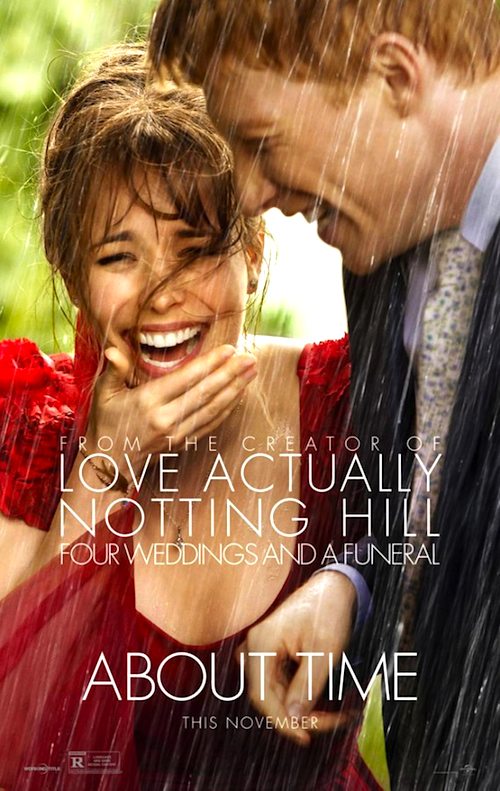
By Joe Bendel. Ginger-haired Tim Lake is about to learn he was born into a family of Quantum Leaping time travelers. According to his father, it only applies to the men, so his mother and sister remain oblivious to their theoretically great power. Like Scott Bakula, they can only jump backwards within their own lifetimes. There will be only one hard and fast rule for them to follow when Four Weddings and a Funeral director Richard Curtis gets his Groundhog Day on with About Time, which screens during the 51st New York Film Festival.
When Lake’s dad drops the H.G. Wells bomb on his 18th birthday, the shy teen assumes it is a joke. Obviously romantically challenged, Tim’s tries to use the family talent to woo his free-spirited sister Kit Kat’s hot houseguest, Charlotte. Yet, she is not having him, regardless of how many do-overs he takes. He will have better luck with Mary, a Yank who you could definitely bring home to meet the family.
Eventually, he does just that. Domestic bliss and moderate professional success seem to be well within the adult Lake’s grasp, but he worries about his increasingly depressed sister. When he tries to prevent her meeting Mr. Wrong, he discovers the one big catch of time travel. When asked, it turns out his exceptionally laidback father has one or two more revelations in store for him.
Everything surrounding About Time, including Curtis’s reputation, screams romantic comedy, but that simply is not the case. Granted, the first act is devoted to Tim’s clumsy courtship of Mary, but that is simply a way to establish the parameters of the time travel system (only to break them shortly thereafter). About Time is really a father-son relationship dramedy, and a pretty good one.
Probably the most popularly accessible film at this year’s NYFF, About Time is not exactly awards bait per se, but any Oscar campaigner worth their salt should be willing to take a shot with Bill Nighy. As usual, he is a model of wit and sophistication, but he delivers the big fatherly pay-off in spades. Yet, he still maintains that understated persona, foreswearing mawkish sentiment.
From "About Time."
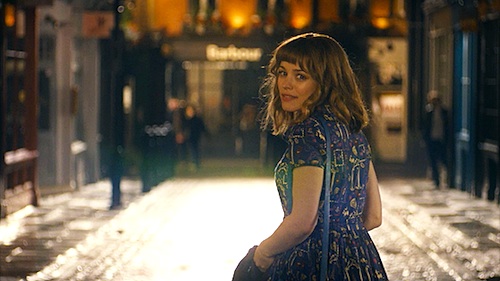
Domhnall Gleeson is appealingly earnest as Lake, plus he has red hair. However, Rachel McAdams looks rather out of place as Mary, not that it matters. Women in general are rather passive in About Time, essentially playing the role predestined by their time traveling men. Even Lindsay Duncan, the dread terror from Le Week-End, plays a decidedly subordinate role as Tim’s mother.
Still, like Curtis’s past crowd pleasers, About Time is peppered with colorful supporting turns and near cameos, notably including Richard E. Grant and the late great Richard Griffiths as two hammy stage actors. Surprisingly, British TV veteran Richard Cordery steals the show when we least expect it as Lake’s eccentric Uncle Desmond. Pan Am’s Margot Robbie certainly looks the part of Charlotte the temptress (which adds entertainment value). On the other hand, Tom Hughes is conspicuously miscast (again) as Kit Kat’s bad boy boyfriend Jimmy Kincade.
About Time bends its own rules left and right, but viewers will just have to deal with it. (This is fantastical time travel rather than the science fictional variety.) Curtis is more interested in building to emotional moments, which resonate considerably more deeply than one would expect. Recommended for fans of Nighy and mainstream relationship-driven fantasy, About Time screens today (10/2) and Sunday (10/6) as a Main Slate selection of the 2013 New York Film Festival.
By Joe Bendel. Tourists visiting Prague’s Rudolfinum concert hall will find themselves in Jan Palach Square. The newest public square in the Old Town quarter, it was known as Square of Red Army Soldiers during the grim era of Communism. An earnest university student, Palach sacrificed his life to re-awaken opposition to the Soviet occupation of 1968 (those very same Red Army Soldiers), eventually becoming a galvanizing symbol of the Velvet Revolution.
Polish filmmaker Agnieszka Holland was also studying in the then-Czechoslovakia when Palach self-immolated on Wenceslas Square. She shared the feelings of inspiration, frustration, and rage that swept across the country in the days that followed. The tenor of those oppressive times is masterfully captured in Holland’s Burning Bush, a highly cinematic three-night miniseries produced for HBO Europe, which screens during the 51stNew York Film Festival.
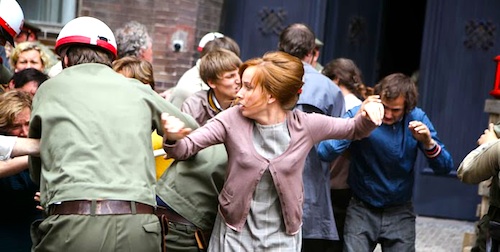
Watching a man ignite himself into flames is a disturbing sight, as Holland shows viewers in no uncertain terms. Unfortunately, Palach does not die immediately, but lingers on life support for three days. Having left multiple letters of protest, there was no question why Palach did what he did. As he hoped, the student movement is emboldened to call for a general strike. The government swings into full panic mode, fearing more will follow his example. The Party’s heavy-handed techniques do not sit well with Police Major Jireš, but his ostensive subordinate is more than willing to do the dirty work he assumes will advance his career.
As months pass, Palach’s fragile mother, Libuše Palachová, becomes the target of a ruthless harassment campaign. When a hardline member of parliament publicly slanders Palach at a regional CP conference, the Palach family decides to file suit, but finding a lawyer willing to accept their case is a difficult proposition. Eventually, Dagmar Burešová agrees to take the case, but it will cost her family dearly.
Although Palach appears relatively briefly in Burning Bush, his absence is felt keenly throughout. He is the missing man—the ghost at the banquet. However, his mother and her advocate are very much of the world as it was, and must carry on as best they can. Frankly, Burning Bush will be nothing less than revelatory for many viewers. Typically films dealing with the Prague Spring and subsequent Soviet invasion end in 1968, with a happier 1989 postscript frequently appended to the end. However, Holland and screenwriter Štĕpán Hulík train their focus on the nation’s absolutely darkest days.
A onetime protégé and close collaborator of Andrzej Wajda, Holland has vividly addressed the Communist experience with films like The Interrogationand To Kill a Priest, while also finding tremendous American success directing leading-edge HBO programs like The Wire and Treme. On paper, Holland sounds like the perfect director for this project, yet she manages to exceed expectations with a clear-cut career masterwork.
From "Burning Bush."
There is considerable scale to Burning Bush, but it is intimately engrossing. Viewers acutely share the fear and pain of the Palach family and marvel the Bureš family’s matter-of-fact defiance. Somehow Holland simultaneous builds the suspense, as Burešová methodically exposes the Party’s lies and deceits, as well as a mounting sense of high tragedy, as secret police rig the system against her.
Jaroslava Pokorná’s turn as Palach’s mother is not merely a performance, it is an indictment viewers will feel in their bones. It is a convincingly harrowing portrayal of a woman nearly broken by the Communist state. Likewise, Petr Stach conveys all the inner conflicts roiling inside Jiří Palach, the brother forced to hold himself together for the sake of his family (and arguably his country). Ivan Trojan’s increasingly disillusioned Major Jireš adds further depth and dimension to the film. Although it is the “glamour” role, Tatiana Pauhofová still scores some impressive moments as Burešová, particularly with Jan Budař as her husband Radim Bureš.
Chosen by the Czech Republic as its official foreign language submission to the Academy Awards, Burning Bush is either excellent cinema or outstanding television, depending on how chose to categorize it. Although its 234 minute running time might sound intimating, it is a blisteringly tight and tense viewing experience. An important but deeply moving work, itis the one true can’t miss selection of this year’s NYFF, especially since its length makes it such a challenge to program. At this point only stand-by tickets are available, but it is worth trying your luck when the exceptional Burning Bush screens this Friday (10/4) and the following Wednesday (10/9).