By Joe Bendel. They lack the official recognition of the Falasha Ethiopians, but a small group of Igbo Nigerians remain convinced they are part of one of the ten lost tribes of Israel. ‘Small’ would be the word to emphasize here; in a country almost entirely divided between Christian and Muslim believers, Jewish Nigerians are a distinct minority. Nonetheless, growing numbers of Igbos are embracing Judaism as part of their heritage. Jeff L. Lieberman documents their lives and faith in Re-Emerging: The Jews of Nigeria, which screens as part of the 2012 African Diaspora International Film Festival in New York.
It is complicated, but many Igbo believe they are the modern day descendants of the Tribe of Gad. It could certainly be possible, but it would have been one arduous trek. One has to have a little faith. Still, the Jewish Igbo point to striking ways their language and culture corresponds to Hebrew and Jewish religious practices. Tragically, the Igbo experience during the 1967-1970 Nigerian Civil War also somewhat paralleled that of European Jewry during World War II, with an estimated three million Igbo killed due to the massacres and economic blockades perpetrated by the Muslim north.
From "Re-Emerging: The Jews of Nigeria."
Whether Eri, fifth son of Gad, really made it to Nigeria hardly matters to Rabbi Howard Gorin, who emerges in Re-Emerging as one of the most impassioned international advocates for the Jewish Igbos. Like Rabbi Gorin, the Jewish scholars who have visited the Igbo community describe the experience for Lieberman as inspiring and even humbling.
Indeed, there are some surprisingly affecting moments in Re-Emerging. Lieberman also supplies a good deal of helpful cultural-historical context without bogging down the film in anthropological minutia. Nor does Lieberman turn a blind eye on the institutional corruption afflicting Nigeria at large. Yet he raises the intriguing question of what Igbo Judaism might mean for African-Americans, many of whom are descended from captured Igbo slaves, without fully exploring the implications.
Re-Emerging is an informative film that broadens one’s perspective on both the Jewish and African Diasporas. Indeed, it is a laudably inclusive selection of this year’s ADIFF that ought to expand the festival’s audience. Recommended for multicultural and multi-faith audiences, Re-Emerging: The Jews of Nigeria screens next Monday (12/3) at the Columbia Teachers College Chapel as the 2012 ADIFF continues in venues throughout New York.
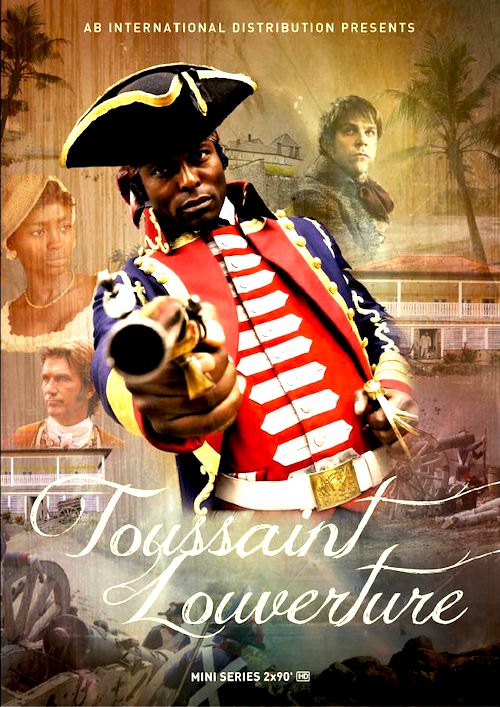
By Joe Bendel. Toussaint Louverture was a freed slave, an abolitionist, and a onetime slave-owning plantation master. He led an epic life dramatized in all its messy glory throughout Philippe Niang’s two part French miniseries, Toussaint Louverture (trailer here), which screens in its entirety as the centerpiece selection of the 2012 African Diaspora International Film Festival in New York.
Told in flashbacks, viewers know right from the start that Napoleon will eventually have his fill of Louverture, consigning him to prison, where his lackeys interrogate the Haitian general for the whereabouts of an apocryphal buried treasure. In a way, Louverture was lucky to be there. Having watched a cruel slaver murder his father, the young Louverture would have been next had Bayon, a more humane plantation holder, not interceded (evidently, this scene involves some dramatic license, but so be it). Recognizing the boy’s talents, Bayon somewhat reluctantly teaches Louverture to read and even grants him his freedom as a young man. The evolving, cliché-defying relationship between the two men is one of the strongest elements of this bio-drama.
Eventually, Louverture takes arms, but again this is complicated. Serving as an officer first for the Spanish and then the French, Louverture fought against every European power in Haiti at one time or another. Although he is an abolitionist, Louverture strives to maintain strategic ties to the colonial landlords. The Louverture Niang shows the audience is not a class warrior. He wants to keep their capital in Haiti—he just doesn’t want to be considered part of it. However, this inevitably brings conflict with hotter heads intent on score-settling.
Indeed, the tragedy of Niang’s Louverture is the way cynical white, black, and mulatto Haitians exploit racial resentment to further their power games. It is also fascinating to see how the chaos of the French Revolution shaped events a hemisphere away. However, given Louverture’s reputation as one of history’s great revolutionaries, many viewers will be surprised that there are no battle scenes in Niang’s production, just the anticipation and consequences of armed conflict.
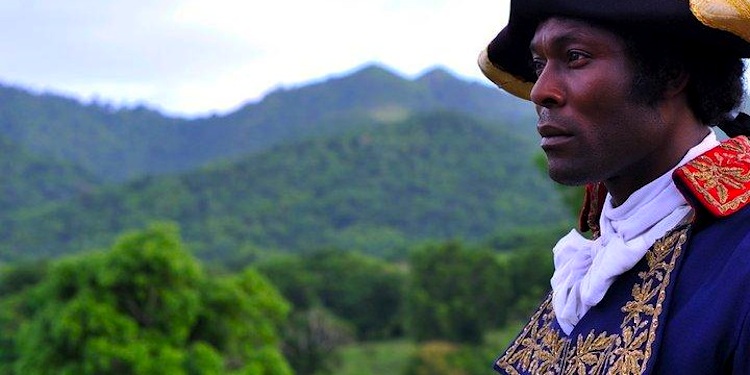
Jimmy Jean-Louis as Toussant Louverture.
Something of a throwback to the epic historical minis of the 1980’s, Louverture is sweeping, melodramatic, and ennobling in a very satisfying way. As one might expect, Jimmy Jean-Louis’s dynamic lead performance is the key. He is suitably intense, without allowing Louverture to degenerate into a fire-breathing revolutionary stereotype. Likewise, Philippe Caroit genuinely humanizes the French old guard as the decidedly un-Legree-ish Bayon.
A French television veteran, Niang’s tele-movie Prohibited Love (which screened at the 2010 ADIFF) also dealt with racial themes pointedly, but without wallowing in didacticism. Louverture is even better. In fact, it should appeal to audiences across the ideological spectrum, aside from any odd remaining Bonapartists out there. Appealingly old fashioned, Toussaint Louverture is a well produced period drama, recommended for history buffs and Francophone audiences when it screens next Saturday and Sunday (12/1 and 12/2) as the centerpiece of this year’s ADIFF.
By Joe Bendel. It is like the Bewitched version of the “Scottish Play.” Two identifiably different actors will play the murderous general, due to complicated circumstances. It is all part of the backstage drama brought to the fore in Nadine M. Patterson’s meta-postmodern-experimental-musical-docudrama Tango Macbeth (trailer here), which screens during the 2012 African Diaspora International Film Festival in New York.
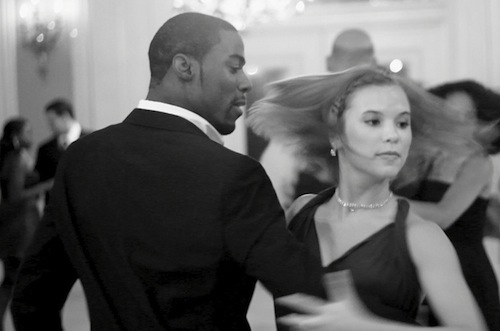
Unconventional in many ways, this Macbeth will be choreographed. Yes, there will be tango, as well as some vaguely Fosse-esque steps, but that is the least of Patterson’s gamesmanship. While the play itself is shot in stylized music video-style black-and-white, the ostensive behind-the-scenes rehearsal will be filmed in Wiseman-like color. There will be nearly as much fireworks going on amidst the cast and crew as in the presumptive play within the film.
Hopefully, it is all a bit of meta-meta fun, or else Macbeth #1 will be in for some indigestion when he finally screens Tango. Yet, the Shakespeare is still in there and the cast is often quite good bringing out the flavor and dynamics of Shakespeare’s most perilous tragedy. In fact, Brian Anthony Wilson is absolutely fantastic as Macduff (and himself as Macduff), blowing the doors off the Thane of Fife’s big scenes. Based on his work in Tango, most viewers will probably be up for watching him tackle the title role in a more traditional production.
From "Tango Macbeth."
Alexandra Bailey also has some powerful scenes as Lady Macbeth, apparently developing some nice chemistry with both Macbeths. If Carlo Campbell, Macbeth #1, always appears in character[s], than it is a really fearless performance. Ironically though, Eric Suter’s best scene comes not as Macbeth #2, but when he was still a swing player, appearing as Lady Macbeth’s assassin.
It might seem hypocritical to criticize Anna Karenina for Joe Wright’s stylistic excesses, but praise Patterson’s explicitly avant-garde approach. Yet, they are coming from two very different places. While Wright is just tossing in a distracting bit of hipster pretension, Patterson is fundamentally deconstructing both Shakespeare and traditional notions of stage drama.
The talented ensemble makes quite a mark in Tango, yet it is likely to disappoint anyone hoping to see actors in classical costume, dancing about with roses in their teeth (perhaps bitterly so). However, for the aesthetically adventurous it is a fascinating production. Recommended for frequent patrons of the Anthology Film Archives, it screens Saturday (11/24) and Sunday (11/25) as part of this year’s ADIFF.
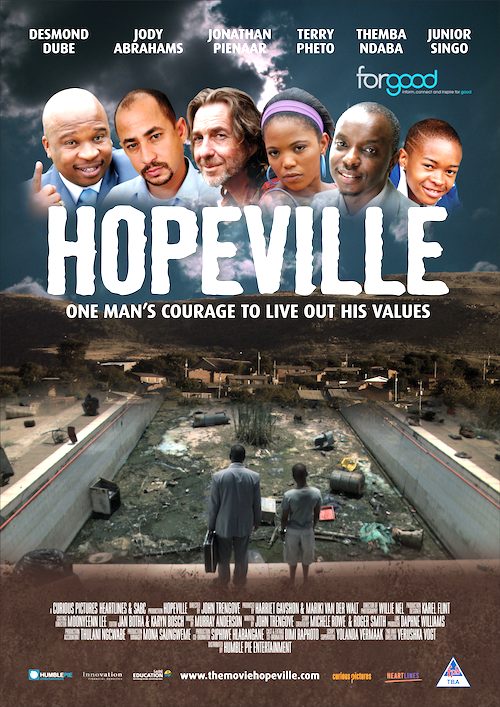
By Joe Bendel. Hopeville is the sort of town that will drive you to drink. It is probably not the place for a recovering alcoholic granted provisional custody of his estranged son, but Amos Manyoni does not have a lot of options in John Trengove’s Hopeville (trailer here), an original feature film adaptation of the popular South African miniseries, which screens as part of the 2012 African Diaspora International Film Festival in New York.
Pools play in important role in the life of Manyoni’s son Themba. He was a champion swimmer, but his mother tragically died in an accident en route to one of his meets. Clean and sober for over a year, Manyoni regains his parental rights, as long as he adheres to three conditions: stay away from alcohol, hold down a steady job, and provide Themba access to a pool. Hopeville sounds perfect. He has a gig lined up there with the municipal government and there is a pool, except not really.
Drained and in a state of disrepair, the pool now serves as a garbage dump. The corrupt mayor and his council cronies are planning to develop it into a booze drive through, but they are reluctant to tell Manyoni their plans forthrightly. Instead, they do their best to secretly undermine his efforts to single-handedly fix up the pool. Much to their frustration, though, Manyoni’s work begins to inspire the depressed town.
Hopeville is the sort of film tailor-made for feel-good festival play. There is redemption, family values, spirited old folks, and triumph over adversity. Manyoni even develops a romance with Fikile, the mayor’s ice cream vendor mistress, but it is decidedly chaste—just an odd kiss and a bit of handholding.
From "Hopeville."
Of course, you cannot spell “Hopeville” without “evil.” That might be too strong a term, but Desmond Dube’s venal mayor is definitely a pointed portrayal of post-apartheid political opportunists. Yet, by and large, Hopeville is about inclusion and multi-racial community.
Themba Ndada is painfully earnest but still reasonably down to earth and credible as Manyoni. While there is a lot of manipulation going on, viewers will still find themselves caring about his trials and tribulations. While Dube plays the mayor like a caricature of graft, Hopeville boasts several appealingly colorful supporting turns, including Jonathan Pienaar as the Fred, the not-as-bad-as-he-looks barkeep.
On one hand, Hopeville is competently produced, likable, and well-intentioned. It is also predictable and sentimental. Sometimes, that is all rather comforting. Recommended for patrons in the mood for reassuringly inspirational cinema or interested in contemporary South African film, Hopeville screens this Saturday (11/24) and the following Thursday (12/6) as part of the ADIFF in New York.
By Joe Bendel. An expansionist Eastern regime is dead set on war with Japan, at a time when America’s defense capacity and influence in the UN are both at all time lows. They say it’s the near future, but it feels only too near. Still, there may yet be hope in Isamu Imamake’s apocalyptic anime feature The Mystical Laws, created by executive producer Ryuho Okawa (founder of the controversial Japanese religious fusion movement, Happy Science) which opens this Friday in New York.
In an authoritarian country not identified as China, a shadowy military science officer named Tathagata Killer assumed power in a coup. Now known as the Godom Empire, his kingdom becomes the dominant super-power, thanks to the remarkable technology provided by the beautiful but mysterious industrialist Chan Leika.
The world slept while the demonic dictator consolidated power, except Hermes Wings. Partly a Doctors Without Borders-style NGO and partly a secret society dedicated to preserving free democratic values, Hermes Wings is considered the greatest threat to the Godom overlord, so he targets them accordingly. Through tragic circumstances, Sho Shishimaru rises to the top of Hermes Wings. There is a reason people have confidence in him: according to prophecies, he might be both the savior and the second coming of Buddha, which is an awful lot for any dude to live up to.
From "The Mystical Laws."
Mystical Laws could be described as a Buddhist Left Behind, with generous helpings of Christian symbolism thrown in for good measure. It is also anime. In truth, just about every conception of divinity is covered in Mystical, including the embodiment of the “Spirit of Japan,” who looks rather attractive. Some of the symbolism is impossible to miss, such as the swastikas the Godom army marches under, or the crosses on which they crucify enemies of the state. Still, if the slightly odd film represents an attempt to proselytize, it is dashed hard to tell what for.
Okay, so subtlety really isn’t Mystical’s thing. Nonetheless, the first two acts constitute a rather intriguing end-of-the-world/sci-fi conspiracy thriller. The relationship between Shishimaru and Leika is also nicely developed, and the Buddhist elements give it all a distinctive flavor. Unfortunately, the third act is largely given over to a Harry Potter-esque clash of fireballs and god-rays.
You have to take satisfaction from a Japanese film that bemoans the lack of American military bases. Indeed, it takes notions of faith, freedom, and sacrifice profoundly seriously. With art and characterization well within the anime industry standard, perhaps even slightly higher, it might be the most effective end-of-days religious thriller, well maybe ever (for what that’s worth). It certainly puts to shame impassioned but clunky evangelical films, like Jerusalem Countdown.
Mystical probably is not your Cheetos-eating fanboy’s anime. However, anyone interested in a film arguing that religion plays an essential role in a healthy society (and also implying a need for a strong military) might just get sucked in, in spite of themselves. Recommended for fans of challenging anime, aesthetically adventurous evangelicals, and nontraditional Buddhists (collectively a woefully underserved market), The Mystical Laws opens this Friday (11/23) in New York at the Cinema Village.
By Jason Apuzzo. Imagine being subjected to 24-hour secret police surveillance, or being surrounded by informers at your place of work – whose mission is to gain your confidence in order to evaluate your loyalty to the state.
Or imagine being subjected to random body searches, conducted by capricious security officials with too much time on their hands. (OK, admittedly we already have that – even if only at our nation’s airports.)
For the most part, however, Americans only have a dim sense of what it’s like to live in a truly repressive society – such as East Germany was behind the Iron Curtain during the Cold War. And this, ultimately, is the true value of director Christian Petzold’s gripping new film Barbara, which starts its U.S. theatrical run in December and recently screened at the AFI Festival in Hollywood. Germany’s official submission for the Best Foreign Language Film Oscar, Barbara is the most compelling depiction since The Lives of Others of day-to-day life in a modern surveillance state, in this case the communist East Germany of the early 1980s.
Nina Hoss as Barbara.
Already the winner of the Silver Bear for Best Director (Christian Petzold) at the Berlin Film Festival, Barbara stars Nina Hoss in the title role as a pediatric surgeon whose promising career at the prestigious Charité hospital in East Berlin is cut short when she files for an Ausreiseantrag, officially expressing her desire to leave East Germany. A terse and enigmatic blonde, Dr. Barbara Wolff also happens to be in the midst of a torrid, secret affair with a West German businessman – who’s quietly arranging for her escape to the West, as he makes officially sanctioned business trips into East Germany.
As punishment for her desire to leave East Germany, Barbara is sent to a rural hospital near the Baltic Sea, where she works under the watchful eye of Dr. André Reiser (actor Ronald Zehrfeld), who heads a modest pediatric unit. André tries to get chummy with Barbara, which she resists – suspecting him of being an informant for the Stasi (the East German secret police), who periodically arrive at her front door to strip search her or otherwise harass her.
Just another day in East Germany’s worker-paradise, you might say.
As the story unfolds, however, Barbara slowly warms up to André, as she gradually comprehends his quiet, understated resistance to the inhumanity around them. She also grows absorbed in her clinical work with children – especially Stella, a pregnant escapee from a socialist labor camp, whose only wish is to raise her child in the freedom of the West. Barbara’s feelings of professional and personal responsibility for Stella complicate her own plans to defect, leading to the film’s suspenseful finale.
A climate of fear.
‘Understated’ really is the word for Barbara. Don’t expect lengthy speeches about tyranny, or furniture-smashing sex scenes in this film. More like an austere German drama from the 1970s (Volker Schlöndorff’s The Lost Honour of Katharina Blum comes to mind), Barbara gets most of its mileage out of quiet moments of drama between people who by force of circumstance are incapable of trusting each other.
As such, the film becomes a profound indictment against the type of society in which allegiance to a political system overwhelms common humanity.
Having myself visited East Germany and the Soviet Union prior to the fall of the Berlin Wall, and having known Soviet dissidents (including one who worked in the Kremlin), my sense is that Barbara gets the details right in terms of depicting the inauthentic, paranoid lives people led behind the Iron Curtain – particularly those with secrets to keep. The film also captures the creepy voyeurism that fuels the modern surveillance state – where the bogus imperatives of political fanatics justify shocking levels of access into people’s private lives.
Nina Hoss is already getting Oscar buzz for her performance as Barbara, and with good reason: she brings a distinctly European mixture of intelligence, world-weariness and discreet sexiness to her role. (It’s easy to imagine Deborah Kerr or Eleanor Parker playing her role in another era.) The rest of the cast fares similarly well – particularly Rainer Bock as the chief Stasi officer. By contrast, Ronald Zehrfeld sometimes seems too soft and cuddly as André, a man ostensibly doing double-duty as head of a clinic and state’s informer – but in the film’s sweeter, more intimate moments he shines.
The cost of a conscience.
The main takeaway of Barbara is that we don’t want our own society ever looking like East Germany does in this film – dreary, lifeless and deeply fearful. It’s a punitive, masochistic world lacking any defining features beyond those associated with mindless (and heartless) political conformity.
Of course, the totalitarian society shown in Barbara is also one that was doomed to collapse, in no small measure due to the type of quiet heroism and compassion depicted in the film. That’s Barbara‘s other big takeaway – the importance of individual heroism, and fidelity to one’s conscience – and it’s a message that’s as important today as it was when the Wall came down.