Escaping Russia: LFM Reviews Purge, Submitted by Finland for the Oscars

By Joe Bendel. Finland and the Soviet Union shared some complicated history over the last hundred years or so. They fought at least two wars against each other, give or take, and then brought the world the term “Findlandization.” In contrast, Estonia and the U.S.S.R.’s relations were more straight-forward. The latter forcibly dominated the former, and the Baltic Republic did not like it one little bit. Although it tells an Estonian story, Sofi Oksanen’s novel has had great resonance for Finnish readers. In fact, former East Carolina University basketball recruit Antti J. Jokinen’s adaptation of Oksanen’s international bestseller Purge has been selected by Finland as their official foreign language Academy Award submission.

One fateful night, Zara, a sex slave fleeing her Russian mobster captors, seeks refuge at Aliide’s remote farm house. The old woman is instantly suspicious, but she takes in the exploited woman nonetheless. As it happens, Zara did not make her way there by accident. Their tragic histories are intertwined, as the audience learns in a series of flashbacks.
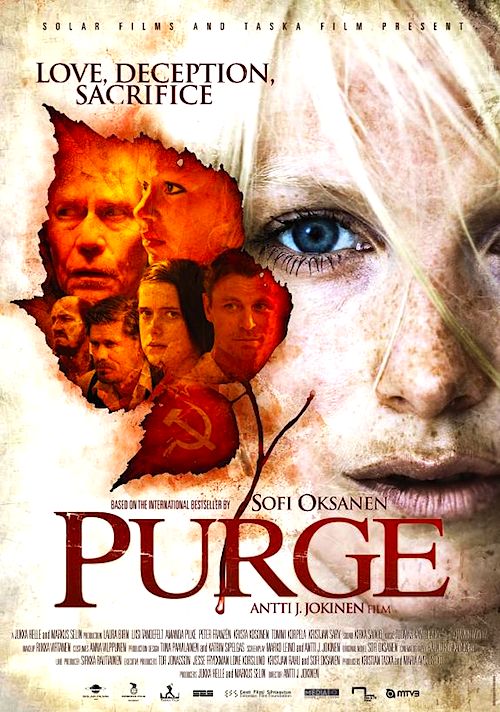
Aliide was always a little strange. While she fell head over heels for the dashing Hans Pekk, it is her sister Ingel who turns his head. Yet Aliide is more than willing to help Ingel shelter her former freedom fighter brother-in-law from the Soviet authorities. Frankly, she kind of likes knowing exactly where he is at all times. Decades later, that secret hiding space under the floor boards will come in handy again.

In a case of ironic symmetry, both women will suffer tremendously at the hands of Russians. Even though Aliide eventually marries a true believer, she still cannot avoid seeing the inside of a Communist torture chamber. Despite all the humiliations Zara endures as an unwilling prostitute, Aliide’s torments are probably even worse. As a result, Purge is often a difficult film to watch, but it is never exploitative or morally ambiguous in the ways it presents such horrors. Whether motivated by ideology or sadism, the reality of rape and assault remain the same.

Laura Birn gives an incredible performance as the mid-twentieth century Aliide. A twitchy young woman in an apparent state of arrested development, she is not the sort of victim figure viewers can easily embrace. In truth, she has a bit of a Machiavellian streak, yet she still experiences more pain and degradation than anyone could possibly deserve.

Jokinen is not afraid to confront his audience with all manner of atrocities. Nonetheless, he also shows a deft touch with the quiet moments occasionally stolen by the Estonian lovers. He clearly differentiates each time period without resorting to distracting visual gimmicks, balancing each narrative relatively evenhandedly.

Purge might be a dark horse contender, but Jokinen has Hollywood ties, having directed Hillary Swank-Kadyrov and Jeffrey Dean Morgan in The Resident, so who knows? Purge is certainly a quality period production, which often counts for something with Academy voters. It might be a bit too honest for their tastes, though. Regardless, Purge would be an enormously worthy nominee, definitely recommended for patrons who have a chance to catch it on the festival circuit.

LFM GRADE: A-

Posted on November 19th, 2012 at 12:46pm.
From the Tel Aviv Opera: LFM Reviews Gottfried Helnwein and the Dreaming Child

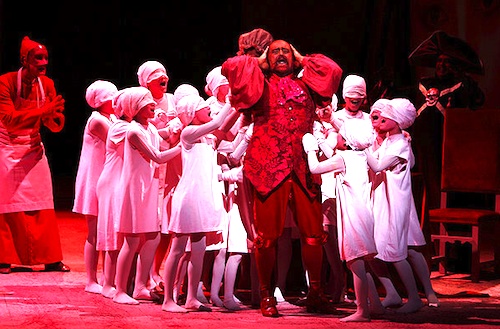
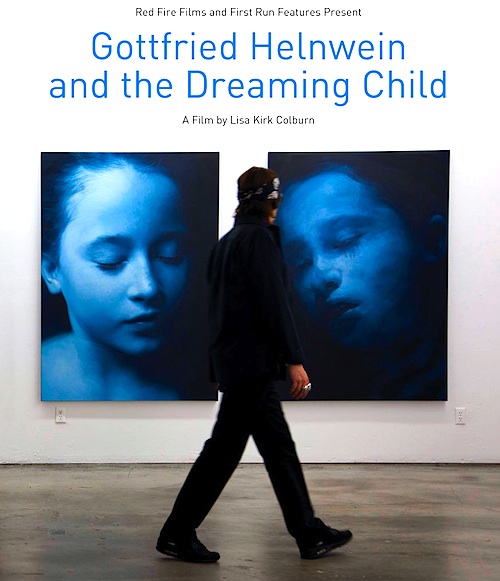
By Joe Bendel. Austrian born artist Gottfried Helnwein hosted the wedding ceremony of Marilyn Manson and Dita Von Teese, presided over by Alejandro Jodorowsky. That fact alone sets off plenty of alarm bells. Nonetheless, Helnwein has produced an impressive body of work, largely informed by the horrors of the Holocaust. It was the themes and sensitivities of his oeuvre that inspired the Israeli Opera to commission Helnwein’s designs for an ambitious new production. Lisa Kirk Colburn documents the visual artist’s sometimes dramatic collaborative process in Gottfried Helnwein and the Dreaming Child (trailer here), which opens this Friday in New York.

In a telling historical irony, Helnwein was accepted by the art academy that famously rejected Hitler. Coming of age at a time the Holocaust simply was not discussed in Austria, Helnwein discovered the truth on his own. The revelation profoundly influenced his work both as a student and a mature artist. Images of children in various states of vulnerability reappear over and over in his photo-realist paintings. Not surprisingly, Helnwein had a deep affinity for Hanoch Levin’s allegorical play, The Dreaming Child and its Helnweinesque title character.

When Helnwein designs a stage production, he does not dash off a few set decorations and call it a day. Essentially he takes over the show, at least to judge by the evidence of Dreaming Child. Director and co-librettist Omri Nitzan comes across like an evenhanded mediator, but some of the Opera’s creative crew clash repeatedly with the celebrity artist. That’s just what you get when you bring in a design auteur.

From "Gottfried Helnwein and the Dreaming Child."

Leading up to the premiere of Dreaming Child, Helnwein also mounts a new showing of his large scale public installation piece, Selektion. Frankly, the story behind that piece (and its rather rocky debut in Cologne) might be even more documentary-worthy than the Dreaming Child production.

Fortunately, Colburn’s film shows us more than Helnwein puttering about his studio. In fact, he is an artist with something to say and he takes advantage of the opportunity to do so. To her credit, Colburn does not leave any obvious questions unaddressed, showing her subject’s high-handedness as well as his passion and empathy. Viewers should note: there is also a brief but humanizing post-credits stinger. It looks like a cool shot Colburn fell in love with, but could not figure out any other place to put it.

An engaging art documentary comparable to recent releases like Bel Borba Aqui and Gregory Crewdson: Brief Encounters, Dreaming Child also offers additional social-historical significance by forthrightly exploring the themes of Helnwein and Levin’s work. Recommended for Helnwein’s fans and patrons of Israeli culture, Gottfried Helnwein and the Dreaming Child opens this Friday (11/23) in New York at the Quad Cinema.

LFM GRADE: B

Posted on November 19th, 2012 at 12:45pm.

Chinese Women on Screen: LFM Reviews Daybreak

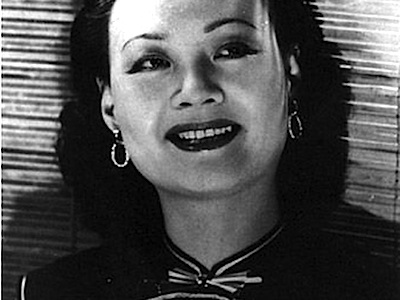
Chinese silent film star Li Lili.

By Joe Bendel. Like Ruan Lingyu, Li Lili was a true diva of silent Chinese cinema. And if you think former diva status would not be particularly convenient during the Cultural Revolution, your suspicions are correct. Having upstaged Madame Mao in the 1930’s hardly helped, either. Yet there should have been no complaints about the ideological content of Sun Yu’s Daybreak, which screens this Tuesday as part of the Asia Society’s current film series, Goddess: Chinese Women on Screen.

Ling Ling is a fresh faced country girl, who comes to Shanghai with her man in search of employment. Briefly, things look promising when they find work at a yarn factory. Unfortunately, trouble with the law forces him to ship out as a merchant seaman, leaving her vulnerable to the city’s predatory elements.

First, Ling Ling is drugged and raped by the playboy factory owner. Later, when wandering lost through the city, she is sold into a brothel by an ostensive protector. It might be a bad business, but Ling Ling adapts to it, reasserting command of her illicit destiny as a high-priced prostitute, but with both a heart of gold and a raised political consciousness. Dispensing aid to her struggling neighbors while conspiring with subversive elements, Ling Ling truly becomes a new woman.

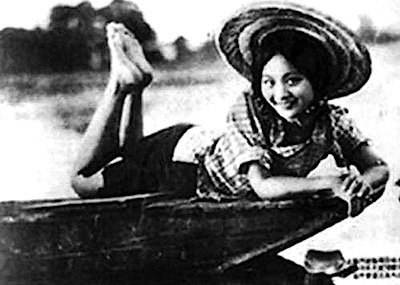
From "Daybreak."

Of course, it ends tragically. All the best propaganda does. Although Daybreak is not as stylishly realized as Wu Yonggang’s The Goddess, a revolutionary hooker is certainly a much more attractive radicalizing agent than a clenched-fist factory worker. The camera absolutely loves her – and just like Ruan, Li Lili knew how to milk a death scene for all its worth.

It is not hard to see why Li was such a diva of the silent era (in fact, she was once part of a theatrical tandem known as the Four Divas). Her Ling Ling is cute, innocent, and eventually saucy – but nobody’s dummy. Despite all the wrongs done to Ling Ling, she is never a mere victim in Daybreak, which is a major reason why it remains such a notable work.

A product of its time, Daybreak is an interesting but imperfect film, whereas Li’s story is absolutely fascinating. China’s last living silent film star, she led an epic life in ways both great and terrifying. Indeed, it raises a great historical “what if” question. In the way we wonder about Hitler’s artistic frustrations, perhaps if Lan Ping (a.k.a. Jiang Qing) had been a better actress, the suffering of millions might have been avoided. Recommended in its own right, mostly for Li Lili’s luminous presence, Daybreak screens this Tuesday night (11/20) at the Asia Society, as their can’t miss Goddess series continues.

LFM GRADE: B

Posted on November 19th, 2012 at 12:44pm.

Falling to Earth: LFM Reviews Flight

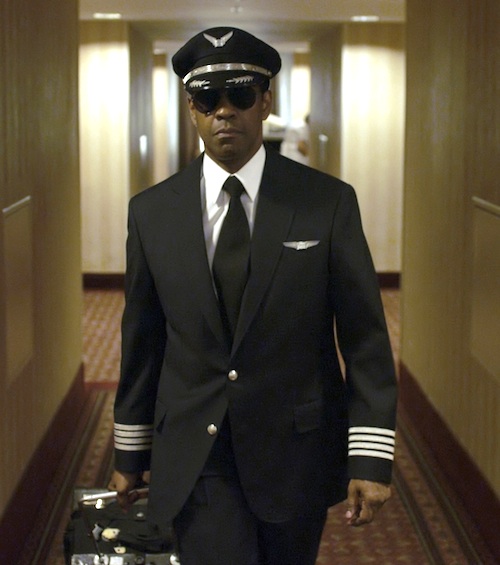
Denzel Washington in "Flight."

By Patricia Ducey. The three most important things in moviemaking are: story, story, story. That twist on the old real estate maxim (“location, location, location”) illustrates why Robert Zemeckis’s Flight stalls out and thuds to earth after an admittedly spectacular opening crash sequence and Denzel Washington’s superior performance.

First, Denzel: I confess that his early work, especially Malcolm X and The Hurricane, impress me more than his turn toward the anti-hero, as in his Oscar-winning role in Training Day as a despicable, corrupt detective – and he chooses another flawed character here in Whip Whitaker, the ace pilot with a tragic flaw: hopeless addiction.

Captain Whitaker awakens one morning in an anonymous hotel room, still drunk from the night before – his doughy, tattooed body looking a lot worse for the wear. He and his bedmate Trina have been up partying all night, and on her way out the door she urges Whip to hurry; they have a flight in a couple of hours. So Whip, with a last beer and a line of coke to chase away the beery fog, strides confidently through the airport to actually pilot 102 souls from Orlando to Atlanta on his Southjet flight.

His young copilot Ken (Brian Geraghty) is simultaneously in awe of the man and suspicious of his condition; Whip inhales a hit of oxygen and offers his young partner one too, which he declines. They take off into the rain, which soon grows into a thunderstorm and stomach-wrenching turbulence. But master pilot Whip pushes the plane to its limits and expertly guides them into the clear. Everyone on board breathes a sigh of relief. As they descend for landing, however, the hydraulics fail and the plane veers out of control and into a nosedive – and the passengers are thrown around the cabin like rag dolls. Whip takes control. He orders Ken and flight attendant Margaret (Tamara Tunie) to help him in a series of unorthodox maneuvers in a last, desperate attempt to land the crippled liner. Miraculously, he does just that. And despite his blood alcohol level, he has pulled off a landing that Sully Sullenberger would envy.

At this point, Flight is firmly planted in the social drama genre. Whip’s life revolves around his addition to booze and drugs, enabled by his denial and consummate skill in the air. He has already lost his wife and son due to his drinking problem, and his first thought post-crash is to summon his drug dealer (John Goodman) to his hospital bed with refreshments. The media dub him a hero, but he holes up in his ramshackle farm outside of town to avoid them – and the truth. We wonder if he will ever sober up, or if he will continue to escape responsibility for the crash. However, that is not enough to sustain two hours of story. He is already divorced and at rock bottom at the time of the initial crash, so there is no suspense in watching him play that single note.

Shining in a moment of crisis.
Continue reading Falling to Earth: LFM Reviews Flight

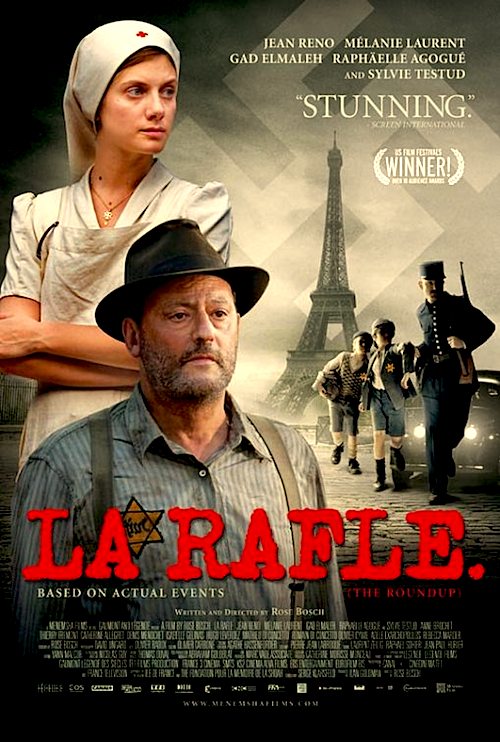
Occupation and Collaboration in France: LFM Reviews La Rafle (The Round Up)

By Joe Bendel. Conveniently, the infamous Winter Velodrome no longer stands in Paris. Yet, perversely, cycling races were still held in the venue as late as 1958, well after it served as a temporary holding facility for 13,000 Jewish Parisians, forcibly “rounded up” at the request of the occupying National Socialists. It was an episode of history France preferred to forget, since it was the Vichy authorities doing the rounding-up. While the actual event went scrupulously undocumented, Rose Bosch dramatizes the tragic events in La Rafle (The Round Up), which opens today in New York.

The fatality rate of those imprisoned in the Velodrome was nearly one hundred percent. Viewers will have no illusions where the captives are ultimately headed, but those in the Velodrome held out hope their next accommodations would be better. We come to meet many of the roughly detained, including children like Joseph Weismann and his friends, the Zygler brothers. While they used to run free through the streets of Montmartre, the boys suddenly find themselves enduring the heat and inadequate water and sanitation of the Velodrome. Fellow prisoner Dr. David Sheinbaum is the sole extent of the medical treatment available until the arrival of solitary Protestant charity nurse Annette Monod.

Based on years of research, Bosch takes pains to show both the good and bad sides of the French national character. While the Weismann’s anti-Semitic neighbors cheer their deportation, the Parisian fire department reacts with shock and empathy, struggling to improve conditions in the Velodrome, against the gendarmerie’s express wishes.

Those who have seen Sarah’s Key or read the novel on which it is based will be familiar with the 1942 Roundup. Designer Olivier Raoux’s recreated Velodrome has the look and feel of a real life, slightly past its prime building, collapsing under the weight of its involuntary guests. Bosch’s scenes within its confines have a visceral you-are-there impact. However, the intermittent depictions of Hitler and the craven Petain lack the same power, only serving as a wan indictment of their banal evil.

In a bit of a surprise, it is Jean Reno who masterfully serves as the film’s moral center, portraying Dr. Sheinbaum with a profound spirit of world weary humanity. The impossible romantic tension that develops between him and Mélanie Laurent’s Monod is also deeply touching. That sense of “if only thing were different” palpably hangs in the air between them as they labor to ease the suffering around them as best they can.

Post-Schindler’s List, there have been a number of well-meaning dramas that have addressed the Holocaust, with varying degrees of success. La Rafle ranks as one of the more accomplished due to its technical merit and Reno’s assured, anchoring performance. Recommended for connoisseurs of French cinema and WWII films, it opens today (11/16) in New York at the Quad Cinema.

LFM GRADE: B

Posted on November 16th, 2012 at 10:38am.

LFM Reviews Anna Karenina

By Joe Bendel. Anna Karenina won the game of Russian birth roulette. Born into privilege, she initially enjoyed all the benefits of her well structured life, but lost everything due to a reckless love affair. Such was the price of offending Russian society at a time when it was trying to act French. Notions of social role-playing have now inspired the hyper-stylization of Joe Wright’s take on Tolstoy’s classic Anna Karenina, which opens this Friday in New York.

Everyone is playing their socially expected role you see, so why not set Anna Karenina in a creaky old theater? From time to time, Wright will break away from the stagey confines, particularly when checking in on Levin, the rustic landowner and long suffering friend of Karenina’s ne’er do well brother. Of course, there are also trains – like the one taking the title character to Moscow, where she hopes to provide emergency marriage counseling for said brother and his justly aggrieved wife Dolly. It is sort of a pleasant trip spent in the company of the Countess Vronsky, whose cavalry officer son meets her at the station.

The mutual attraction between Karenina and Vronsky are immediately evident, only intensifying at an eventful Moscow society ball. Having thrown over the plodding Levin in hopes of landing Vronsky, Dolly’s younger sister Kitty is deeply hurt when the officer ignores her in favor of the married Karenina. Spooked by the prospect of scandal, she hastens back to St. Petersburg and her husband Karenin, a progressive but culturally traditional government official. As everyone should know, Vronsky follows her—and so does scandal.

There have been enough movie and television treatments to support a lengthy compare and contrast session here. In many ways, Tom Stoppard’s adaptation is quite distinctive, establishing a strong contrast between country simplicity and urban hypocrisy, while finally giving Levin his due. However, Wright’s stylistic conceit is far too distracting, taking viewers out of the story time and time again. The theatrical device is not even particularly original, having been used to greater effect in Manoel de Oliveira’s Satin Slipper, Louis Malle’s Vanya on 42nd Street, and several Shakespearean films. Frankly, it is a rather baffling aesthetic choice, considering the whole appeal of a novel like Anna Karenina is the big messy sweeping grandeur of it all.

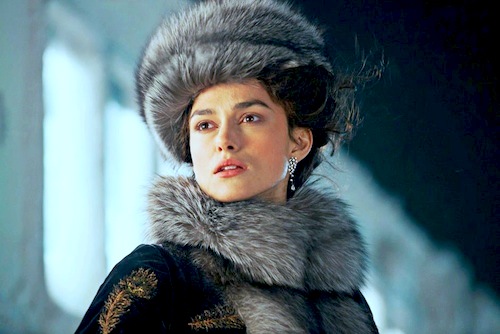
Nonetheless, there are several outstanding performances in Wright’s film, especially from his lead, Keira Knightley. It is hard to think of anyone else with the same brittle beauty and aristocratic bearing, who can convey burning self-destructive passion and guilt-ridden anguish with comparable power. Yet the real surprise of Wright’s Karenina is Jude Law’s performance as Karenin, the wronged husband. Even though he looks considerably younger than the Karenin as described in the source novel (about twenty years older than his wife), Law creates a deeply sympathetic portrait of a fundamentally decent man, trying to act accordingly, despite the painful embarrassment of the circumstances.

Keira Knightley in "Anna Karenina."

In contrast, the casting of Aaron Taylor-Johnson as Vronsky is a head-scratcher. In truth, Wright lets his Vronsky off rather easily. In previous versions, Vronsky is something of a shallow cad, but here he is more or less a dumb kid who fell in love too young, but that creates a host of dramatic problems. Essentially, Anna Karenina is supposed to fall for Vronsky, because he is manlier than her husband, not vice versa. What she sees in this Vronsky is hard to fathom. I got stuff in the fridge that looks older than Taylor-Johnson and I’m not ready to throw it out yet.

Granted, Wright’s visual approach lends itself to some dramatic transition shots, but it never lets the film settle in and put down roots. Watching it makes one wonder what the director had in mind. Perversely, it is like Wright elicited award caliber performances from Knightley and Law, but then deliberately undermined them the postmodern theatricality and a maddening case of miscasting. There is room for some experimentation when tackling Tolstoy, but it should serve the interests of the picture. For instance, Sergei Solovyev’s relatively recent Russian production of Anna Karenina was considerably more expressionistic than traditional costume dramas, while staying true to the novel’s tone and story.

It is a shame Wright had to be so showy, because there is quite a bit of good stuff in Stoppard’s screenplay and the mostly impressive work from the accomplished ensemble cast. Recommended mostly for Knightley and Law’s diehard fans, Wright’s frustrating Anna Karenina opens this Friday (11/16) in New York at the AMC Loews Lincoln Square.

LFM GRADE: C+

Posted on November 14th, 2012 at 11:14am.