Punk Rock Behind The Iron Curtain: LFM Reviews All That I Love

By Joe Bendel. Punk rock is supposed to be subversive. For Communist Poland poised on the brink of Martial Law, it was downright revolutionary, in spades. Yet, young Janek and his friends were not trying to be political, and this is exactly why their music is so threatening in Jacek Borcuch’s All That I Love (trailer above), Poland’s most recent submission for official foreign language Academy Award consideration, which screens this Saturday as part of the Film Society of Lincoln Center’s new retrospective, Transitions: Recent Polish Cinema.

Janek’s brother also plays in his hardcore punk band, All That I Love, affectionately known as ATIL for short. His mother is a nurse, which is all fine and good, but his father is a mid-level officer in the Polish Navy. Ordinarily this is a good thing, leading to a few modest perks for the family. However, when courting Basia Martyniak, the very cute daughter of Solidarity organizers, it is not so hot. The rebellious nature of his music does not cut much ice with the Martyniaks either, but Basia is impressed.

Though not necessarily impressed himself, Janek’s father is still supportive enough to arrange rehearsal space on the local base. Clearly the naval captain is not the typical Communist apparatchik, a fact not lost on Sokołowski, the neighborhood Party snitch. Resenting the boys’ ill-concealed interest in his cougarish wife, Sokołowski targets them where it will hurt the most—their music.

Throughout the film, Borcuch juggles a number of disparate elements quite sure-handedly, including a rather tender coming-of-age romance and some paint-peeling punk, based on the music of the era-appropriate Polish band WC. It is also a story of human tragedy, directly resulting from an inherently oppressive political ideology. Yet part of the irony of ATIL is that Janek’s family will probably be far better off in the new Poland that rises from the ashes of Communism for having gone through their tribulations in the film. Unfortunately, viewers can surmise the short term will be rather long and difficult for them in the December of 1981.

There is no denying the charismatic appeal of Borcuch’s teen-aged leads. Mateusz Kościukiewicz’s Janek could have walked out of Tom Hanks’ That Thing You Do into Jaruzelski’s police state, while as Basia, Olga Frycz resembles a considerably younger and warmer Nicole Kidman. Yet, arguably Andrzej Chrya serves as the lynchpin of the film, investing Janek’s father with humanity and integrity that will first challenge and then reconfirm all our assumptions of Poland’s Communist military.

With convincing period detail, Elwira Pluta’s design team faithfully recreates the bleak look of Martial Law era Poland, when Brutalist-style Soviet housing projects were considered desirable. Nevertheless, despite the apparent downer ending mandated by history, ATIL is a surprisingly uplifting film, deriving optimism from the spirit of its characters.  An excellent kick-off for the FSLC’s Transitions series, ATIL screens this Saturday (9/10) and next Thursday (9/15) at the Walter Reade Theater.

Posted on September 7th, 2011 at 10:15am.

The War Photography of Robert Capa: LFM Reviews The Mexican Suitcase @ DocuWeeks LA 2011

By Joe Bendel. Many writers, most notably Hemingway and Malraux, tried to write the Spanish Civil narrative for a worldwide audience. However, it was the work of trailblazing war photojournalist Robert Capa that supplied the images for the Republican cause célèbre. Unfortunately, thousands of his negatives were lost, suspected to be somewhere in Mexico. Through the efforts of the International Center of Photography (ICP), founded by the photographer’s late brother Cornell, the not-so apocryphal case was found and its contents have been catalogued and preserved. The story of the photos and the photojournalists behind the camera are told in Trisha Ziff’s The Mexican Suitcase (trailer here), which is currently screening as part of the 2011 DocuWeeks in Los Angeles.

Not really a suitcase per se (strangely, it is not pictured on the film’s one-sheet), the suitcase was a small partitioned box crafted by darkroom assistant Imre “Csiki” Weiss. Inside were not just scores of Capa negatives, including some of his best known images, but also those of his wife Gerda Taro and close colleague David Seymour, a.k.a. “Shim.” In fact, the suitcase led to many photos previously considered part of the Capa canon to be reattributed to Taro or Seymour.

Those who only know Capa as a name and perhaps for the iconic “Falling Soldier,” supposedly taken at Cerro Muriano (the authenticity of which has fallen into dispute), should certainly gain an appreciation of his work through Suitcase. Though it was impossible to compose shots in a traditional sense during the heat of battle, he clearly had a talent for framing the action on the fly. The film also gives Taro and Seymour their proper due for battlefield fearlessness.

Unfortunately, Suitcase is overly simplistic in its treatment of the Spanish Civil War, perhaps reflecting the involvement of groups dedicated to promoting the legacy of the Communist-oriented Abraham Lincoln Brigade. As a result, Suitcase strictly adheres to the “good war” Party line, ignoring the sometimes bloody Republican in-fighting between Communists and Anarchists, the Republican atrocities committed against the Catholic Church, the purges perpetrated by Republican sponsor Joseph Stalin (by this time generally public knowledge amongst the educated classes), and the bitter divisions amongst ALB veterans stemming from the Molotov-Ribbentrop Pact. That is unfortunate, because it robs the film of nearly all the irony and messiness that made the war such a compelling episode of world history. Indeed, which would you rather read, Ernest Hemingway’s undeniably pro-Republican but still nuanced For Whom the Bell Tolls or Alvah Bessie’s Party approved propaganda?

Spanish War photography from Robert Capa.

As art history, Suitcase is fascinating stuff, lucidly establishing the significance of the suitcase’s recovery and the further light its contents shed on the work of Capa, Taro, and Seymour. It also serves as an effective commercial for the ICP and its talented staff. On the other hand, as historical commentary on the Spanish Civil War, the film is rather shallow and should in no way be considered definitive. A mixed bag, recommended at least for photography buffs, Suitcase screens through Thursday (9/8) in Los Angeles at the Laemmle Sunset 5, after which point it should be officially qualified for Oscar consideration, unless canceled New York screenings during Hurricane/Tropical Storm Irene affect its standing.

Posted on September 6th, 2011 at 12:08am.

Co-eds & Cajuns: LFM Mini-Review of Shark Night 3D

By Jason Apuzzo. THE PITCH: Riffing off last year’s surprise cult hit Piranha 3D, Rogue Pictures cross-breeds Jaws with Deliverance to create Shark Night 3D – an energetic genre quickie that follows a pack of sexy, edible college students as they navigate a nightmarish evening along Louisiana’s backwaters, dodging voracious sharks and insane Cajuns.

THE SKINNY: Though not half as wild or excessive as Piranha, the surprisingly satisfying Shark Night delivers plenty of thrills, bikinis and even some unexpected satire – while turning Lake Pontchartrain into one of the creepiest cinema backwaters since Boggy Creek.

WHAT WORKS: • The film’s remote Louisiana locations create an unnerving and slightly bizarre atmosphere – an upside-down, backwoods world in which the otherwise ludicrous storyline of shark-fueled Cajun revenge against fancy college kids actually makes (some) sense.

• Sara Paxton delivers a surprisingly credible performance as the lead co-ed, given that she spends the entire film either in an eye-popping cyan bikini or covered in fish-gore.

• It’s hard not to love the film’s colorful, freakish Cajuns – one of whom has teeth sharpened like a possum, another of whom quotes Nietzsche (“It’s beyond good and evil!”) while describing his bizarre, money-making scheme to … ***SPOILER WARNING*** … live-webcast college students being eaten by sharks. ***END OF SPOILERS*** These backwater charismatics give the film a slightly Texas Chainsaw Massacre vibe.

• The 3D is excellent, with the film having been shot natively in that format. The underwater scenes in particular look frothy and alive.

WHAT DOESN’T WORK: • The film’s lead bad-guy, as played by male model Chris Carmack, is too much of a pretty boy and seems out of place among the ragin’ Cajuns.

• There’s far too much build-up in getting to know the various college kids, none of whom are all that interesting and most of whom are chowder by film’s end.

• The sharks look a little too nimble and digital. I miss the days when movie sharks were bulky, slow and rubber.

• For much of the film, the sharks seem smarter than the college kids. Then again, perhaps that was the point.

THE BOTTOM LINE: The basic fun of Shark Night, its biggest surprise, is that the behavior of the human villains is far more outrageous and ruthless than anything the sharks can muster. In the dog-eat-dog world of today’s economy, the film seems to be saying, it’s amazing what some people will do to get a head. Or to get an arm. Or a leg.

(Incidentally, Shark Night is rated PG-13, and most of the film’s violence and nudity are merely implied. This film doesn’t even come close to the bacchic excesses of Piranha, which probably deserved an NC-17.)

There have been some great underwater creature features over the years, from the 3D Creature from the Black Lagoon in 1954, to Jaws and The Deep in the 1970s, to last year’s Piranha (see my review here; Piranha 3DD, with David Hasselhoff and Gary Busey, comes out November 23rd). Shark Night is definitely a minor entry in this genre, but it holds its own.

Hurry!

What’s surprising is that the people behind this unassuming little thriller thought to supplement their toothy sharks with creepy human characters, backwater Cajuns apparently suffering from a major case of class envy. These Cajuns ridicule and sneer at the college kids, and it’s hard to blame them given the way these supposedly brainy kids walk (or swim) right into one obvious trap after another. Shark Night indulges in a certain amount of satire directed not only at the rustic Cajuns, with their outrageous and gruesome money-making scheme, but also toward naive city kids who are useless outside of their safe, academic/urban environments. The same kids who seem hip on their Tulane University campus early in the film – lazily playing Halo, indulging in loose sex talk, and planning their lucrative post-collegiate careers – get ripped to pieces out in the ‘real’ world, fooled at every turn by their cagey Cajun rivals. It’s not exactly Tennessee Williams material, but Shark Night knows when to amplify the terror of the sharks with a dash of class warfare – all to juicy, amusing effect.

I haven’t had the chance to visit Louisiana since Hurricane Katrina, although I’ve been very eager to get back. I think I’ll stick to the cities, though. Those Cajun guys look too clever for me, and I wouldn’t want to end up as some shark’s gumbo.

Posted on September 3rd, 2011 at 2:43pm.

LFM Review: Helen Mirren, Sam Worthington Restructure The Debt

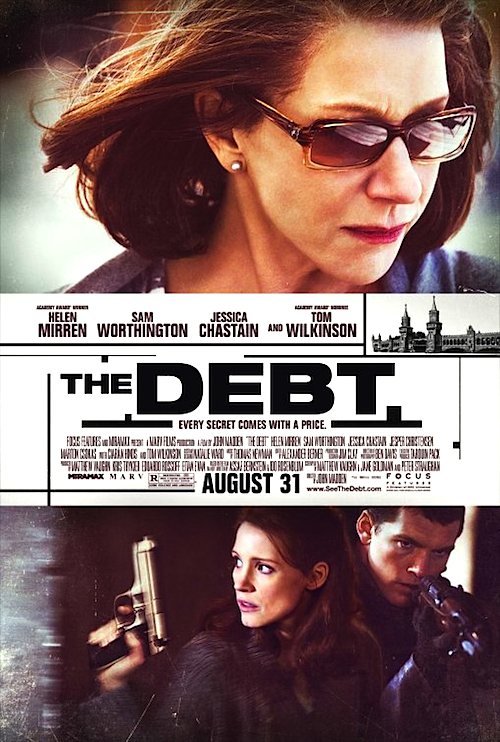
By Joe Bendel. Rachel Singer understands the dark side of human nature. After all, her ex-husband Stephan Gold is a high-ranking cabinet official, and her daughter Sarah Gold is a journalist. In fact, Gold’s new book has reopened a number of old wounds for her parents. Singer and Gold were part of a three agent Mossad team charged with capturing “The Surgeon of Birkenau,” a National Socialist war criminal clearly modeled on Mengele. Though they were supposedly forced to kill the doctor when he attempted to escape, we quickly discover there is something wrong with the official story in John Madden’s restructured The Debt (trailer here), which opens today in New York.

Based on Assaf Bernstein’s Israeli film of the same title, The Debt first presents the account of the fateful mission that made Singer a national icon in Israel. It is that story Sarah Gold told in her bestselling book, which Singer dutifully agrees to help publicize. Yet, when press reports surface of a senile patient in a Ukrainian nursing home claiming to be the notorious Surgeon, Dieter Vogel, she and her ex take it deadly seriously. So does David Peretz, the third member of the team, who was always too troubled by the events that transpired in 1965 East Berlin to enjoy their heroic celebrity.

Now a wheelchair-bound senior intelligence official, Gold’s field ops days are behind him. Though the conscience plagued Peretz has recently reappeared, he will be in no condition to deal with the Surgeon. It is up to Singer to covertly enter Ukraine and finish the job. While she cases the sanatorium, The Debt flashes back to East Berlin, showing how it all really went down.

As adapted by screenwriters Matthew Vaughn & Jane Goldman and Peter Straughan, Madden’s Debt closely hews to the plot and structure of the original. However, the new version plays up the three Mossad agents’ romantic triangle and also adds a bit of a moralizing “truth is important” spin to the ending. However, like the source film, The Debt never suggests Singer’s team had the wrong man, only faulting their execution, the result of stress exacerbated by generational guilt and sexual tension. Indeed, The Surgeon is presented as evil incarnate, played with icy menace by Jesper Christensen.

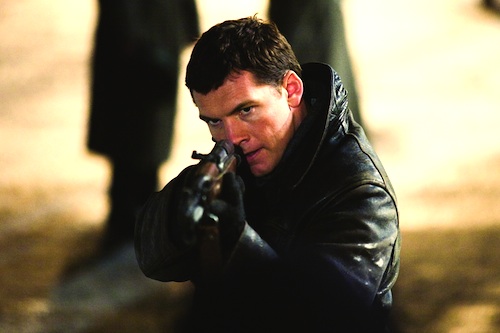
Sam Worthington in "The Debt."

When casting an actress of a certain age for a somewhat action oriented film, Helen Mirren is pretty much the extent of the short list. Though she brings the appropriate presence and credibility to the 1997 Singer, the heart and guts of the film remain in 1965 (as was the case with its predecessor). Madden cranks up the claustrophobic tension in their “safe” flat quite effectively, while making it vividly clear how the legacy of the Holocaust weighed on the team as first generation children of survivors.

Frankly, Sam Worthington is surprisingly compelling as the young but already too tightly wound Peretz, suggesting he might actually be a very good actor, who just had the mixed luck to be in utterly terrible but hugely successful films like Avatar and Clash of the Titans. Yet, perhaps the greatest surprise is Jessica Chastain, who rises to challenge of playing the same character as Dame Helen in the same film. In fact, she might even get the better of her, investing the younger Gold with equal measures of strength and vulnerability.

Though it still has not fixed the problematic third act showdown, The Debt remains a leanly muscular morality play-thriller. While the English language version might be a bit more inclined to cast the Mossad in an unfavorable light, there is never any ambiguity as to the Surgeon’s truly malevolent nature. A surprisingly faithful and well executed remake, The Debt should definitely satisfy those who enjoy a John Le Carrré-esque story, who have do not already know the twists and turns of the original. It opens today (8/31) in New York at the Angelika Film Center.

Posted on August 31st, 2011 at 6:14pm.

Surviving the Aftermath of 9-11: LFM Reviews Rebirth

By Joe Bendel. New Yorkers are tough. Since the horrific events of September 11th, the City has weathered blackouts, blizzards, tornadoes, earthquakes, and hurricanes. Still, the lingering trauma of 9-11 dwarfs all subsequent travails. Capturing the physical rebuilding of Ground Zero and the emotional healing of five New Yorkers profoundly affected by the tragedy, director and conceiving producer Jim Whittaker shot almost a thousand hours of footage, resulting in perhaps the first documentary with its own non-profit governance structure: Rebirth, which opens this today in New York at the IFC Center.

Affectionately called “Captain Manhattan,” FDNY Cap. Terry Hatton was already widely regarded as a fireman’s fireman, even before his heroic death during the collapse of Tower 1. For his best friend and colleague Tim Brown, both grief and survivor’s guilt would debilitate his psyche. Yet, despite his depression, we watch as Brown tries to take affirmative steps to prevent such acts of terror in the future, accepting an appointment to the then newly created Department of Homeland Security and serving as an advisor to Mayor Rudy Giuliani’s ill-fated presidential campaign.

Like Brown, Tanya Villanueva Tepper grieves a New York firefighter, her fiancé, but her new life seems to fall so well into place, she starts to feel guilt over her happiness. In contrast, construction worker Brian Lyons has a more difficult recovery process. He also mourns for a FDNY brother, his younger brother, Mike. In addition, his tireless work in the rescue and recovery efforts has left him with persistent health issues and a case of PTSD. Nick Chirls also lost someone close to him: his mother. Unfortunately, a difficult bereavement would lead to an estrangement between Chirls and his father.

Yet, of the five interview subjects, Ling Young is arguably the most compelling. A dutiful state employee at work on the 78th floor at the time of the attack, Young suffered burns so serious, they caused considerable physiological complications. Though her physical healing process remains unresolved, she emerges as the film’s most inspiring figure.

It is hard not to be moved by pain and honesty expressed by Whittaker’s POV figures. However, the time lapse footage of the Ground Zero rebuilding project might ironically prove counterproductive. While it is impressive to see the construction of the transit hub and smaller buildings in fast forward, it is conspicuously obvious that the Freedom Tower has yet to rise triumphantly from the rubble.

To his credit, Whittaker treats his subjects with sensitivity and respect. Still, it seems clear he chose to play it safe at each juncture, glossing past Brown’s reasons for signing on with the Giuliani campaign and including only a brief vent from Chirls directed at moral relativist apologists for the terrorists. Perhaps it is just as well, focusing Rebirth squarely on the personal makes it more immediate and universally relatable, but the gaps still show. After all, what happened in Lower Manhattan was not a random happenstance, but a deliberate act of mass murder motivated by a hateful ideology. Rebirth completely ignores that reality, concentrating solely on the consequences.

In truth, it is a defensible decision, but it requires far more context than that found in Rebirth to fully understand September 11th. Technically, it is also a well-crafted production, with important aesthetic contributions coming from composer Philip Glass and cinematographer Tom Lappin, who gives the oral history portions a warm glossy look. (As an aside, viewers should look for Jon Fein & Brian Danitz’s thematically related documentary Objects and Memory, also boasting a Glass score, when it airs on PBS as part of their ten year anniversary programming). Well intentioned and executed, but clearly determined to avoid controversy, Rebirth opens today (8/31) in New York at the IFC Center.

Posted on August 31st, 2011 at 5:41pm.

Thriller Double Feature: LFM Reviews John Carpenter’s The Ward, The Caller

By Joe BendelTo be young and crazy in the 1960s only meant one thing: prepare yourself for some generous helpings of electro-shock treatment. Unfortunately, the beautiful and institutionalized Kristen has even greater problems in John Carpenter’s The Ward, which is now available on DVD.

After burning down a remote farmhouse while mysteriously decked out in her night-gown, Kristen is delivered into the care of Dr. Stringer. He does not seem like a bad fellow, but his nurse is evidently still out of sorts from all the trouble she had with that McMurphy character. Yet, despite their aggressive battery of pharmaceuticals, Kristen is often left unattended with the other four young women in her ward.

Iris, an artist, is initially the most welcoming of the group.  Emily is the assertive one, often assuming the role of protector for Zoey, who seems to suffer from an acute case of arrested development. Conversely, Sarah, the catty sexpot, specializes in generating bad vibes. It would all be like a CW show in an insane asylum, except that the spirit of a former patient is apparently trying to kill them all.

Just about every horror movie fan wants the new John Carpenter film to be a triumphant return to form. As a result, there is a temptation to forgive a lot in The Ward. Truthfully, though, it is just a serviceable genre picture at best that relies far too heavily on scares derived from stuff sneaking up behind character and going boo, rather than genuinely tapping into the fear of the unknown. Even the spooky old nut house is not all that memorable, particularly when compared to that of the Vicious Brothers’ Grave Encounters.

To its credit, the cast is fairly game. Though not a scream queen in the Carpenter-Jaime Lee Curtis tradition, Amber Heard is quite credible as the take-charge Kristen, which is essential a given where the film is headed. Jared Harris is not exactly Peter Cushing either, but he is still pretty good as Dr. Stringer, projecting an ethically ambiguous erudition appropriate to the genre.

Amber Heard in John Carpenter's "The Ward."

Though it is reasonably well executed, the big twist might frustrate genre fans as well, because we have seen it before in films of relatively recent vintage. (Here’s a hint: in one such movie Alfred Molina played the head-shrinker.) However, the biggest disappointment of The Ward is the absence of that unquantifiable but instantly recognizable eerie atmosphere that permeates the classic Carpenter canon. Judged on its own merits, The Ward is a mediocre to sort-of okay b-movie, with some featured performances arguably exceeding the industry standard. Yet compared to They Live, The Thing, the original Halloween, and even Prince of Darkness, it is rather watery beer, but fans can still check it on DVD.

In established horror movie tradition, Mary Kee’s threatening calls are coming from inside her own apartment. The ‘from thirty years in the past’ thing is a neat trick, though. While never explained, viewers should just go with the cosmically crossed line set-up if they can find Matthew Parkhill’s The Caller (trailer here), which opened this past Friday. Continue reading Thriller Double Feature: LFM Reviews John Carpenter’s The Ward, The Caller