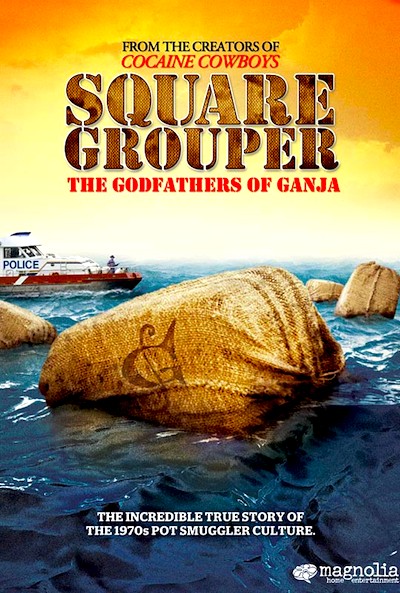
By Joe Bendel. The late 1970’s were a time of stagflation and economic malaise (sound familiar?). However, there was one booming business that offered a chance for any idiot to make serious coin: pot smuggling. Director Billy Corben explores the diversity and eccentricity of the South Florida smuggling scene in its heyday with profiles of three very different sets of co-conspirators in Square Grouper: The Godfathers of Ganja (trailer here), which opened Friday in New York.
Those who were in or around the 1970’s smuggling economy will recognize “Square Grouper” as the term for the bales of marijuana periodically found bobbing in the waters off Florida’s shores. As for the rest of us, well now we know. Needless to say, everyone Corben interviews knows what it means.
The Ethiopian Zion Coptic Church did not have to chase after stray bales. They were probably the most powerful and successful syndicate profiled in Grouper. They were also an officially recognized church, combining the hippie lifestyle with aspects of evangelical Christianity, namely rather judgmental attitudes regarding homosexuality and sexual relations in general. Weed, on the other hand, was a sacred sacrament. With connections running deep into the Jamaican government, the Ethiopian Zions had a professional operation and extensive property holdings. Yet their evangelical zeal proved to be their undoing, when media footage of underage kids toking it up in their compound turned the public against them.
Perhaps Grouper’s middle story is its saddest. Robert Platshorn was a working-class salesman from Philadelphia’s South Street who fast talked his way into a profitable drug-running gig, at least for a little while. However, he became infamous as the leader of the media-dubbed “Black Tuna Gang.” Corben clearly suggests Platshorn was a small fish victimized by an overzealous prosecution and grandstanding in the press by Griffin Bell, Carter’s Attorney General. Perhaps, but even if it is not an outright crime, Platshorn is clearly guilty of some big league stupidity. Continue reading The Cure for Malaise? LFM Reviews Square Grouper
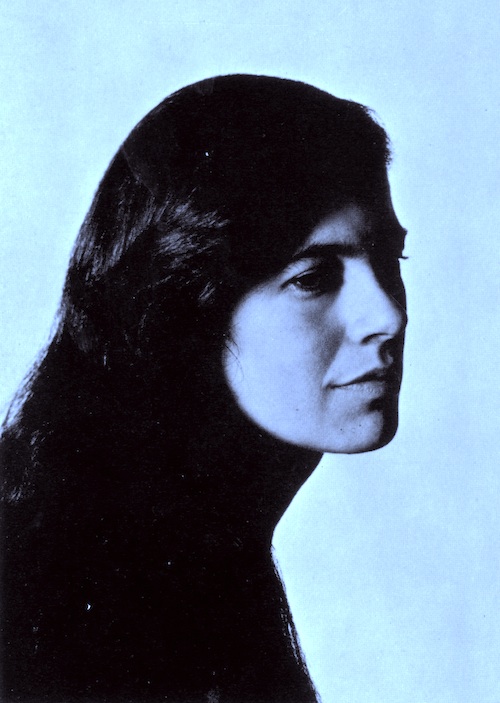
By David Ross. Sigrid Nunez was during the mid-1970s Susan Sontag’s secretary and her son David Rieff’s lover. Her recently published memoir Sempre Susan (read a racy excerpt here) has improbably returned Sontag to the spotlight, just when her long slow fade seemed to have begun in earnest. A mandarin even by the standards of the intelligentsia, Sontag did much to instate the European art film as a phenomenon of the intellectual vanguard during the 1960s and 1970s.
So too her look and bearing codified what it meant – and still means – to be a ‘serious intellectual.’ Sontag always struck me as feline: elegant, self-contained, sharp-clawed, well-groomed (intellectually and physically). To extend my metaphor, I imagine her as a silky Persian cat perched atop a garden wall, occasionally glancing with disdain at all the mere dogs clumsily being dogs below – romping idiotically, smelling each other’s behinds, crapping in the bushes, having fun.
This semester I gave my students Sontag’s essay onGodard’s Vivra Sa Vie, one of several self-consciously ‘important’ essays on film anthologized in Sontag’s breakthrough volume Against Interpretation (1966). I admire its elegant minimalism (rather like the movie itself), but I find it lacking in heft and emotional engagement (again like the movie itself). I paired Sontag’s essay with our own Jennifer Baldwin’s photo-essay on Vivra Sa Vie, which in many ways I consider more satisfying because more immediate and more human. My students laughed at Jennifer’s cri de femme: “I want Nana’s fuzzy black coat.” Sontag did not make the students laugh. I wonder if she ever made anybody laugh. Possibly not.
Virginia Woolf said of Yeats, “Wherever one cut him, with a little question, he poured, spurted fountains of ideas.” This Titanism – this quality of thinking and being on a grand scale, of bringing to bear the whole of one’s self – is the hallmark of the great intellectuals. Sontag never pours or spurts. She makes a clinical exercise of what should be a vast excitement.
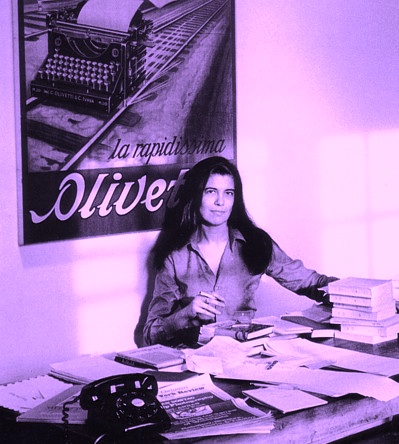
Sontag at work.
In terms of film criticism, I favor Pauline Kael, if only because she understood the cardinal romantic truth that intellect is merely an expressive device of the personality. Kael suffers from serious lapses in taste and judgment, but her wild and woolly prose is more alive than Sontag’s and her passions more transparent and seemingly sincere. Sontag was more sophisticated in her range of interests and enthusiasms, but only more serious and ambitious in a way. She was interested in exploring her own capacity for exploration, interested in her own mind and what it could figure out. Her form of criticism is a kind of intellectual ceremony, a kind of Japanese tea ceremony in which Sontag dispenses herself in refined and smallish doses. In the end, Sontag is a bit too astringent for my taste. A film should not be an intellectual puzzle or a pretext for critical experiment; it should be a hub of personal meaning.
I reread yesterday Sontag’s “Notes on Camp,” also from Against Interpretation. It’s a brilliant little piece, but it says far more about Sontag herself than about camp. Its real content is the curious involutions of its own form and expression. It is about itself, and in this regard functions more like a poem – a clever but dry one – than like criticism properly defined. Continue reading Sempre Susan
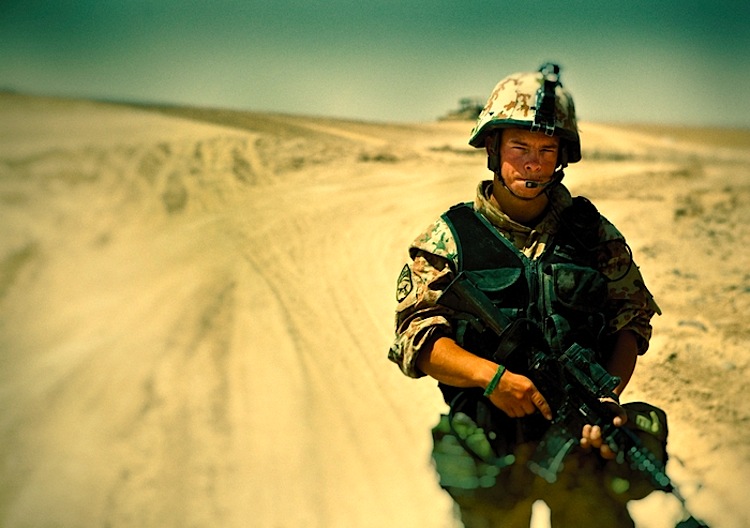
By Joe Bendel. Just because they are Danish soldiers, that does not mean they should trust the media any more than their American counterparts. A group of Danes serving in Afghanistan learns this PR lesson the hard way in Janus Metz’s embed-style documentary Armadillo, which opened yesterday in New York and elsewhere.
Amazingly, as the film opens, the Danish unit stationed at the Helmand forward operating base (nicknamed Armadillo) has yet to suffer a fatal casualty. In fact, when the group of soldiers Metz follows from enlistment and basic training arrive at Armadillo, boredom seems to be their greatest foe. In a rather clumsy effort to be provocative, Metz makes much of their choice of entertainment: violent video games and run-of-the-mill porn, as if this were shocking for a group of twenty-something men serving in the middle of nowhere without any interaction with women.
The Danish soldiers make an effort to reach out to the locals, but they have trouble overcoming the widespread fear of Taliban reprisals. Isolated and untested, the Helmand outpost is simply too tempting a target for the Taliban to resist for long. Eventually they make their move. Unfortunately, it is impossible to really tell what went down in the soon-to-be-controversial incident. Most of the camerawork is a veritable blur, which is understandable considering that bullets were flying. However, Metz never establishes any reference points for area in question, or sets the scene in any way. Continue reading LFM Review: Armadillo & The War in Afghanistan
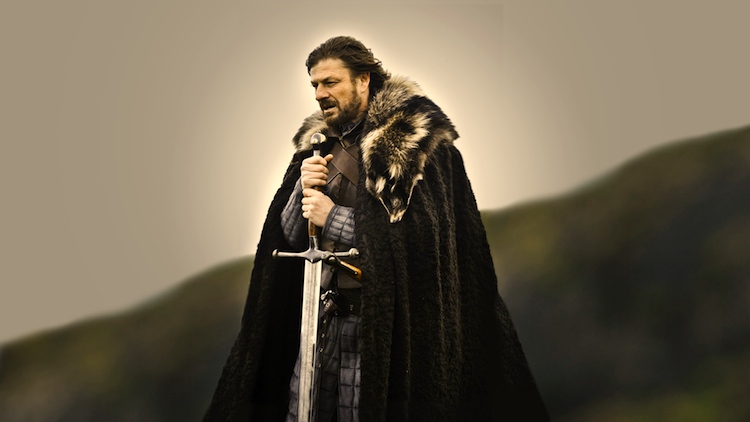
Sean Bean as Eddard Stark in HBO's "Game of Thrones."
By Joe Bendel. The Lord of the Rings and Narnia films proved there is now adequate technology to credibly adapt epic fantasy for the big (or small) screen. Having sufficient time is a separate issue. Readers of big fat fantasy novels are not simply interested in hack-and-slash action. Exotic world-building and impossibly intricate plotting are arguably even more important for them. Enter HBO, who have done right by the fans of George R.R. Martin’s A Song of Fire and Ice novels with their ten episode series adaption of the first book, Game of Thrones, which debuts this Sunday night.
“Winter is coming” says the motto of the House of the Stark, but winters in the Seven Kingdoms have a bite beyond mere cold temperatures. Lord Eddard “Ned” Stark understands winters and wars better than anyone. A grizzled veteran who prefers his northern provincial home to life at the court in King’s Landing, he is ever loyal to his monarch and former comrade-in-arms, Robert Baratheon. However, when the “King’s Hand” (essentially a Viceroy) dies under mysterious circumstances, Stark reluctantly accepts the position. It will be awkward, though. There is little love between the House of Stark and the House of Lannister, whose ranks include Queen Cersei and her arrogant twin brother Ser Jaime.
Emilia Clarke as Daenerys Targaryen.
While the Lannisters give Stark plenty to worry about, there are other storms brewing on the horizon. Viserys Targaryen, Baratheon’s vanquished rival for the throne, has made an alliance with the barbarian hordes of the east, betrothing his sister to their Khal. Meanwhile, Stark’s illegitimate son Jon Snow has joined the Night’s Watch, which stands guard over the great northern wall, where there have been disturbing reports from the “lawless lands” on the other side.
Naturally, everything gets very complicated. In fact, those just looking for a little swordplay might grow impatient with the first two installments. Still, Game’s knack for ending each episode with a dramatic revelation should keep most viewers hooked. Fans of the novels should be especially delighted with the series’ attention to gritty details that vividly bring Martin’s fantasy world to life. Time is also profitably allotted to explore dozens of relations that a two hour feature would have had to sacrifice, such as the sparring sessions and life lessons dispensed to Arya, the youngest Stark daughter, by her fencing instructor – who looks and sounds as if he stepped out of a Rafael Sabatini novel (that is not a bad thing).
Coming in with serious swashbuckling credibility from his work as Bernard Cornwall’s Richard Sharpe, Sean Bean was the perfect (and perhaps only) choice to play Stark. He effortlessly combines a commanding presence with an unassuming integrity. An alumnus of sitcoms and The Full Monty, Mark Addy is surprisingly effective as the blustering, tempestuous king. He also has some intriguingly nuanced scenes with the beautiful Lena Headey, who makes a riveting Lady Macbeth figure as Queen Cersei.
Undeniably though, the real breakout fanboy superstar from Game will be Peter Dinklage as Tyrion Lannister, the queen’s hedonistic younger brother, known as “The Imp” for his diminutive size. Recognizing the appeal of a good anti-hero, Dinklage plays his role to the hilt, chewing the scenery and visibly enjoying his character’s wickedness. It is contagious. The Imp’s scenes crackle with verve, giving the series a jolt of energy with each and every appearance.
Game is a laudably ambitious undertaking that works remarkably well based on the evidence of the first six episodes. It gets epic fantasy right and definitely leaves viewers wanting more at the conclusion of each installment. While not especially violent (though there are certainly some intense sequences), parents should fully understand Game is not Narnia. There are plenty of elements that will definitely remind viewers they are watching HBO, the home of Michael Apted’s Rome, if you follow. Regardless, most relatively mature viewers should be absorbed by its intricate story and first-rate effects. Definitely recommended, Game’s first episode, Winter is Coming, debuts this Sunday (4/17), only on HBO.
By Jason Apuzzo. • One of the biggest pieces of Cold War news recently is that Ice Station Zebra may be getting a remake! For those of you not familiar with the film (shame on you!), Ice Station Zebra was one of the greatest Cold War thrillers of them all – a Cinerama spectacular starring Rock Hudson, Ernest Borgnine, Patrick McGoohan and Jim Brown about a race to the Arctic Circle between the U.S. and the Soviet Union to recover the secret payload of a Russian spy satellite.
Although everyone shines in the picture, Patrick McGoohan – most famous for his work on The Prisoner TV series – really owns the film, and along with John Sturges’ direction (and the exceptional cinematography and production design) really elevates it to an elite level among thrillers. Among the big three movies adapted from Alistair MacLean’s novels – Ice Station Zebra, Where Eagles Dare and The Guns of Navarone – I probably would have to rate Zebra #3 (due to its somewhat slow pacing), but the film is most certainly a classic, and I’d do anything to see in its original Cinerama format.
What is completely horrifying, however, is that the person writing the screenplay for this remake is apparently writer/director David Gordon Green of Your Highness (?!), the new goofball epic featuring Natalie Portman and James Franco. How does this kind of thing happen?! Why can’t Warner Brothers do something sensible like have John Milius or Vince Flynn or Tom Clancy write it? Bloody hell.
I assume the new film would take place in the present day. Here’s hoping the screenplay goes through a few more hands …
Their rationale? According to the Bureau, “[t]he time-travel drama is becoming a hot theme for TV and films. But its content and the exaggerated performance style are questionable. Many stories are totally made-up and are made to strain for an effect of novelty. The producers and writers are treating the serious history in a frivolous way, which should by no means be encouraged anymore.” Well! Based on this criteria, they should probably ban everything Hollywood sends them.
The folks over at MGM who are currently scuttling around LA post-production houses scrubbing the Chinese from Red Dawn should definitely take note of this and make sure no time travel films are currently in the MGM pipeline – or that any new time travel subplots are being added to Red Dawn! After all, we’ve learned from a recent interview given by one of Red Dawn‘s producers that the greatest minds in the world – geniuses, Bobby Fischer/Ernst Blofeld-types who spend their days working on game theory – have been devising amazing new plot scenarios for that film, even though it’s already in the can. Perhaps the Wolverines are now being sent back to The Battle of the Little Bighorn to fight at General Custer’s side? Who can say?
Milla fetes Gorbo.
On the positive side, hopefully this means Source Code won’t make it to China.
• Behold Milla Jovovich to the right, at a special 80th birthday fete for Mikhail Gorbachev – held, for some bizarre reason, at the Royal Albert Hall in London. (Again I ask, what’s the matter with the Brits? It’s like they’re becoming a more expensive version of Lithuania.) I guess if you’re already Russian you can attend these things in good conscience. Or not. It’s funny, though, because I’m not sure Gorbo would’ve encouraged her to wear that dress back in the old Soviet Union. A little too much Western decadence, there.
 By Joe Bendel. The late 1970’s were a time of stagflation and economic malaise (sound familiar?). However, there was one booming business that offered a chance for any idiot to make serious coin: pot smuggling. Director Billy Corben explores the diversity and eccentricity of the South Florida smuggling scene in its heyday with profiles of three very different sets of co-conspirators in Square Grouper: The Godfathers of Ganja (trailer here), which opened Friday in New York.