By Jason Apuzzo. Scenes from the Sundance hit The Devil’s Double, the new film about the mobster-like lifestyle of Saddam Hussein’s son Uday, are slowly starting to trickle out onto the internet. The Devil’s Double just played last month at The Berlin Film Festival, and Lionsgate will be releasing the film here in the States on July 29th. Libertas’ Joe Bendel reviewed the film at Sundance in January and absolutely loved it (see his review here).
The scene above features Dominic Cooper as Uday Hussein’s body double Latif Yahia, as he practices his performance as ‘Uday’ in the mirror in the midst of an aerial bombardment during the first Gulf War. He’s soon joined by Uday’s mistress Sarrab, played by French actress Ludivine Sagnier. [Can anyone play mistresses better than French actresses?] Check out the scene to get a flavor of the film. Afterward, you can catch a bit of the film’s Berlin Film Festival press conference.
Based on what I’ve been seeing, the film looks like a total hoot – saucy, brutal and very entertaining. And also bold as hell. Note Sarrab’s wicked line about the Iraqi people not believe Saddam’s “crap.”
We’ll certainly be keeping an eye on the film in coming days …
Dominic Cooper and Ludivine Sagnier in "The Devil's Double."
By Jason Apuzzo. Today we begin a new feature here at Libertas called The Sword & Sandal Report!, to complement ourInvasion Alerts! and Cold War Updates!The Sword & Sandal Report! will cover the recent explosion of new films & TV shows dealing with the ancient world, and especially those depicting the worlds of ancient Greece, Rome and the Biblical lands – but also ‘sword and sorcery’-type projects that cover the Middle Ages, or alternative-style fantasy worlds. So dust off your sandals, grab that Roman-Gladius sword off the wall, strap on your helmet … and ladies, get ready to wear some loose clothing.
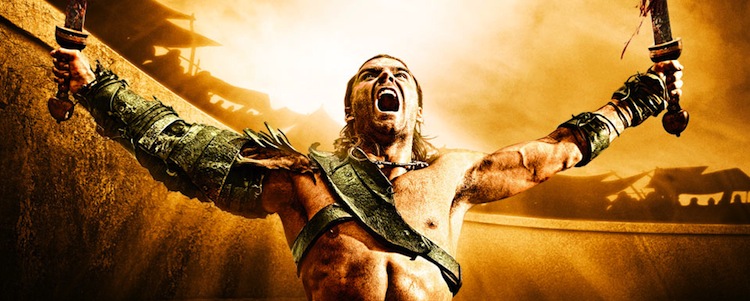
Or, as in the case of Spartacus: Gods of the Arena on Starz, wear no clothing at all!
I’ve always loved sword-and-sandal movies or peplum, particularly of the Italian/Steve Reeves-Hercules variety, but also Hollywood-on-the-Tiber classics like Ben-Hur or Helen of Troy – or fantasy fare like Ray Harryhausen’s Jason and the Argonauts. If the purpose of the cinema is to ‘take us away’ to imaginative lands of the past, where heroes are always larger than life and nobler – and women lovelier and more virtuous (or more wicked and licentious, as your tastes demand) – then these films really accomplish that. In recent years. the peplum has been revived largely by Ridley Scott’s Gladiator from 2000, although the results since that time have admittedly been mixed – with a few hits like Frank Miller’s 300, and quite a few reekers like Oliver Stone’s Alexander.
Nonetheless, I’ve been wanting to do The Sword & Sandal Report! for some time, because – when done properly – these films not only convey a wonderful spirit of adventure, fantasy and romance, but they can also be great vehicles for communicating basic ideas about freedom. In fact, it’s often the case in the more modern sword-and-sandal films that the only idea conveyed whatsoever – in the midst of all the dust, carnage and orgiastic sex – is the basic need to fight for one’s freedom, an idea we champion wholeheartedly here at Libertas.
At the same time, sword-and-sandal movies are also an entertaining way to learn about history, even when these films diverge (often drastically) from established fact. And, as in the case of something like The Fall of the Roman Empire or El Cid, sword-and-sandal movies can also be among the more poetic and erudite films you will ever see. So let’s let get started …
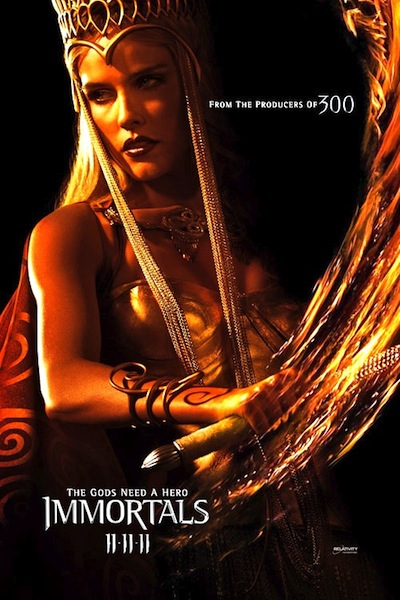
• Very big news recently on the sword-and-sandal front was the early rollout of the media campaign for The Immortals, Tarsem Singh’s 3D take on the Theseus myth coming from Universal and Relativity Media in November. The film features Henry Cavill (the new Superman) as Theseus, and also Mickey Rourke, Freida Pinto, John Hurt and Transformers 2/Red Dawn hottie Isabel Lucas as the goddess Athena. Producer Mark Canton talks about the film here and here, new posters are out for the film here, plus Immortals is already getting the graphic novel treatment (see here), and Tarsem Singh and Isabel Lucas together talk about the film here and here.
Because this is a ‘Tarsem’ movie (he helmed the memorably perverse Jennifer Lopez thriller, The Cell), the early vibe I’m getting on this film is that it could be a hyper-violent, MTV-Zack Snyder-type mess, but we’ll see and I’ll hope for the best. Certainly the benefit of casting Mickey Rourke these days as a villain – in Immortals he plays the wicked King Hyperion of Crete – is that you don’t need to put any extra fright makeup on his face.
Isabel Lucas as Athena in "Immortals."
• While producing The Immortals, Mark Canton is also apparently prepping the 300 prequel with Zack Snyder and Frank Miller … which was initially going to be called Xerxes, but which is now lacking a title, as the title ‘Xerxes‘ has apparently been dropped. Why? Too many X’s? I think Xerxes is a great title – crisp, simple and dramatic. Were they worried no one would understand that it was a 300 prequel? Here’s hoping they don’t title the film 299 – or, worse yet, Themistocles.
In any case, Canton talks about his enthusiasm for the prequel here, and you can also see a full breakdown of the Xerxes storyline via Frank Miller here. On paper, it looks like the film could be genuinely spectacular.
• Robert Towne (Chinatown) has been hired to write Pompeii, Sony’s four-part miniseries based on the best-selling historical thriller by Robert Harris and produced by Ridley and Tony Scott, among others. Read the details about the project here, and Jeffrey Wells does a nice job of tracking the intriguing similarities between Harris’ Pompeii and Towne’s Chinatownhere.
I haven’t read Harris’ Pompeii, although I’ve been to Pompeii itself – an otherworldly ghost town, meticulously preserved since its unearthing – and I’ve read Harris’ Imperium and enjoyed it a great deal. Because Ridley Scott’s involved, expect Pompeii to be big, ponderous, vaguely conspiratorial but otherwise respectable – with a boffo conclusion, as it were.
• Wrath of the Titans, sequel to the godawful remake of Clash of the Titans, has just begun shooting – and you can check out the official plot synopsis of that film here. Wrath was written by a completely different team of screenwriters than the first film, and is being helmed by Battle: Los Angeles director Jonathan Liebesman, so here’s hoping the new film is a lot better than the last. All I ask is that the new film not feature ‘heroic’ pseudo-Islamic suicide warriors (the ‘Djinn’), nor gratuitously insult Indian Hindus, and maybe include a few more women in the cast next time? Just a thought. Actually that’s three thoughts. Continue reading Sword & Sandal Report!: Immortals, Pompeii, Spartacus & The Latest on the ‘300’ Prequel
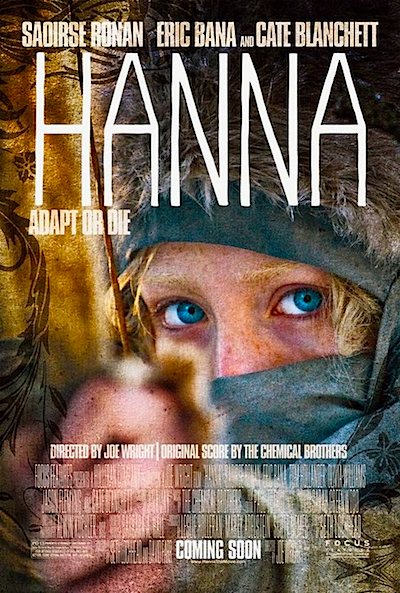
By Joe Bendel. There are 102 stars on the memorial wall at CIA headquarters in Langley. Each one signifies an officer who died in the line of duty. In their latest film, director Joe Wright and screenwriters Seth Lochhead and David Farr add at least eight stars to their ranks, inviting the audience to give a bloodthirsty cheer for each and every execution. Hollywood has come a long way since we first met James Bond’s CIA colleague Felix Leiter, but it is difficult to think of a film more hostile to the men and women who serve in America’s intelligence services than Wright’s Hanna, which opens widely today.
Hanna was developed by the Agency to be a super-killer. However, when the program was canceled, vampy agent Marisa Wiegler was charged with disposing of the evidence—and you know what that means. Somehow though, Hanna’s presumed father Erik was able to whisk her away to a remote Finnish hideaway, where he continues her training, relentlessly attacking her like a fatherly version of Inspector Clouseau’s man-servant Cato.
When Hanna decides she is ready to face Wiegler, she activates Erik’s clunky CIA signal beacon, a piece of hardware perhaps developed by the same company that produces self-destruct switches for super villains’ lairs. (This seems like an oddly passive strategy, considering Hanna and Erik spend about eighteen hours of the day stalking wild game or each other.)
Extracted simply so she can escape again, Hanna cuts through at least eight CIA personnel and a number of freelance contractors on her way to rendezvousing Erik. If that were not disturbing enough, dear old Erik also kills two completely innocent German cops, though their deaths are kept antiseptically off-screen.
As Hanna, Saorise Ronan is quite a credible young action star and can be excused for not fully appreciating the film’s ideological implications. For his part, Eric (with a “c”) Bana mostly broods sullenly as Erik (with a “k”). However,Cate Blanchett’s Wiegler looks and sounds like a stand-up comic’s bad impression of the late Ann Richards. At least she is allowed a personality. The rest of the film’s CIA personnel and associates are colorlessly interchangeable—mere meat for Hanna’s grinder, except for one conspicuously “swishy” contractor, a bizarre exercise stereotyping for this day and age.
To give due credit, Wright stages some energetic action sequences. Unfortunately, this also makes the film more effective as propaganda. It is only too easy to picture Hanna playing for months in countries across the Mideast eager to indulge in some cheap anti-Americanism. Indeed, following the revelation that YouTube clips of Brian De Palma’s anti-Iraq broadside Redacted helped spur the fatal shooting of two American servicemen at the Frankfurt airport, a film like Hanna can no longer be viewed in an ethical vacuum.
Frankly, Wright, Bana, Blanchett, and the rest of the grown-ups behind the film should be asked directly how they would explain their film to the family of CIA officer Johnny Michael Spann, the first official American casualty in Afghanistan – killed by duplicitous Taliban terrorists. What would they say to the family of William Buckley, the CIA Beirut station chief brutally tortured and murdered by Hezbollah? What would they say to the friends and family of anyone of the fallen 102?
Indeed, Hanna has serious issues far beyond its gaping logical holes and clunky performances. It is deeply cynical and profoundly disrespectful of the American intelligence officers who risk their lives on behalf of their country. Entirely problematic, Hanna should be avoided when it opens today.
By Jason Apuzzo. Writing in The Wall St. Journal today, P.J. O’Rourke weighs with a blistering critique of the new Atlas Shrugged. I’ve excerpted from his piece below. What’s interesting about O’Rourke’s take on the film is that it’s quite obviously coming from someone sympathetic to Rand’s overall cause, and therefore lacking an ideological axe to grind.
I’d like to just say generally that we’ve been as supportive of this film as we can be here at Libertas. Long before people in the conservative/libertarian/Tea Party world began jumping on board this film’s train (so to speak), Libertas was the first to report from the film’s set, conducting the first extensive interview with the film’s director, Paul Johansson (see here and here). It’s also worth mentioning that back in 2005 we did a special tribute to Ayn Rand at The Liberty Film Festival, in which we showed the restored 1942 film version of Rand’s We the Living (directed by Goffredo Alessandrini, with Alida Valli and Rossano Brazzi) and had filmmaker/restoration producer Duncan Scott and noted Rand scholar Jeff Britting speak. So we want these sorts of projects to do well.
However, it’s becoming increasingly obvious that this current version of Atlas Shrugged has few advocates outside of the usual right-wing media chorus, and even a few doubters within it. Suffice it to say that P.J. O’Rourke was not overwhelmed by what he saw:
Atlas shrugged. And so did I.
The movie version of Ayn Rand’s novel treats its source material with such formal, reverent ceremoniousness that the uninitiated will feel they’ve wandered without a guide into the midst of the elaborate and interminable rituals of some obscure exotic tribe.
Meanwhile, members of that tribe of “Atlas Shrugged” fans will be wondering why director Paul Johansson doesn’t knock it off with the incantations, sacraments and recitations of liturgy and cut to the human sacrifice.
Upright railroad-heiress heroine Dagny Taggart and upright steel-magnate hero Hank Rearden are played with a great deal of uprightness (and one brief interlude of horizontality) by Taylor Schilling and Grant Bowler. They indicate that everything they say is important by not using contractions. John Galt, the shadowy genius who’s convincing the people who carry the world on their shoulders to go out on strike, is played, as far as I can tell, by a raincoat.
The rest of the movie’s acting is borrowed from “Dallas,” although the absence of Larry Hagman’s skill at subtly underplaying villainous roles is to be regretted. Staging and action owe a debt to “Dynasty”—except, on “Dynasty,” there usually was action.
In “Atlas Shrugged–Part I” a drink is tossed, strong words are bandied, legal papers are served, more strong words are further bandied and, finally, near the end, an oil field is set on fire, although we don’t get to see this up close. There are many beautiful panoramas of the Rocky Mountains for no particular reason. And the movie’s title carries the explicit threat of a sequel.
You can read the rest of the piece here. O’Rourke goes on to make a point I’ve made here previously, which is that Shrugged‘s producers really should’ve considered either: a) setting the film in some sort of ‘alternate’ future, in which trains were not considered the most vital means of transportation (requiring some alteration of Rand’s basic storyline), or; b) simply setting the film in an ‘alternate’ version of 1957, when the novel was actually published. Continue reading P.J. O’Rourke: “Atlas Shrugged. And So Did I.” + Shrugged Part I Producer Says There May Not be Any Sequels
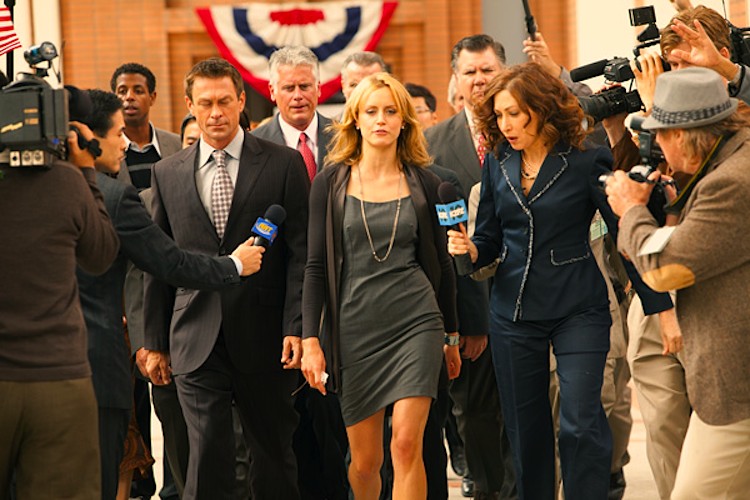
By Jason Apuzzo. To the left is a picture of George Clooney taken on the set of his The Ides of March (based on Beau Willimon’s play Farragut North).
The film is being directed by Clooney himself, and will feature Clooney playing a presidential candidate – a state governor named “Mike Morris” – loosely based on Howard Dean, circa 2004. Based on the poster and the title of the film (drawn from Shakespeare), Clooney seems to be associating himself here with both Obama and Julius Caesar.
According to IMDB, the film revolves around “an idealistic staffer for a newbie presidential candidate” who “gets a crash course on dirty politics during his stint on the campaign trail.” So the “idealism” of this staffer is presumably bound-up in the persona of one George Clooney as the candidate.
Incidentally, the IMDB page for the film misspells the name of Clooney’s character, who is listed as “Governer [sic] Mike Morris.” So apparently this “idealism” does not involve an ability to spell.
The film will also reportedly star Ryan Gosling, Philip Seymour Hoffman, Marisa Tomei, Jeffrey Wright, Paul Giamatti and Evan Rachel Wood – and will be released on Oct. 14th.
I’m at a loss for words here, although the phrase “jumping the shark” comes to mind. Also: looking ahead, I will make a point of never linking the words “George Clooney” and “self-aware” in the same sentence.
By Joe Bendel. For many South Koreans, it is difficult to believe the reports of horrific human rights abuses committed in the North. That is why Polish director Andrzej Fidyk became the prime mover behind Yodok Stories, a stage musical about the inhuman atrocities regularly happening in North Korean concentration camps. Fidyk also documented the controversial theatrical production, undertaken at great risk by defectors who survived the Yodok camp, in his eye-opening Norwegian-produced film, likewise titled Yodok Stories, a standout selection of the 2009 Tribeca Film Festival now available for free in its entirety (see above) at Snag Films.
One thing the North Koreans certainly know is how to do is stage huge spectacles of tens of thousands of tightly choreographed participants, like the grand pageant celebrating the fortieth anniversary of DPRK Fidyk recorded in his 1988 documentary Parade. Impressed by the technical skill required to mount such a production, Fidyk wanted to collaborate with a former North Korean director to document the rest of the North Korean experiment in Communist collectivism. After many inquiries, he eventually found Jung Sung San. Continue reading LFM Review: Yodok Stories & North Korean Tyranny + Watch Film Now for FREE