The Last Days of East Germany: The Mistake

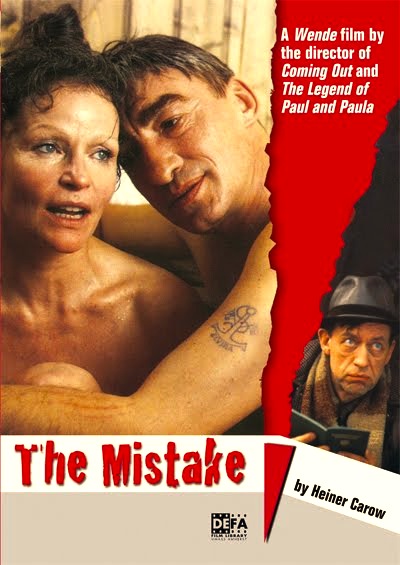
By Joe Bendel. The personal should not have to be political, but it always was in the former DDR, often with tragic consequences. As a still attractive woman of advanced years, Elizabeth Bosch ought to be able to pursue a September romance with a handsome visitor to her provincial town in relative peace and privacy. Yet, since he is West German (a Hamburger), their affair attracts the wrong sort of attention in Heiner Carow’s The Mistake, the best and final film of the Anthology Film Archives’ Wende Flicks retrospective, which concludes at the landmark East Village theater this coming Wednesday.

Elizabeth Bosch has always cleaned up after other people, yet she does not even have hot running water in her modest pre-Wende East German home. That means she and her visiting grandchildren must take their baths in the yard, which catches the eye of the wandering Jacob Alain. Though he starts off on the wrong foot, he quickly wins over Bosch. It is not as if he has much competition, aside from Bosch’s boss Reimelt, a small man unfortunately blessed with a measure of power. The town’s slovenly mayor, he blusters about the hard work of building socialism unaware that it sounds like a punch-line to the weary Bosch.

While Bosch and Alain might ordinarily prefer to take things slowly, they simply do not have the time. For a while they make do with letters and all-too brief rendezvouses in East Berlin, but the situation is clearly not sustainable. When Bosch’s older Party loyalist son announces his promotion, it further complicates matters. Now family contacts with the West will come under increasing scrutiny.

Mistake is a sad but wise love story that also serves as a pointed reminder of what life was like under Communism. Bosch does not even have hot water, yet the Stasi still takes an active interest in her romantic affairs. The film also pays tribute to those who stood up to injustice in the DDR – bringing together Alain, Bosch, and her younger son Holger at a candlelight Christmas prayer service for East German dissidents. It all has remarkable emotional heft thanks to the finely nuanced work of its leads.

Angelica Domröse and Gottfried John look like an attractive, warts-and-all couple who we would like to see together. Yet we know the system is stacked against them. Domröse is especially compelling, finely balancing strength and vulnerability as Bosch. It is one of the great unsung performances of world cinema.

One of the best cinematic depictions of mature romance, Mistake is an outstanding film. It is also a heartrending and infuriating document of life under the oppressive Communist system, yet its inescapable political implications never eclipse the human drama. Highly recommended, it screens this Wednesday (11/3) in New York as the concluding film of the Anthology Film Archives’ Wende Flicks retrospective of the East German DEFA film studio’s final productions.

Posted on November 2nd, 2010 at 11:35am.

UPDATED: Stallone Rises … Then Falls

By Jason Apuzzo. Check this out above, from Sly Stallone on Twitter …

Stallone rises!

[UPDATE: … and now Stallone falls. He’s now walking back these remarks above, telling The Hollywood Reporter that his comments were not directed at Obama specifically, but were “a reference to all career politicians.” Sure, Sly. Did the heat get to ya?]

Posted on November 2nd, 2010 at 11:01am.

UPDATE: Tom Cruise would be the Lead in any Top Gun Sequel

Good to go: Tom Cruise, back when he was Tom Cruise.

By Jason Apuzzo. I wanted to update people on a story that we covered previously. Apparently the screenwriter on the proposed Top Gun sequel, Christopher McQuarrie, has come out and said: “There is no Top Gun 2 in which Maverick is not the starring role.” It had previously been reported that Cruise’s Maverick character would only have a relatively minor role in the sequel.

We’ll see how this plays out. I’ve already expressed my thoughts on this proposed project here.

[UPDATE: Tony Scott has confirmed that if a sequel happens, he will be directing it. Scott also told the Wall Street Journal the following about the proposed project:

“It’s not a reboot, it’s not a reinvention, it’s not a remake,” Scott insisted. “The world of ‘Top Gun’ today is very different. It’s really computer geeks sitting in Nevada playing war games. It’s the end of an era for fighter pilots, but those fighter pilots then become test pilots, and the planes now that they go to fight are drones, but while they’re perfecting [the drones], they fly them.” … “David Ellison is the guy that inspired me,” Scott said. “He’s a pilot. People kept talking about ‘Top Gun 2’ and talking with Jerry [Bruckheimer] and talking with me [about the possibility of doing it], but it wasn’t until David came and he showed me these visuals of what the Air Force is doing today that I said yes, I want to be involved. So it’s not a reboot at all. It’s a totally new movie.”

We’ll continue to keep you updated about this as we learn more.]

[UPDATE #2: And here’s more from Tony Scott about the film, from over at the MTV Movie blog.]

Posted on November 1st, 2010 at 1:43pm.

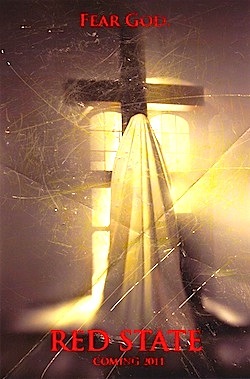
Kevin Smith’s Red State Poster

By Jason Apuzzo. Kevin Smith, movie maestro of white trash, has just put out this teaser poster for his new horror thriller about homophobic Christians, Red State.

He’s apparently hoping to debut the movie at Sundance.

I think the poster more or less speaks for itself.

[UPDATE: Smith is apparently intending to score the film with speed metal and country music. Perfect. What we have here, apparently, are the makings of a white-trash version of Machete – i.e., a hyper-political exploitation thriller being used to revive the career of a director whose career is gradually hitting the skids.

I doubt this strategy will work any better than it did for Robert Rodriguez, though.]

Posted on November 1st, 2010 at 9:35am.

The First Wave of ‘Political’ Sci-Fi: LFM Reviews Monsters

Walls can't keep America secure in "Monsters."

By Jason Apuzzo. For the past several months here at Libertas we’ve been covering the massive new wave of politically-charged ‘alien invasion’ projects that are about to be unleashed on moviegoers over the next two years or so. The origins of this intriguing new wave of films probably go back to 2008, when J.J. Abrams and Matt Reeves released Cloverfield, a sci-fi cult hit that played out as a kind of faux-documentary riff on the 9/11 attacks. [Abrams would also incorporate a 9/11-style attack on the planet Vulcan in 2009’s Star Trek.] Also in 2008 came Indiana Jones and the Kingdom of the Crystal Skull, George Lucas and Steven Spielberg’s affectionate riff on 1950s sci-fi invasion films, in which Dr. Jones confronts not only aliens (of a somewhat benign variety) but the Soviet communist menace, as well. Of course, the ‘alien invasion’ genre then got supercharged in late 2009 by James Cameron’s Avatar, which not only revived 3D but ‘politicized’ sci-fi to a degree unseen since the early 1950s.

One of the things that makes this new wave of films so interesting – and redolent of similar waves from the 1950s – is that it extends from the mega-big budget (e.g., the $200 million Battleship from Universal, starring Liam Neeson) to the low-budget (such as next month’s Skyline, made for under $10 million). And on a thematic level, although not all the plotlines are known for these films, many of them seem to be channeling political anxieties associated with terrorism, foreign threats, nuclear fears, as well as paranoia about the increasingly radical tone of American politics. [See my exchange with the LA Times’ Patrick Goldstein on this subject here.]

By the time this new wave of films peaks – probably about two years from now – Gareth Edwards’ Monsters (opening in select theaters today) is unlikely to be remembered as a high-water point of the genre, even for low-budget fare. Edwards’ film is too languorous, too derivative of other (and better) films to really linger in the memory. What Monsters does accomplish, however, is suggest how easily science fiction can be adapted to comment on contemporary political concerns.

America conducts urban warfare in Mexico in "Monsters."

The set-up for Monsters is relatively straight-forward. In the near future, America has sent space probes out into our solar system searching for microbial evidence of life. These probes have crashed back to Earth in the vicinity of the U.S.-Mexico border, where alien life forms brought back from space have swiftly grown into massive creatures – ‘monsters,’ that more or less look like grilled scampi – that have ravaged the countryside, and even major cities. The U.S. and Mexican militaries have thus conducted a massive (but largely futile) operation to both contain and destroy the creatures, resulting in urban warfare and endless bombing runs that have reduced many urban centers in Mexico to rubble. What’s more, we’re led to believe that the American bombing runs over Mexican cities have been far more devastating and lethal than the creatures themselves. Continue reading The First Wave of ‘Political’ Sci-Fi: LFM Reviews Monsters

The Last Days of East Germany: Miraculi

By Joe Bendel. Filmmakers working behind the Iron Curtain had a natural affinity for the absurd and the surreal. Given their experiences under Communism, they could easily relate to such Kafkaesque cinemascapes. It also behooved them to keep their social critiques obscured by layers of allegory and symbolism. A passion project only made possible by the fall of the Berlin Wall (or the epochal “Wende”), Ulrich Weiß’s Miraculi represents the culmination of such cinematic strategies. Finally produced in 1991, Miraculi screens next week as part of Wende Flicks: Last Films from East Germany, a retrospective of the East German DEFA studio’s final years (1990-1994), presented at Anthology Film Archives in conjunction with the Goethe-Institut New York.

In the Czech Republic, one of the few annoying holdovers from the Communist era are the plain clothes transit inspectors looking to fine riders who cannot produce their appropriately punched tickets. Evidently East Germany had these transit narcs as well. Through a series of chance circumstances, Sebastian Mueller, a mild mannered juvenile delinquent, joins the ranks of the volunteer transit inspectors. In truth, he is not very good at his duties, but he takes them very seriously, alienating his father, who labels him a traitor to the workers.

Episodic and trippy, Mueller’s story defies pat description. In a strange way, Weiß invests Mueller’s reviled voluntarism with strange and cosmic dimensions. Yet, one can easily glean the power dynamics at work. As one character explains, stiffing the tram is truly the only safe method of rebellion available to her, so who cares if she is caught.

Miraculi’s dense layers of meaning are probably only fully grasped by those who experienced the oppressive drabness of the GDR. That being said, there are plenty of signifiers astute westerners should be able to catch. Indeed, the significance of an abnormal psychology lecture delivered to Mueller and his fellow inspectors is hard to miss, if viewers have any familiarity with the Soviet bloc’s record of institutionalized psychiatric abuse.

Undeniably both subversive and demanding, there is no possible way Miraculi could have been produced under the Soviet-dominated GDR regime. It is a world away from Soviet Realism, even though it scrupulously captures the depressed grunginess of industrialized East Germany. It is a rich, challenging work, recommended to viewers who do not have to “get” everything they see to appreciate a film. It screens this coming Monday (11/1) at Anthology Film Archives as part of the remarkable Wende Flicks series. Truly a cinematic event, many of the Wende selections have never been subtitled or shown outside of Germany, until now. Yet films like Miraculi are both historically important and fascinating in their own right. The Wende Flicks series runs in New York from November 1st through the 3rd.

Posted on October 29th, 2010 at 10:58am.