Northern California film enthusiasts take note: you’ve got a great weekend ahead of you. Starting this Friday at the magnificent Art Deco Paramount Theatre in Oakland, Abel Gance’s legendary silent masterpiece Napoleon will be screening in its newly restored form. The film’s four performances (March 24th, 25th, 31st and April 1st) will mark the American premieres of both the complete 5 1/2 hour Photoplay-BFI restoration by Academy Award-winner Kevin Brownlow and the film’s new, monumental orchestral score by Carl Davis – who will conduct the 46-piece Oakland East Bay Symphony live.
One of the most innovative and epic films of all time, Napoleon will be presented with its original 3-screen ‘Polyvision’ climax, with the screen dramatically expanding to three times its width (for the film’s finale, two custom-built screens will flank the Paramount’s normal screen).
This screening represents the first performance in 30 years of Napoleon with orchestra and Polyvision. No screenings are being planned for any other city and there are currently no plans for DVD, BluRay, streaming, or television. (Why? One is tempted to ask …) In any case, tickets for the live performances can be purchased here. To read more about the film’s restoration and the screening, see The New York Times.
In other Bay Area cinema news, starting tonight (3/22) and running through Sunday (3/25) the Disposable Film Festival will be taking place in San Francisco. One of the most refreshing and unpretentious film festivals around, the Disposable Film Festival was founded in 2007 by Eric Slatkin and Carlton Evans to celebrate the creative potential of ‘disposable’ video: i.e., short films made on everyday equipment like cell phones, pocket cameras, and other inexpensive video capture devices.
The Disposable Film Festival, which represents a real breakthrough in the democratization of both filmmaking and film festivals, kicks off in San Francisco this weekend before traveling to cities around the world. Make sure to check it out, and tickets for the festival are available here. You can also check out what The Wall Street Journal says about the fest, and read founder Carlton Evans’ recent, fascinating post about disposable filmmaking at The Huffington Post.
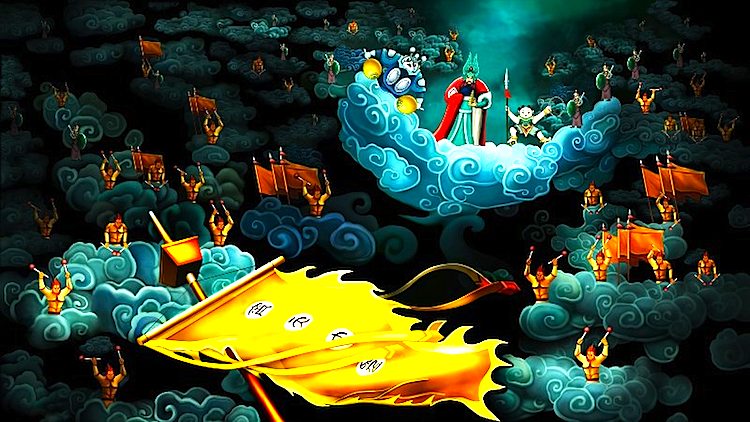
By Joe Bendel. Wan Laiming was the Walt Disney of China. Unfortunately, his long planned masterwork finally came to fruition on the eve of the Cultural Revolution. Just as the second part of his animated adaptation of the Ming-era novel Journey to the West was released to general acclaim, the Chinese film industry was shuttered for reasons of ideological madness. Recognized as one of the greatest Chinese animated features ever, Wan’s complete The Monkey King—Uproar in Heaven has been meticulously restored, frame-by-frame, and converted to widescreen 3D. Su Da and Chen Zhihong’s Monkey King restoration had its North American premiere screenings during the 2012 New York International Children’s Festival.
Being in fact a monkey, the Monkey King is perfectly suited to animation. Supernaturally powerful, he happily leads the monkey tribe of Flower Fruit Mountain, but his rambunctious nature attracts celestial attention. On the orders of the Jade Emperor, the Monkey King is whisked up to the heavens, only to be given a dubious title and shunted off the a harmless corner of the cosmos. The Monkey King does not play that game, though. He creates quite the ruckus before returning to his clan on Flower Fruit Mountain. However, the beings of the higher realm consider his rebellious drive a threat and will not leave well enough alone.
Often thought to be influenced by Hindu deities, the Monkey King clearly fits the Trickster archetype. While he eventually settles down in the source novel, Uproar features him at his most uproarious. Frankly, some of his moves prefigure several signature sequences from the Matrix franchise. He is also quite proficient with his magical staff, delivering plenty of satisfaction for martial arts fans.
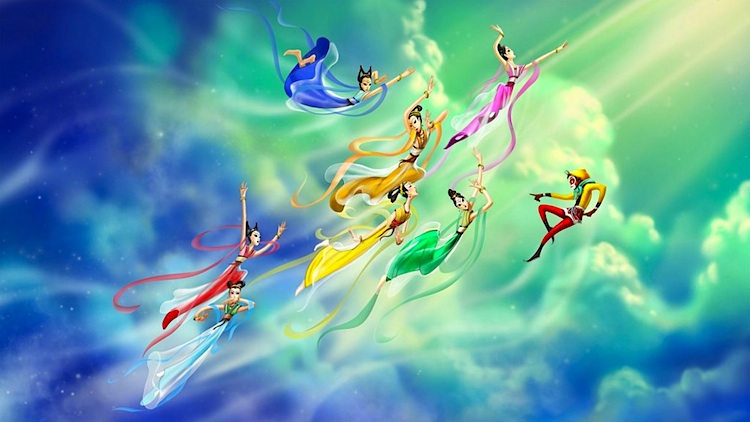
However, the look of Wan’s film, by way of the Su and Chen’s restoration, is truly remarkable. It has a rich lushness, but there is also a mystical vibe that resists comparison to other films. It is also hard to describe the film’s color palate, but it is quite distinctive (and a testament to the filmmakers’ restoration efforts). Some sequences are incredibly graceful, such as the Monkey King’s encounter with a wonderfully cinematic group of fairies, at least until his mischievousness asserts itself. In addition, the restored Uproar is one of the most skillful and refined examples of 3D rendering, aside from Wim Wenders’s Pina. More than just pointy objects jutting out from the screen, the 3D here emphasizes depth on a grand scale.
The Monkey King’s story holds a place of honor amid China’s rich cultural legacy, which the ideological campaigns of the mid and late 1960’s tragically nearly destroyed. Presumably, some purists will debate aspects of the 3D digital refurbishment, most definitely including the 3D itself, but also the restoration directors’ abridgment of the film, the newly composed and recorded soundtrack (directly inspired by the Beijing Opera) and their alteration of the aspect ratio. However, these debates are good to have.
Ultimately, their efforts will bring Wan’s images to a new generation of viewers and ensure they will be preserved for generations to come. Perhaps more to the point, Uproar is an enormously entertaining spectacle that is both high-brow and action-oriented. Recommended for kids and animation fans with an interest in Chinese Culture, The Monkey King—Uproar in Heaven is likely to have a long life on the festival circuit and in specialty distribution, following its enthusiastically received screening last night at NYICFF.
A new trailer is out for the film For Greater Glory, about the Cristero War (or ‘Cristiada’) of 1926 to 1929, which was an uprising against Mexico’s then-Marxist government. For Greater Glory opens June 1st, with a cast featuring Andy Garcia, Eva Longoria, Peter O’Toole, Oscar Isaac, Ruben Blades and Bruce Greenwood.
By Joe Bendel. It is a time in Algiers when Jews and Muslims lived together harmoniously. It is also an animated fantasy with a talking cat. Nonetheless, there is a distinctive mix of gentle nostalgia and broad comedy in Joann Sfar & Antoine Delesvaux’s The Rabbi’s Cat, which screens as part of the 2012 New Directors/New Films.
The time is the early 1920’s, after the Russian Revolution, but before World War II. We know this because Rabbi Sfar regularly gets shipments of Russian Rabbinical texts sent to him for safekeeping from the Bolsheviks. He has a cat with no name, known only as “le chat du rabbin.” While his identity comes from the Rabbi, it is the Rabbi’s voluptuous daughter Zlabya whom the cat loves best. However, the Rabbi temporarily forbids the cat to see his mistress when the cat mysteriously begins talking one day.
Actually, the talking thing comes and goes, to the Rabbi’s befuddlement. He will have even more to puzzle out when through a turn of magical realism, a Russian refugee is found alive and well in his latest cargo from the Soviet Union. Of course, nobody can understand his Russian, except the cat, who inconveniently is currently amid one of his speechless stretches.
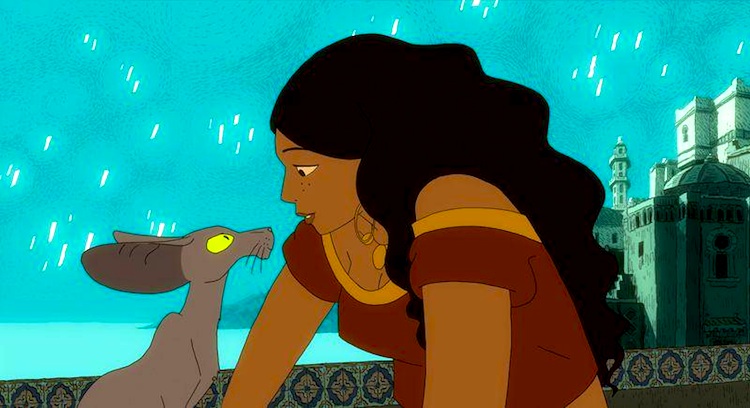
From "The Rabbi's Cat."
There are enough Jewish identity jokes in Cat to fill Billy Crystal’s next Catskills set. Yet, there is also something seductively exotic about this cat’s eye view of Algiers. Sfar and Delesvaux earnestly want to present a picture of interfaith tranquility, perfectly represented by the Rabbi and his Sufi cousin, Sheik Mohammad Sfar, two branches of the same but diverse family. They even skewer the unrehabilitated and pre-Spielbergized Tintin in one rather random scene. Yet, they do not completely burry their heads in the Kumbaya sand, depicting the touchy intolerance of an Islamist Bedouin clan, whose hospitality quickly becomes somewhat precarious for the inclusively motley Sfar expedition.
Considering Cat adapts non-sequential volumes of Sfar’s popular graphic novel series, it is hardly surprising the narrative jumps around quite a bit. In an odd way, though, that hop-scotching gives the film its energy. Those looking for something to offend them will probably find it here, but Cat is mostly just harmless fun. Though a bit spicy at times, it is probably okay for older kids, but parents should probably decide on a case by case basis.
Evocatively rendered, Cat’s animation captures the spirit of the original comic art, while conveying the allure of the Middle Eastern locales. It also represents a bit of festival history, holding the distinction of being ND/NF’s first 3D selection and their first screening deliberately intended for family viewing. Recommended for animation fans, particularly admirers of Sfar’s work, and kids who can handle subtitles and more advanced thematic material (but still enjoy talking animals), The Rabbi’s Cat screens this Sunday (3/25) at MoMA and the following Tuesday (3/27) as ND/NF continues at both venues.
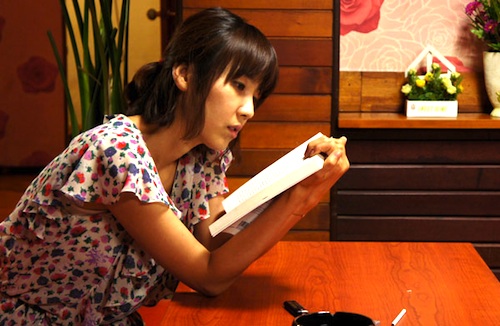
By Joe Bendel. Even in Korea, the movie business is a tough racket. It disillusions people something fierce. However, the characters in Lee Kwang-kuk’s directorial feature debut might have been that way before they got into the industry. They also might be each other or possibly just passing their stories off as their own. Let the narrative games begin when Lee’s Romance Joe (trailer here), screens at the 2012 New Directors/New Films.
This will get complicated. Our first narrator will be Seo Dam, but as an aspiring screenwriter, his storytelling skills cannot compare to someone who has seen a bit of life, like Re-ji, who works for a coffeehouse, whose motto might as well be “coffee, tea, or me.” The parents of a long struggling assistant director have come to his friend Seo Dam fearing their absent son may have committed suicide, just like Woo Joo-hyun, a popular actress with whom he once worked.
As they mill about wondering what to do next, Seo Dam tells them the story of his new screenplay, in which a young boy arrives at Re-ji’s establishment looking for his long lost mother. Simultaneously, Re-ji delivers coffee and hard sells her services to Lee, a screenwriter-director in need of inspiration. She gets him to bite with the tale of “Romance Joe,” a depressed filmmaker who previously checked into the same hotel with suicidal intentions. She had inadvertently walked in on the man while making a delivery with the young boy from Seo Dam’s screenplay. As Romance Joe warms to her, he tells her an episode from his youth, when he fell in love with the haunting Kim Cho-hee after unwanted notoriety drove her to also attempt suicide.
Is Re-ji also the long lost mother of the boy in the screenplay, because they both once tried to end it all by cutting their wrists, just like Kim Cho-hee? This question will be definitively answered. Is Woo Joo-hyun also Kim Cho-hee? Is Re-ji Kim Cho-hee as well? No, most likely not (but don’t take my word for it). It appears safe to assume Re-Ji is Re-ji, whether appearing as subject or narrator and then subject again. Likewise, the missing assistant director is pretty clearly established to be Romance Joe. As for the sequestered director Kim, since Re-ji compliments him on his ironic approach to narrative, he seems the more likely fictional analog to Lee Kwang-kuk than Romance Joe.
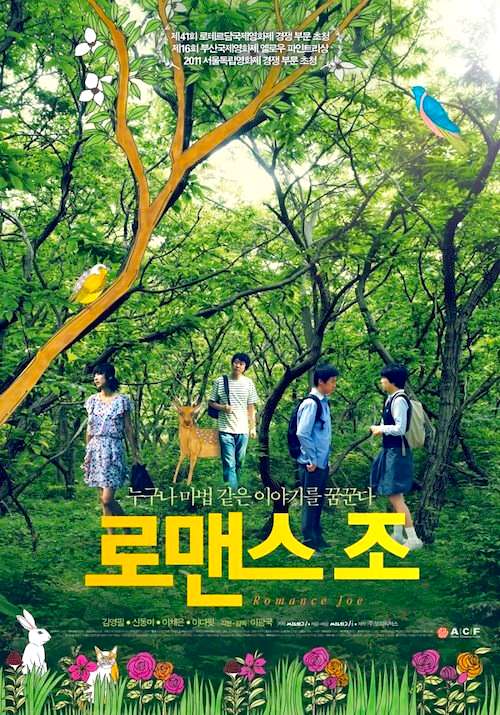
From "Romance Joe."
That took more time to distill than you want to know. Yet, RJ is a tragic love story at heart, presenting an unlikely vehicle for such bravura postmodern gamesmanship. In contrast, a cerebral mystery like Mariano Llinás’ head-reeling Extraordinary Stories lends itself to such an approach quite well, because viewers do not resent having information withheld from them and perspectives fiddled with.
In a way, RJ is like a set of deliberately mismatched Russian dolls that do not quite fit within each other. Yet, the drama is so genuinely earnest, particularly that of the young lovers, it still pulls viewers in, even with the constant narrative shifts. Lee Chae-eun is quite remarkable, equally convincing and heartbreaking as the teenaged and thirtysome Kim Cho-hee. Yet it is Shin Dong-mi who really makes the film sing. It is a star-making turn, appealingly wry or saucy, depending on the circumstances. Unfortunately, the relative blandness of several male cast members does not help viewers looking for hooks to grab onto, but impressive young David Lee develops some poignant chemistry with the older Lee Chae-eun.
No matter how viewers respond to RJ, it is a film that will stick with them, daring them to make conclusions about what they saw and when it happened. Lee Kwang-kuk rather subversively deconstructs Korean tearjerkers like Il Mare (ill-advisedly remade by Hollywood as The Lake House), but it is Shin and the other Lees, David and Chae-eun, who really make it work. Recommended for adventurous film snobs, Romance Joe screens this Saturday (3/24) at MoMA and Monday (3/26) at the Walter Reade Theater, as part of New Directors/New Films 41.