LFM Book Review: David Mamet’s The Secret Knowledge

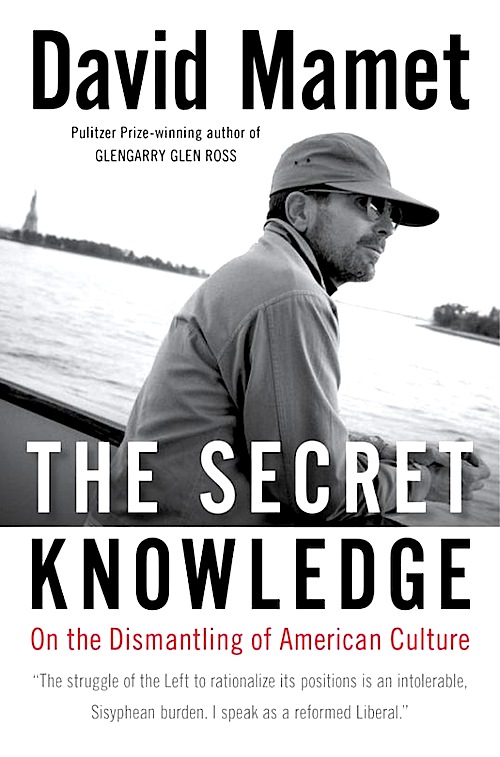
By David Ross. I wrote a while ago about David Mamet’s splashy conversion to conservatism (see here), about which I was naturally excited, Mamet being the highest ranking defector in the modern Cold War between right and left. I eagerly awaited his book, The Secret Knowledge: On the Dismantling of American Culture, hoping for a manifesto that would function as an elegant rapier thrust, or at least a solid groin kick, and hurt all the more coming from a man whom the left cannot write off as a cretin from the land of “low-sloping foreheads” (to borrow a phrase from New York Times columnist David Carr). Mamet has, after all, lent intellectual heft to Broadway and Hollywood for more than three decades.

It pains me to confess that Mamet’s book is dreadful. It’s not, as one might imagine, that his conservatism turns out to be a smug centrism in the David Brooks mode or an idiosyncratic wire-drawn intellectual construct in the Hitchens mode. On the contrary, he shares the talk-radio mindset of bitter far-right disgust, and he seems sturdily committed to the entire Republican platform, for better and for worse. Conservatives will immediately recognize Mamet as their man.

The problem is twofold: 1) What seems to Mamet revelatory a year or two into his conservative phase is not so revelatory to those of us who’ve spent twenty or thirty years toiling in the conservative vineyards. He’s like a blind fellow who can suddenly see and proceeds to inform everybody that the sky is blue and the grass is green and chesty women look good in tight sweaters. 2) The book is badly argued (where it’s argued at all) and badly written in the basic mechanical sense. Mamet’s prose is gnarled and parenthetical and weirdly affectless (c.f. his nerveless, deadpan directorial style). It’s not as bad as Sean Penn’s prose, which is almost literary anti-matter (see here), but, lord, it ain’t good. Here’s a sample, cherry-picked only slightly:

If a country, a region, a race is in difficulty because of a lack of funds, any new or recurrent failure subsequent to any subvention in aid may be attributed to insufficient aid, and provide the rationale for that funding’s increase. But it may only do so given the acceptance of the nondemonstrable, indeed disprovable theory that government intervention increases wealth. (pg. 36)

This is to say, more or less, that governments like to throw good money after bad. I can only suppose that writing street-smart dramatic dialogue and writing elegant expository prose are entirely different skills, and that Mamet is a writer only in a restricted sense. Continue reading LFM Book Review: David Mamet’s The Secret Knowledge

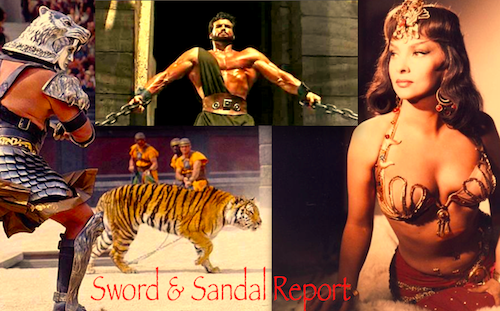
Sword & Sandal Report: The ‘300’ Prequel, Immortals, Conan, Ironclad & Sean Bean Slash Through the Ancient World!

From "Immortals."

By Jason Apuzzo. • A lot’s happened since our last Sword & Sandal Report. First of all, we now have a new and slightly better trailer for Immortals, the forthcoming 300-style take on the Theseus myth coming this October starring the new Superman, Brit star Henry Cavill.

As I’ve said before, I like the concept of building a film around the ancient Greek hero Theseus, lover of Ariadne and slayer of the Minotaur – but from this new trailer it still looks we’re dealing with more CGI overkill here from the same producing team that gave us 300 – a film which, for all its cheeky/politically incorrect depiction of the ancient Persians, still felt way too much like a cross between a video game and a Chanel ad. Immortals looks like it’s picking up right where 300 and the Clash of the Titans remake left off, substituting CGI and TV commercial styling for a lack of storyline or interesting characters. I’ve seen two trailers for this film so far, and I still have no idea what the film is about – why, for example, as the tagline goes, ‘the gods need a hero’ (gods being gods, they usually don’t need human heroes) – although I have seen a lot of massed CGI armies and shouting. And Mickey Rourke wearing what look like Bronze Age bunny ears.

And by the way, where’s the Minotaur in this film? There’s no sign of it – nor of the Labyrinth. I’m hoping the creators of this film are aware that what Theseus is most famous for is slaying the Minotaur inside the Labyrinth – think of slaying the Minotaur as being for Theseus what, say, the 56-game hitting streak was for DiMaggio – and that it might’ve been a shrewd idea to include either a Minotaur or a Labyrinth somewhere in the film or the trailer. Is it too much to ask for a Minotaur or a Labyrinth in a movie about Theseus? Hello?

At least Isabel Lucas looks good as Athena – who will apparently be an action figure in this film. Incidentally, Immortals has some new character posters out, and there are some good screengrabs here from the new trailer.

• Speaking of 300, the big news about the prequel is that it will no longer be called Xerxes, but 300: Battle of Artemisia – a triumph of brand marketing over common sense. The new film, of course, is not about the 300 Spartans, and is about Xerxes – but no matter, brand triumphs over all and the producers are obviously worried that no one in foreign markets like Poland or Thailand or West Virginia will understand that a film called Xerxes is actually a prequel to 300. (Maybe they should just call it 200 – that makes about as much sense.) In any case, Zack Snyder will not be directing the prequel – it will apparently either be Noam Murro and Jaume Collet-Serra. (Murro, interestingly, has done commercials for the Halo video games – and may do the next Die Hard film.) So what does any of this mean? Not very much, except that this would-be franchise is still on the drawing board while a lot of time passes. By the time Battle of Artemisia hits theaters (in late 2012 at the earliest), both Clash of the Titans and Wrath of the Titans will have been released, along with Immortals, and 300 will be at least 5 years in the past.

One of the things that made 300 so intriguing was its apparent relevance to our contemporary War on Terror. With Iran becoming more belligerent all the time, that relevance will likely still be there by 2012 or 2013, but one can’t help but wonder whether an opportunity is being lost with this franchise …

Jason Momoa as Conan.

• Conan the Barbarian 3D has a new international trailer out, an amusing new ad, and also a red band trailer for the more bloodthirsty among you. This film seems to be cruising along toward its late summer (August 19th) release, without a lot of heat or buzz – mostly, I suspect, due to the cast not being filled with A-listers. But the film looks diverting enough (as these things go), and – in an important carryover from the Schwarzenegger films – willing to have a sense of humor about itself. This, incidentally, is what’s noticeably lacking from the Immortals trailers thus far – a sense of humor.

Conan also has some new posters out (see here and here), and a lot of good new productions stills are available (here and here). I feel willing to give this film a chance, although I’m not expecting El Cid, if you know what I mean … Continue reading Sword & Sandal Report: The ‘300’ Prequel, Immortals, Conan, Ironclad & Sean Bean Slash Through the Ancient World!

Rock Mega-Concerts

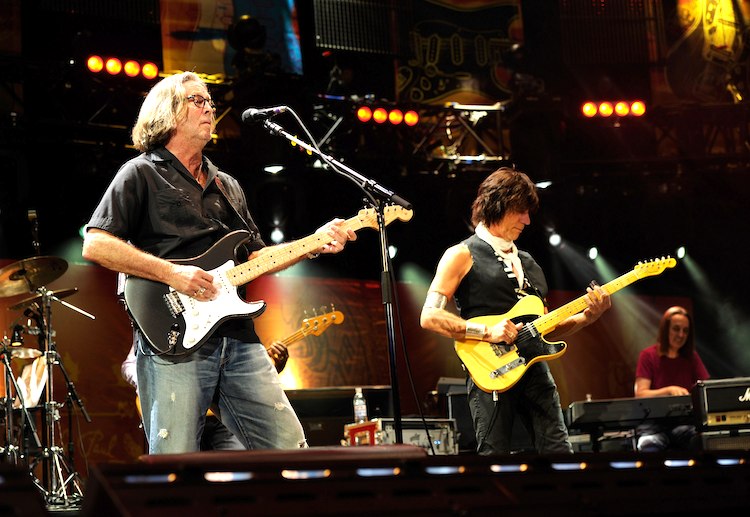
Eric Clapton and Jeff Beck at the 2010 Crossroads Guitar Festival.

By David Ross. Two rock mega-concerts are now streaming on Netflix: the Rock’n’Roll Hall of Fame’s 25th Anniversary Concert (2009) and the third installment of Eric Clapton’s Crossroads Guitar Festival (2010), each weighing in at something like five hours. I have nothing very nice to say about the Hall of Fame concert. Like rock itself in its thirty-five-year phase of senescence, the concert has a smarmy self-congratulatory masturbatory quality that quickly becomes nauseating. A fair representation of the rock aristocracy is present – Jackson Browne, Crosby, Stills, and Nash, Mick Jagger, Billy Joel, Metallica, Prince, Lou Reed, Simon & Garfunkel, Bruce Springsteen, James Taylor, Sting, U2, Stevie Wonder, etc. – but the music has a mere pretense of energy and inspiration. It’s a slick simulacrum of an inspiration that fled in the seventies. For the most part, this concert is no better than a Vegas floor show.

Little Anthony, Buddy Guy, Dion, B.B. King, Jerry Lee Lewis, and Darlene Love are duly wheeled out, but their participation is gestural and patronizing. The baby boom billionaires can thereby flatter themselves as reverent keepers of a tradition that they have of course utterly sold out.

U2 particularly irks me, not because they’re not good – they are very good – but because they’re good in the wrong way. Theirs is a triumph of will – of sheer determination and professional organization and marshaled nerve; not for them the more equivocal experiments in interrogation, introspection, or poetry, the anxious plum-line dropped deep. Their real genius is steering their own ascension as icons and negotiating the cultural politics of their own global gigantism. Though they’ve made a lot of good music, they turn out to be oddly cognate with postmodern media manipulators like Madonna and Lady Gaga.

Bruce Springsteen & Tom Morello at the Hall of Fame concert.

The only performance worth mentioning is the Springsteen/Tom Morello version of Springsteen’s dustbowl anthem “The Ghost of Tom Joad.” As much as he seems like he could use a good knock on the head from a cop during one of those IMF or World Bank melees, Morello, I have to admit, kills it. He may be the single-most annoying guy ever to play the guitar really well. For his part, Springsteen begins by issuing platitudes about “high times on Wall Street, hard times on Main Street,” which is a little rich coming from a guy who’s worth maybe $500 million, most of which, I hazard to guess, is invested by these very same Wall Street vampires. Springsteen has lost a good deal of his voice and looks increasingly like an aging tough guy from The Sopranos, but he’s still a rock’n’roll true believer, the last of them perhaps, along with Patti Smith. You won’t see him cavorting with Jay-Z and Beyonce at Cannes or hobnobbing with Sir Mick at the Monaco Grand Prix. Continue reading Rock Mega-Concerts

EXCLUSIVE: Libertas Reviews the Clint Eastwood-Leonardo DiCaprio J. Edgar Hoover Screenplay

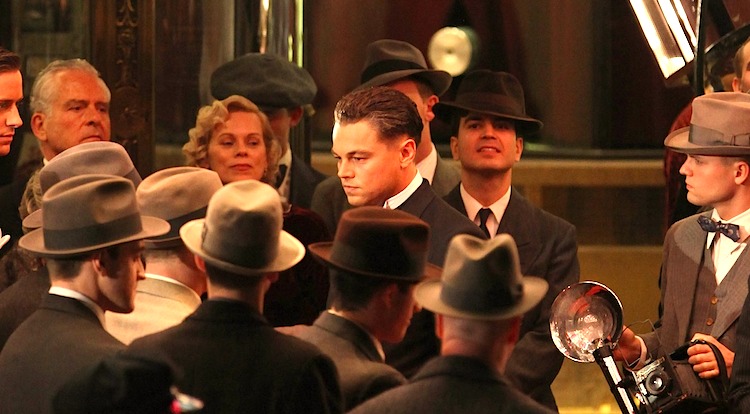
Leonardo DiCaprio as J. Edgar Hoover in Clint Eastwood's "J. Edgar."

By Jason Apuzzo. • I had the opportunity recently to read Dustin Lance Black’s screenplay for the new Clint Eastwood-Leonardo DiCaprio film J. Edgar, set for release this October. Even though the film covers a fair bit of Cold War history, in terms of the FBI’s handling of communist infiltration, due to the fact that J. Edgar covers Hoover’s full professional story – from his rise in the late 1910s all the way through to the Nixon years – I’ve decided to talk about the screenplay outside the context of one of our regular Cold War Updates!. I would love to give the screenplay an even more exhaustive write-up, frankly, but due to my own time constraints I’ll have to keep things brief – and focus primarily on what the film will be saying about the anti-communist struggle.

I’ve decided to write about this screenplay publicly because it’s covering extremely important areas of history – 50+ years of it, in fact, dwelling on issues of law enforcement and privacy that still resonate with us today – and also because we’re dealing here with an actual historical figure, with a very public record. (I’ll also try to keep things here as spoiler-free as possible – with the understanding, again, that we’re dealing with Hoover’s long public record.) People should know, frankly, how the man who founded the FBI and shaped a large part of 20th century American domestic history is going to be portrayed.

Young Hoover arrives to investigate a bombing.

There’s a lot to like about J. Edgar in its first act. Hoover’s colorful rise is set against the struggle over communist infiltration of American society during the late teens and early ‘20s – a struggle rarely covered in cinema, as most people assume (mistakenly) that Soviet agents only first hit our shores during the 1930s. The screenplay actually begins with the bombing of Attorney General Mitchell Palmer’s home by communist/anarchist saboteurs in 1919, and we see famous figures like the young FDR and Dwight Eisenhower pour out onto the street in the aftermath – as a peppy, ambitious young Hoover arrives on a bicycle and begins piecing together clues over the bombing. In fact, if you’ve seen early set photos of DiCaprio as Hoover on a bicycle (see right), those images are likely from this opening sequence of the film – a sequence that sets the tone and mood of the film with America under a constant sate of siege (first from communist agents in the 1920s, then from criminal mobs in the 1930s, and finally from Soviet agents again from the late 1930s forward). We see Hoover and his maverick team take down Emma Goldman and a violent gang of communist-anarchist saboteurs, and Hoover begins to put the policies and procedures of modern criminal investigation in place.

The communist/anarchist saboteurs in this section of the film, incidentally, are not depicted as terribly pretty people. They’re made to look dangerous and deceptive – not as victims of a witch hunt, or martyrs. In fact, with their bomb-making factories, and attempted gamesmanship of the legal system, obvious parallels will be drawn with today’s Islamic terrorists. The message here couldn’t be more plain: a robust federal investigative force is needed to face down this threat, and ensure domestic security. Continue reading EXCLUSIVE: Libertas Reviews the Clint Eastwood-Leonardo DiCaprio J. Edgar Hoover Screenplay

Cold War Update: Michael Bay Rules the Summer, 007 Marries, Plus New Trailers for The Iron Lady, 5 Days of War & More!

Michael Bay & Co. premiere "Transformers: Dark of the Moon" in Moscow.

By Jason Apuzzo. • Libertas is about to break some major news regarding one very big, forthcoming movie related to the history of the Cold War, so stay tuned …

• .. although of course, the biggest Cold War-related news of late is the whopping debut of Transformers: Dark of the Moon, a film steeped in the lore and romance of the U.S.-Russia space race (see my review of the film here). Dark of the Moon had its huge, worldwide premiere just over two weeks ago in Moscow, and as of the writing of this post is already approaching the $500 million mark at the worldwide box office.

I’m liking this film even more as I ruminate over it – and over the entire Transformers series, which snuck up on me unexpectedly, in so far as I only ever saw the first two films on DVD. Some of you might ask, is it possible – or even healthy – to ‘ruminate’ on a Michael Bay film about giant toy robots? I’d say ‘hell yes’ it is, when the films are as well-crafted, warm and human as these are – not to mention freedom-loving. And although Dark of the Moon to some extent surrenders to its (admittedly fantastic) technology in the third act, it only feels that way because – once again – Bay does such a nice job setting up his characters in the film’s early sequences. This is the aspect of Bay’s work that is so consistently underestimated by critics: his ability to create sympathetic characters, who bring a human dimension to the mayhem that otherwise transpires in his films. Believe me, f this were an easy thing to do, more directors would do it.

Incidentally, it looks like Bay may actually complete the trifecta here. Both previous Transformers films were the top grossing films in their year (in part due to Avatar straddling 2009-10), and it looks like Dark of the Moon may complete the hat trick. I don’t think anybody’s done anything like this since the Lucas-Spielberg heyday. Dark of the Moon is also is tracking young, which has suddenly – and mysteriously – become Hollywood’s big problem this summer; plus, the film is also blowing up all of those silly, premature burials of 3D – most of which were based on bad 3D conversions.

In related news, Michael Bay talks-up the native 3D aspect of the film to The New York Times, Rosie Huntington-Whiteley talks about working with Bay, and Shia LaBeouf does this extremely colorful interview with Details. He apparently landed both Megan Fox and Isabel Lucas while making these films. That’s heroic. They’re not paying this kid enough. Continue reading Cold War Update: Michael Bay Rules the Summer, 007 Marries, Plus New Trailers for The Iron Lady, 5 Days of War & More!

LFM Mini-Review: Cars 2

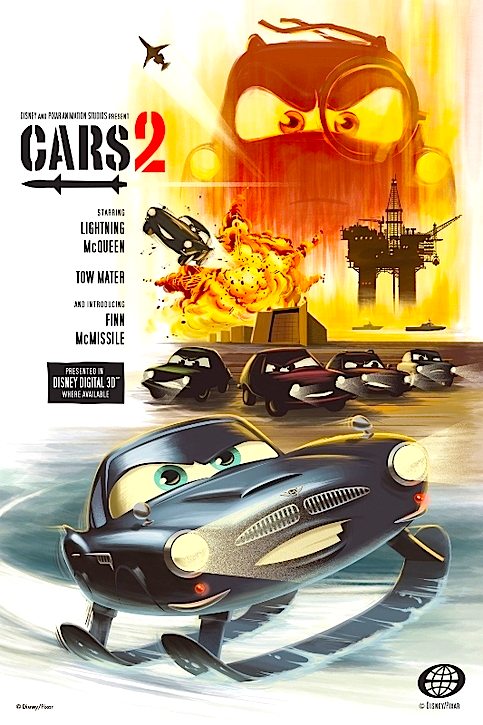
By David Ross. THE PITCH: Hayseed tow-truck gets mixed up in international espionage. Strange alternate universe in which cars behave like people. No explanation. Kind of creepy.

THE SKINNY: Cars 2 brings Pixar’s exuberant twenty-five-year spree to a grinding halt. Call it a mid-life crisis. The problem is not moral – the usual descent into greed, cynicism, and indifference – but conceptual. The plot is a confused and hyperactive whirlwind of genre elements and action sequences, perhaps amenable to the ADHD generation, but constantly preventing the film from taking emotional or moral root. Monsters Inc., The Incredibles, and Toy Story 3 – Pixar’s three incontestable masterpieces – are likewise action oriented, but they have a certain organic rhythm, a pattern of pause and eddy. They feel human, in short, while Cars 2 rushes in unremitting machine rhythm, much like a NASCAR race.

WHAT WORKS:

• Pixar’s technical genius has reached new and incredible heights. In the opening sequence, Finn McMissile – a 007-style Aston Martin played by Michael Caine – plunges off an oil derrick into a stormy ocean. The rolling, frothing, thoroughly natural wave dynamics are pure geek showboating. Pixar has evidently conquered all the primary technical challenges of computer animation: water, fire, wind, hair.

• Larry the Cable Guy is full of hillbilly fun as the loyal bumpkin Mater. Olivier he’s not, but then again he’s playing a buck-toothed tow-truck. Apprenticeship with the Royal Shakespeare Company not required.

WHAT DOESN’T WORK:

• In my un-American, dubiously male opinion, cars have ruined the world with their noise, pollution, and facilitation of urban-suburban sprawl. Imagine a time when it was possible to open one’s front door, pick a direction, and walk for twenty miles without fear of being flattened or suffocated in toxic fumes. In light of which, a world consisting entirely of cars – a world that is already ours in some sense – is intrinsically obnoxious and unsettling. How about a world consisting of humanoid retroviruses? Anthropomorphized Iranian centrifuges? Continue reading LFM Mini-Review: Cars 2