The Price of Liberty: LFM Reviews Ironclad

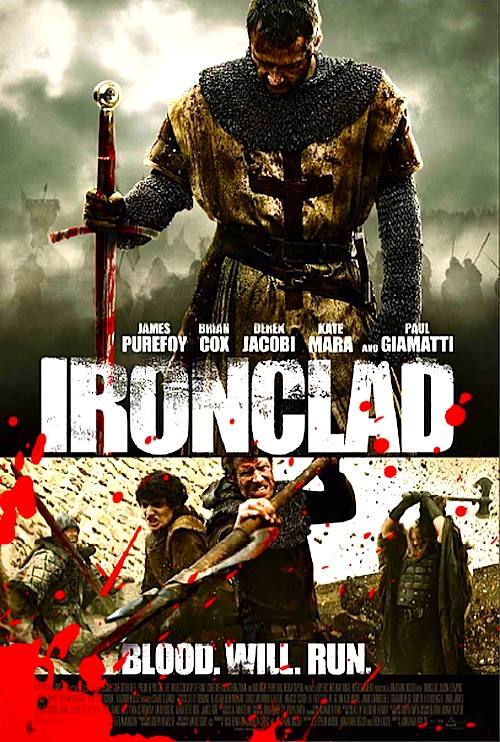
By Joe Bendel. The price of liberty has always been high, in both blood and treasure. It was true during the revolution we just celebrated on the Fourth of July and it was true during the Baron’s Revolt against King John, which led to the Magna Carta – a flawed but important document that informed our founding fathers’ conception of constitutional rights. Preferring the divine right of kings to the rights of man, John tried to reassert his absolute rule and nullify the Magna Carta, but an intrepid band of warriors will defy him, to their last breaths, in Jonathan English’s rip-roaring Ironclad (trailer here), which opens this Friday in New York.

Tired of his cruel and erratic rule, England’s barons rose up against John the First (and only), but for political reasons, they left the weakened despot on the throne after securing his signature on their revolutionary document. Unfortunately, many were lulled into a false sense of security. When John makes his play, assembling a mercenary army and securing Rome’s support, he catches most of his foes unawares. Only Rochester Castle stands between him and London. However, twenty men assembled by Baron Albany are determined to hold it at all costs, in hopes that the French will arrive to install a proper monarch.

One of those men is William Marshal, a Knight Templar recently returned from the Crusades. Like the Twelfth Century equivalent of the IDF, the Templars are well accustomed to facing numerically superior enemies. Granted twenty against one thousand is a tall order, but thanks to its construction, Rochester can be ably defended by a small force. Yes indeed, the siege is on.

Ironclad delivers plenty of old school hack-and-slash action for Game of Thrones fans jonesing for a fix. However, equally striking are its scenes of the aftermath of battle, conveying the pain and bone-weariness of the warriors. The film also presents the best depiction of medieval siege techniques yet captured on film.

While the action is thoroughly satisfying, Ironclad proves to be a film of unexpected substance. The screenplay by Jonathan English and co-writer Erick Kastel (based on a first go-round by Stephen McDool) takes notions of faith and freedom deadly seriously. Marshal explicitly states that there is nothing noble about war, ever, yet some things are still worth fighting for—in nearly those exact words. Continue reading The Price of Liberty: LFM Reviews Ironclad
LFM Review: Battlefield Heroes

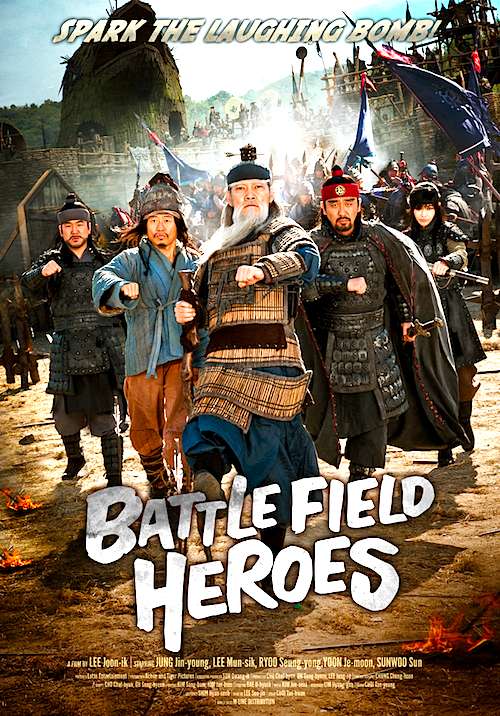
By Joe Bendel. War, what is it good for? The conscripts from Baekje have absolutely no idea. They perfectly demonstrate the superiority of a volunteer army. The men (and at least one woman) of the still independent (just barely) Goguryeo Kingdom are hardly there by their own free choice, but they have a stronger motivation to fight. Yet they will still do all the dying while the glory will be reserved solely for the officers in Lee Joon-ik’s caustic farce Battlefield Heroes (trailer here), which screens during the 2011 New York Asian Film Festival.

Prepare to get muddy, bloody, and absurd. If Brecht recast Braveheart in the Seventh Century Korea, it would look a lot Battlefield. Of the Three Kingdoms of Korea, Baekje has fallen to the Chinese-aligned Silla. The Tang Dynasty has enlisted the wary Silla in its campaign against the weakened Goguryeo. However, the crafty Silla general Kim Yu-sin is only biding his time.  He might look like an addled old coot, but he’s crazy like a fox.

None of these grand macro schemes matter to “Thingy,” a dirt poor disrespected serf from former Baekje. In fact, when he accidentally defects to Goguryeo, it would only mean switching from a besieger to the besieged, were it not for Gap-sun. Meeting the ardent Goguryeo lady warrior makes quite an impression on Thingy. Needless to say, it is not mutual.

Frankly, even as a medieval keep under attack, Pyongyang was probably more livable then than now. However, Battlefield is seen as something of an allegory, with the plucky but riceless Goguryeos signifying the North, the devious Sillas serving as the South, and the Chinese Tangs functioning as stand-ins for the good old USA. Yet, as Lee must understand, North Korea is not starving because of a Southern blockade, but through the deliberate policies of its government. Not to sound churlish, but good luck making veiled political commentary in the tightly regimented DPRK. As for the imperialist Chinese, perhaps they better represent, you know, China. Continue reading LFM Review: Battlefield Heroes

4th of July Classic Cinema Obsession: An American in Paris

By Jennifer Baldwin. I’ve been thinking lately about how art is often more “real” to me than real life. As Truffaut said: “I have always preferred the reflection of life to life itself.” One of the reasons I spend so much time watching movies, in fact, is because after I’ve watched a good movie I feel renewed. Beautiful art has that ability to renew and enliven the spirit. Highbrow, lowbrow, middlebrow – to me it really doesn’t matter as long as I get that kick of delirious pleasure.

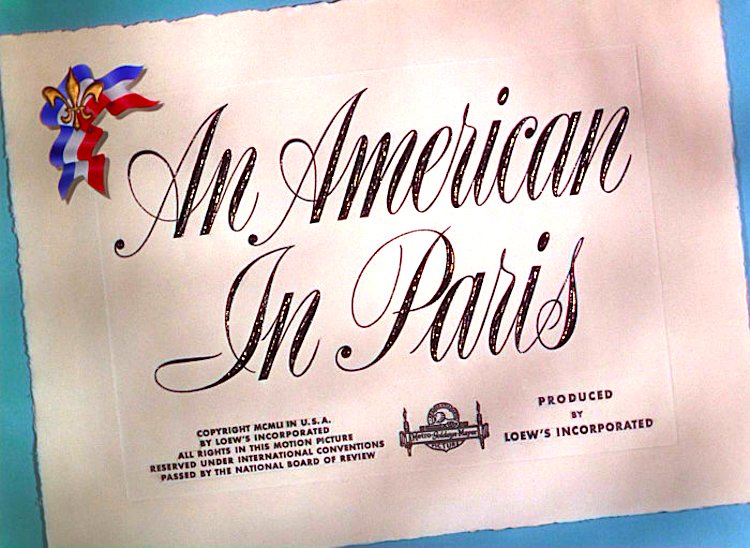
An American in Paris gives me that kick. It’s everything that’s great about mid-century American popular culture, fusing elements of high art with low art to create a joyful, exuberant experience. American pop art at its best is confident, playful, eclectic, improvisational, and spontaneous. It has energy and rhythm, a freewheeling delight in its own creativity. An American in Paris, at its heart, is about our relationship to art, about our desire to be renewed and enlivened by it. Continue reading 4th of July Classic Cinema Obsession: An American in Paris

Classic Movie Journal: It’s Hard to Say “So Long” to TCM Star of the Month Jean Simmons

By Jennifer Baldwin. When featuring an intriguing star, TCM’s Star of the Month tribute is an overdose of straight-up, hardcore, pure pleasure. For one night each week, the month is turned over to a movie star and we witness, with relentless intensity, every curve and turn and height of the star’s career – until the month ends and we feel indecent over how much we’ve come to know this person.

We don’t really “know” them, of course. We only see their performances. But film is funny in its deceptive intimacy, and saying farewell to the Star of the Month is like saying farewell to a summer camp best friend or a wartime romance: “It was wonderful, darling. I’ll never forget the good times we had. We’ll always have that April on TCM!” The star is in your life, in your living room, for a whole month and then, suddenly, the star gets snatched away. The light goes out.

Of course, some months I’m just not interested in the chosen one. Singing Cowboys in July? Don’t fence me in, baby, I’d rather be out playing beach volleyball at the park. But just this past month of June, Jean Simmons had me glued. I hadn’t realized it until she passed away last year, but Jean Simmons was around a lot in my teenage years. I really identified with her, with the intelligence, strength, and vulnerability she brought to the screen. Young Bess at fifteen; Guys and Dolls at sixteen; Elmer Gantry at seventeen. I must have watched these movies on an endless loop when I was in high school.
When I finally got around to Angel Face in college, it bothered me for weeks. I told friends and family and random people on the street about this movie, about this character — Diane Treymayne — and how I just couldn’t shake her. She creeped me out, and I just couldn’t shake her. She was a murderer, a psychopath, but I just couldn’t let her go. I SYMPATHIZED with her. It was disturbing.

You’re not supposed to sympathize with the Spider Woman. Sure, you can understand her motivations, even get some perverse pleasure out of her power and wicked determination, but you’re not supposed to feel bad for her. But there I was — and here I am — feeling sorry for Simmons’ Diane Treymayne.

And that ending! That last, stomach-shocking scene, throwing all my emotions for a fireball crashing loop. Every time I watch the finale in Angel Face I go, “Oh my God! What the hell?!” Every time. Every single time. And I’ve seen it at least a dozen times. Continue reading Classic Movie Journal: It’s Hard to Say “So Long” to TCM Star of the Month Jean Simmons

LFM Review: Osamu Tezuka’s Buddha: The Great Departure

By Joe Bendel. People think religion is all about sermonizing and casting judgment, but not Osamu Tezuka. His Eisner Award winning manga serialization of Gautama Buddha’s life emphasizes all the good parts, particularly the violence and passion of India circa 500-600 BC. Check your peaceful coexistence t-shirts and bumper stickers at the door when Kozo Morishita’s anime adaptation, Osamu Tezuka’s Buddha: The Great Departure, the first installment of projected feature trilogy, screens as a joint presentation of the 2011 New York Asian Film Festival and the 2011 Japan Cuts Festival of Contemporary Japanese Cinema.

Of course, Buddha was born Siddhartha Gautama, the privileged son of the king of the Shakya Kingdom. Shakya’s bounteous natural resources are coveted by the more Spartan Kosala kingdom, but providence has protected somewhat more peaceful Shakya, so far. As the Kosalan Army masses for an invasion, providence gets a bit of help from Tatta, an untouchable Oliver Twist with a supernatural power to possess nature’s creatures. Much to Tatta’s surprise, his new running mate Chapra takes advantage of the fog of war to save the Kosalan general, earning his protection and patronage as a supposed warrior class orphan.

None of this really has anything to do with Siddhartha. His path will only tangentially cross that of Tatta and his compatriots, at least in this film. However, as untouchables, they act as an effective counterpoint to the insular upper-class life Siddhartha will eventually reject. Indeed, Departure is a pointed critique of the caste system, largely driven by the story of Chapra’s forbidden attempt at social mobility. Naturally, combat will play a significant role in his efforts. Continue reading LFM Review: Osamu Tezuka’s Buddha: The Great Departure

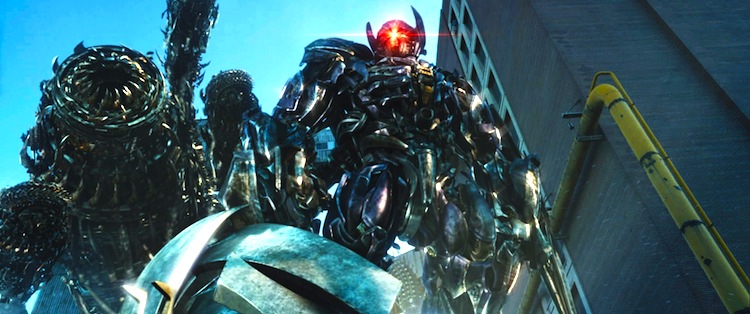
LFM Review: Transformers: Dark of the Moon

By Jason Apuzzo. The Transformers series is basically a high-speed, whipsaw collision of three things: 1) the venerable, 1950’s-based alien invasion genre, with its subtext of American freedom-fighting in the face of overwhelming technological threats from abroad; 2) a Hasbro toy line; 3) the retro-80s/MTV sensibilities of director Michael Bay.

This unusual and unexpected combination of elements have proven extremely successful at the box office over the past four years, but like any successful franchise, the Transformers movies are also more than the sum of their parts. The movies are fun, epic in scale, earthy in their humor, cheekily conspiratorial in their politics, playfully fetishistic in their focus on cars and girls, and keenly attuned to the sensibilities of the moment – what’s cool and what isn’t – in the same way the Bond films were in their heyday.

But the films offer a bit more than that, actually.  Like Michael Bay’s best work – Pearl Harbor comes to mind – the films are unbending in their affection for the things that make America special: our independent streak, our fighting spirit, our passion for technological innovation. The films also radiate middle class values: the value of hard work and sacrifice, of remaining loyal to friends, and the importance of family – even when your family drives you insane.

The high-class, professional girlfriend.

Transformers: Dark of the Moon doesn’t necessarily add anything new to this formula that wasn’t there in the first two films. The familiar elements are all there in the first half of Dark of the Moon, but what Bay adds in the film’s second half are action sequences so gigantic and complex in scale – and amplified by astonishingly detailed 3D imagery – that one can only really compare them to Avatar or to certain moments in the Star Wars prequel trilogy. And the sum of all this ultimately is quite arresting and entertaining … but sometimes a bit overwhelming.

So let me just blurt it out here and say that as much as I liked the film, it also felt a bit excessive. The first two Transformers movies I first saw on DVD, on a portable player, in a situation in which the action in my field of vision was tightly contained, and the audio channels compressed down to classic L-R stereo. Watching Dark of the Moon in 3D on a big screen in 7.1 sound – with the film’s rapid fire dialogue, multi-layered conspiracy plotlines, and mind-shattering action sequences – left me feeling liked I’d just spent 2 1/2+ hours behind a jet engine … while reading Stephen Ambrose. It was a lot to take in.

Michael Bay’s directing style might best be described as palimpsestic, like something out 17th century Baroque painting or drama: dense, tightly packed plotlines are unfolding as comic one-liners shoot at you rapid-fire, while imagery of complex machines hurtle through space in balletic, gravity-defying maneuvers … right as Rosie Huntington-Whiteley is turning a corner in an outfit that makes her look curvier than Jessica Rabbit.

And you have about .3 seconds to take all that in before the next shot.

Not a millimeter of the frame nor a single audio frequency is wasted in Dark of the Moon. Every moment is packed to the gills with detail – and frequently with references to other films. It’s a unique style that I’ve come to like from Bay – the style of a muralist, rather than a portraitist – and a style that assumes the audience is capable of absorbing an ocean of detail. But sometimes, as when you’re looking at a huge mural in a museum, it can be a bit overwhelming.

This isn’t a complaint or a criticism, so much as an observation: Michael Bay seems to be inaugurating a different kind of filmmaking in the Transformers series, a type of complex, information-rich filmmaking style that assumes his audience can go back endlessly on DVD/Blu-ray after seeing the film and actually figure out what the hell happened, and savor all the details (and there are plenty to savor; especially if you like Osprey helicopters, or Rosie Huntington-Whiteley’s legs). Because I liked Dark of the Moon, I recommend you do that – because on first viewing it’s quite a lot to take in. Continue reading LFM Review: Transformers: Dark of the Moon