By Joe Bendel. Marian Kołodziej’s art is not merely art, but testimony of the unimaginable. It is displayed not in a gallery, but in a labyrinth nestled beneath a small Polish church near Kołodziej’s former residence, Auschwitz. Through his darkly distinctive art, Kołodziej bears witness to the Holocaust in Jason A. Schmidt’s documentary The Labyrinth, which screens this Saturday as part of the shorts program at the 2011 John Paul II International Film Festival in Miami (as well as at the Boulder International Film Fest on the same day).
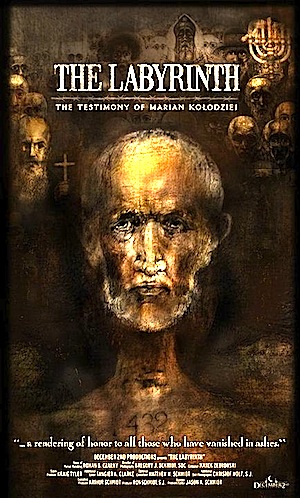
A youthful member of the Polish resistance, Kołodziej, number 432, was one of the first prisoners at Auschwitz, who were forced to build its architecture of death. Surviving the ordeal, he established a successful career as a set designer, but almost never discussed his horrific experiences. However, when Kołodziej began drawing as part of his therapy for a considerable stroke, the ominous images of the concentration camp came bursting forth.
Explaining the real life sources of his work, Kołodziej’s stories are mostly harrowing, but in rare instances also inspiring. The artist movingly pays tribute to Father Maximilian Kolbe, the Catholic priest who was canonized as a “martyr of charity” for taking the place of another man condemned to die in a starvation chamber. In drawings that are particularly powerful but just as gruesome, Kołodziej often depicts Kolbe comforting his fellow prisoners.
Almost Boschian in their nightmarish detail, Kołodziej’s work conveys the true nature of the Holocaust more compellingly and directly than any narrative feature could ever hope to. No matter how well intentioned or painstakingly produced, audiences are always conscious of a film’s artifice on some level. After two hours screen time, everyone goes back to life as usual. By contrast, each of Kołodziej’s pieces is a moment of agony frozen for all eternity. One can avert one’s eyes, but it will always be there as a silent indictment of the National Socialists’ crimes against humanity.
Respectfully crafted, Schmidt lets Kołodziej’s drawings and words (heard in translation) speak for themselves. Elegant in the simplicity of its approach, the thirty-eight minute Labyrinth is a hauntingly poetic documentary. It is also a perfectly fitting selection for the John Paul II Festival, considering that it was the Polish pontiff who canonized Kolbe and strived to improve the Catholic-Jewish relations throughout his tenure. Highly recommended, it screens this Saturday (2/19) at the FIU Marc Pavilion as part of the JP2FF’s shorts program.
By Jason Apuzzo. Hey! Word broke today that Friday Night Lights‘ Adrianne Palicki will be the new Wonder Woman in David E. Kelley’s reboot of that TV series for Warner Brothers. My first reaction? So far, so good – at least in the looks department. I assume, incidentally, that Ms. Palicki will be playing the role as a brunette (she’s worked previously as both a blonde and as a brunette).
Whether this new TV series will be in any way working off the D.C. Comics reboot of the character, a reboot which sparked a controversy last year (which we covered extensively here at Libertas), is unclear. Here, however, is how the series is described over at Deadline:
In the reboot, from Warner Bros. TV, Wonder Woman/Diana Prince (Palicki) is a vigilante crime fighter in L.A. but also a successful corporate executive and a modern woman trying to balance all of the elements of her extraordinary life.
So there it is. We apparently can have successful female corporate executives on TV, by the way, but not in the Governor’s office in Sacramento.
And on that point, since Diana Prince is now going to be a corporate executive, I definitely advise her not to bother doing business here in California, where Warner Brothers is based – because it’s too expensive. Try Texas or Arizona instead. Or perhaps she could tie the ‘lasso of truth’ around our new/old California governor, and get him to admit that we’re all going to be living out of garbage cans if he raises taxes? Perhaps they could put that in the pilot episode!
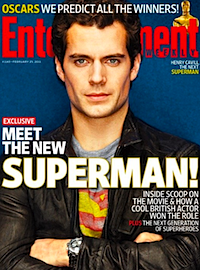
In other superhero news, incidentally, we’re also today getting the first, semi-official look at the new Superman, Brit actor Henry Cavill, in the latest edition of EW.
There’s been a certain amount of controversy lately over the fact that he’s a Brit playing an iconic American character, but since America seems to be outsourcing everything these days, why not our Superman? [Sigh.] My choice for Superman would’ve been Mark Sanchez.
By Jason Apuzzo. I’ve been trying to crystalize my thoughts on the Atlas Shrugged trailer since seeing it Friday. As a coincidence, I recently finished reading Atlas Shrugged – for reasons other than the film’s release, as it turns out, but which nonetheless put me in the mood to see the trailer and get a sense of what the filmmakers had done with the material.
On seeing the trailer, something occurred to me that I’d mentioned to director Paul Johansson when we were on the film’s set – which is that Atlas Shrugged, which was first published in 1957, takes place in a kind of alternate, indefinite future. The precise nature of that future, its look and feel, struck me as being something that a filmmaker could exploit to great advantage, particularly in so far as Rand’s novel veers strongly toward dystopia late in the story – depicting death rays, fascistic military police, optical refractor beams, and the like. Reading the novel, it seemed to me that Rand’s story was rife with possibilities to create a filmic world similar to that of Fritz Lang’s Metropolis or Ridley Scott’s Blade Runner – albeit of a different, less nightmarish cast.
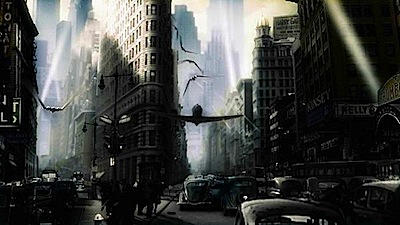
From "Sky Captain and The World of Tomorrow."
What complicates matters, of course, is that our vision of ‘the future’ circa 1957 was much different from our vision of the future today. Rand’s novel deals primarily with the railroad and steel industries, for example, industries that have lost their futuristic sheen amidst the successive eras of the Jet Age, Space Race and Information Age. (In fact, trains and steel had already lost their glamor, so to speak, by the time Rand wrote her novel.) Suffice it to say that today’s Hank Rearden would not likely be pouring steel; nor would Dagny Taggart likely be operating a railroad. Indeed, I suspect Dagny would be somewhere in Silicon Valley pushing forward the boundaries of the Information Age, while Rearden might be in a clean-room designing next-generation microchips.
This, ultimately, is why I think Atlas Shrugged – in order for it to be faithful – is probably best set during the 1950s, albeit in an ‘alternate’ version of the 1950s. I’m thinking here of something like the alternate version of the 1930s presented by Kerry Conran in his flawed but interesting fantasy epic from 2004, Sky Captain and the World of Tomorrow.
In that similarly low-budget effort, Conran used digital technology to create a stylish, alternate 1930s of flying robots, advanced Nazi superweapons, airplane-submarines and flying air bases in order to bring to life a fanciful story of how World War II ‘might’ have been fought, had a few scientific super-geniuses had their way. This, it seems to me, might’ve been a interesting approach to take with Atlas Shrugged. Ultimately, however, Paul Johansson never really had the opportunity to contemplate such an option – in so far as he was hired to direct Atlas Shrugged just over a week before cameras rolled, an extremely challenging situation for any director, let alone someone charged with a project of this scale.
I don’t think such a retro-futuristic approach would’ve made the film more expensive to do. It is, in fact, quite possible these days to create realistic sci-fi dystopias on a budget. To show one recent example of this, I’ve embedded below the trailer for award-winning writer-director-ILM visual fx designer Grzegorz Jonkajtys’ recent film The 3rd Letter (previously titled, 36 Stairs), about which I’ve posted here at Libertas previously.
The 3rd Letter takes place in a polluted, dystopian future-metropolis in which human beings depend on bio-mechanical alterations in order to withstand the deteriorating climate. The full film is about 15 minutes long, quite lavish in its visual design, and was apparently made on a budget of around $7000. The film quietly speaks volumes about where independent filmmaking is headed, in terms of how technology is currently able to support highly expansive visions.
Contrary to what many people have been saying, I don’t believe Atlas Shrugged is a project that needed a $200 million budget or the participation of Angelina Jolie/Charlize Theron to do it properly. What the film did need, in my opinion, was an audacious cinematic vision to match Rand’s own.
We’ll soon see if that’s what it got.
[Editor’s Note: It also occurs to me since writing this post that, if one were to ‘update’ Atlas Shrugged to the world of today, it would be interesting to have Dagny working in the post-9/11 airline industry, with Rearden providing lighter, stronger metals for her airplanes. Plus: imagine the fun one could have depicting the TSA.]
By Jason Apuzzo. With the protests currently taking place in Iran, we wanted to alert Libertas readers to a short film called Interrupted Lives: Portraits of Student Repression in Iran (see the trailer above). Interrupted Lives is a 20 minute documentary that deals with the repression of free-thinking students by the Iranian government, and specifically examines documented human rights cases of student imprisonment, torture or execution since the 1979 revolution.
The film is available to be seen in full here. Interrupted Lives will be traveling to major university campuses this Spring – including Harvard, Berkeley, and Oxford. We wish the filmmakers the very best in this important effort.
[Editor’s Note: Mad Men Season 4 , reviewed in full here at LFM by Jennifer Baldwin, will be released on DVD/Blu-ray March 29th.]
By David Ross. Our own Jennifer Baldwin has written stylishly – very stylishly in my opinion – on Mad Men. I share her admiration for the glamour of the era, and I particularly share her instinct that the Eisenhower generation in some sense enabled the mayhem of the 60s:
The reason AMC’s original series Mad Men was such a sensation when it debuted four seasons ago, and what continues to make it one of the best shows on TV, is that it approaches the 1960s from a somewhat different angle. It’s the angle of men in suits, women in tasteful and elegant clothing, cocktails and business meetings – in other words, the world of grown ups. This is the 1960s from the point of view of the adults. What makes the show so brilliant is that by focusing on the adults of the era it shows where the real breakdown of society occurred in the 60s: not with the kids, but with their parents.
Kids will always rebel, in any era, in any time period. It’s part of our adolescent development to test boundaries and question our world. But it’s up to the adults in a society to maintain civilization in the face of this adolescent upheaval. Where the 60s went wrong – where the rot set in – wasn’t that the youth started tuning out and turning on, it’s that the adults did as well.
This is well put: it is indeed “up to the adults in a society to maintain civilization in the face of [… ] adolescent upheaval.” As I see it, however, the essence of the sixties dysfunction was not that the adults tuned out and turned on, but that they did not entirely trust in their own culture and world view. Their liberalism was too relativistic, pluralistic, urbane – too unsure of itself at root – and they had become unconsciously estranged from the tradition that should have functioned as the great countervailing force: the ‘culture’ that should have thundered in refutation of the ‘counter-culture.’ Too tentative to muster the necessary ferocity or tenacity, they failed to acculturate their own children, and they suffered the patricidal consequences.
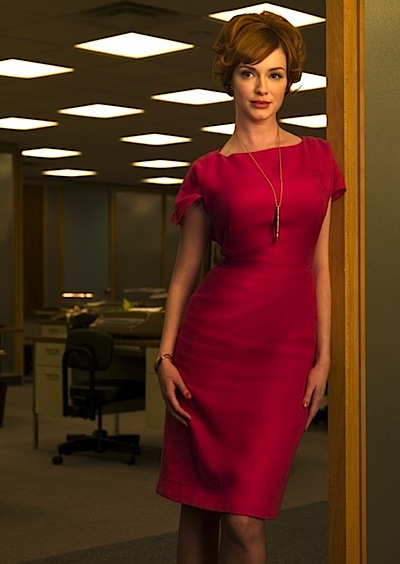
Christina Hendricks as Joan Holloway.
The ultimate origin of the problem is hard to identify. Could it be that having won World War II and vanquished the most monstrous manifestation of evil in the history of the world, the Eisenhower generation let its guard down? Assumed that the culture needed no further defense? Or was this generation simply – and forgivably – a bit weary at the core?
There is a subtle point to be made, but Mad Men – of which I have seen only the first season – does not seem to make it. Instead, the show depicts the culture of the 50s and early 60s with a heavy-handed Baby Boomer bias, turning a complicated and often brilliant era of American art and culture – the era of Nabokov and Coltrane – into a flimsy straw man of political convenience, as if to say, “You see! This is why we had to wreck the world in order to save it!” I have previously aired something of this complaint in my “Defense of the 1950s” (see here).
I simply don’t accept the clichés in which Mad Men tirelessly traffics. My grandparents belonged to the exact generation of Mad Men and occupied a Jewish version of the same milieu. My grandfather was a corporate lawyer in Manhattan, a drinker of good Scotch, an amateur photographer (I have his lovely old Leica), a dapper wearer of Burberry coats and felt homburgs, a weekend golfer with a second house in Westport, Connecticut. Mad Men‘s revelry in boorishness and chauvinism – its excited finger-pointing at sexual naughtiness and latent dysfunction – seems utterly detached from my grandparents’ unselfconscious sophistication and from the real elegance of their world. This world was sober, thoughtful, and ordered. It was perhaps a bit passive and naively broadminded, but it was not stupid and never crude. It was a middle-brow world, but middle-brow, in 1960, encompassed the Museum of Modern Art, The New Yorker, and the New York City Ballet.
Daniel Mendelsohn, writing in The New York Review of Books, weighs in with a lengthy and devastating critique along my own lines. He derides the show as cheap soap opera, an obligatory point in the pages of NYRB and one that the show’s defenders are likely to concede with a shrug. He may touch a nerve, however, when he denies “the special perspective [the show’s] historical setting creates, the graphic picture that it is able to paint of the attitudes of an earlier time, attitudes likely to make us uncomfortable or outraged today.” Mendelsohn continues:
To my mind, the picture is too crude and the artist too pleased with himself. In Mad Men, everyone chain-smokes, every executive starts drinking before lunch, every man is a chauvinist pig, every male employee viciously competitive and jealous of his colleagues, every white person a reflexive racist (when not irritatingly patronizing). It’s not that you don’t know that, say, sexism was rampant in the workplace before the feminist movement; it’s just that, on the screen, the endless succession of leering junior execs and crude jokes and abusive behavior all meant to signal ‘sexism’ doesn’t work – it’s wearying rather than illuminating.
Here, as with Don’s false identity and (literally) meretricious mother, Mad Men keeps telling you what to think instead of letting you think for yourself. As I watched the first season, the characters and their milieu were so unrelentingly repellent that I kept wondering whether the writers had been trying, unsuccessfully, for a kind of camp, for a tartly tongue-in-cheek send-up of Sixties attitudes. (I found myself wishing that the creators of Glee had gotten a stab at this material.) But the creators of Mad Men are in deadly earnest. It’s as if these forty- and thirty-somethings can’t quite believe how bad people were back then, and can’t resist the impulse to keep showing you.
This impulse might be worth indulging (briefly), but the problem with Mad Men is that it suffers from a hypocrisy of its own. As the camera glides over Joan’s gigantic bust and hourglass hips, as it languorously follows the swirls of cigarette smoke toward the ceiling, as the clinking of ice in the glass of someone’s midday Canadian Club is lovingly enhanced, you can’t help thinking that the creators of this show are indulging in a kind of dramatic having your cake and eating it, too: even as it invites us to be shocked by what it’s showing us (a scene people love to talk about is one in which a hugely pregnant Betty lights up a cigarette in a car), it keeps eroticizing what it’s showing us, too. For a drama (or book, or whatever) to invite an audience to feel superior to a less enlightened era even as it teases the regressive urges behind the behaviors associated with that era strikes me as the worst possible offense that can be committed in a creative work set in the past: it’s simultaneously contemptuous and pandering. Here, it cripples the show’s ability to tell us anything of real substance about the world it depicts.
This critique is reasonable as far as it goes, but it misses the show’s water-carrying tendency in the larger campaign of the kulturkampf. The show does not represent the failure of the anthropological eye, but the triumph of the revisionist strategy by which the Baby Boomers have always justified their berserk torching of the culture. The show fails because it’s not fundamentally interested in its own subject matter except as the premise in a political syllogism. It has no real curiosity. No real affinity. Too often its portrait is an effigy brandished at a show trial.
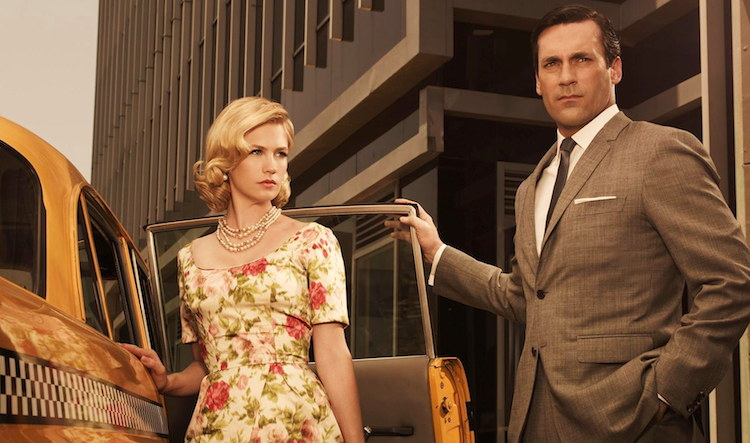
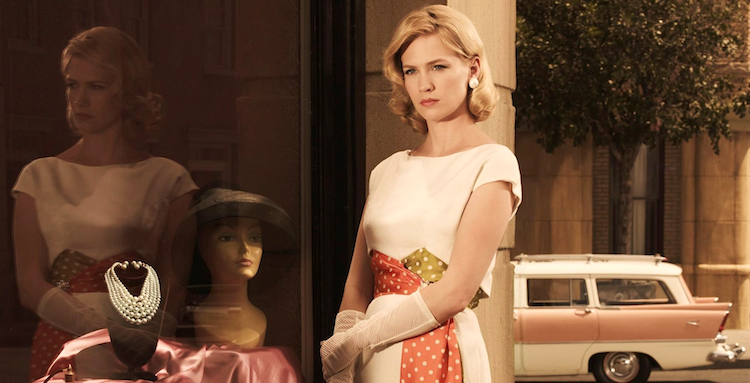
January Jones in "Mad Men."
It’s true that Mad Man depicts the nascent counterculture somewhat caustically, but I wonder whether this merely reflects the show’s implicit alignment with the perspective of the older generation. It seems to me we are supposed to understand that we witness the birth of the counterculture through Don’s eyes, and that the putative inadequacy of his comprehension is one more point against him and his generation.
I wish there were a corrective to adduce, but films like George Lucas’ American Graffiti and Barry Levinson’s Diner are a bit patronizing in their own way, envisioning an aimlessness and harmlessness that has nothing to do with the complexities that were roiling through the culture in a late efflorescence of modernism. For me, the defining tableau is an auditorium at Cornell, Nabokov at the lectern, Pynchon seated amid the crowd.
By Jason Apuzzo. Special thanks to reader Vince for alerting me to the fact that Peter Weir’s The Way Back, an epic saga starring Ed Harris and Colin Farrell about a breakout from one of Stalin’s gulags, will be released on DVD and Blu-ray on April 22nd. You can pre-order the film below through the LFM store.
We greatly admired The Way Back here at Libertas (see our review here), along with the courage it took to make it, and are glad to see the film making the transition to DVD/Blu-ray so quickly. It’s often frustrating for us to recommend indie films of this kind here on this site, and then have to wait 6 months from their appearance in a film festival or in limited theatrical release for people to be able to see them. Bravo to the team behind The Way Back for making it available so swiftly. This, one hopes, is the way of the future for indie releasing.
 A youthful member of the Polish resistance, Kołodziej, number 432, was one of the first prisoners at Auschwitz, who were forced to build its architecture of death. Surviving the ordeal, he established a successful career as a set designer, but almost never discussed his horrific experiences. However, when Kołodziej began drawing as part of his therapy for a considerable stroke, the ominous images of the concentration camp came bursting forth.