By Jason Apuzzo. For the past several months here at Libertas we’ve been covering the massive new wave of politically-charged ‘alien invasion’ projects that are about to be unleashed on moviegoers over the next two years or so. The origins of this intriguing new wave of films probably go back to 2008, when J.J. Abrams and Matt Reeves released Cloverfield, a sci-fi cult hit that played out as a kind of faux-documentary riff on the 9/11 attacks. [Abrams would also incorporate a 9/11-style attack on the planet Vulcan in 2009’s Star Trek.] Also in 2008 came Indiana Jones and the Kingdom of the Crystal Skull, George Lucas and Steven Spielberg’s affectionate riff on 1950s sci-fi invasion films, in which Dr. Jones confronts not only aliens (of a somewhat benign variety) but the Soviet communist menace, as well. Of course, the ‘alien invasion’ genre then got supercharged in late 2009 by James Cameron’s Avatar, which not only revived 3D but ‘politicized’ sci-fi to a degree unseen since the early 1950s.
One of the things that makes this new wave of films so interesting – and redolent of similar waves from the 1950s – is that it extends from the mega-big budget (e.g., the $200 million Battleship from Universal, starring Liam Neeson) to the low-budget (such as next month’s Skyline, made for under $10 million). And on a thematic level, although not all the plotlines are known for these films, many of them seem to be channeling political anxieties associated with terrorism, foreign threats, nuclear fears, as well as paranoia about the increasingly radical tone of American politics. [See my exchange with the LA Times’ Patrick Goldstein on this subject here.]
By the time this new wave of films peaks – probably about two years from now – Gareth Edwards’ Monsters (opening in select theaters today) is unlikely to be remembered as a high-water point of the genre, even for low-budget fare. Edwards’ film is too languorous, too derivative of other (and better) films to really linger in the memory. What Monsters does accomplish, however, is suggest how easily science fiction can be adapted to comment on contemporary political concerns.
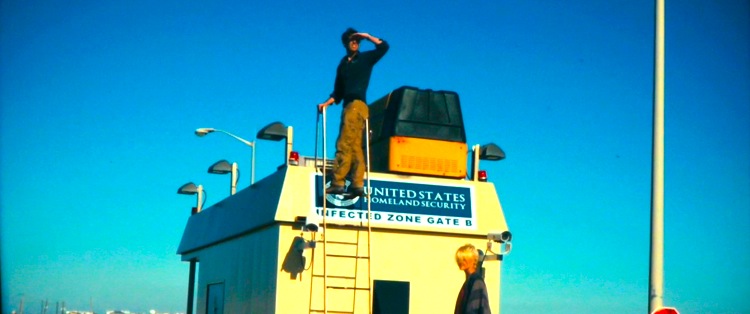
America conducts urban warfare in Mexico in "Monsters."
The set-up for Monsters is relatively straight-forward. In the near future, America has sent space probes out into our solar system searching for microbial evidence of life. These probes have crashed back to Earth in the vicinity of the U.S.-Mexico border, where alien life forms brought back from space have swiftly grown into massive creatures – ‘monsters,’ that more or less look like grilled scampi – that have ravaged the countryside, and even major cities. The U.S. and Mexican militaries have thus conducted a massive (but largely futile) operation to both contain and destroy the creatures, resulting in urban warfare and endless bombing runs that have reduced many urban centers in Mexico to rubble. What’s more, we’re led to believe that the American bombing runs over Mexican cities have been far more devastating and lethal than the creatures themselves. Continue reading The First Wave of ‘Political’ Sci-Fi: LFM Reviews Monsters
By Joe Bendel. Filmmakers working behind the Iron Curtain had a natural affinity for the absurd and the surreal. Given their experiences under Communism, they could easily relate to such Kafkaesque cinemascapes. It also behooved them to keep their social critiques obscured by layers of allegory and symbolism. A passion project only made possible by the fall of the Berlin Wall (or the epochal “Wende”), Ulrich Weiß’s Miraculi represents the culmination of such cinematic strategies. Finally produced in 1991, Miraculi screens next week as part of Wende Flicks: Last Films from East Germany, a retrospective of the East German DEFA studio’s final years (1990-1994), presented at Anthology Film Archives in conjunction with the Goethe-Institut New York.
In the Czech Republic, one of the few annoying holdovers from the Communist era are the plain clothes transit inspectors looking to fine riders who cannot produce their appropriately punched tickets. Evidently East Germany had these transit narcs as well. Through a series of chance circumstances, Sebastian Mueller, a mild mannered juvenile delinquent, joins the ranks of the volunteer transit inspectors. In truth, he is not very good at his duties, but he takes them very seriously, alienating his father, who labels him a traitor to the workers.
Episodic and trippy, Mueller’s story defies pat description. In a strange way, Weiß invests Mueller’s reviled voluntarism with strange and cosmic dimensions. Yet, one can easily glean the power dynamics at work. As one character explains, stiffing the tram is truly the only safe method of rebellion available to her, so who cares if she is caught.
Miraculi’s dense layers of meaning are probably only fully grasped by those who experienced the oppressive drabness of the GDR. That being said, there are plenty of signifiers astute westerners should be able to catch. Indeed, the significance of an abnormal psychology lecture delivered to Mueller and his fellow inspectors is hard to miss, if viewers have any familiarity with the Soviet bloc’s record of institutionalized psychiatric abuse.
Undeniably both subversive and demanding, there is no possible way Miraculi could have been produced under the Soviet-dominated GDR regime. It is a world away from Soviet Realism, even though it scrupulously captures the depressed grunginess of industrialized East Germany. It is a rich, challenging work, recommended to viewers who do not have to “get” everything they see to appreciate a film. It screens this coming Monday (11/1) at Anthology Film Archives as part of the remarkable WendeFlicks series. Truly a cinematic event, many of the Wende selections have never been subtitled or shown outside of Germany, until now. Yet films like Miraculi are both historically important and fascinating in their own right. The Wende Flicks series runs in New York from November 1st through the 3rd.
By David Ross. Directors usually make the worst of children, treating them as objects of pedophilic lust (Lucrecia Martel’s Holy Girl, for example) or as spunky mini-adults (Paper Moon). The most fatuous movies – your standard Hollywood fare – share the romantic conviction that children are uncorrupted vessels of purity and innocence and embody a spiritual grace that can alone redeem the fallen world of adults. This notion derives from Wordsworth’s “Ode: Intimations of Immortality from Recollections of Early Childhood” (1807), and specifically from the eighth section, which addresses the child in these terms:
Thou, whose exterior semblance doth belie
Thy Soul’s immensity;
Thou best Philosopher, who yet dost keep
Thy heritage, thou Eye among the blind,
That, deaf and silent, readst the eternal deep,
Haunted for ever by the eternal mind,
Mighty Prophet! Seer blest!
On whom those truths do rest,
Which we are toiling all our lives to find,
In darkness lost, the darkness of the grave.
Any parent who’s attempted to wrestle a crying kid into a car seat will immediately recognize the nonsense of these lines. Wordsworth began the poem before he had any children, but, amazingly, carried on with it after his first son had been born.
The films below represent a far more serious attempt to understand and to poeticize the experience of childhood, and constitute a kind of hall of fame of the genre. They are not films for children, but films about children with profound implications for adults.
Pather Panchali (1955, Satyajit Ray)
Aparajito (1957, Satyajit Ray)
Good Morning (1957, Yasujiro Ozu)
The Four Hundred Blows (1959, Francois Truffaut)
Murmur of the Heart (1971, Louis Malle)
Spirit of the Beehive (1973, Victor Erice)
Alice Doesn’t Live Here Anymore (1974, Martin Scorsese)
Small Change (1976, Francois Truffaut)
Cria Cuervos (1976, Carlos Saura)
Fanny and Alexander (1983, Ingmar Bergman)
My Neighbor Totoro (1988, Hayao Miyazaki)
Nobody Knows (2004, Hirokazu Koreeda)
Larry Clark’s Kids (1995) and Catherine Hardwicke’s Thirteen (2003) deserve a different kind of mention. These films are not easy to stomach, nor great in the world-cinematic sense, but they bring a sharp anthropological eye to our present post-moral (post-human?) degeneracy. It would be nice to write them off as sensational and lurid, but there’s the sneaking, disconcerting suspicion that the world they depict actually exists.
From Catherine Hardwicke's "Thirteen" (2003).
I should offer a caveat about My Life as a Dog (1985), whose loose narrative of semi-humorous and psychologically pat anecdote more or less created the template for the consideration of childhood in contemporary cinema. The filmhas a vivid sense of physical and social detail, admittedly, but it’s a tad precious, and more than a tad dependent on the kind of schematic psychology found in college textbooks. I’m sure it’s true that the son of an emotionally withdrawn and intellectually preoccupied mother will tend to act out, and that plenty of warmth and attention is just the cure – but none of this is particularly the stuff of arresting art.
By Jennifer Baldwin. I’ve never been to Disneyland’s Tomorrowland theme park. In fact, one of my biggest regrets was not visiting Disneyland while I lived in L.A. The very name itself – “Tomorrowland” – seems to encapsulate the streamlined optimism and chrome-shiny futurism of the mid-1960s. TOMORROWLAND! It’s the kind of name that promises all the greatness of tomorrow, none of the dreariness of today.
In the season four finale, Don’s ready for Tomorrowland. It might be a little fake, a little false, just maybe a little too happy and sunny with optimism, but it’s The Future, it’s Tomorrow. Megan is Don’s Tomorrowland.
She’s everything Betty is not: patient, warm, caring, easy-going, independent. She gets along with Don’s kids; she doesn’t freak out when the milkshake gets spilled. She even seems to bring out the Dick Whitman in Don (though I wonder if it’s really Megan who brings it out or if it’s really the freedom of that California world, which always seems to unleash the inner Dick Whitman).
What I find interesting is that Megan doesn’t “know” all about Don’s Dick Whitman past and yet he seems to feel that she does know the “real” him. This is in contrast to the way Don acted with Faye. She knew his secret and yet he continued to put on a mask and play a part with her, the part of suave and damaged creative genius. I should have known Don and Dr. Faye would never work out.
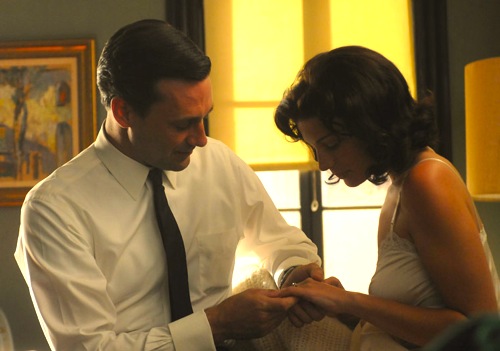
Don & Megan.
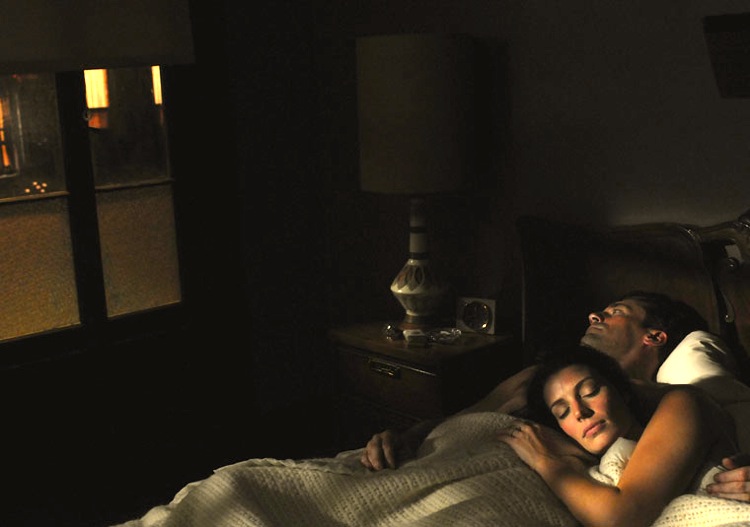
With Megan – whether their relationship will last or not – Don does seem to be more boyish, more smiley and at ease (in other words, more like Dick Whitman). But as always with Don, I’m left wondering if this too isn’t an act, Don “playing” the part of Dick Whitman in order to fool himself. The last shot of Don, in bed with Megan in his apartment, looking out the darkened window suggests that Faye’s words to him hold some truth: Don only likes the beginnings of things.
But isn’t that true of all of us? Aren’t the beginnings always the best? When Tomorrowland first opened in Disneyland, it was new and exciting, a thrilling glimpse into a Disney-styled future. Over the years, Disney has tried to keep the park new and futuristic, with the underlying fear that if they’re not careful, Tomorrowland will become “Yesterdayland,” and who wants yesterday?
We all want something new, something fresh. That’s one of the first essentials of advertising, after all, as Don rightly pointed out in the first season finale. “New. It creates an itch.” We all have that itch, we all long for the thing that will satisfy our longings, the thing that will let us start over again, the thing that will take us into tomorrowland and a happy future. And isn’t that new thing just over the horizon? Isn’t it some new person who comes along, a new job, a new city, a new relationship, a new life we’ve always been looking for?
Unfortunately for us – and for Don – Tomorrowland will eventually turn into Todayland, and then Yesterdayland, but we keep itching for the New.
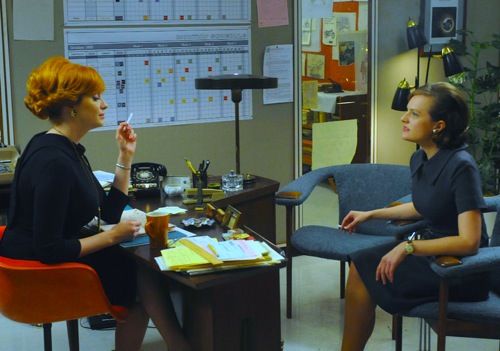
Joan & Peggy.
I’m as skeptical as Joan and Peggy about Don’s marriage to Megan. It smacks of the “boss marries his secretary” cliché that weaker men like Roger succumb to. This isn’t quite fair to Megan, of course, because she seems much more genuine, gentler, and deeper than vapid Jane. But she’s still a bit of a wild card in that she’s so new to Don, so new to us the audience, that who knows what will happen after the marriage and beyond. Will the shiny newness of Megan wear off and turn into the hard emptiness of Betty?
I imagine Betty was once that new and shiny thing in Don’s eyes as well, but now she’s a cold, bitter, emotionally stunted woman. I’ve gone from loving Betty as a character to hating her, but her final scene in this final episode of the season has made me kind of love her again. Here’s a woman who is so desperately messed up, it’s hard not to sympathize with her a little as she touches up her make-up in anticipation for her “accidental” run-in with Don. Poor Betty! She went for the “new” in Henry Francis, only to find that this “newness” gets old pretty fast. You can see it all on her face in that final scene with Don: “What if Don and I could be together again? What if things had been different? What if I made a mistake in marrying Henry? What if Don is still The One?”
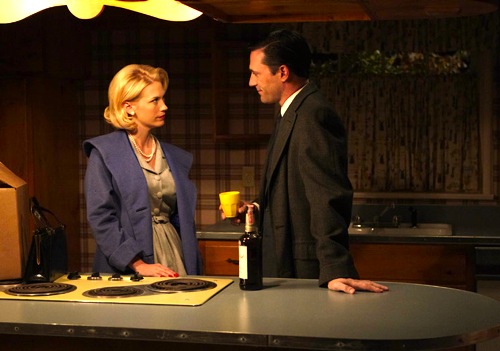
Betty & Don.
I knew she still had feelings for him, but those final moments between the two of them (especially on her side) were filled with so much wistful regret, so much melancholy, I almost couldn’t watch. Beautiful acting by January Jones and Jon Hamm. I know it’s impossible at this point, but in my fairy tale head-version of the show, Don and Betty get back together after many long years of soul searching and maturing. They meet again when they are middle aged and reconnect – older and wiser now, they are ready to be together. It’s a fantasy, of course, and one the show is unlikely to fulfill. But isn’t that what we humans do? We wish for a fantasy that can never come true? In the future, just over the horizon, in Tomorrowland, things can start anew, we can find happiness.
But Tomorrowland is a façade. It’s not the future, it’s not a new beginning. It’s just pretend. It’s a theme park attraction masquerading as a real tomorrow. We’ll have to wait and see if Don’s new life with Megan will be a real future, a real tomorrow, or if it’s all just Tomorrowland.
Megan & Don.
Some final thoughts:
• It turns out I was wrong and my cousin was right: Joan DIDN’T have an abortion. She kept the baby and Greg thinks it’s his. I have to admit, I was not expecting that. Well done, all of you who guessed it!
• Poor Doctor Faye! I went from instantly disliking her to really loving her character, but it looks like Faye just wasn’t in the cards for Don. Oh well. I think she and Don could have been great together, but Don’s still looking for home and family (something he never had as a child), and Faye just wasn’t it. Once again, Faye has all the right insights. She said Don would be married by the end of the year, and so he is (just not to her).
• Is Bert Cooper gone for good? I hope not, since Robert Morse is a legend and a delightful presence on the show. Come back, Bert!
• Finally, I loved the call back to the first episode of the season – “Who is Don Draper?” – in Sally’s line to her dad, “Who is Dick?” when she saw the name painted on Anna’s wall. Don’s answer was interesting. He doesn’t really lie; instead, he admits that he is Dick, though he doesn’t tell his daughter the complete truth. But in finally admitting a small part of his Dick Whitman identity to Sally, I’m hopeful that Don will continue to integrate his Dick and Don sides, and eventually become a whole, complete person. I’m sure this development is way down the line (if we ever get there at all), but it was a nice way to bookend the season.
Who is Don Draper? He was a man who seemed lost and out of control for part of the season, a man adrift and despairing. He was also a man who began putting his life back together, who tried to find a new identity after his marriage. He tried to improve himself, began dating again, found some measure of happiness in a relationship with Faye (and now Megan). And in his California trip, even with Anna gone, Don seemed to become more like Dick Whitman, even if it was only for a week’s vacation. As for whether this change, this integration of his two sides will continue next season, we’ll just have to stay tuned.
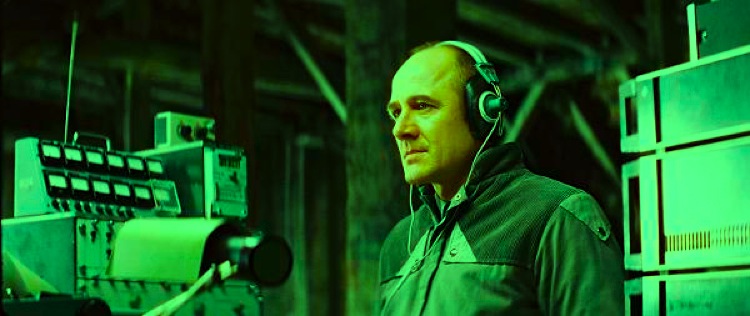
From Florian Henckel von Donnersmarck's "The Lives of Others."
By David Ross. Ever since National Review published this list of conservative films (see here), I have been thinking about the matter. Nearly all great films have conservative elements – one might say that all art is conservative in its greatest moments – but this is cheating; by ‘conservative film’ we mean a film that explicitly and purposefully articulates some aspect of conservative philosophy. By this definition, there are few great conservative films. Jean Renoir’s Grande Illusion (1937), Ernst Lubitsch’s Ninotchka (1939), and Florian Henckel von Donnersmarck’s The Lives of Others (2007) seem to me the greatest. Werner Herzog’s Aguirre: The Wrath of God (1972) is a monumental aesthetic achievement, but one hesitates to call its romantic hero-worship – its Miltonic Satanism – ‘conservative’ in the contemporary American sense of the word.
Whit Stillman’s Metropolitan (1990) and Barcelona (1994) are fine if less exalted examples of conservative filmcraft. Lively, droll, and not in the least doctrinaire, these films are models for a conservative film movement. Metropolitan is a sequence of chatty interludes set in the dying world of Park Avenue gentility. It is a lament for lost manners, ritual, and social order, even as it concedes a degree of snobbery and attenuation and acknowledges a certain placid decadence. This is the movie’s strength: it understands that its own fondness is not an arguable position or even a position at all; it is a kind of savor for one’s own experience and one’s own kind. The essence of the film’s conservatism is this casual disregard for the utilitarian calculus – the grinding guilty math – that underpins liberalism and orders the modern mind. The entire film seems to speak the words: “Traditions have their charm, and charm is enough.” Barcelona, about American cousins making a hash of things in Spain, is a snappy romantic comedy that skewers anti-Americanism and European smugness generally. Any American who’s lived in Europe will cheer the film’s defense of hamburgers and related metaphysical principles.
For Barcelona’s famous “ant farm” analogy, see here.
For the Telegraph’s list of ‘great’ conservative films, see here.
• James Cameron is now everywhere, attached to everything. Apparently he’s going to be producing a Fantastic Voyage remake (the original film had a very strong Cold War subtext, by the way); he’s also about to announce some new venture with Governor Schwarzenegger (probably something political, rather than filmic); and you can read his latest thoughts here, here and here on subjects ranging from the future of 3D … to the Avatar sequels … to the ‘hotness’ of Angelina Jolie and how perfect she would be as a star for Sony’s Cleopatra, to which Cameron may or may not be attached. Also: you can catch part of the deleted Earth-opening from Avatarhere, which is just about to hit Blu-ray. At none of these links, however, will you read about an actual start-date for shooting Cameron’s Avatar sequel – which is surely what has Fox sweating bullets right now.
• The cast of the teen TV series Glee apparently got themselves in a lot of hot water over their racy spread in GQ magazine – and one of the show’s cast members has already apologized, more or less, for the provocative shoot (even though everybody involved in the shoot was safely over 18). I decided to investigate the matter, because I knew that Libertas needed to take a position on this important controversy … and having reviewed the photo spread thoroughly, I can confirm that in my professional opinion the pictures are, indeed, hot.
• You know what’s even hotter than the Glee photoshoot for GQ? Russian spy Anna Chapman’s photoshoot for Russian Maxim. I can’t even show it to you here, frankly. [I had no idea there was a ‘Russian Maxim,’ by the way – did you?] This photoshoot – and the accompanying video – remind me of why I miss the Cold War so much: the Girls of Al Qaeda can’t really pose for Maxim in a burqa, can they? [Read here, by the way, about how Muslim countries vary in their cinema censorship.] The pity of it is that we don’t deport known terrorist sympathizers in this country, yet we did deport Ms. Chapman. What a shame! Why did we give such a valuable ‘asset’ back to the Russians? Maybe we can get her back in a one-for-one deal involving Valerie Plame. [By the way, on this note, HBO is currently developing a new Cold War CIA drama.]
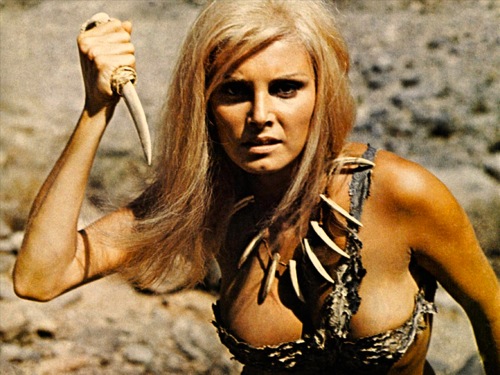
Victoria Vetri, in better days.
• On the Classic Movie front, the Wall Street Journal has a great article out right now about the new Errol Flynn box set of action films; and both Francis Coppola (here) and Walter Murch (here) do some fascinating interviews about Apocalypse Now, coming soon to Blu-ray. Originally Coppola wanted to do that film in 3D – although there are no current plans for a conversion.