LFM Review: Eastwood’s Hereafter

By Joe Bendel. That bright light must be significant. Near death researchers argue that since so many accounts agree on the particulars, there must be something to them. Some even hint at a conspiracy of silence in Clint Eastwood’s latest film, but the jazz-supporting actor-director thankfully never veers too far into such X-Filish territory in Hereafter, which expands nationally this Friday following its limited New York opening.
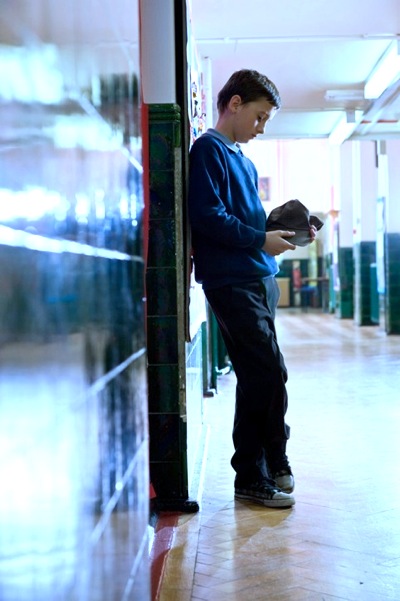
Frankie McLaren in "Hereafter."

Conversing with the dead made psychic George Lonegan nearly unfit for life among the living. Much to the dismay of his slick operator brother, he chucked it all in, despite the serious money to be made, preferring a quiet blue collar life. Yet, just like Pacino’s Michael Corleone, he keeps getting pulled back into his former life. French television talking head Marie Lelay got a glimpse of what haunts Lonegan. Caught up in a Southeast Asian tsunami, she briefly crossed over and back. Slightly preoccupied with the experience, her career and romantic relationship suffer as a result – while in a third story arc, young Marcus, an identical twin grieving his brother Jason, is desperately searching for a legitimate medium like Lonegan amidst all the charlatans of London’s New Age scene.

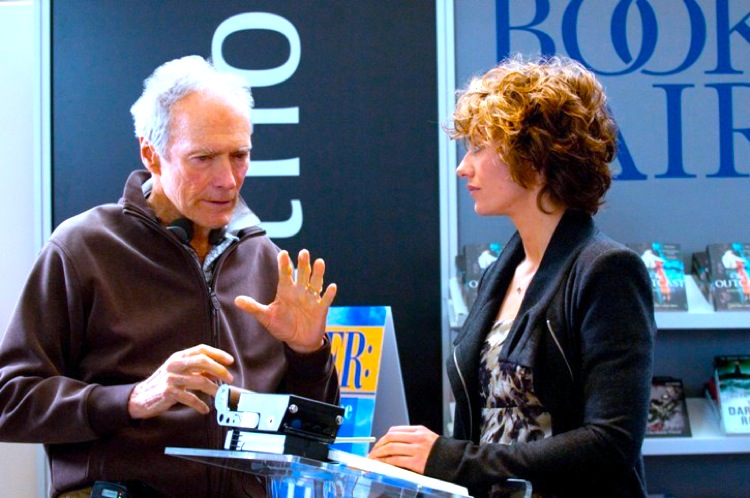
Eventually, these three twains will meet, but it takes an awfully long time to get there. Despite the supernatural themes, Eastwood strives for an elegiac tone throughout Hereafter, eschewing cheap chills. (However, it is truly horrifying when the action culminates at a publishing trade show.) Though a bit snoozy, the director’s string-heavy score sets the right mood. Indeed, Hereafter has a very Euro-art film sense of time and ambiance.

Arguably, Hereafter is one of those films of which the whole is less than the sum of its parts. The opening tsunami sequences are reasonably tense and realistic. However, subsequent scenes of Lelay moping around taking bad career advice are paint-by-numbers stuff. Lonegan’s relationship with his brother is also rather standard issue, but his aborted flirtation with a fellow student in his adult ed. cooking class is sharply written and finely turned, by Matt Damon and Bryce Dallas Howard, respectively. However, the most reliable strand involves the two twins, quite impressively played by Frankie and George McLaren. Completely natural in every scene, they are remarkably assured young actors.

Sensitively lensed by cinematographer Tom Stern, Hereafter is certainly a classy package. The discrete payoff might also grow on mature viewers upon later reflection. However, the overall presentation is a bit too long and much too self-serious. A respectable film but nowhere nearly as engaging as Gran Torino, Hereafter seems unlikely to be a major player come awards season. Earning a modest recommendation, Hereafter opens wide today.

Posted on October 22nd, 2010 at 10:57am.
Watch this Deleted Scene from Four Lions, Opening Nov. 5th

By Jason Apuzzo. Watch this deleted scene from Four Lions above – it’s a hoot. As regular Libertas readers know, Four Lions is a blistering satire about Islamic terrorism from the UK’s Chris Morris. The film opens here in America on November 5th, and is sure to spark a lot of debate. We loved it here at Libertas; you can read my review of it here.

Posted on October 21st, 2010 at 1:53pm.

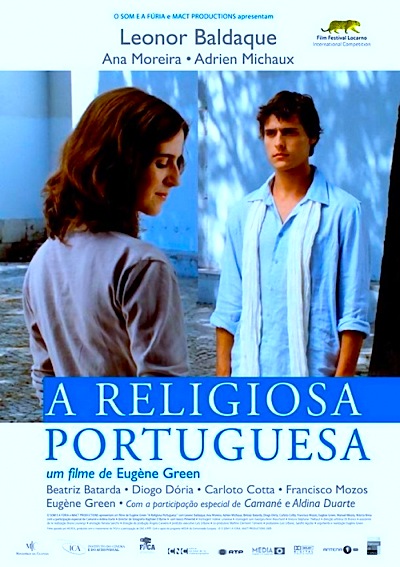
LFM Review: The Portuguese Nun

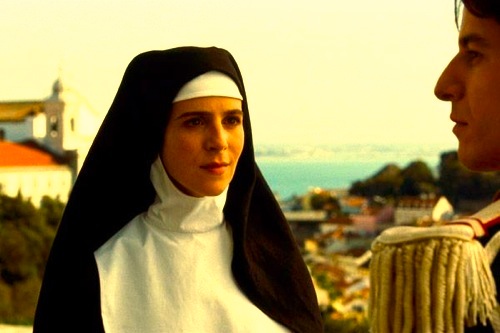
Leonor Baldaque in "The Portuguese Nun."

By Joe Bendel. For his latest film, Eugène Green did not set out to adapt The Letters of a Portuguese Nun, the scandalous epistolary romance now attributed to the Comte de Guilleragues, but he plays a director shooting such a project. Yet, even that film-within-a-film is highly unorthodox in Green’s oddly spiritual The Portuguese Nun (trailer here), which opens this Friday at the Anthology Film Archives in New York.

Julie de Hauranne is a Portuguese-French actress fluent in her mother’s language, but making her first trip to Lisbon for Denis Verde’s avant-garde re-working of The Portuguese Nun. There will be no dialogue and few scenes of her together with her co-star. Instead, they are filming the visuals that will accompany their pre-recorded voice-overs. Those rather easy set-calls allow her plenty of time to explore the city. In doing so, she makes a fleeting, but perhaps deep connection to D. Henrique Cunha, a would-be aristocrat disgraced by his family’s connections to the Salazar and Caetano regimes. She also meets Vasco, a veritable street urchin and becomes fascinated with a real Portuguese nun, Sister Joana, who prays nightly at the candlelit Nossa Senhora do Monte Chapel, a place where the spirit could move even an avowed atheist.

If nothing else, Nun will convince viewers Lisbon is a spectacularly beautiful city. The word “picturesque” just does not cut it—not even by half. Its architectural splendor is perfectly matched by a soundtrack of exquisitely sensitive fados. These things are particularly noticeable since Green seems determined to keep the audience at arm’s length from the on-screen drama.

Rarely do Nun’s verbal cadences ever approach anything realistically conversational. Instead, there is a distinctly recitative quality to the dialogue, which Green emphasizes all the more by regularly directing his cast to deliver their lines straight into the camera in self-conscious close-ups. Though de Hauranne is frequently in motion roaming through the city, the film often feels static, like a series of frozen tableaux. Despite the sparkling sheen of Raphaël O’Byrne’s cinematography, Nun has the rigid formality of medieval paintings. Appropriately, it also takes questions of religious faith just as seriously.

Though one suspects the “North American born,” French-naturalized Green leans somewhat to the left, there are absolutely no cheap shots taken at Catholicism in Nun. Instead, meeting Sister Joana is a transformational experience for de Hauranne. In an exchange one could never find in a Hollywood film, the saintly Nun explicitly connects faith and love with words that are powerful, because they are spoken with humility. Likewise, instead of being a snarky Bill Maher, the worldly actress’s questions elicit heartfelt responses, because they are meant in good faith, so to speak.

Frankly, Nun is a strange film to get a handle on. At times, Leonor Baldaque is so deliberately inexpressive as De Hauranne, she could be mistaken for a bad CGI effect. Though essentially playing himself, Green is nearly just as stiff when appearing as Verde. Conversely, Diogo Dória’s turn as the haunted Cunha is deeply compelling and fundamentally humane, while Ana Moreira radiates piety as Sister Joana.

In terms of method and tone, Nun almost approaches experimental filmmaking, yet it has a romantic soul and a respect for the transcendent faith of Sister Joana that borders on genuine reverence. It also shows unexpected flashes of sardonic wit. Clearly, Nun is intended for an exclusive, self-selecting audience, yet it has moments of arresting beauty well beyond the sights and sounds of Lisbon. It would surely baffle multiplex audiences several times over, but the elusive Nun is highly recommended to the stylistically adventurous. It opens this Friday (10/22) in New York at the Anthology Film Archives.

Posted on October 21st, 2010 at 9:55am.

The Complete Metropolis Screens on TCM, Nov. 7th

By Jason Apuzzo. There is some great news today, which is that Turner Classic Movies will be showing the newly restored, ‘complete’ version of Fritz Lang’s Metropolis on the evening of Sunday, November 7th – along with a documentary associated with the restoration process. Make sure to catch this important piece of cinematic history – I assure you, you won’t regret it. To read more about this special screening, visit the TCM website.

Incidentally, you can read LFM Contributor Jennifer Baldwin’s review of the newly restored, ‘complete’ Metropolis here, and you can also read my long-ago review of the ‘original’ cut of Metropolis here.

Posted on October 20th, 2010 at 5:05pm.

The Infidel Screens in Los Angeles Tonight/Oct. 20th

By Jason Apuzzo. We wanted our Los Angeles readers to know that there is a screening of the extraordinary new Omid Djalili comedy The Infidel here in LA tonight at 7pm, at the Harmony Gold Theater (where we used to do some of our Liberty Film Festival screenings), and both Omid Djalili and Richard Schiff will be there for a Q&A session after the film.

If you haven’t had the chance to see this film yet, you really should. [It’s available for purchase in our LFM Store as a DVD or download, by the way.] It’s completely hilarious, and deals in a warm-hearted way with a lot of taboo subjects that most American filmmakers currently seem too timid to cover.

You can read my full review of The Infidel here.

Posted on October 20th, 2010 at 3:03pm.

Watch Scenes From The Taqwacores, Coming Oct. 22nd to New York

By Jason Apuzzo. MTV News is showing a clip today (see above) from The Taqwacores, a film which opens this Friday in New York – and travels to art house theaters nationwide in subsequent weeks. The movie – which was a hit at Sundance – deals with the new Muslim punk scene here in the U.S.

Indiewire is actually showing a much more interesting clip from the film here, although the clip can’t be embedded. Take a look …

Posted on October 20th, 2010 at 2:47pm.