On balance I like the look of the film, and the scale of it seems impressive for an indie production. Obviously the cooperation of the military was critical here. My understanding is that Act of Valor began as a documentary-style production about SEAL operations and then gradually morphed into a more conventional narrative – and the trailer certainly has a hybrid, docudrama feel to it. In any case, it looks like something that will be worth seeing in IMAX when it’s released in that format come February of next year.
By David Ross. Erik Mongrain’s “Air Tap” (see above) is a genuine benchmark of the modern guitar. The composition is perfect, the technique largely novel. Beyond the slightly uncharacteristic “Air Tap,” Mongrain’s music seems at first merely atmospheric in the Windham Hill tradition, but his compositions turn out to be aggressively intricate and even scholarly – as it were solutions to thorny riddles of musical theory. One realizes that Mongrain has fully departed from bop and rock histrionics in order to create a new mode on an entirely different basis of order, symmetry, and almost Asian apertures of silence. If Bach had played the koto, he might have sounded something like this. Mongrain’s two albums – Fates (2007) and Equilibrium (2008) – are as deceptively understated and precisely reflective as Ezra Pound’s “In a Station of the Metro” (1913):
The apparition of these faces in the crowd;
Petals on a wet black bough.
I would call Mongrain a link in the guitar’s fundamental evolution. He is, of all things, a Quebecois – see here for biographical details.
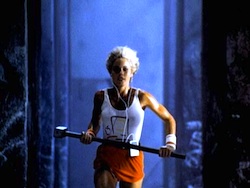
By Jason Apuzzo. As a brief tribute to Steve Jobs and his remarkable legacy, I thought we’d take a look back at Apple’s famous 1984 ad introducing the Macintosh, an ad directed by Ridley Scott. It was this ad, run only once – during 1984’s Super Bowl – that introduced the Macintosh to the world.
The ad is, of course, a succinct and marvelously effective little riff on George Orwell’s original 1984 – although somehow I don’t remember any busty blonde athletes in that novel, do you? (Jobs & Co. really knew how to sell.)
In any case, enjoy it, reminisce, and perhaps even learn something from it. The ad very much captures Jobs’ innovative spirit, which we’ll certainly miss.
By Joe Bendel. He was frequently dubbed “the Quiet Beatle,” but George Harrison could also be called the cineaste Beatle. One of his first solo projects was the original soundtrack for Joe Massot’s psychedelic Wonderwall, completed while the Fab Four were still together. After the band broke up, he eventually founded Handmade Films, providing a jolt of capitol for independent British filmmakers. Harrison himself gets a full 208 minutes of screen-time in Martin Scorsese’s definitive documentary, George Harrison: Living in the Material World, which screens this Tuesday at the 49th New York Film Festival, just ahead of its HBO premiere.
Yes, George Harrison was a lad from Liverpool. The youngest Beatle, he was initially recruited because he could actually play. The general gist of the Beatles story will be generally familiar to just about everybody: initially, Lennon and McCartney were front-and-center, carrying the songwriting load, but slowly Harrison asserted himself, introducing the sitars and tablas into their later, trippier recordings. Since Yoko Ono consented to an on-camera interview, their eventual break-up is presented solely in terms of the stress of working so closely together for such a long time. Still, it is hard not to get sucked into Scorsese’s Harrison-centric retelling of the Beatles mythos.
However, it is something of a surprise how eventful Harrison’s post-Beatle years were, despite his often deliberately low profile (essentially constituting the second half of Material). Of course, his spiritual quest continued, which is a major focus for his widow, co-producer Olivia Harrison. Those who saw the IFC Channel’s behind-the-scenes history of Monty Python will already be well aware of Harrison’s close personal relationship to the comedy troupe, but who knew he was a Formula One Racing fan? In fact, one of the most touching interview segments features his friend Jackie Stewart, the “Flying Scotsman.”
If Ono gets a pass, at least Eric Clapton is forthright enough to address on-camera the whole business of how he romanced Harrison’s first wife while they were still married, albeit rather gingerly. Yet, for personal drama, the events surrounding the violent home invasion Harrison survived late in life effectively serves as a rather stark climax.
Harrison’s friends and family make a compelling case he just might have been the most interesting Beatle. Scorsese calls in some major star power, including both surviving Beatles as well as fellow Traveling Wilbury Tom Petty. It is also a pleasure to see Jane Birkin (from Wonderwall) on-screen in any context, but it is just plain creepy when his one-time producer Phil Spector shows up.
Material is a very good rock doc, but the nearly three and a half hour running time is pushing the limit. According to IMDB, it is almost half an hour longer than Ken Burns’ Thomas Jefferson—and Jefferson was the first to do just about everything. Nonetheless, it is consistently more engaging than the Lennon documentary that screened at last year’s NYFF. As a further point in Material’s favor, Scorsese, Olivia Harrison, and their collaborators almost entirely avoid politics, focusing squarely on the musical, spiritual, and personal aspects of his life, essentially in that order of concentration. Informative and entertaining, Material screens this Tuesday (10/4) at Alice Tully Hall as a Main Slate selection of the 2011 New York Film Festival and airs on HBO in two parts this Wednesday and Thursday (10/5 & 10/6).
By David Ross. Two propositions about James Brown: 1) He was the highest energy performer ever. In full overdrive, he was the rubber-legged soul incarnation of Chuck Jones’ Tasmanian Devil. Nobody – not Elvis Presley, Jimi Hendrix, The Who, or Bruce Springsteen – ever approached Brown’s expenditure of calories per second or approximated his capacity for what amounts to self-detonated metabolic nuclear explosion. 2) His bands of the late fifties and sixties – featuring vocal backup by the Famous Flames and best captured on the classic album Live at the Apollo (1963) – were the greatest of the R&B and rock era. These bands were not necessarily the most gifted, but they were the best rehearsed, the most cohesive, the most rhythmically agile, and in all ways the most pinpoint. The most virtuosic rock units – The Who, The Jimi Hendrix Experience, Led Zeppelin, Mahavishnu Orchestra, The E Street Band – sound tattered in comparison. While the rock ethos tended toward drug-induced laziness, Brown was an obsessive-compulsive Karajanesque whip-cracker, as his sixties-era sax player Maceo Parker recalls:
You gotta be on time. You gotta have your uniform. Your stuff’s got to be intact. You gotta have the bow tie. You got to have it. You can’t come up without the bow tie. You cannot come up without a cummerbund … [The] patent leather shoes we were wearing at the time gotta be greased. You just gotta have this stuff. This is what [Brown expected] ….
This YouTube chestnut (see above) shows footage from the famous T.A.M.I. (Teenage Music Awards International) concert, which was held in the Santa Monica Civic Auditorium on October 28 and 29, 1964. In addition to Brown, the concert starred the Rolling Stones, the Beach Boys, Marvin Gaye, Chuck Berry, the Supremes, and Smokey Robinson. The Stones famously whined about having to follow Brown onstage – one understands why. You can purchase the full concert here.
By Jason Apuzzo. I mentioned Showtime’s new Homeland series in our first Terror Watch update; Showtime recently made the entire first episode of the series available free on-line and I’ve embedded it above.
Having watched the episode, what I can tell you is that the series appears to be a somewhat clunky updating of The Manchurian Candidate for the era of the War on Terror, with some extraneous melodrama mixed in. Frankly, given the comments the producers have been making about the series of late (see here and here), I was expecting a somewhat more politically aggressive, stridently left-of-center show. There are certainly hints that the show may head in that direction in the future, but so far what we’re getting here instead is something more ambiguous and interesting (whether it’s entertaining is another matter). And, much to my pleasant surprise, the villains of the piece are actually Al Qaeda! Fancy that. I wasn’t sure Showtime had it in them.
Did hubby get brainwashed by Al Qaeda?
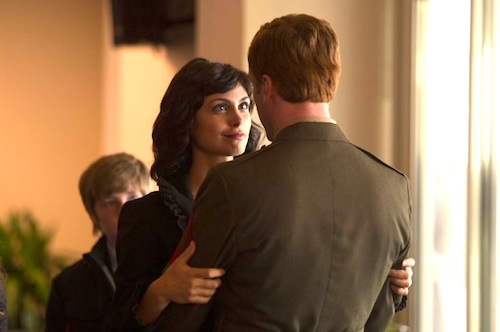
Homeland follows the return of an American soldier back to the United States after the soldier’s 8-year captivity at the hands of Al Qaeda. Quirky, non-conformist CIA case officer Claire Danes has reason to believe the soldier may actually have been brainwashed by Al Qaeda for mysterious ends, although the producers of Homeland have hinted that the plotline will involve the soldier’s eventual run for political office. (My suggestion? He should run for Governor of California. We’d never know the difference.) The theme of the show is quite obviously ‘paranoia’ – i.e., when or whether it’s justified in the post-9/11 era. Thus far the answer from this series – one episode in – is a resounding ‘yes.’
Whether I’ll actually follow this series, of course, is another matter. Homeland thus far looks a little dry and conventional, and Claire Danes (who spends a lot of the first episode popping anti-psychotic pills) doesn’t really excite me very much, although it’s good to see V‘s alien queen Morena Baccarin back in a new series.
What made John Frankenheimer’s original Manchurian Candidate work, of course, was its razor wit, sophistication with respect to its depiction of the Cold War, extraordinary photography from Lionel Lindon – and some extravagant, signature performances from Angela Lansbury, Laurence Harvey and Khigh Dhiegh. It can safely be assumed we won’t be getting anything like that in Homeland, but you may want to give the show a whirl if you have a free hour and wouldn’t otherwise prefer The Playboy Club. Also: feel free to catch this interview conducted by The Wall Street Journal with Claire Danes, whose character in Homeland is apparently based on a real-life CIA officer she was able to meet at Langley.