Ido Haar in San Francisco: Melting Siberia

By Joe Bendel. Ido Haar’s road to San Francisco ran from Israel through Novosibirsk. Chosen as the inaugural filmmaker to launch the San Francisco Film Society’s Artist-in-Residence program, the still youthful looking Haar has already established an international reputation. At one point an editor for BeTipul, the Israeli series on which the HBO series In-Treatment is based (often word-for-word), Haar is probably best known on the festival circuit for the naturalistic, issue-driven documentary 9 Star Hotel. In contrast, his first non-fiction feature was the distinctly personal Melting Siberia, which screens next Wednesday as part of two weeks of programming related to his residency.

Filmmaker Ido Haar.

Given its uniquely tragic history, many grieving spouses and children immigrated to Israel without parents and loved ones. Such was the case with Haar’s mother and grandmother, but his grandfather was very much alive. A Soviet Red Army officer stationed in Latvia, Marina’s father abandoned her and her mother shortly after the war. Always understandably resentful, Haar’s mother never sought out the father she never knew. However, when Haar tracks down his grandfather in frozen Novosibirsk, Marina reluctantly but resolutely follows-up in a series of phone calls, letters, and finally a fateful visit – all faithfully documented by Haar.

Deliberately modest and intimate, Melting is true to life, capturing the messy conflicting emotions and social awkwardness of Haar’s family reunion, finding closure where it can. Clearly a strong woman, Haar’s mother emerges as the star, tough but vulnerable all the way through. Yet even on his supposed best behavior, his grandfather remains a deeply problematic figure. Before their eventual meeting, Marina muses whether deserting one’s family was conduct becoming a Soviet officer. It is a fair question, perhaps even more so following a devastating confrontation between a father and daughter still strangers to each other.

Unlike Haar’s other works, he frequently appears in Melting, good naturedly taking his family ribbing.It augurs well for his stint in-residence at SFFS (2/21-3/5), especially his classroom visits and master class scheduled for this Saturday (2/26). Haar will also be in-attendance for a special screening of Melting next Wednesday (3/2) at New People Cinema in San Francisco. Unblinkingly honest, it is a quietly moving film, well worth seeing at any time.

Posted on February 23rd, 2011 at 5:30pm.
Jafar Panahi (Not) At The Asia Society: Offside

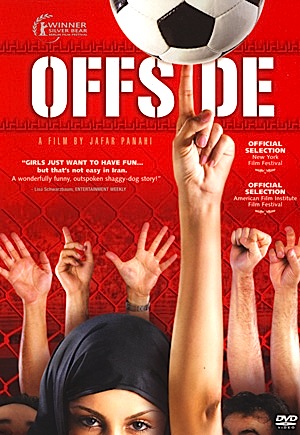
By Joe Bendel. Only the current Iranian regime could make patriotism subversive. Supposedly to protect women from harsh language and rampant testosterone, the paternalistic Iranian regime will not allow women to attend men’s sporting events. It may not be the most pressing human rights abuse in Iran, but it is emblematic of the Islamic Republic’s institutionalized misogyny. Produced under difficult circumstances without official sanction, Jafar Panhi’s Offside depicts the unfortunate drama surrounding several young Iranian girls’ coordinated attempt to sneak into a crucial World Cup qualifying match. Like several of his characters, Panahi would soon find himself behind bars. Currently facing a six year prison term on trumped-up charges, Panahi is not likely to attend when Offside screens this Saturday at the Asia Society as part of their important retrospective-tribute to the persecuted filmmaker.

Disguising themselves as boys, with varying degrees of success, a group of teenage girls successfully bluff their way into the forbidden stadium. Eventually though, they’re rounded up by the equally young military conscripts working the security detail, to be turned over to the morals police at the end of the match. As the young women cool their heels in a holding pen, they try to engage their captors, who have difficulty defending the policy they reluctantly enforce. In fact, several of the female fans seem much more knowledgeable about the game than the soldiers guarding them.

Since Panahi was (not surprisingly) denied official permission to film Offside, he shot rebel-style on digital video, which gives the film a definite cinema vérité look. Panahi’s brave cast of non-professionals duly avoids any sense of affectation. Although some young actors are perhaps a tad uncomfortable in their roles, many, like Shayesteh Irani as the tomboyish “Smoking Girl,” are consistently quite good.

As a film Offside is certainly engaging, as a sort of the dystopian version of Bend it Like Backham, but only too real. Yet it is particularly valuable as an intimate, unfiltered snapshot of Iranian life. Far from a full scale indictment of the Iranian regime, Offside is a small, but telling, slice of everyday absurdism. To borrow an American cliché, one cannot use the film to question Panahi’s patriotism. In fact, the film is suffused with a love of country, as the young fans want nothing more than to chant and cheer for their beloved national team.

Reportedly, even though Offside had only been screened once in Iran at the time of its initial American release, word of the film helped temporarily overturn the ban on women at sporting events, until the religious authorities vetoed the policy change. Offside might seem slight—a group of women simply trying to watch a sporting event—but it signifies the act of questioning authority, even ending with a very minor rebellion of sorts, foreshadowing the Green almost-Revolution.

In addition to his six year sentence, the Iranian government has also imposed a twenty year filmmaking ban on Panahi. This punishes not just the filmmaker, but all Iranian citizens and world cineastes.  Winner of the Silver Bear at the 2006 Berlin International Film Festival (Berlinale), Offside is an excellent example of what the world is losing through the mullahs’ oppression. It screens this Saturday (2/26) at the Asia Society and tickets are free.

Posted on February 22nd, 2011 at 12:46pm.

Aliens in the Heartland: LFM Mini-Review of I Am Number Four

Alex Pettyfer and Teresa Palmer in "I Am Number Four."

By Jason Apuzzo. THE PITCH: Sexy alien teenagers flee to planet Earth on the run from another alien race out to exterminate them. One such teenager, played by Brit star Alex Pettyfer, hides out in a small Ohio town (‘Paradise’) where he falls for a cute blonde at his high school – played, conveniently enough, by Glee‘s Dianna Agron – and otherwise learns to love Heartland America, pickup trucks, pet puppies and middle class life.

THE SKINNY: This very solid, D.J. Caruso/Michael Bay adaptation of the popular young adult novel, I Am Number Four, works effectively because of its excellent casting and detailed attention to the emotional lives of its young characters. The film also works as an affectionate encomium to the values and lifestyle of middle America, right at a time when those things seem most under assault. Frankly, I never thought Ohio could look like such a great place to live – especially post-LeBron.

Alex Pettyfer and Dianna Agron.

WHAT WORKS: • The cast, top to bottom. Alex Pettyfer as the teen alien ‘John Smith,’ and Dianna Agron as his girlfriend Sarah steal the show. Pettyfer comes across as a brooding hunk, and Agron has an ironic, quirky quality to her that makes her appealing. The two have definite chemistry – and, not surprisingly, they’ve apparently been dating off-screen since making this film.

• The depiction of ‘Paradise,’ Ohio as, well, a ‘paradise’ of warm suburban families, football games, Halloween carnivals … I’m ready to move right in. Hollywood so rarely tries to make the Heartland look appealing; here they actually make it look lyrical and inviting.

• Aussie Teresa Palmer nearly steals the show in the third act when she swoops in from Planet Michael Bay on her Ducati motorcycle and starts laying waste to the alien bad guys. Even though she looks to be about 85 pounds – and has a thin, raspy voice – she’s perfectly convincing as an ass-kicker due to the vaguely insane look in her eye (á la Jolie). Also: Aussie accents are sexy, especially when burnished by cigarette smoke.

• The alien creatures were excellent, and suitably menacing. Nice wok, as always, by ILM.

WHAT DOESN’T WORK: • The appearance of the alien bad guys. Essentially they’re 7-foot tall white guys with tattoos, pig-like faces, wearing dark trenchcoats. For some reason they reminded me of ‘Birdman’ Chris Andersen of the Denver Nuggets. It was, however, admittedly rather creepy when they walked into the high school with assault rifles near the end of the film – because they looked like the Columbine killers.

• The general sense that you’ve seen films like this a thousand times; especially films featuring white teenage guys with ‘special powers,’ who need to learn to use them responsibly, etc. Just for variety’s sake, I’d love to see someone make a movie about, say, a chubby Hispanic gal with ‘special powers’ who needs to use them responsibly. Continue reading Aliens in the Heartland: LFM Mini-Review of I Am Number Four

Subversive Chinese Cinema: LFM Reviews Disorder @ MoMA

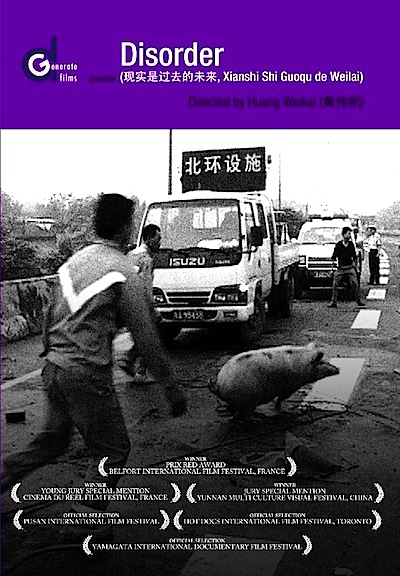
By Joe Bendel. Word to the wise, take care crossing the streets of Guangzhou and the surrounding suburbs. If you are hit by a car, the driver might just try to stuff some cash in your pocket and toss you out of the way. For their part, the police appear woefully inadequate at managing accidents. It is all rather messy and unfortunate, but it’s easy to understand how such episodes caught the attention of scores of Chinese digital video enthusiasts, whose most “youtube-able” footage has been edited together in Huang Weikai’s collage-like Disorder, which screens during the 2011 Documentary Fortnight now underway at MoMA.

China has a reputation for being a tightly regulated society, perhaps tragically so. However, the amateur video assembled by editor-director (emphasis on editor) Huang paints a more anarchic picture. At times, it is somewhat amusing. The face of a restaurant customer finding a roach in his ramen is pure movie gold. Indeed, there are plenty of “you-don’t-see-that-everyday” moments in Disorder, as when a group of men try to corral a pack of panicky pigs on the highway – while the cops watch disinterestedly. They do that quite frequently in Disorder.

However, Disorder is not all light-hearted corruption and incompetence. There is real tragedy as well. Frankly, Huang somewhat downplays the most shocking incident, most likely a by-product of China’s strict one-child policy. Still, his concluding sequences logically have the most political bite, capturing full-scale police brutality in an incident that teeters on the brink of a legitimate riot.

They might be so-called amateurs, but the videographers who recorded these scenes deserve considerable credit for standing their ground and getting their shots. In his editorial judgment, Huang demonstrates a shrewd eye for visuals and a subversive sensibility. Whether he intended to or not, he conveys a sense of the anger and frustration bubbling beneath the surface of many average citizens. Yet they never seem to release it in a coordinated, efficacious manner, as the audience witnesses in graphic terms.

At just about an hour’s running time, Disorder is a particularly manageable dose of the Digital Generation-style of independent Chinese filmmaking, appropriately distributed by dGenerate Films, the Chinese indie specialists. Short but sometimes shocking, it is a strong selection for this year’s Documentary Fortnight. It screens again tomorrow (2/20) as the annual doc festival continues at MoMA, and it might be a ticket in high demand. There were a few technical glitches at last night’s screening (ultimately resolved well enough), so some of the near capacity audience might be back for the second go-round.

Posted on February 19th, 2011 at 2:05pm.

LFM Reviews The Labyrinth at The John Paul II International Film Festival

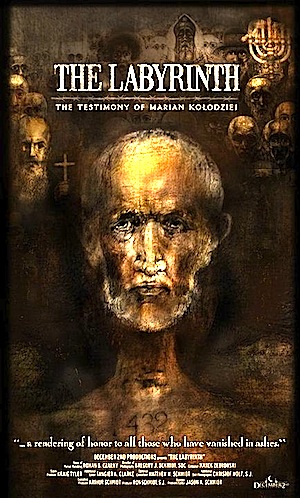
By Joe Bendel. Marian Kołodziej’s art is not merely art, but testimony of the unimaginable. It is displayed not in a gallery, but in a labyrinth nestled beneath a small Polish church near Kołodziej’s former residence, Auschwitz. Through his darkly distinctive art, Kołodziej bears witness to the Holocaust in Jason A. Schmidt’s documentary The Labyrinth, which screens this Saturday as part of the shorts program at the 2011 John Paul II International Film Festival in Miami (as well as at the Boulder International Film Fest on the same day).

A youthful member of the Polish resistance, Kołodziej, number 432, was one of the first prisoners at Auschwitz, who were forced to build its architecture of death. Surviving the ordeal, he established a successful career as a set designer, but almost never discussed his horrific experiences. However, when Kołodziej began drawing as part of his therapy for a considerable stroke, the ominous images of the concentration camp came bursting forth.

Explaining the real life sources of his work, Kołodziej’s stories are mostly harrowing, but in rare instances also inspiring. The artist movingly pays tribute to Father Maximilian Kolbe, the Catholic priest who was canonized as a “martyr of charity” for taking the place of another man condemned to die in a starvation chamber. In drawings that are particularly powerful but just as gruesome, Kołodziej often depicts Kolbe comforting his fellow prisoners.

Almost Boschian in their nightmarish detail, Kołodziej’s work conveys the true nature of the Holocaust more compellingly and directly than any narrative feature could ever hope to. No matter how well intentioned or painstakingly produced, audiences are always conscious of a film’s artifice on some level. After two hours screen time, everyone goes back to life as usual. By contrast, each of Kołodziej’s pieces is a moment of agony frozen for all eternity. One can avert one’s eyes, but it will always be there as a silent indictment of the National Socialists’ crimes against humanity.

Respectfully crafted, Schmidt lets Kołodziej’s drawings and words (heard in translation) speak for themselves. Elegant in the simplicity of its approach, the thirty-eight minute Labyrinth is a hauntingly poetic documentary. It is also a perfectly fitting selection for the John Paul II Festival, considering that it was the Polish pontiff who canonized Kolbe and strived to improve the Catholic-Jewish relations throughout his tenure. Highly recommended, it screens this Saturday (2/19) at the FIU Marc Pavilion as part of the JP2FF’s shorts program.

Posted on February 17th, 2011 at 11:09am.

Atlas Shrugged as Science Fiction

Taylor Schilling as Dagny Taggart.

By Jason Apuzzo. I’ve been trying to crystalize my thoughts on the Atlas Shrugged trailer since seeing it Friday. As a coincidence, I recently finished reading Atlas Shrugged – for reasons other than the film’s release, as it turns out, but which nonetheless put me in the mood to see the trailer and get a sense of what the filmmakers had done with the material.

On seeing the trailer, something occurred to me that I’d mentioned to director Paul Johansson when we were on the film’s set – which is that Atlas Shrugged, which was first published in 1957, takes place in a kind of alternate, indefinite future. The precise nature of that future, its look and feel, struck me as being something that a filmmaker could exploit to great advantage, particularly in so far as Rand’s novel veers strongly toward dystopia late in the story – depicting death rays, fascistic military police, optical refractor beams, and the like. Reading the novel, it seemed to me that Rand’s story was rife with possibilities to create a filmic world similar to that of Fritz Lang’s Metropolis or Ridley Scott’s Blade Runner – albeit of a different, less nightmarish cast.

From "Sky Captain and The World of Tomorrow."

What complicates matters, of course, is that our vision of ‘the future’ circa 1957 was much different from our vision of the future today. Rand’s novel deals primarily with the railroad and steel industries, for example, industries that have lost their futuristic sheen amidst the successive eras of the Jet Age, Space Race and Information Age. (In fact, trains and steel had already lost their glamor, so to speak, by the time Rand wrote her novel.) Suffice it to say that today’s Hank Rearden would not likely be pouring steel; nor would Dagny Taggart likely be operating a railroad. Indeed, I suspect Dagny would be somewhere in Silicon Valley pushing forward the boundaries of the Information Age, while Rearden might be in a clean-room designing next-generation microchips.

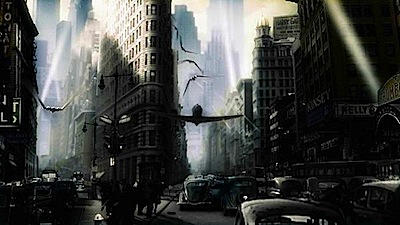
This, ultimately, is why I think Atlas Shrugged – in order for it to be faithful – is probably best set during the 1950s, albeit in an ‘alternate’ version of the 1950s. I’m thinking here of something like the alternate version of the 1930s presented by Kerry Conran in his flawed but interesting fantasy epic from 2004, Sky Captain and the World of Tomorrow.

In that similarly low-budget effort, Conran used digital technology to create a stylish, alternate 1930s of flying robots, advanced Nazi superweapons, airplane-submarines and flying air bases in order to bring to life a fanciful story of how World War II ‘might’ have been fought, had a few scientific super-geniuses had their way. This, it seems to me, might’ve been a interesting approach to take with Atlas Shrugged. Ultimately, however, Paul Johansson never really had the opportunity to contemplate such an option – in so far as he was hired to direct Atlas Shrugged just over a week before cameras rolled, an extremely challenging situation for any director, let alone someone charged with a project of this scale.

I don’t think such a retro-futuristic approach would’ve made the film more expensive to do. It is, in fact, quite possible these days to create realistic sci-fi dystopias on a budget. To show one recent example of this, I’ve embedded below the trailer for award-winning writer-director-ILM visual fx designer Grzegorz Jonkajtys’ recent film The 3rd Letter (previously titled, 36 Stairs), about which I’ve posted here at Libertas previously.

The 3rd Letter takes place in a polluted, dystopian future-metropolis in which human beings depend on bio-mechanical alterations in order to withstand the deteriorating climate. The full film is about 15 minutes long, quite lavish in its visual design, and was apparently made on a budget of around $7000. The film quietly speaks volumes about where independent filmmaking is headed, in terms of how technology is currently able to support highly expansive visions.

Contrary to what many people have been saying, I don’t believe Atlas Shrugged is a project that needed a $200 million budget or the participation of Angelina Jolie/Charlize Theron to do it properly. What the film did need, in my opinion, was an audacious cinematic vision to match Rand’s own.

We’ll soon see if that’s what it got.

[Editor’s Note: It also occurs to me since writing this post that, if one were to ‘update’ Atlas Shrugged to the world of today, it would be interesting to have Dagny working in the post-9/11 airline industry, with Rearden providing lighter, stronger metals for her airplanes. Plus: imagine the fun one could have depicting the TSA.]

Posted on February 16th, 2011 at 11:26am.