LFM Reviews Lucky Them @ The 2014 Tribeca Film Festival

By Joe Bendel. Matthew Sweet is the Grunge version of Eddie Wilson from Eddie and the Cruisers. He only cut one classic album, but many fans still believe he faked his own death to avoid the onslaught of fame. After all, no corpse was ever recovered from his misadventure on that fateful bridge. His former girlfriend has sort of moved on, in a wounded, self-destructive kind of way. However, she will have to seek some closure whether she wants to or not in Megan Griffiths’ Lucky Them, which screens during the 2014 Tribeca Film Festival.

Music critic-journalist Ellie Klug has a bad reputation for sleeping with musicians and blowing off deadlines. She has managed to get by on her street cred as the woman who was there when the Seattle scene exploded, but the editor of Stax is finally ready to cut her loose (really, an alt rock magazine named after one of the all time great soul record labels?). She has one last chance. Her assignment (that she must accept) will be to follow-up on a new lead on Sweet’s whereabouts and hopefully score a reunion for her readers. Reluctantly partnering up with a wealthy old flame who now fancies himself a documentary filmmaker, Klug sets off in search of Sweet.

From "Lucky Them."

Lucky Them largely follows the conventions of road movies, but it has a good handle on the witty and insightful people who practice music criticism. Tough and earthy, yet also vulnerable, Toni Collette’s work as Klug follows vaguely in the tradition of Rosalind Russell in His Girl Friday. She also develops some appealing comedic chemistry with Thomas Haden Church, whose trademark deadpan delivers consistently scores solid laughs. Lucky Them also features a surprise cameo from a genuinely big name who typically commands a pay check greater than the film’s presumed budget. Even more impressively, Joanne Woodward (real Hollywood royalty) served as an executive producer, which probably explains the mystery guest’s participation. You do not say no to Ms. Woodward if you have any understanding of the history of your craft.

To its considerable credit, Lucky Them is much smarter and funnier than skeptical viewers will expect. Griffiths keeps it snappy, but also recognizes when to give a moment time to breathe. Recommended for general audience and jaded music journalists alike, Lucky Them screens Monday (4/21), Wednesday (4/23), and Saturday (4/26) as part of this year’s Tribeca Film Festival.

LFM GRADE: B

Posted on April 21st, 2014 at 3:20pm.
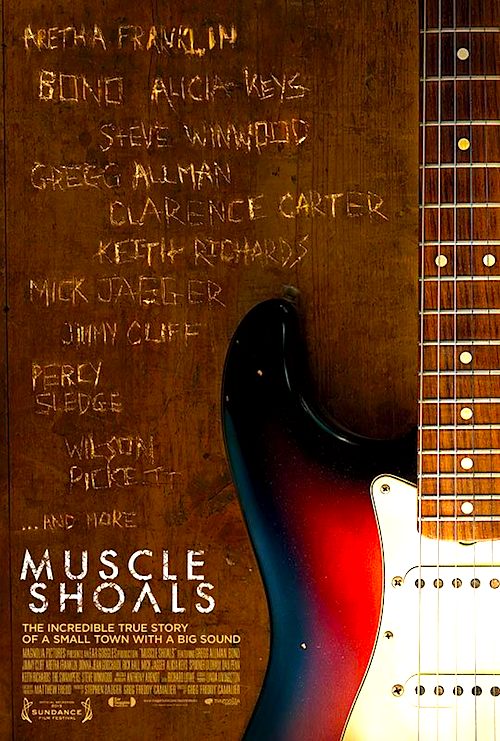
Mud & Soul: LFM Reviews Muscles Shoals; Premieres Tonight (4/21) on PBS

By Joe Bendel. Record collectors are prone to strange fetishes. A vintage Blue Note with an “ear” impressed in the dead wax can still fix ridiculous sums. It probably makes more sense to innocent bystanders when we obsess over recording studios. After all, that is where the magic originally happened. FAME Studios is one such storied shrine. It was there producer Rick Hall fostered a distinctive sound that made soul so much more soulful and midwifed what we now consider “Southern Rock.” Greg “Freddy” Camalier chronicles the man, his studio, and the sound in Muscle Shoals, which airs this Monday on PBS as part of the current season of Independent Lens.

Ironically, many fans do not realize Hall and his original studio ensemble, The Swampers, were all white cats. Regardless of listeners’ racial preconceptions, they directly contributed to some of the greatest hits waxed by artists like Wilson Pickett, Aretha Franklin, Candi Staton, Clarence Carter, Etta James, and Percy Sledge. When we talk of hits, we are referring to classics like “When a Man Loves a Woman” and “Land of 1,000 Dances.”

While many of the great Muscle Shoals recording artists grace Camalier’s film, he focuses on Hall as his protagonist. His producing touch might be golden, but Hall’s formative years were just as hardscrabble as that of any delta bluesman. Abandoned by his mother early on, Hall has faced more than his share of adversity throughout his life. Although he is clearly reserved by nature, when Hall opens up, it is heavy stuff. In fact, his resilience becomes a source of inspiration.

Camalier integrates enough historical context to establish the wider cultural significance of FAME Studios without belaboring the point. He also scored some pretty impressive sit-downs with the likes of Franklin, Carter, and Keith Richards, which he stages in visually intriguing settings. However, the interstitial music never sounds very Muscle Shoalsy. He also over-indulges attempts to explain the local sound in spiritual terms. Sometimes poetic, these often descend into New Aginess corniness (to quote Jobim: “it’s the mud, it’s the mud”).

Muscles Shoals tells an important story with more style than the average music documentary. It is entertaining in a jukebox kind of way, but also compelling on a human level. Recommended for fans of soul, swampy R&B, and the Allman Brothers (who will probably not be seeing Midnight Rider anytime soon), Muscle Shoals premieres on most PBS stations this coming Monday (4/21), courtesy of Independent Lens.

LFM GRADE: B

Posted on April 21st, 2014 at 3:18pm.

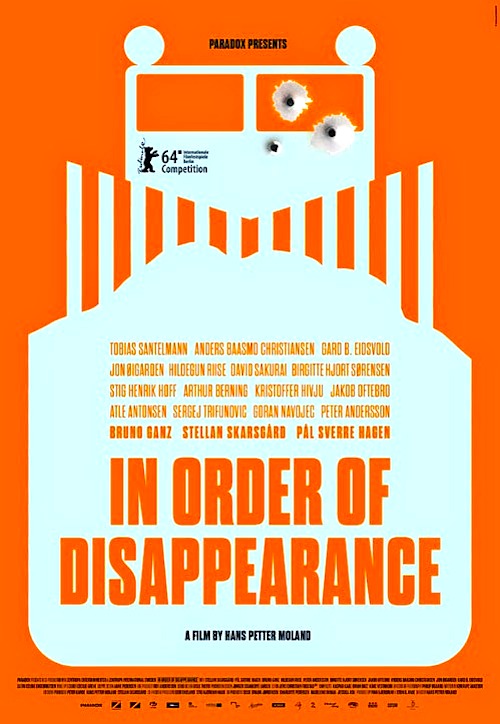
LFM Reviews In Order of Disappearance @ The 2014 Tribeca Film Festival

By Joe Bendel. If revenge is a dish best served cold, then provincial Norway is the perfect place for it. Technically, Nils Dickman is Swedish and he will serve up payback with Ikea-like efficiency in Hans Petter Moland’s comic noir In Order of Disappearance, which screens during the 2014 Tribeca Film Festival.

Dickman (yes, there are comments made regarding his surname) is not a gangster, he is a snowplow driver, but he becomes a very put-out snowplow driver when his son is murdered by a drug gang. Maybe it is in his blood. His older brother was once a gangster, nick-named “Wingman” in honor of Top Gun. Dickman’s anger and initiative are sufficient to ice the low level lackeys who administered his son’s fake overdose, but he will need some help getting to their boss, a legacy kingpin known as “The Count.” As Dickman works his way up the food chain, The Count responds by igniting a gang war with the Serbian mob he assumes is responsible for his underlings’ disappearances.

For some reason, Tribeca programmers have a soft spot for films about snowplow drivers. Even though Emanuel Hoss-Desmarais’s Whitewash won last year’s best new narrative director award, Disappearance is the film to see. Screenwriter Kim Fupz Aakeson (who also wrote the radically different Perfect Sense) neatly balances moody revenge drama (in the tradition of the original Death Wish) with generous helpings of dry, black comedy. In fact, there is a running visual gag that gets funnier and funnier through repetition.

On the other hand, Stellan Skarsgård plays it scrupulously straight as Dickman. He is about as Nordic as a vigilante can get. Despite his severe reserve, viewers get a sense he is so tightly wound, he might shatter if he tipped over. It takes a couple beats to realize the ever-reliable Bruno Ganz appears as the grieving Serbian godfather (known simply as Papa), but his sly turn adds the icing to this frozen ice-cream cake.

On paper, Disappearance would sound like a grim and slightly gory story, but it is great fun on the screen. Moland’s subtle touch and Aakeson’s inventive but rigorously logical plot developments keep the audience locked in every step of the way. Highly recommended for fans of gangster movies with a sardonic attitude, In Order of Disappearance screens again Sunday (4/20) and Wednesday (4/23) during this year’s Tribeca Film Festival.

LFM GRADE: A-

Posted on April 18th, 2014 at 11:11pm.

BoA Steps Up with COBU: LFM Reviews Make Your Move

By Joe Bendel. Their motto is: “dance like drumming, drum like dancing.” Founded by Yako Miyamoto, the first Japanese cast-member of Stomp, the COBU dance troupe puts on an amazing live show combining Taiko drumming with tap and hip hop dancing. If they were not already extensively touring through South Korea, they probably soon will be. That is because reigning K-Pop diva of divas BoA plays a member of the COBU ensemble for her English language film debut. She learned her steps well. Viewers will come for the Taiko dancing and stay for the Taiko dancing when Duane Adler’s Make Your Move opens today nationwide.

Let’s admit right from the start that the screenplay from Adler, the Step Up scribe is pretty clunky. Whenever you hear the sound of grinding metal it is really just the dialogue. However, for dance movies that is just par for the course. What counts are the moves, which are hot, particularly the Taiko sequences choreographed by Miyamoto. The more traditional Dirty Dancing-esque numbers choreographed by Napoleon and Tabitha Dumo also smoke thanks to the agile footwork of BoA and Dancing with the Stars’ Derek Hough.

BoA plays Aya, the Japanese-born Korean leader of COBU, whose visa will expire in a matter of days. She needs confirmed gigs and a sponsor to stay in the country. Unfortunately her only volunteer so far is Michael Griffiths, her brother Kaz’s creepy majority partner in OTO, a swanky new Brooklyn dance club. He would be happy to feature COBU, but he requires exclusivity. Aya would rather be deported than be beholden to a stalker like him.

Kaz used to be partners in the underground hipster club Static with Nick, but they split on bad terms. Their feud threatens to get deadly when each sends thugs to disrupt each others’ businesses. It is an inconvenient time for Donny to leave New Orleans in violation of his parole, hoping to land a dancing gig in his foster brother Nick’s club. However, when Donny sees Aya launch into an unsanctioned impromptu performance in Static, all bets are off. Yes, it is West Side Story in BKLN, but when they are dancing, it all sort of works.

From "Make Your Move."

Although BoA is clearly still a bit uncomfortable with English, the camera absolutely loves her. Frankly, she handles her dramatic responsibilities rather well, thanks to a naturally warm screen presence. Hough is a different story, but at least he can dance. (Yet bafflingly, he sports a spit of peach-fizz so ridiculous looking, even the other characters bust on him for it.)

It is also nice to see Miyamoto get some screen time as Kaori, a COBU troupe member. She even gets to start the big climatic dance number with Hough, before BoA and the rest of COBU come in. It’s a show-stopper alright. Although he never shows any moves, Will Yun Lee also brings some professionalism to the proceedings as big brother Kaz.

To recap, the Taiko choreography and the partner dancing in MYM are rousingly entertaining. The plot and dialogue are what they are. Fans of BoA, COBU, Stomp, or the Step Up franchise will definitely dig it. Recommended for those looking for a dancing fix with a garnish of inconsequential romance, Make Your Move opens today (4/18) in New York at the AMC Empire.

LFM GRADE: B-

Posted on April 18th, 2014 at 10:46pm.

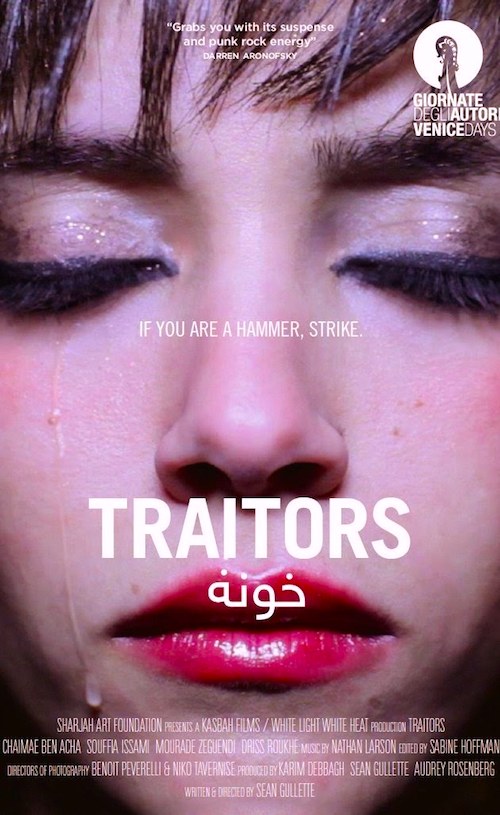
LFM Reviews Traitors @ The 2014 Tribeca Film Festival

By Joe Bendel. So far, the Arab Spring has hardly trickled down at all for women. Malika and her bandmates know this only too well. They are punk to the bone and have plenty to say about their country’s corrupt patriarchal society, but they need cash to express it. More specifically, they must cut a professional grade demo to keep a prospective producer interested. There are ways to make quick money in Tangier, but the drawbacks are considerable, as viewers will witness during Sean Gullette’s Traitors, which screens during the 2014 Tribeca Film Festival.

Malika and her band, Traitors (with no “the”) might sound vaguely familiar to hip readers, because it grew out of the similarly titled short film that played at the 2011 New York Film Festival. Gullette reprises many scenes in the feature version, but there is a new focus on Tangier’s increasing importance as an international drug trafficking hub.

As befitting any self-respecting punk rock diva, Malika has a strained relationship with her parents, particularly her good for nothing father. Thanks to his gambling debts, they are facing the very real possibility of eviction. Plus, she must raise funds for her band’s studio time. Of course, she gets fired from her French call center job around this time, as well. However, she has caught the eye of Samir, a drug dealer with a proposition. Although she more or less knows better, she still accepts his offer to act as a drug mule. As she talks to her traveling companion, the very pregnant Amal, Malika comes to understand the magnitude of her mistake.

In a strange way, Traitors the feature suffers a bit in comparison with Traitors the short. While the former segues into an impressively tight and tense crime drama, its predecessor was a powerful indictment of the everyday misogyny (and even violence) faced by Moroccan women, particularly non-conformists like Malika. Frankly, many viewers (especially those in the know) will want to see more of the rest of Traitors and less of Samir’s thuggish associates.

Still, both incarnations of Traitors prove that Chaimae Ben Acha is a future superstar poised to breakout globally. The camera loves her and she can belt them out like Joan Jett in her prime. This is a richly layered performance, bringing to life a deeply complex character. Malika is unusually intelligent and creative, yet also seriously self-destructive. Artists, you know.

Gullette (co-writer and star of Aronofsky’s Pi) maintains a brisk pace and a nervy vibe, but there is no question this is Ben Acha’s show (although Mourade Zeguendi has his moments as Samir, the complicated drug dealer). Traitors the feature is a good film, but it leaves us wanting to see and hear more from Traitors the band. Maybe that is all part of the master plan. Recommended with conviction for viewers with a punk heart or an interest in women’s rights in North Africa and the Middle East, Traitors screens Sunday (4/20), Tuesday (4/22), Thursday (4/24), and Saturday (4/26) during this year’s Tribeca Film Festival.

LFM GRADE: B+

Posted on April 17th, 11:02pm.

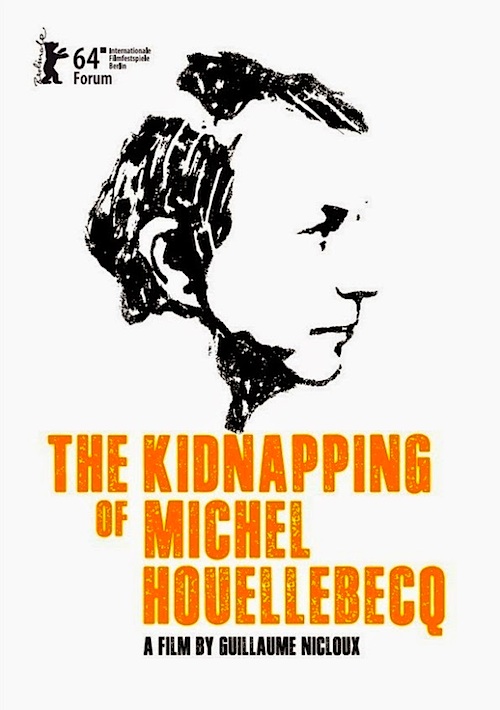
LFM Reviews The Kidnapping of Michel Houellebecq @ The 2014 Tribeca Film Festival

By Joe Bendel. He is the French contemporary equivalent of the kid from “The Ransom of Red Chief.” He smokes like a chimney, drinks like a fish, and is a massive hypochondriac. Frankly, even Michel Houellebecq cannot imagine who would pay to get him back, but that seems to be the only detail his abductors have nailed down in Guillaume Nicloux’s The Kidnapping of Michel Houellebecq, which screens during the 2014 Tribeca Film Festival.

Although Houellebecq translations have been published in America, he has never really caught on in New York literary circles. Charges that his novel Plateforme was anti-Islam probably did not help (these were real legal charges, on which Houellebecq was ultimately acquitted). It also spurred wild rumors that Houellebecq had been abducted by Al-Qaeda when he abruptly disappeared during a book tour. That did not happen. Neither did the narrative written by Nicloux.

When we first meet Houellebecq playing himself as he goes about his daily business, he strikes us as a massively self-absorbed bundle of tics. This impression only grows stronger when he is kidnapped by a trio of cut-rate gangsters. At first he resents the intrusion into his life, but he soon seems to appreciate having his captors at his beck and call. Luc is nominally in charge, but he clearly answers to people above him. He has stashed Houellebecq at his parents’ home, where he is watched over by Maxime the bodybuilder (played by French bodybuilder Maxime Lefrançois) and MMA fighter Mathieu (played by Mathieu “the Warrior” Nicourt).

Much to Luc’s frustration, Houellebecq largely wins over his parents and associates, despite his frequent demands for cigarettes and his favorite Spanish wine. Perhaps their greatest bone of contention is Luc’s refusal to let the writer keep his cigarette lighter. It seems like a small point in the larger scheme of things and an understandable position for a kidnapper to take, but it becomes symbolic of Houellebecq’s efforts to reassert his control.

Although more scripted than mumblecore, there is enough improv room for Houellebecq to put his stamp on the film. Nobody can accuse him of being overly concerned with his public image. It might be a great comedic performance, but it certainly feels like it has the ring of truth. He also develops some truly bizarre but effective screen chemistry with Nicourt, Lefrançois, and Luc Schwarz.

Kidnapping deftly skewers notions of the public intellectual and sends-up Houellebecq’s iconoclastic image, but the humor is of a decidedly dry variety. Houellebecq’s future biographers will surely have a field day with it, but it requires a post-modern sensibility to appreciate its docu-fictional games. Recommended for highly literate Francophiles, The Kidnapping of Michel Houellebecq screens this Friday (4/18), Saturday (4/19), Wednesday (4/21), and next Friday (4/25) during this year’s Tribeca Film Festival.

LFM GRADE: B

Posted on April 17th, 2014 at 10:51pm.