An Anime Anthology from the Creator of Akira: LFM Reviews Short Peace

By Joe Bendel. They are four very personal potential apocalypses. Three occur during Japan’s past and one is set during its future. The ultimate results will vary drastically according to the characters and circumstances involved. Produced under the auspices of Katsuhiro Otomo, the creator of Akira, the anime anthology Short Peace screens in many markets this Friday (but look for it in New York on the 21st).

After a brief but strange opening prelude, Peace commences with Shuhei Morita’s Oscar nominated Possessions, which truly deserved to carry home the little statuette. Its loss can only be ascribed to a lack of taste on the Academy’s part, because it is a visually striking work with unexpected depth. A lush supernatural fable in the tradition of Kwaidan, Possessions takes place during a dark and stormy night in Eighteenth Century Japan. A weary traveler seeks shelter in a shrine, only to find himself in a supernatural repository for broken objects that hold a “grudge.” Fortunately, the man is both handy and spiritually sensitive. Morita’s richly detailed animation is strikingly elegant, yet it has an appropriate macabre undertone. Possessions evokes scores of classic Japanese movies, yet there is something strangely moving about it.

Otomo’s own Combustible packs quite an emotional punch, as well. Set during the Edo era (or thereabouts), it follows the ill-fated son and daughter of upper class neighbors, who are obviously meant for each other, but are irreparably separated when he rejects his birthright to join the fire brigade. Unfortunately, his services will soon be required. Inspired by the look and composition of Japanese watercolors and screen art, Combustible is stylistically stunning. Nothing like conventional anime, it borders on the outright experimental, yet it is driven by a narrative worthy of classical tragedy.

Arguably, Hiroaki Ando’s Gambo could be considered a kaiju film, yet it is perfectly in keeping with the tone of Otomo’s contribution. A demon has terrorized a forest village, carrying off their young girls until only one remains. Venturing into the woods to meet her fate, she encounters Gambo, a gigantic white bear, who is the earthly servant of the Gods. When the two supernatural creatures clash, things get intense and unusually bloody.

The action continues with Hajime Katoki’s A Farewell to Arms, a post-apocalyptic techno-thriller following an armored military unit’s campaign to take out an automated battle tank. A veteran designer on Mobile Suit Gundam, Katoki puts the pedal to metal, delivering a barrage of explosions amid a deadly cat-and-mouse game.

Arguably, Peace’s constituent films proceed from best to worst, but the decline is remarkably gradual. Frankly, there is no clunker in the lot. While the overall running time is only sixty-eight minutes, we can hardly accuse it of false advertising, since it announces its shortness in its title. Regardless, the four chapters will convince any viewer anime can be a form of high art. Absolutely necessary viewing for any and every animation fan, Short Peace screens in Colorado at the Littleton Drafthouse this Friday (4/18), in New York at the Village East on the following Monday (4/21). Check Eleven Arts’ website for further cities and dates near you.

LFM GRADE: A

Posted on April 17th, 2014 at 10:41pm.

Spooky Action from Dante Lam: LFM Reviews That Demon Within

By Joe Bendel. This is a haunted film on many levels. It is loosely inspired by the case of Tsui Po-ko, the notorious cop-killing HK cop, who launched a one man crime-spree. His unquiet ghost hangs over the film, alongside the Demon King and other traditional malevolent spirits, whom the film’s villains periodically invoke. Yet, within the film itself, a highly strung police constable may or may not be tormented by ghosts from his past. Yet, he might somehow still bring a desperate criminal gang to justice in Dante Lam’s That Demon Within, which opens this Friday in New York.

The thoroughly by-the-book Dave Wong is so unpopular with his colleagues he has been banished to the night watchman’s booth in a major hospital. Raised by his pathologically strict father to do the righteous thing in any circumstance, he automatically agrees to give blood when a critically injured O-negative patient arrives. It turns out his transfusion saved Hon Kong, a.k.a. the Demon King, the leader of demon-mask wearing “Gang from Hell.” Inspector “Pops” Mok is not exactly thrilled by Wong’s act of compassion, because Hon had just killed two of his men in a raid gone bad.

When the eerily resourceful Hon escapes, Wong concludes it is his destiny to capture the ringleader and the rest of his gang. However, when Hon’s accomplices turn against him, there might be an opportunity for the Demon King and his nemesis to forge a narrow alliance. At least Hon seems to think so.

From "That Demon Within."

Lam is one of the top action directors in the world, so it is no shock that he stages some impressive shootouts. However, his flair for creepy ambiance and ambiguous psychological suspense is a happy surprise (if by happy you mean dark and ominous). Eventually, he mostly resolves the open question of how much skullduggery may be ascribed to supernatural agencies versus everyday criminal evil, but one thing is certain: karma is absolutely merciless.

If you need a wiry hardnose, it is tough to beat Nick Cheung, who is especially steely as Hon. Better known as a romantic lead, Daniel Wu has played the odd psycho before, rather overdoing the twitch in Shinjuku Incident, for instance. However, even when he completely loses it, he keeps Wong clearly tethered to his tragic past, thereby maintaining viewers’ investment quite compellingly throughout the ensuing chaos. This is largely a two-man show, but Astrid Chan adds a note of authority as the psycho-therapist enlisted to treat Wong by his sympathetic superior officer.

In Demon, Lam stages plenty of well lit, intricately choreographed action sequences, but also takes us on an atmospheric tour of the graveyards and condemned tenements of Kowloon. Tense and moody, it is recommended for multiple genre enthusiasts and fans of the superstar co-leads when it opens this Friday (4/18) in New York at the AMC Empire, from China Lion Entertainment.

LFM GRADE: B+

Posted on April 17th, 2014 at 10:38pm.

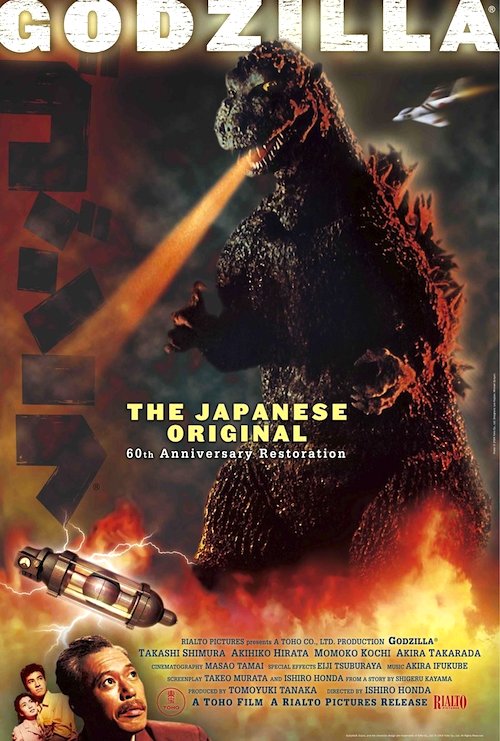
LFM Reviews The Restored Original Godzilla

By Joe Bendel. There was a time when the sight of a mutant lizard leveling the city of Tokyo would have been somewhat traumatizing. It became a campy tradition, but it started as a surprisingly moody expression of national angst. Sixty years later, Godzilla is still the king of the monsters, but his original uncut 1954 Japanese debut (sans Raymond Burr) will be a revelation for many fans. Coming on the heels of its debut at the 2014 TCM Film FestivalFilm Forum pays homage to the granddaddy of all kaiju movies with a special one week engagement of Ishirô Honda’s Godzilla, beginning this Friday.

There are dozens of drastic differences between the version released in the U.S. (with scenes added featuring Burr as American reporter Steve Martin) and Honda’s original high concept apocalyptic morality play. Initially, we do not see Godzilla, but we witness the effects of his handiwork. In an episode reportedly inspired by the Lucky Dragon Incident, a commercial fishing boat has inexplicably disappeared in a remote quadrant of the Pacific. The company responds by sending more ships to the last known coordinates, which only compounds their tragic losses. Of course, we know who is responsible, but Godzilla will not actually show himself, peaking over a mountain ridge in an entrance to rival Harry Lime in The Third Man, until late in the first act.

Dr. Kyohei Yamane suspects the mutant monster dubbed Godzilla (or Gojira) is a nasty by-product of the nuclear age. Destroying such a beast is no easy feat, as the military conclusively proves during their futile defense of Tokyo. As events unfold, the professor’s daughter Emiko finds herself in a uniquely Japanese love triangle, betrothed to the distant Dr. Daisuke Serizawa, but in love with salvage captain Hideto Ogata, who suddenly finds himself all kinds of busy. Serizawa has developed an Oxygen Destroyer that just might be able to stop the rampaging monster, but he refuses to open another Pandora’s Box.

Of course, Godzilla is all about the monster, but Serizawa is a fascinating character in his own right. He adopts western style dress and furnishings, yet he consents to a traditional arranged marriage. Frankly, he often seems oblivious to Emiko, driven by his obsessions and haunted by his mysterious wartime experiences.

There also happen to be real performances in the genuine article Godzilla, including Akihiko Hirata as the brittle and intense Serizawa. Momoko Kōchi also gives an acutely sensitive turn as the conflicted Emiko Yamane. As for screen presence, it is hard to beat Ozu and Kurosawa veteran Takashi Shimura, who would later reprise his role as Dr. Yamane, unless you were a mutant lizard monster.

Yes, most of Godzilla’s scenes were rendered by “Suitmation” (which was exactly what it sounds like), but Honda really focuses in on the human dimension during his now legendary attack. He makes us feel for the people caught up in the terror, rather than glossing over the little people getting stomped on. Obviously, the look of Godzilla caught on, but it is the sound that seals the deal. There is something alarming (even bitchy) about his high-pitched keening roar that gets under the skin. You would absolutely not want to hear anything like it in real life.

By any reasonable critical standard, the original Godzilla qualifies as a good movie—for real. It has far more going on than you would assume for subsequent sequels. Yet, it still delivers the kaiju goods. Sixty years later, Godzilla is still one of the baddest cats to grace a movie screen. If you do not catch him now in his original glory, you risk some profoundly bad karma. Recommended for fanboys and cineastes, the restored, undubbed Japanese Godzilla opens this Friday (4/18) at Film Forum.

LFM GRADE: A

Posted on April 15th, 2014 at 12:04am.

John Turturro, Ladies Man: LFM Reviews Fading Gigolo

By Joe Bendel. You cannot get by in New York with part-time floral arrangement work. Yet, as a vocation, it probably means poor struggling Fioravante is a sensitive soul, who is good with his hands. His cash-strapped former boss hatches an unlikely scheme to capitalize on those talents in John Turturro’s Fading Gigolo, which opens this Friday in New York.

Murray Schwartz’s antiquarian bookstore had been in his family for years, but it did not survive the neurotic Upper Eastsider’s mismanagement. Fortunately, Schwartz’s wife still has a job, but his longtime clerk Fioravante is scuffling to make ends meets. A trip to his dermatologist gives Schwartz an idea so crazy, it just might work. Evidently, the cougarish Dr. Parker and her BFF Selima are looking for a man’s services. Frankly, they would prefer someone who is mature and less intimidating than the stereotypical boy toy type. Reluctantly (and rather skeptically), Fioravante agrees to let Schwartz pimp him out to his high class clientele.

Naturally, Fioravante is a hit with the well heeled ladies, because what woman wouldn’t lust after John Turturro? However, things will get complicated when Schwartz seeks the delousing services of a widow in the Brooklyn Hasidic community. Picking up on Avigal’s loneliness as she picks through his step-child’s hair, Schwartz convinces her to try Fioravante’s services. While their meeting is downright chaste by his recent standards, it would still be considered scandalous within her community. Further complicating matters, Fioravante and his new client start developing confusing feelings for each other. Her out-of-character trips to Manhattan also attract the suspicions of Dovi, the Orthodox neighborhood patrolman, who has long carried a torch for her.

Frankly, Fading is the sort of Woody Allen movie Allen ought to be making, but isn’t. It is a wistfully mature film, deeply steeped in an elegant sadness. The notion of writer-director Turturro casting himself as the illicit lover of Sharon Stone and Sofia Vergara might seem self-serving, but the aging average Joe-ness of Fioravante is part of the point. It is his comfort with intimacy that makes Fioravante desirable. If anything, Fading is old school Alan Alda sensitivity porn rather than a vehicle for people doing it like rabbits.

Turturro shows a remarkably deft touch as a director, patiently letting his scenes unfold. He gets a key assist from the jazz soundtrack, which includes several seductions from boss tenor Gene Ammons. Jug had a seductive sound that could get anyone to say “yes,” but it also perfectly suits the sophisticated New York milieu.

From "Fading Gigolo."

Allen does his shtick as Schwartz, but it is funny more often than not. Yet, it is Turturro who quietly commands the screen as Fioravante, a sad clown incapable of acting less than chivalrous. He develops some achingly powerful chemistry with Vanessa Paradis in her first English language role as Avigal. Their scenes together are a reminder how dramatically potent denial and yearning can be on-screen.

Likewise, Liev Schreiber could not possibly be any more earnest as the lovesick Dovi. Stone and Vergara certainly look the parts of Fioravante’s clients, but never come close to exposing the inner depths of their souls. In a small supporting role, Bob Balaban nearly steals the show as Schwartz’s lawyer, Sol. In fact, Fading is well stocked with brief but neatly turned performances, including Loan Chabanol as a French expat who makes a strong impression late in the game.

Absolutely never smarmy, Fading is an emotionally intelligent film intended for an adult audience. It should satisfy all of Woody Allen’s fans, but Turturro gives it his own distinctive stamp. Highly recommended, Fading Gigolo opens this Friday (4/18) in New York at the Angelika Film Center and the UES’s City Cinemas 1, 2, 3.

LFM GRADE: B+

Posted on April 14th, 2014 at 11:45pm.

Leconte Adapts Zweig: LFM Reviews A Promise

By Joe Bendel. Few understood the pain of involuntary exile as acutely as Stefan Zweig. In his day, the Jewish Austrian was the world’s most translated author, but he took his own life while living as a political émigré in Brazil. In his posthumous novella, Journey into the Past, Zweig’s protagonist is also stranded in Latin America, separated from his love and homeland. For his first English language film, French director Patrice Leconte adapted Zweig’s wistful German tale with a British cast. Whether you consider it reserved or repressed, it is most definitely “Old” Europe that dictates social expectations for the characters of Leconte’s A Promise, which opens this Friday in New York at the IFC Center.

Friedrich Zeitz has done the near impossible. Like a German Horatio Alger hero, the poor orphan worked his way through university as a scholarship student, eventually finding employment in the offices of the steelworks owned and operated by the dreaded Herr Karl Hoffmeister. At least, Zeitz is told to fear his aristocratic boss. However, when Herr Hoffmeister notices the young man’s keen grasp of metallurgy and relentless work ethic, he takes a shine to his new clerk.

With his health slowly declining, the increasingly home-bound Herr Hoffmeister promotes Zeitz to serve as his private secretary and liaison to the corporate office. Of course, that home is more of a castle. As soon as he is admitted into the Hoffmeister estate, Zeitz promptly falls head over heels for his boss’s younger wife, Charlotte (who goes by Lotte, echoing Zweig’s wife and secretary, Lotte Altmann).

Lotte Hoffmeister is unfailingly gracious and welcoming to Zeitz, but she initially seems oblivious to his attraction, despite the way his eyes bug out of his head like a cartoon character whenever she is around. Still, maybe someone notices his torch-carrying. Just as Zeitz is transferred to Hoffmeister’s embryonic mining operation in Mexico, Lotte Hoffmeister confesses Zeitz’s ardor is reciprocated. They vow (or promise, if you will) to do something about it, once he returns from his two year stint abroad. Then World War I breaks out.

From "A Promise."

One of the ironies Leconte and co-adaptor Jérôme Tonnere clearly make, without excessively belaboring it, is the extent to which highly intelligent people can lose sight of the critically important macro events swirling around them – because they are caught up in their own personal dramas. Despite working in the steel industry, Zeitz and Herr Hoffmeister are caught completely flat-footed by the onset of the first World War (you think they might have noticed a slight uptick in government orders). Likewise, the climatic reunion commences just as the growing ranks of National Socialists launch another street protest-riot.

The passionate feelings of Zeitz and Frau Hoffmeister are so chaste and restrained A Promise is likely to frustrate most viewers more accustomed to instant gratification. Yet, the yearn and burn of their thwarted love is quite powerful for those who can appreciate it. Unfortunately, Rebecca Hall and Richard (Game of Thrones) Madden must make the most vanilla couple you will ever see as Zeitz and Frau Hoffmeister. In contrast, Alan Rickman outshines everyone as the sly but not villainous Herr Hoffmeister, showing the sort of erudite charisma he brought to bear in overlooked films like Bottle Shock and Song of Lunch.

Handsomely mounted, A Promise’s period details are elegant but convincingly Teutonic in their chilly austerity, while superstar cinematographer Eduardo Serra gives it all a sensitive sheen superior to the look of your average BBC historical. A mature and emotionally sophisticated literary drama largely waterlogged by its two cold fish romantic leads, A Promise is flawed but still oddly enticing for those who share its Old European sensibilities. It opens this Friday (4/18) at the IFC Center.

LFM GRADE: C+

Posted on April 14th, 2014 at 11:44pm.

LFM Reviews Draft Day

By Joe Bendel. Nobody wants to draft the next Ryan Leaf or JaMarcus Russell, but they often look like sure things at the time. Of course, nobody ever understood the Knicks’ Frédéric Weis debacle, especially when Artest was still available. Granted, that is a basketball digression, from 1999, but the point is we still are not ready to forgive and forget. The stakes are consequently high for Cleveland’s GM when he makes a costly trade for the number one pick. He had better choose wisely, but the clock is ticking throughout Ivan Reitman’s Draft Day, which opens today pretty much everywhere.

Sonny Weaver basically has one season left to turn things around. He largely inherited the current team, but he did little to endear himself to fans when he fired their legendary head coach, who also happened to be his father, now deceased. With the owner pressuring him to make a big move, he reluctantly agrees to a deal, trading away their next three years of first round drafts for the upcoming number one pick. (Ironically, it is your 2014 Super Bowl champion Seattle Seahawks who have that coveted #1 spot.)

Weaver quickly develops buyer’s remorse, but the trade is done. Everyone assumes he will opt for the presumptive number pick, Bo Callahan, the Heisman winning quarterback from Wisconsin. His owner is delighted with the prospects of a marquee player like Callahan, but Weaver cannot shake the Leafy vibe he gets from him. Further complicating matters, Weaver’s front office colleague and not so secret lover has just informed him she is pregnant.

You really have to hand it to Kevin Costner. After some pretty lean years, he has clawed his way back to leading man status in major Hollywood releases. Going back to the sports well obviously makes sense in theory and it works ably enough again in practice. Since it is all about wheeling and dealing, Draft Day is bound to be compared to Moneyball and not unfairly so. The truth is there is something oddly cinematic about watching the respective GMs’ hard bargaining, firing off lines like: “that offer already expired, it’s a different world than it was thirty seconds ago.”

Frankly, the only sports action we see are the teams’ research tapes and there are no surprises there, because Weaver will explicitly tell them to show the footage of Callahan getting sacked. Still, there is something very sporting about Draft Day’s persistent faith in next season.

From "Draft Day."

Without question, Costner is the film’s lynchpin and he still has what it takes. He convincingly gives Weaver darker shades than his Bull Durham, Field of Dreams, and Tin Cup characters, but he remains undeniably charismatic. While they do not burn down the joint with their passion, he and Jennifer Garner develop some relatively likable and believable romantic chemistry together. Denis Leary and Frank Langella both do their shtick as the Browns’ head coach and owner, respectively, but it is the latter veteran thesp who really gives the film some sly zip. Football fanatics will also dig the scores of real life NFL cameos, mostly notably including Jim Brown (as far as old school cineastes are concerned).

Reitman keeps it all moving along briskly, capitalizing on the draft’s constantly ticking clock. While it ends up somewhere not wholly unexpected, getting there is a surprisingly satisfying trip. A well conceived and nicely executed comeback star vehicle, Draft Day is easily recommended for fans of football or Costner rom-dramedies. It opens today (4/11) across the country, including the AMC Loews Lincoln Square in New York.

LFM GRADE: B

Posted on April 11th, 2014 at 9:21pm.