Real Jazz on PBS: LFM Reviews Jazz and the Philharmonic

By Joe Bendel. For many ardent listeners, the words “jazz” and “philharmonic” have heavy significance when used in close proximity. It automatically summons images of the all-star concerts and recording sessions the legendary Norman Granz produced in concert halls around the country. This is not a Granz production. The philharmonic reference is more in keeping with the classical tradition. However, the jazz is still for real in Jazz and the Philharmonic, a concert featuring alumni of the National YoungArts Foundation, the Henry Mancini Institute Orchestra, and some of the top names in jazz, which airs on most PBS stations this Friday (yes, real honest-to-gosh jazz on PBS).

Of course, jazz and classical crossover fusions are nothing new. That is exactly what Third Stream Jazz was all about. While many of the program selections feature jazz soloists playing with the Mancini Orchestra (whose namesake would surely have approved of the program, especially the theme from Charade), there are several straight-up solo, duo, or trio jazz performances, which is obviously not a bad thing.

In fact, it is a very good thing when Chick Corea, Dave Grusin, and Bobby McFerrin open the concert with an elegant but persistently swinging “Autumn Leaves” for voice and two pianos. Corea fans really get their money’s worth throughout the concert, with the NEA Jazz Master performing in a variety of settings, mostly notably joining the Mancini Orchestra on his “Spanish Suite,” a composition perfectly suited to the evening. His duet with McFerrin, “Armando’s Rhumba” is not as distinctive, but they clearly enjoy making music together, which is part of the fun of a show like this.

In addition to “Spanish Suite, Terence Blanchard also has feature spots on “Fugue in C Minor” and “Solfeggietto,” probably the two most overtly swinging-the-classics numbers of the evening. However, he is probably best showcased fronting the orchestra for a rendition of “Charade,” a wonderfully lush arrangement that brings to mind his classic Jazz in Film CD. Yet, perhaps the most effective jazz and classical dialogue comes when Elizabeth Joy Roe and Shelly Berg tackle “The Man I Love” as a lyrical but muscular piano duet, from the classical and jazz sides, respectively.
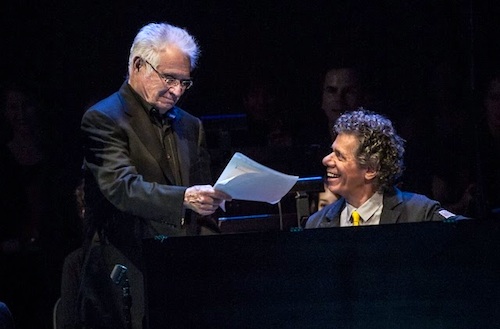
From "Jazz and the Philharmonic."

Nevertheless, the surprise peak of the concert integrates the sounds of deep roots Americana as well as jazz and classical when violinist Mark O’Connor joins pianist Dave Grusin on a sensitive and soulful version of “Simple Gifts,” the Shaker standard subsequently incorporated into Copeland’s Appalachian Spring. Rather fittingly, Grusin’s “Mountain Dance” follows. Purists might dismiss it as too “smooth,” but man, is it ever a pretty melody, sounding almost tailor made for the full orchestral treatment. It also provides a nice launching pad for O’Connor. In fact, Grusin takes two rather impressive solos as well: one fleet and swinging and the second surprisingly adventurous—so take that jazz snobs.

Aside from a weird choice for a closer (Also sprach Zarathustra from 2001, really?), Jazz and the Philharmonic is an extremely welcome dose of jazz on primetime PBS. It ranges from pleasantly entertaining to downright revelatory. It should motivate viewer-listeners to keep an eye out for a talented newcomer like Roe and catch up with the work of accomplished veterans like O’Connor and Blanchard. Naturally, it always sounds great from a technical perspective, thanks to the late, great engineer Phil Ramone, in whose memory it is dedicated. Highly recommended, Jazz and the Philharmonic airs on hip PBS outlets this Friday night (2/28).

LFM GRADE: A

Posted on February 25th, 2014 at 10:22pm.
Koontz’s Cook Finally Makes it to the Big Screen: LFM Reviews Odd Thomas

By Joe Bendel. This Dean Koontz protagonist is not shy when it comes to voice-over narration, but never exactly breaks the fourth wall, per se. He is probably entitled to his own eccentric commentary, considering he has the ability to see ghosts and bodachs, supernatural parasites that feed on fear and suffering. However, his greatest nemesis might be lawyers, given the legal wrangling that long delayed the release of Stephen Sommers’ Odd Thomas, which finally opens in New York this Friday.

Thomas comes from crazy stock and therefore understands the need to keep his dubious gift secret. Only a handful of people know of his power, including Pico Mundo’s chief of police Wyatt Porter, who appreciates the sort of inside information Thomas can provide. His loyal girlfriend Stormy Llewellyn is also in on the truth and a few of their friends vaguely suspect he has the Shine.

Normally, he chases down workaday serial killers before they can murder again, like his former classmate Harlo Landerson from the film’s prologue. However, the alarming number of bodachs converging on Pico Mundo portends a tragedy of grander scale.  They seem particularly interested in “Fungus Bob” Robertson, so dubbed by Thomas and Llewellyn because of his unfortunate grooming habits. Robertson also has an unhealthy interest in Satanism and a couple of mystery friends. Thomas will try to sleuth out Robertson’s plans without alerting the bodachs to his uncanny powers of perception, because they do not take kindly to folks like Thomas.

Frankly, the first half of Odd Thomas feels like a ghost-hunting TV show from the 1980’s, with its quaint small town setting and Thomas’s wholesome courtship of Llewellyn. However, as the stakes and tension start to rise, the film becomes considerably darker. Sommers (best known for The Mummy and G.I. Joe franchises) pulls off some third act sleight-of-hand surprisingly adroitly and the manner in which earthly cults intersect with paranormal malevolence is somewhat intriguing.

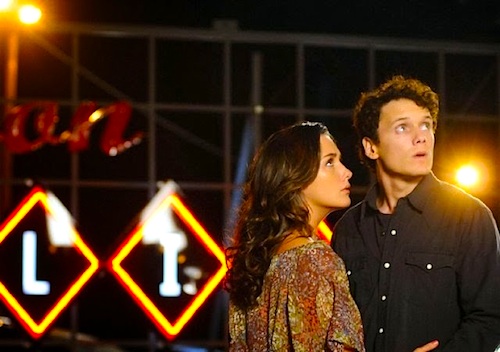
From "Odd Thomas."

Still, Anton Yelchin and Addison Timlin are almost too cute and freshly scrubbed-looking as Thomas and Llewellyn. Frankly, Sarah Michelle Gellar’s Buffy was much edgier, notwithstanding the characters’ dark backstories in the Koontz source novel. Still, Odd Thomas has the distinction of featuring Willem Dafoe as an unqualified good guy, without even the hint of moral compromise, perhaps for the first time since Triumph of the Spirit. He is actually not bad plodding along with all due decency as Chief Porter.

Arguably, the biggest issue for Odd Thomas is the lack of a strong villain. Broadway actor Shuler Hensley is game enough as Robertson, but the character is played more for yucks than scares. Likewise, the bodach effects are serviceable enough, but not especially memorable.

When watching Odd Thomas one can see how it probably works so much better as a novel. There is some pop at the end that presumably has even more kick on the page. Yet, the film as a whole has the feel of an extended pilot that it never shakes off. Better than you might expect, but still better suited to the small screen, Odd Thomas finally opens this Friday (2/28) in New York.

LFM GRADE: B-

Posted on February 25th, 2014 at 10:10pm.

LFM Reviews Mothers @ MoMA’s 2014 Documentary Fortnight

By Joe Bendel. Granted, motherhood is an endeavor that always requires courage and conviction, but the level exhibited by Chinese mothers resisting mandated sterilization is something else entirely. Documentarian Xu Huijing captured the local cadres of provincial Ma village going about their shocking business in his very personal expose, Mothers, which screens as part of this year’s Documentary Fortnight at MoMA.

As Xu explains in his brief opening narration, he would not be here today if the Communist Party had had its way. He was a second child conceived in the fourth year of the One Child campaign. Like his mother, Rong-rong has already had a second child and paid a hefty fine as a result. She has also paid several subsequent fines for not consenting to mandatory sterilization.

Zhang Qing-mei, Ma’s “director of women’s care,” and thug-turned-village-deputy Zhang Guo-hong can no longer tolerate her disobedience. They have to meet the quota of fourteen sterilizations handed down from high. The problem is that Ma is running out of fertile women. To make matters worse, women who voluntarily request such a procedure do not count towards the quota. Shamelessly, in full view of Xu’s camera, Deputy Zhang will brazenly harass Rong-rong’s grandmother and direct the local school to expel her children to put pressure on the fugitive mother.

The manner in which the Zhangs conduct “family planning” will make most jaws drop, but the real kicker comes when they complain about the village’s dwindling number of marriages and children enrolled in the local school. Hello McFly, that’s what happens when you sterilize everyone. Their village is slowly dying, yet they double-down on the very policies so obviously responsible.

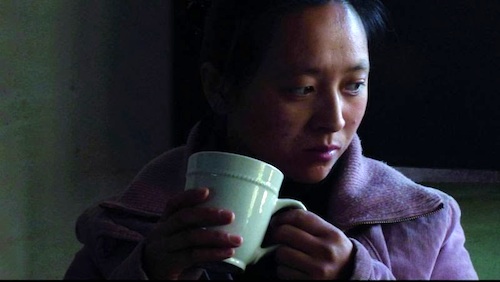
From "Mothers."

Mothers clocks in just short of seventy minutes, but it is loaded with incendiary moments. Frankly, it brings to mind A Handmaid’s Tale, even including the dystopian religious fervor, courtesy of Zhang Qing-mei, who bizarrely likens Mao Zedong to a saint and a divine emperor. The mind reels.

Recently, the Communist government has promised some flexibility in One Child enforcement, but broad reforms still seem unlikely (just ask the great filmmaker Zhang Yimou). In any event, the policy has already wrought tremendous emotional damage that will reverberate for decades. You can see it clearly in Mothers. A bold work of cinematic journalism and a gripping human interest story, Mothers is highly recommended when it screens Thursday (2/27) with Leslie Tai The Private Life of Fenfen (another worthy selection) during MoMA’s 2014 Doc Fortnight.

LFM GRADE: A

Posted on February 25th, 2014 at 1:25am.

LFM Reviews The Private Life of Fenfen @ MoMA’s 2014 Documentary Fortnight

The Private Life of Fenfen (Trailer) from Leslie Tai on Vimeo.

By Joe Bendel. Evidently, fifteen minutes will not get you very far in today’s China. Guo Lifen (familiarly known as Fenfen) gained considerable new media-social network notoriety as the subject of Leslie Tai’s collaborative documentaries, but the reality of her class and circumstances remained unchanged. Her personal travails will become grist for public consumption in Tai’s The Private Life of Fenfen, which screens as part of this year’s Documentary Fortnight at MoMA.

Guo Lifen has a lot of history with Tai. By giving her editorial control over their previous film, Tai hoped to avoid issues of exploitation. The divorced Guo also has considerable history with men that could be considered unambiguously exploitative. After completing their collaboration My Name is Fenfen and her own Sister Heaven Sister Earth, Tai gave a camera to record Guo video diary. Three years later, Guo handed Tai over one hundred hours of tape, declaring her dreams were now “dead.”

It is stark stuff, including accounts of family strife, domestic abuse, and an abortion precipitated by her lowlife fiancé’s drunken attack. Guo recounts it all matter-of-factly, as if she were already dead on the inside. Frankly, her testimony is quite spooky, but Tai’s presentation strategy is somewhat debatable.

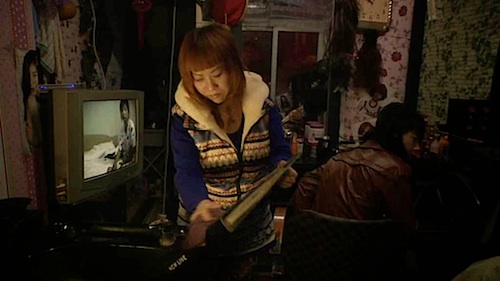
From "The Private Life of Fenfen."

Rather than simply edit it together, she films closed circuit broadcasts of Fenfen’s diaries, as if it were a legit reality TV program, in the sort of greasy spoons and hole-in-the-wall shops that cater to migrant workers such as Guo. While it adds an uncomfortably voyeuristic dynamic to the film (particularly when we hear some of the viewers’ unkind commentary), it also provides the constant reminder that this is where Guo came from and this is where she will inevitably return.

Guo is still relatively young. She should be able to make mistakes and get on with her life, but she clearly does not think she has that option. At best, she hopes for a modest measure of peace and quiet.  In its unassuming way, that is a damning indictment of contemporary China. Well worth seeing, The Private Life of Fenfen screens Thursday (2/27) as part of a double bill with Xu Huijing’s extraordinarily revealing Mothers, during MoMA’s annual Documentary Fortnight.

LFM GRADE: B

Posted on February 25th, 2014 at 1:20am.

LFM Reviews Karaoke Girl @ The 2014 San Francisco Indie Fest

By Joe Bendel. Before New York’s disgraced former congressmen and governors embark on their next vice tour of Thailand, they ought to give some thought to the women working in Bangkok’s redlight district. Sa is one of them, but the extent of her nightclub work is kept somewhat ambiguous in Visra Vichit-Vadakan’s docu-fiction hybid Karaoke Girl, which screens during the 2014 San Francisco Indie Fest.

Sa Sittijun essentially plays herself, a pure-hearted country girl, who came to the city to provide for her family. Initially, she really did work in a factory, but when it closed she was forced to take a hostess job in a karaoke bar. Of course, her family still thinks she is cracking eggs on the assembly line. It is probably more tiring work at the club, requiring constant maintenance. Due to the late hours, Sa also often has close contact with dodgy sorts. In fact, crime is a very real occupational hazard.

Despite all the hardships she endures, Sa gives alms with great frequency. She also sends money home quite regularly and returns periodically to drag her ailing father to the doctor. In short, she deserves better than the lot she drew in life, most definitely including her unreliable lover, Ton. One can only hope the Thai release for Karaoke and its success on the international film festival circuit will lead to better things for Sittijun.

Clearly, Vichit-Vadakan had up close and personal access to Sittijun’s life (or at least a revealing approximation of it). Yet, since she mostly avoids the lurid aspects of the redlight business, it does not feel as intrusive as it might. Instead, we come to understand “bar girls” must spend time on their laundry and pursue problematic relationships, just like everyone else.

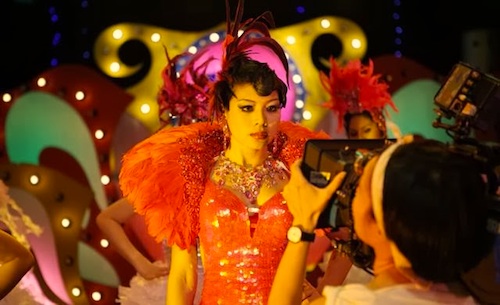
From "Karaoke Girl."

Frankly, Karaoke is the sort of visually arresting docu-straddler These Birds Walk was supposed to be, but fell short of. For one thing, Sa is a far more engaging (and even sympathetic) focal character. Also, the rural backdrops and nocturnal city scenes are considerably more striking than Birds’ visuals. Great credit is due to co-cinematographers Chananum Chotrungroj and the American executive producer, Sandi Sissel (whose credits also include Salam Bombay) for maintaining an intimate focus on Sa, but still capturing a powerful sense of place.

No matter how much of her actual life is reflected on screen, Sittijun expresses a whole lot of emotional truth. Quiet but powerful, with a surprisingly spiritual dimension, Karaoke Girl is recommended for all those concerned with the condition of working women (broadly defined) in the developing world. It screens at the New Parkway Theater (in Oakland) this Thursday (2/20) as part of this year’s SF Indie Fest.

LFM GRADE: B+

Posted on February 18th, 2014 at 9:08pm.

LFM Reviews Beijing Love Story

By Joe Bendel. Beijing is a lot like New York. It is a tough city, but you can still find some wildly romantic backdrops there. Five couples of varying ages and degrees of matchedness will go through love’s ups and downs all over the Chinese capital, as well as during a romantic side-trip to Greece in Chen Sicheng’s Beijing Love Story, which opens tomorrow in New York.

Unlike his married boss Wu Zheng, Chen Feng is a decent enough guy. Unfortunately, he does not have much money or legal Beijing residency. Nonetheless, the outrageously cute Shen Yan still falls for him at a hipster singles’ party. Can their romance survive the pressures of money woes and a surprise pregnancy? Her wealthy ex and the painful in medias res opening say no, but viewers should not put too much stock in either.

Meanwhile, Wu’s tomcatting is about to catch up on him. Somewhat disappointed by his lack of faithfulness, his wife Zhang Lei tries to take a page from his playbook, possibly complicating the life of her boss and platonic friend, Liu Hui in the process. He has an assignation of his own to worry about. He is meeting his mysterious mistress, Jia Ling, for a weekend in Greece. Since the two lovers are played by “Big Tony” Leung Ka Fai and Carina Lau, you would expect things to heat up here and they do.

Liu will play Jia’s games in Greece, but he is always serious about being Liu Xingyang’s father. However, she is rather upset with him, because he will not allow her to appear on a national talent show with her string ensemble. Smitten Song Ge is happy to lend a sympathetic ear and maybe even her transportation money if he can earn enough from after school jobs and maybe borrow some from his grandfather, “Old Wang.” Of course, Wang has his romantic difficulties as well. His cousin keeps fixing him on with blind dates, but his heart is never in it, even with a recently returned expat, who should be well out of his league.

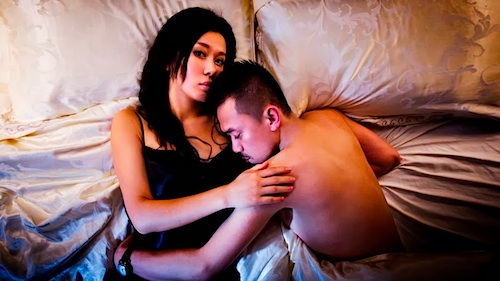
Without question, Beijing works best when it follows the Liu family. Leung and Lau have scorching chemistry and the Greek locale inspires the film’s most visually stylish sequences. In contrast, the innocence and exuberance of Song’s courtship of Liu Xingyang is like a breath of fresh cinematic air. As teenaged Liu and Song, Nana Ou Yang and Liu Haoran come across like good kids at heart, but with massive screen presence.

From "Beijing Love Story."

The other interrelated couples are not necessarily dead weight, but they do not deliver the same satisfaction. Frankly, Yu Nan is absolutely terrific as the wronged Zhang, but her storyline functions more as a transition from Chen & Shen to Liu & Jia than as a fully developed arc in its own right. Wang Qinxiang is also surprisingly moving as Old Wang, but Chen really pulls out the manipulative stops for the closer. He also shows big city Beijingers at their most annoying during the initial tale of his namesake (played by the writer-director). Tong Liya’s Shen has all kinds of charisma, but there is only so much she can do for this underwhelming slacker love story.

It is not often we have a Valentine’s appropriate film to recommend for February 14th, but this year we have one. Based on Chen’s hit television series of the same name, Beijing Love Story hits more ambiguous notes than viewers might expect, but that is a good thing. Ultimately, it is the veteran superstars (Leung and Lau) and the ridiculously young looking stars of the future (Nana Ou Yang and Liu Haoran) who really sell it. Recommended for Valentine viewing, Beijing Love Story opens tomorrow in New York at the AMC Empire, from China Lion Entertainment.

LFM GRADE: B

Posted on February 13th, 2014 at 12:21pm.