LFM Reviews Frontline’s Syria’s Second Front, Children of Aleppo

By Joe Bendel. You can draw a lot of conclusions about people simply from judging the groups trying to kill them. Most western observers are utterly baffled by the bedlam of the Syrian Civil War. However, it is pretty easy to side with the initial rebel groups who rose up against the Assad regime and now find themselves battling a virulently Islamist faction in the north, once the particulars of the conflict are established. This Tuesday, PBS’s Frontline broadcasts Syria’s Second Front and Children of Aleppo, two boots-on-the-ground reports from Syria documenting the precarious state of the original, largely secular rebels and the dire conditions faced by sympathetic civilians.

ISIS, the Islamic State of Iraq and Syria, is supposedly so extreme and violent, al-Qaeda wants to keep them at arm’s length. Presumably, they will patch things up if ISIS takes operational control of Syria, which is not outside the realm of possibility. They have little use for secular society and a special enmity for reporters, whom they are perfectly willing to execute on sight. Nevertheless, Muhammad Ali, a daring independent journalist with a memorable name, has infiltrated ISIS controlled territory with a team of Free Syrian Army aligned rebels.

When ISIS eventually leaves town, everyone is relieved to see them go. Frankly, many of the local citizenry are quite courageous expressing their hopes for a free secular democratic state. However, the prospects are rather iffy, even if the fractious rebel forces can unite against both ISIS and Assad. Second Front offers some cautious optimism on this score, but it is tempered by the shocking footage of the better organized ISIS brutally administering Sharia Law.
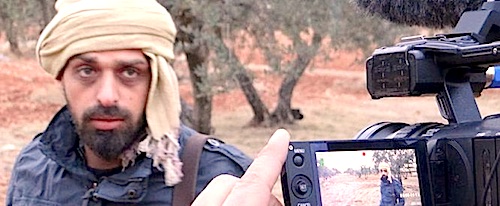
From "Syria's Second Front."

According to Children of Aleppo, an estimated 11,000 children have been killed in the course of the Syrian conflict. Most parents opted to shelter their sons and daughters outside the country. One FSA captain is a notable exception. He and his wife still live in their once fashionable Aleppo flat with their son and three daughters. The captain’s comrades are now like extended family to his girls, which would be almost heartwarming, if their familiarity with the sounds of war were not so tragically well developed.

Those who have seen Matthew VanDyke’s Not Anymore will also recognize his footage of a twelve year old protest singer, who just started performing for his camera as a shell landed nearly on top of them. Both survived, but she evidently now lives in Qatar. Frankly, VanDyke’s film is even more effective than the Frontline films at putting a human face on the Syrian civil war. Although it is now available online, interested New Yorkers can see VanDyke’s short doc on the big screen on February 28th as part of the 2014 Winter Film Awards. In contrast, Syria’s Second Front better establishes the ideological and geopolitical context for the various factions.

The one-two punch of last month’s Secret State of North Korea and the upcoming Syria’s Second Front make this Frontline’s strongest season perhaps ever. Both broadcasts represent solid investigative journalism conducted in countries that do not recognize press freedoms. Highly recommended, Frontline’s twofer of Syria’s Second Front and Children of Aleppo air tomorrow night (2/11) on most PBS stations nationwide.

LFM GRADES: A-/ A-

Posted on February 11th, 2014 at 12:37am.
LFM Reviews The Hourglass Sanatorium, Presented by Martin Scorsese

By Joe Bendel. Smuggling a censored film was a trickier proposition in 1973. Instead of a flash drive, you had to schlep cans of film. Nevertheless, Wojciech Has managed to convey his banned, mind-bending prestige production to Cannes, where the jury led by Ingrid Bergman awarded it the Jury Prize. While never explicitly political, it is easy to see why Has’s The Hourglass Sanatorium would be too much for a risk averse Communist apparatchik to countenance when it screens as a handpicked selection of Martin Scorsese Presents: Masterpieces of Polish Cinema, hosted by the Film Society of Lincoln Center.

Based on the novel and short stories of Bruno Schulz, Hourglass is never intimidated by the constraints of narrative. Józef is traveling to a remote sanatorium, where his lower middle class merchant father Jakub is a patient. Actually, his father is already dead everywhere else except the decaying sanatorium. Within the crumbling walls, the randy inattentive staff apparently has the power to roll back time to a point where his father is still living. Through the strange power of the sanatorium, Józef is able to revisit his past through his subconscious (or vice versa) for a series of chaotic encounters with his sort of late father. Or something like that.

You could debate just what Hourglass is until the cows come home, but no way, no how is it Socialist Realism. Meaning that densely ambiguous spells nothing but trouble for a professional censor. To make matters worse, Has chose not to soft pedal the main characters’ Jewish heritage while the Polish Communist Party was still engaged in its campaign of anti-Semitic purges. At times, Has even evokes images of the Holocaust, even though the work of Shulz (himself a fatal victim of National Socialism) predated WWII.

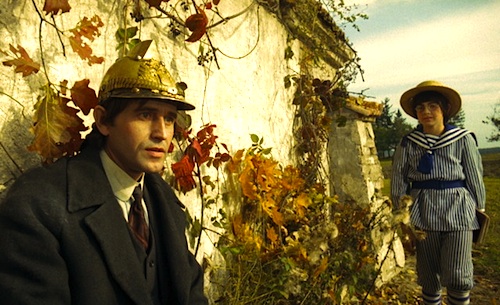
From "The Hourglass Sanatorium."

Good for Berman for digging Hourglass. It will not be to everyone’s tastes. However, it is visually stunning. The depth of vision Has employs with his swooping camera is truly dizzying. It might be heresy to suggest, but Hourglass could be that rare classic worth giving the 3D fixer-upper treatment. Ironically, the film authorities clearly opened the coffers during the production stage. The work of art director Andrzej Halinski is absolutely baroque, even decadent in an evocatively decayed way. Viewers may well wonder if Hourglass was an early influence on a young Tim Burton or Terry Gilliam.

Hourglass is an auteur’s film in just about every way, rather than an actor’s showcase. It is dashed difficult to forge an emotional connection with the audience amid all the trippiness, but at least Jan Nowicki looks convincingly lost as Józef.

Undergarments are rather loose in Hourglass, so parents should be strongly cautioned. More to the point, it is sure to raise questions with no objective answers. This is definitely high-end cult cinema, but those who appreciate extravagant set pieces and dark fantasyscapes will dive into the experience. Recommended for the adventurous and literarily inclined, The Hourglass Sanatorium screens this Friday (2/14) and Sunday (2/16) at the Walter Reade Theater, as part of Martin Scorsese Presents: Masterpieces of Polish Cinema.

LFM GRADE: B+

Posted on February 10th, 2014 at 12:28am.

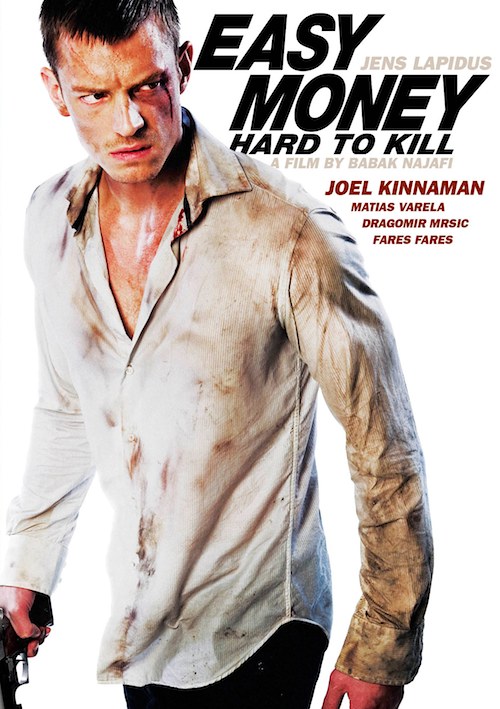
LFM Reviews Easy Money: Hard to Kill

By Joe Bendel. When on work release, convicted cocaine smuggler Johan “JW” Westlund seizes the opportunity to get back to “work.” This was not always his world, but he will find there is no going back to the upright, respectable existence he once led in Babak Najafi’s Easy Money: Hard to Kill, which opens this Friday in New York.

There were a lot of casualties at the end of the first Easy Money film, but somehow Mrado Slovovic survived, despite being run-over by a car and shot at close range by Westlund. One might expect the wheelchair-bound hitman to hold a grudge, but he and Westlund bond when they become cellmates. It must be all that shared history. Once a promising business student, Westlund lent his analytical skills to an up-and-coming coke syndicate to subsidize his extravagant lifestyle. In retrospect, it was not such a great plan for the future. Trying to go straight, Westlund develops a game-changing stock-trading program, only to find during his first furlough his so-called partner has double-crossed him.

Slightly put out, Westlund chucks in the work-release song-and-dance, arranging to break Slovovic out instead. He might be paraplegic, but Slovovic is still one bad cat. He also knows the daily routine of the Serbian mob’s unassuming money launderer. While they work on their hasty caper, small time South American trafficker Jorge and lowly Lebanese enforcer Mahmoud are also making their desperate plays for survival. Naturally all three alumni from the first film will come together in some fashion during the third act.

Viewers should be able to readily follow Hard to Kill even if they did not see the franchise opener, but the constant parade of faces that are supposed to be familiar will be more rewarding to those who have. Regardless, HTK is slick, stylish, and strangely multicultural, but hardly in a way that embraces global fellowship. This is not a film that will have you humming “It’s a Small World,” but it might scare you straight, unless you live in Colorado, where these sorts of things are practically legal.

Joel Kinnaman, the star of AMC’s The Killing and the RoboCop reboot so coincidentally opening just before HTK, is suitably flinty as Westlund, but Dragomir Mrsic out hardnoses everyone as Slovovic, while still expressing his acute disappointment in himself as a father. Likewise, Fares Fares makes a compelling sad sack as the luckless Mahmoud.

Since Easy Money: Life Deluxe has already released in Sweden, it is a safe bet anyone who survives the second cut will be back to try their luck a third time. HTK does not break a lot of new ground, but the intriguing relationship that develops between Westlund and Slovovic elevates it above more routine Scandinavian crime dramas. Recommended for those who enjoy gangster films with healthy doses of violence and irony, Easy Money: Hard to Kill opens this Friday (2/14) in New York at the Cinema Village.

LFM GRADE: B

Posted on February 11th, 2014 at 12:19am.

He Also Does Taxes: LFM Reviews The Attorney

By Joe Bendel. Depending on who you ask, the late ROK President Roh Moo-hyun was either a principled idealist or a corrupt demagogue. A new film unequivocally holds to the former view. A thinly fictionalized Roh will argue a life-altering, inspired-by-true-events case in Yang Woo-seok’s The Attorney, which opens today in New York.

Even though he never graduated from high school, Song Woo-seok became a self-taught bar-certified attorney (sort of like Lincoln). He even briefly served as a judge, but resigned to pursue a more lucrative practice, for the sake of his family. Recognizing an early opportunity, Song becomes one of the first to take advantage of a legal change allowing attorneys to register property deeds in place of a notary. At first, the legal establishment is openly contemptuous of the bounder. Then the business starts pouring in.

Eventually, other attorneys started competing for Song’s real estate business, so Song once again makes a shrewd move into a tax practice. Ironically, when the paper-pushing Song finally litigates a case, the fix is in right from the start. In acknowledgement of a debt from his early scuffling years, Song reluctantly agrees to represent Jin-woo, the son of a forgiving noodle shop proprietor. Unfortunately, this is no ordinary criminal case, but a dubious national security prosecution, with confessions already lined up courtesy of the ruthless Captain Cha Dong-young.

When it gets down to political business, The Attorney is certainly not shy about waving the bloody martial law shirt. However, the first half of the film is actually a rather touching story of hard work and sacrifice rewarded, in the tradition of The Pursuit of Happyness. Song Woo-seok (a fusion of the director and star’s names) is an earnest everyman, who earns his piece of the pie the old fashioned (but unfashionable) way.

Of course, once the sainted Soon-ae’s son is arrested, The Attorney shifts into high moral outrage gear. Korean box office superstar Song Kang-ho leaves it all on the field as his half namesake, wringing all the righteous indignation and heroic sincerity he can out of the courtroom cross examinations. At least Yang and co-writer Yoon Hyun-ho step back from the Few Good Men, acknowledging an experienced government employee like Cha will never cop to ordering a “Code Red” on the stand.

From "The Attorney."

Fans of Song Kang-ho, Korea’s top domestic movie star, should probably seek out The Attorney, despite its excesses, because there is no telling how much of him will be left once Harvey Weinstein finishes editing Bong Joon-ho’s Snowpiercer with a hacksaw. Yet, it is veteran actress Kim Young-ae who really instills the film with dignified sensitivity as honorable gravitas as Soon-ae. It is also amusing to see Oh Dal-su (Oldboy’s sleazy private prison warden) do his shtick as Song-Woo-seok’s sitcomish office manager. Unfortunately, Kwak Do-won (a great villain in A Company Man) largely phones in Cha, the cold fish.

In a way, The Attorney sort of confirms the theory that political liberty inevitably follows economic liberty. After all, Song Woo-seok sure is busy with real estate transactions in the early 1980’s. While the performances are mostly quite impressive, it never really captures the telling period details. Without the narrative reference points, viewers might mistake it for a contemporary legal drama. While it is sure to stoke political debate in Korea, The Attorney is only recommended for American viewers with a crack cocaine level addiction to legal table-pounding melodramas when it opens today (2/7) in New York at the AMC Empire.

LFM GRADE: C+

Posted on February 7th, 2014 at 3:28pm.

Vengeance is Shohei Imamura: LFM Reviews Black Rain

By Joe Bendel. These days, fifty-five is a relatively young age to pass, especially for a former pop idol. For the family and fans of Yoshiko Tanaka, it would be a tragic case of symmetry. Justly lauded for her role as a “hibakusha” Hiroshima survivor, Tanaka succumbed to cancer in 2011. Although not exactly the sort of wrong-side-of-the-tracks noir that made his early reputation, Shohei Imamura’s Black Rain made a fitting capstone to the Asia Society’s Vengeance is Imamura retrospective when it screened this past weekend.

Yasuko was not in Hiroshima proper when the bomb was dropped, so she should be unaffected by “the flash.” However, she was caught in the “black rain” during the immediate aftermath. Despite her beauty, that is enough for most parents to put the nix on inquiries from her marriage broker.

Frankly, her matchmaking woes are more painful for her uncle Shigematsu Shizuma and his wife Shigeko. They had taken their niece into their home for safe keeping during the waning days of the war, promising to arrange her betrothal. Her potential old maid status grieves them personally and represents a potentially loss of face with their family and ancestors. Yet, as Yasuko’s prospects dim, she becomes increasingly devoted to the ailing Shizumas.

Imamura served an early apprenticeship with Yasujiro Ozu, so it is not so surprising to see his mentor’s influence imprinted on Rain. Like many of Ozu’s signature films, which focus on fathers and daughters or uncles and nieces, Rain is defined by the relationship between Yasuko and old man Shizuma. The way their bond steadily deepens is absolutely beautiful and agonizing to behold.

From "Black Rain."

As Yasuko, Tanaka is exquisitely beautiful, profoundly moving, and in retrospect, sadly eerie. Likewise, Kazuo Kitamura is a wonderfully complex figure of strength and pathos. Their screen rapport is real and affecting.

Rain is also impressive on a technical level, vividly recreating the chaos and destruction of Hiroshima. Nevertheless, it is a far cry from an Irwin Allen picture. It is also worlds removed from Ridley Scott’s Black Rain, which was also partly set in Japan and released in the same year. However, it makes much of the criticism leveled at The Wind Rises look largely misplaced. While Miyazaki’s animated feature addresses the repressive tactics of the militarist government’s secret police, Black Rain presents the Japanese war experience entirely in terms of passive victimhood. Yet, its overt anti-nuclear sentiments earn it a pass. Regardless, Black Rain is a mature and engrossing work from a master filmmaker. Highly recommended, it concludes the Vengeance is Imamura series tonight (2/1) at the Asia Society.

LFM GRADE: A-

Posted on February 4th, 2014 at 12:36am.

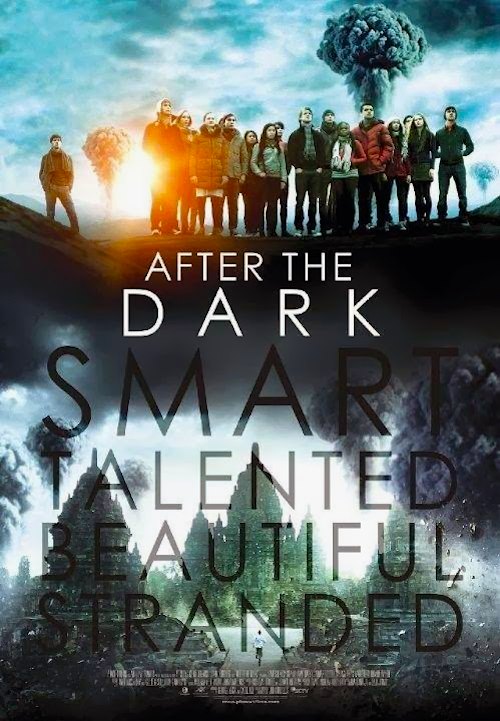
Talking Through the Apocalypse: LFM Reviews After the Dark

By Joe Bendel. In most lifeboat scenarios, it is women and children first. That is not necessarily the case for the hypotheticals one philosophy class will grapple with. Logic will be the first thing thrown over the side in John Huddles’ After the Dark, which opens this Friday in select theaters.

The elite philosophy class of Jakarta’s western school for wealthy expats is a little put out having to do work on the final day of class, but Mr. Zimit is playing hardball with their grades. They will each draw a profession from his box and then vote on who gets a place in the bomb shelter. There are twenty of them and enough air and provisions in the bunker for ten.

As their “thought experiments” play out, we see the survivors interacting, like rats trapped in a cage, but since they are all just jawing back in their Jakarta classroom, where is all this melodrama coming from? It gets rather puzzling at times as when, for obvious reasons of jealousy, Zimit decrees James, the just-getting-by boyfriend of his prized pupil Petra, shall hence forth be gay. To be true to himself, James subsequently starts sleeping with the class’s token gay Adonis in bunker world. That drives Petra into the bunker-arms of Zimit, which in turn disturbs James because he always had a bad feeling about that guy. Frankly, it would be much more interesting to see how that could possibly come out in a classroom conversation than to sit through the dramatic representation.

Dark’s basic premise is intriguing, but the execution is a logical shipwreck, starting at the top with Mr. Zimit. Supposedly he wants his students to think like philosophers, but it is more like he is training them to be actuaries. You’re a gelato maker—sorry not much earnings potential there. In a running gag, Zimit summarily executes the poor shmuck stuck being the poet before selection even begins, because he so obviously lacks utility. Really, that is what a philosophy teacher thinks of poetry? I put it to you Mr. Zimit, any philosophy instructor who neglects the age old philosophic study of aesthetics is a substandard teacher who therefore must relinquish his role in deciding who will live and who will die.

Regardless, Sophie Lowe is surprisingly good as Petra, the sensitive smartie. The whole class is ridiculously attractive, but the girls generally sound more convincingly like members of a gifted-and-talented class than the meathead guys. Yet, the film’s real trump card is the Indonesian locales who add a distinctively surreal wtf-ness that helps forestall all the questions regarding logical inconsistencies.

Have you ever woken up at night with what feels like a brilliant idea, but thought otherwise once you read your scribbled notes in the morning? That probably happened to Huddles, except he still thought it was a fine notion and proceeded to film it. There is a germ of something here, but he should have given his subconscious more time to kick it around. However, Russian audiences evidently disagreed, making it a surprise box office champion over several studio films, which is impressive considering its relatively sympathetic gay character probably makes it illegal under Putin’s “homosexual propaganda” law. A head-scratcher all the way around, After the Dark releases in select theaters and on VOD this Friday (2/7).

LFM GRADE: C

Posted on February 4th, 2014 at 12:33am.