Bring Your iPad: LFM Reviews Spike Lee’s Red Hook Summer

By Joe Bendel. For the final cut of Pulp Fiction, Quentin Tarantino deleted a scene of Uma Thurman talking to John Travolta through the lens of a camcorder. It was already too clichéd. That was nearly twenty years ago. In his latest film, Spike Lee heavily relies on a similar device, hoping the upgrade to an Apple iPad makes it seem fresher. Such a strategy perfectly represents the tired blood of Red Hook Summer, which opens this Friday in New York.

Colleen Royale can hardly stand her father, Enoch Rouse, introduced to viewers as “Da Good Bishop” of the Little Piece of Heaven church, or his old time religion. Nonetheless, she deposits her anti-social suburban son Flik in her father’s Red Hook housing project apartment for the summer. Like a little Spike Lee, Flik has a compulsive need to film the world around him, but no faith. Thus begins a generational cold war, with the minister determined to bring the young cuss to Jesus.
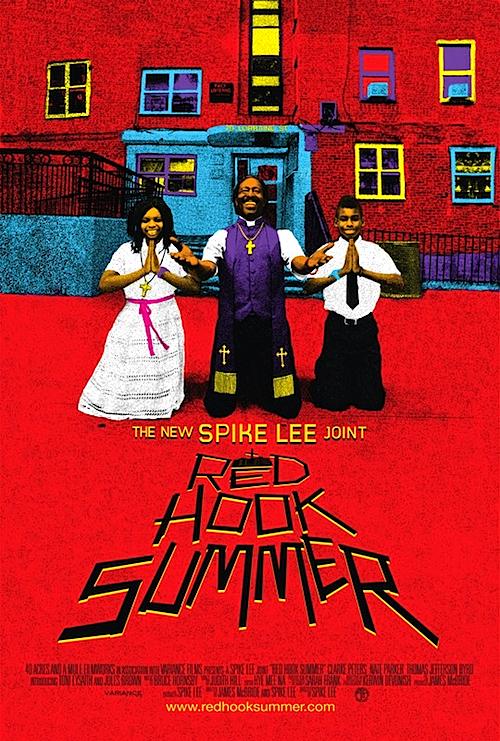
Frankly, Hook’s first two sluggish acts are downright laborious, but grandfather and grandson seem to be building a relationship by meeting each other halfway. That would be a worthy enough lesson we could all stand to be reminded of again, if the film followed through on it. Instead, Lee foists one of the laziest, most obvious third act revelations on viewers, completely undermining any good will he might have built up thus far. Remember Enoch Rouse is a man of the cloth. Anyone who has seen a Hollywood film in the last twenty years should be able to guess the rest.

Yet, since Hook clearly implies Rouse’s daughter has a good idea what her father’s deep dark secret is, it is absolutely baffling why she would send her son to stay with him unsupervised, with only his annoying sense of entitlement for protection, unless she is just understandably sick of the sullen brat. No matter, Lee is determined to pull Rouse through the gauntlet, which he does in punishing, Grand Guignol style.

To be fair, Clarke Peters does his best to maintain Rouse’s basic humanity, working like his soul depends on it, but Lee stacks the deck against him. Nonetheless, his performance stands head and shoulders above the rest of the cast. That includes Lee himself, briefly appearing in the guise of Do the Right Thing’s Mr. Mookie, clearly hoping viewer enthusiasm for his defining film will rub off on this wan return to the County of Kings.

Hook is a bad movie, but it is not the fault of the musicians. New Orleans’ Jonathan Batiste performs some stirring Hammond B-3 solos and brings some refreshing energy to film when appearing in character as “Da Organist” TK Hazelton. Likewise, Bruce Hornsby draws on his jazz chops for a pleasing gospel influenced instrumental soundtrack.

Yes, Hook sounds great, but the paucity of originality is honestly depressing. Perhaps it is time for Lee to follow Woody Allen’s lead and leave his beloved New York to make a psychological thriller with social climbing Londoners. At least then he would not have the overpowering temptation to fall back on his predictable Spikisms. Not recommended, Red Hook Summer will disappoint even Lee’s most dogged champions when it opens this Friday (8/10) in New York at the AMC Empire.

LFM GRADE: D-

Posted on August 8th, 2012 at 1:04pm.
New Trailer for Kathyrn Bigelow’s Zero Dark Thirty, Dramatizing the Hunt for bin Laden

A new trailer and five photos for director Kathryn Bigelow’s Zero Dark Thirty have come online. Zero Dark Thirty dramatizes the daring and successful Navy SEAL Team 6 bin Laden raid in Pakistan from last year.

The film opens on December 19th, and stars Joel Edgerton, Jessica Chastain, Edgar Ramirez, Kyle Chandler and others.

Posted on August 6th, 2012 at 12:59pm.

LFM Reviews Defiant Requiem @ DocuWeeks 2012 in NY & LA

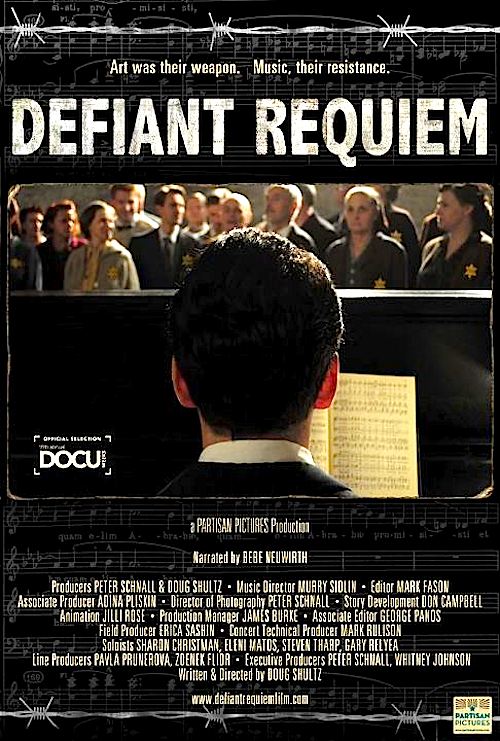
By Joe Bendel. A Catholic requiem in a concentration camp might sound like a problematic endeavor. So it was, but not necessarily for the reasons one might assume. It was actually the programming choice of a group of prisoners, led by a remarkable maestro. The story of the Terezin performances of Verdi’s Requiem and the subsequent on-site re-staging for survivors decades later are documented in Doug Shultz’s Defiant Requiem, which screens as part of the 2012 DocuWeeks in New York and Los Angeles.

Verdi’s Requiem is a draining chorale work, in many ways. It would not seem like a natural piece of music to unwind with after a hard day of labor—slave labor to be more accurate. However, these were far from normal times for the Terezin (a.k.a. Theresienstadt) concentration camp captives. These Czech citizens had been swept up by the conquering National Socialists and held at Terezin until they were deported to a death camp. Nonetheless, many died at Terezin due to the inhuman conditions, but a determined young conductor harnessed the power of music to keep their spirits up.

Gathering those interested around an old upright providentially discovered in the basement of his barracks, Rafael Schächter started his make-shift chorus off with Czech popular songs and Smetana operas, but he eventually coaxed them into the Requiem. The key might have been his translation of Verdi’s Latin into Czech. As Murry Sidlin, the conductor of the commemorative Requiem concerts observes, the Requiem’s lyrics hold tremendous meaning for anyone unjustly denied their liberty and dignity. Rife with prophesies of judgment from above, Verdi’s opus is not just a requiem. It became a J’Accuse—an indictment of the National Socialist crimes so bold, only the International Red Cross inspectors could miss its significance.

Yes, the Requiem was performed at that Terezin, the concentration camp temporarily remodeled into a Potemkin village to fool the Red Cross. It was there that Sidlin brought members of Catholic University of America chorale ensemble and a full orchestra, for an emotional performance.

In fact, mounting Verdi’s Requiem and telling the story of Schächter has become a mission for Sidlin, who serves as the film’s musical director and one of its primary commentators. It is an important story, but the film also fosters a greater appreciation for Verdi’s work. Wisely, Shultz takes a rather traditional documentarian approach, largely approximating the shape of Sidlin’s music-with-historical-context concert presentations of the Requiem, filling in here and there with tastefully recreated scenes in the rehearsal cellar and some animated sequences adapted from surviving Terezin drawings. This is hardly the place to get experimental, after all.

Granted, anyone who knows anything about the Holocaust and the fate of the Terezin prisoners in particular will sadly know exactly what to expect from the film. Nonetheless, it deepens our understanding of life at Terezin and offers up an example of music as an instrument of survival. Frankly, hearing some of the stormier passages promising divine justice will likely make viewers’ hair stand on end. Highly recommended precisely for such memorable moments, Defiant Requiem screens through Thursday (8/9) in New York at the IFC Center as part of DocuWeeks New York as well the week of August 17-23 during DocuWeeks LA.

Posted on August 6th, 2012 at 12:58pm.

Playing Liars’ Poker in Hong Kong: LFM Reviews Supercapitalist @ The Asian American International Film Festival

By Joe Bendel. Like a financial Luke Skywalker, Connor Lee is about to assume his destiny as the son of a legendary trader. He will find his destiny in Hong Kong. His Chinese is limited, but he speaks money. That will be all he needs in Simon Yin’s $upercapitalist, the centerpiece selection of this year’s Asian American International Film Festival, which opens this Friday in New York.

Lee regularly predicts the unthinkable, yet is never able to adequately capitalize on his foresight. That may soon change. He has caught the eye of hedge fund master of the universe Mark Patterson, who dispatches him to Hong Kong. His assignment is to mount a takeover of Fei & Chang, a hidebound family run conglomerate in which they already own a minority stake. This does not sit well with the ruling Chang family, especially the heir apparent son, Richard, who is spearheading a top secret project afoot to radically re-engineer the company’s ailing import-export division.

Will Lee facilitate the revitalization or the liquidation of the company? This depends on who gets the final word: the devil or the angel sitting on his shoulders. The devil is Quentin Wong, Lee’s colleague and mentor in the HK fast life. The angel is Natalie Wang, a corporate publicist working with Richard Chang and his IT guru.

From "Supercapitalist."

Once again, $upercapitalist portrays an American hotshot who must go abroad to get a lesson in business ethics. At least it is HK rather than the CP dominated Mainland doing the teaching this time around. However, the supposed killer app for employee motivation Richard Chang’s team is developing sounds highly dubious. Essentially, their plan to increase productivity involves an intra-company facebook, in which workers try to amass attaboys from their peers. I think I’d rather start the day with a dozen lashings.

Conceived as a star vehicle for himself, screenwriter Derek Ting has a few nice moments in $upercapitalist as Lee. Mostly though, his character follows the old school Tom Cruise template of a humbled young Maverick finding redemption through the help of a more emotionally mature love interest. Kathy Uyen holds up her end well enough as the virtuous publicist, but it is not a particularly well fleshed out role.

However, as Wong, Darren E. Scott clearly enjoys playing the villain, bringing a nice infusion of energy to his scenes. Still, for those who follow Asian cinema, the real highlight of $upercapitalist is seeing veteran HK actors Richard Ng (a Jackie Chan alumnus also seen in Detective Dee) and Kenneth Tsang (recently in Starry Starry Night, as well as John Woo classics like Once a Thief) do their thing as Chairman Donald Chang and his board member brother Victor, respectively.

$upercapitalist is not a bad boardroom soap opera, but it falls in too easily with the lazy Bain Capital attacks currently circulating in the media. Frankly, if Fei & Chang’s import/export division is dragging down the entire company, they have a responsibility to all their employees to fix the problem. Of course, why worry about the complexity of reality in a film when simplistic stereotypes are so much safer? A decent showcase for some fine supporting work, the flawed but still quite watchable $upercapitalist opens this Friday (8/10) in New York at the Village East.

LFM GRADE: C

Posted on August 6th, 2012 at 12:57pm.

Women’s Rights & Islam: LFM Reviews Invoking Justice @ The Asian American International Film Festival

By Joe Bendel. They are called Jamaats. In Muslim areas of Southern India, these neighborhood old boys’ networks supposedly apply sharia law. However, in practice, they regularly provide cover for abusive and even homicidal husbands. At least, such appears to be the case based on the evidence presented to the upstart women’s Jamaats. Deepa Dhanraj documents the efforts of the women’s Jamaat leaders to redress gender based injustices in Invoking Justice, which screens during this year’s Asian American International Film Festival in New York.

As per Indian custom, Islamic law officially supersedes secular law in the provincial south. It is a nice set-up if you are a man, particularly if you and your cronies are on the community Jamaat. If you are a woman, though, the system is literally rigged against you. However, a small but growing number of Muslim women have challenged the institutionalized misogyny by forming alternative women’s Jamaats. While their legal standing is rather iffy, especially by the local standards, the civilian police force has to deal with them. This often means the men’s Jamaats must as well, albeit rather grudgingly.

From "Invoking Justice."The kinds of cases women’s Jamaat activists investigate are frankly shocking, including several cases of spousal murder and one abused wife and mother desperately trying to divorce her pedophile husband. The women’s Jamaat founder Sharifa Khanam clearly knows the Koran and uses it to shame their male counterparts. Yet, on a fundamental level, they still acknowledge the primacy of Islamic law over civilian authority. Indeed, this begs an obvious question Dhanraj does her level best to ignore: is religious-based law compatible with any meaningful notion of justice? Indeed, viewers might well wonder if non-Muslims living in Tamil Nadu have any recourse for legal redress, whatsoever.

To be fair, Dhanraj largely adopts the observational approach, only sparingly mixing in traditional on-camera interview sequences. We see the Jamaat case-workers do the leg work and build the trust of families seeking their assistance. Tellingly, it is not just women who petition the women’s Jamaats for help, but often the male relatives of women who have been battered and even killed.

Invoking is certainly eye-opening stuff. However, if ever there was a film that could have benefited from a little confrontational showboating, it would have been this one. Ultimately, viewers will feel justice is not being served in Tamil Nadu and may well suspect the situation is even worse than it appears in Dhanraj’s documentary. Still, capturing courage on-screen is always a worthy endeavor. Earning a moderate recommendation for those concerned about the state of women’s affairs in the Islamic world, Invoking Justice screens this coming Saturday (8/4) at the Chelsea Clearview, as part of the 2012 AAIFF.

LFM GRADE: B-/C+

Posted on August 3rd, 2012 at 11:35am.