New York Jewish Film Festival 2012: Remembrance

By Joe Bendel. The unfettered flow of information is a powerful thing. During the final days of WWII, Tomasz Limanowski smuggled shocking photographic evidence out of a Nazi concentration camp in Poland. Thirty-some years later, his former lover is shocked to discover he is still alive, thanks to a BBC interview. Based on historical events, their incredible story of love and survival is told in Anna Justice’s Remembrance, which screens at the upcoming 2012 New York Jewish Film Festival.

Limanowski is not Jewish, but the resistance fighter is quite resourceful, which makes him a natural scrounger in the camp. He is thought to stand the best chance of breaking out and rendezvousing with the Polish Homeland Army with his comrades’ negatives. However, his decision to bring Hannah Silberstein with him complicates their plans. She is Jewish, speaks German, and is very sick. In fact, unbeknownst to Limanowski, she is pregnant.

Somehow, Limanowski and Silberstein manage to escape (in a markedly well shot and edited sequence), but with her health failing, they are forced to take refuge at his former estate. Of course, it has been confiscated by the National Socialists, but his mother Stefania now lives in a servant’s cottage and Limanowski’s resistance colleague Janusz still tends to the stables. Unfortunately, his mother’s anti-Semitism comes as a rude surprise to her son. It will also be the cause of much future grief when the couple must separate.

Decades later, both lovers assume the other is dead. Silberstein is now Hannah Levine, married to a perfectly nice research doctor in Brooklyn. When she happens to see Limanowski’s British interview on her dry cleaner’s television, it all comes flooding back, inconveniently during an important dinner party.

Alice Dwyer as Hanna Silberstein.

In a way, Remembrance shares a kinship with Sophie’s Choice, but it is a more forgiving, life affirming film. Levine née Silberstein suffers acute survivor’s guilt that viewers can well understand and easily pardon. Indeed, her complicated but loving relationship with her husband is just as important to the film’s dramatic structure.

The inherent decency of its three principles (this obviously does not include mother Limanowski) is what makes Remembrance such a touching film. It vividly portrays the personal consequences of two successive totalitarian ideologies that conspire to keep the star-crossed lovers apart. In addition to the horrors of the concentration camp, Justice also forthrightly depicts the terror of the post-war Communist regime. Years later, its attempts to excise the Homeland Army from the history books fittingly dovetails with the film’s themes of memory and documentation.

As young Limanowski, Mateusz Damiecki is viscerally intense and totally credibly as the scholarly-looking action hero. Alice Dwyer is also quite compelling depicting the young Silberstein’s drive to survive. Yet, there is something unusually honest and real about Dagmar Manzel and David Rasche’s scenes together as Hannah and Daniel Levine. (Though the Sledgehammer! star still apparently works round the clock in television, Rasche has also appeared in a handful of interesting international films recently – Remembrance being the most notable.)

Pam Katz’s literate screenplay (co-written with the perfectly named Justice) features one of the most moving letters ever heard on film via disembodied narration. Never ginning up phony drama, the sensitively rendered Remembrance consistently rings true. It is one of the best Holocaust-themed features in recent years, considerably superior to Sarah’s Key, Protektor, and Berlin ’36. Highly recommended, it screens this coming Monday (1/16) and Tuesday (1/17) at the Walter Reade Theater as part of the 2012 New York Jewish Film Festival.

Posted on January 10th, 2011 7:55pm.

The Man in the Hood: LFM Reviews El Sicario, Room 164

By Joe Bendel. Don’t ask who that masked man is. You don’t want to know. In 2009, a ‘sicario’ (a professional killer working for the Mexican drug cartels) gave an in-depth interview to Charles Bowden for a revealing Harper’s article. Despite the cartel’s $250,000 bounty, he subsequently consented to a lengthy on-camera interview with Bowden’s filmmaker colleague Gianfranco Rosi, who shaped his pseudo-confession into the documentary El Sicario, Room 164 (trailer below), now playing in New York at Film Forum.

Rosi and Bowden are deliberately sketchy about the details, but the film was shot in a border town hotel room (number 164), where the masked sicario once held and tortured someone who owed money to his cartel. Eventually, he turned the battered man over to another team of sicarios. While he does not know his victim’s ultimate fate, he knowledgeably assumes a grisly end. Though this disturbing information seems to lend considerable significance to the location, it quickly becomes apparent the sicario has done such crimes innumerable times before in similar motels and so-called “safe houses” on either side of the border.

The sicario might very well be embellishing a host of individual details, but the broad strokes he sketches out ring chillingly true. Like a talented young baseball player, the sicario was recruited by his cartel at a young age. After serving a drug-running apprenticeship, the cartel greased his way into the police academy. Yes, the killer is also a copper. He estimates about a quarter of the graduates of all Mexico’s law enforcement academies are cartel plants. Not surprisingly, the free access to squad cars greatly simplifies the kidnapping process.

164 is all kinds of scary. Frankly, it makes it pretty clear narco-terrorist warlords have taken over the country. This is not happening in remote Afghanistan, but along our southern border. It is also evident the current administration is not capable of thinking sufficiently strategically over the long term to combat them in any meaningful way. Sending them a bunch of free guns as part of Operation Fast & Furious just is not going to do it. Continue reading The Man in the Hood: LFM Reviews El Sicario, Room 164

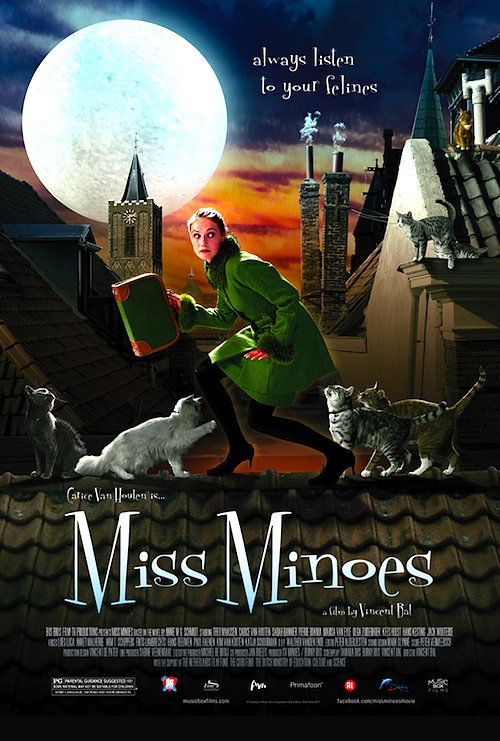
The Dutch Cat Woman: LFM Reviews Miss Minoes

By Joe Bendel. Do not call Miss Minoes catty. The proper term is feline. She should know what passes for political correctness amongst the cat population. She used to be one. Indeed, she has a difficult time acclimating to the human world in Vincent Bal’s Miss Minoes (trailer above), which opened Friday in New York.

After an unfortunate accident involving a mysterious barrel of chemicals from the local deodorant factory, Miss Minoes suddenly transforms into a human. However, she retains many of her feline characteristics, including a taste for fish, the fear of dogs, and an ability to caterwaul. Though some of her former friends now shun her, she can still communicate with the cats of Killendoorn, whom she uses as a network of informers for Tibbe, the incompetent journalist temporarily sheltering her. Naturally, newsmakers do not think twice about talking in front of cats. They are commonplace in this quaint little town and frankly rather disposable.

For a while, Tibbe becomes top dog at the paper. Unfortunately, when Miss Minoes and her feline associates goad him into writing an unsourced attack on the deodorant factory owner (a secret animal hater) he becomes the Mikael Blomkvist of Killendoorn. Still, a philanthropic industrialist will surely be no match for a woman with the mentality of a house cat and the eight year old girl living below Tibbe.

Without question, Carice van Houten’s work as Miss Minoes is quite a pleasant surprise. Her twitchy, cat-like mannerisms and wide-eyed naivety are rather disarmingly winning. Though an international star, she is clearly not afraid to look silly, which is cool. On the other hand, Theo Maassen’s Tibbe is just a big lunkhead. He might be somewhat “likable,” but it is hard to invest in a character that is dumber than the animals around him.

Yet the biggest problem with the film is the standard issue villain, Mr. Ellemeet of the DEO factory (broadly but flatly played by Pierre Bokma). Frankly, the nefarious businessman-slash-hypocritical fussbudget is such a cliché even the cats in the film seem bored with him. It really is a shame, because his subplots are so rote and uninspired, they weigh the film down like an albatross around its neck.

Indeed, there are some nice elements to be found in Miss Minoes, including an appealingly eccentric lead turn from van Houten. Cinematographer Walther Vanden Ende’s warm lighting and autumnal color palette are also quite inviting. They just get no help whatsoever from the inert, paint-by-numbers screenplay, based on Annie M.G. Schmidt’s Dutch children’s book. For cat loving little girls, it is probably still quite engaging, but parents should be warned, there is some mild, dubbed cursing. Cineastes should also beware, the dubbing is considerably below current anime standards. Mostly harmless and occasionally charming, despite trafficking in the worst class-based stereotypes, Miss Minoes opened Friday in New York at the Cinema Village and the Elinor Bunim Munroe Film Center.

Posted on December 27th, 2011 at 7:43pm.

The New Trailer for The Dictator; Film Debuts May 11th, 2012

By Jason Apuzzo. The first trailer is now out for Sacha Baron Cohen’s forthcoming comedy, The Dictator, and for the most part I like it. Cohen has obviously thrown political correctness out the window, and at first glance it looks like this film could be hilarious. Take a look, and judge for yourself …

Posted on December 14th, 2011 at 12:38pm.

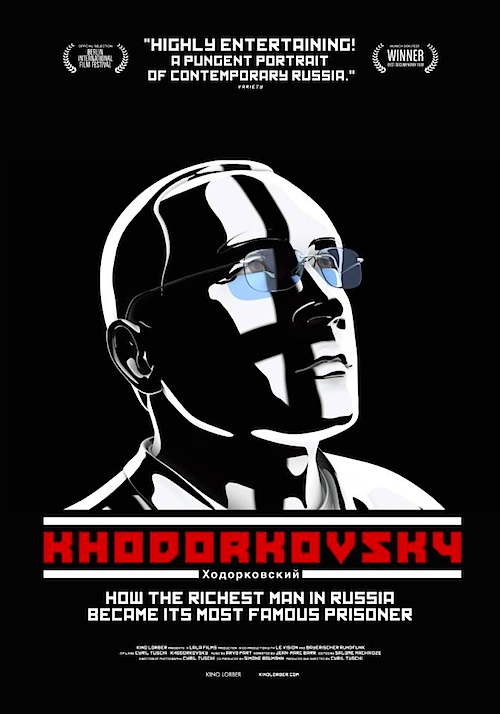
LFM Review: Khodorkovsky

[Editor’s Note: Cyril Tuschi’s Khodorkovsky is available free in its entirety at Vimeo.]

By Joe Bendel. Former German Chancellor Gerhard Schröder is now the chief lobbyist for Russian energy concerns. It may explain his less than vigorous interest in the political persecution of Mikhail Khodokorvsky, the chairman of the Yukos Oil Company and a leading bankroller of Russian opposition parties. It certainly helps explain how the Putin regime does business. Unfortunately, not even eight billion (with a “b”) dollars could protect Khodorkovsky from Kremlin persecution. German filmmaker Cyril Tuschi examines both the man and the dubious case brought against him in Khodorkovsky, which opens tonight in New York at Film Forum.

As any Russia watcher knows, Khodorkovsky is complicated individual. He was once an ardent Communist, which is how he was allowed to take control of Yukos during the fixed privatization process. He was not just an oligarch, he was the worst of the lot by any standard of open corporate governance. At this time, he enjoyed close relations with the Kremlin. Around the turn of the millennium, he radically changed the Yukos corporate culture, embracing openness and capitalism. He also started supporting democratic reformers. He is now serving a prison sentence in Siberia, as the result of what Schröder reportedly called “a thing between men.”

Though fascinating and not a little bit scary, this basic story is all well documented. However, Tuschi uncovers new (or criminally under-reported) information (particularly regarding the suspicious murder of a provincial mayor making trouble for Yukos) and scores legitimate interviews with Khodorkovsky himself, mostly conducted via letters but also hurriedly shot in between sessions of the Siberian kangaroo court. Aside from his subject, Tuschi also talks on camera to almost all of Khodorkovsky’s close associates not currently behind Russian bars, notably including his insightful early business advisor, Christian Michel, as well as a surprising number of Russian officials.

Tuschi’s German perspective hardly burnishes the former Chancellor’s image, but it gives the film an intriguing twist. He also includes dramatic black-and-white animated interludes that unmistakably evoke the Orwellian nature of the Khodorkovsky case. A classy package, Arvo Pärt’s fourth symphony, which he dedicated to Khodorkovsky, serves as the film’s soundtrack. Even Tuschi’s commentary is rather sharp. About all that is missing is a happy ending. Indeed, the documentarian had to know he was onto something when his laptop containing the film’s final edit was “mysteriously” stolen from his home.

Frankly, Tuschi’s documentary is timely beyond the prosecution of Khodorkovsky, reminding audiences wealth cannot provide a lasting defense against a government wielding unchecked power, as the case in neo-Soviet Russia. In fact, the circumstances of his imprisonment are so egregious, Milan Horáček, the German Green Party Human Rights delegate to the European Parliament, adopted his cause, stating unequivocally: “One can’t distinguish between human rights for the young, old, poor or rich.”

More documentaries should aspire to be like Khodorkovsky. Never smug or snarky, it is a bold, and sometimes artful film that truly challenges the powerful,  An important and engrossing work of big-screen journalism, it is highly recommended when it opens tonight (Wednesday, 11/30) in New York at Film Forum, with Tuschi scheduled to attend the 7:50 screening.

Posted on November 30th, 2011 at 11:42am.

LFM Review: Chico & Rita

By Joe Bendel. In the late 1940’s and early 1950’s, scores of Cuban musicians found success playing in American. Chico and Rita were two of them—almost. Their Afro-Cuban musical romance is told in Fernando Trueba, Javier Mariscal, and Tono Errando’s Chico & Rita, one of eighteen officially submitted films in best animated feature Oscar race and a 2011 European Film Awards nominee, which screened at this year’s African Diaspora International Film Festival.

Chico is a Bebop influenced piano player and something of ladies man. Rita is a stunning vocalist and all woman. During their first auspicious meeting, sparks fly and maybe a few faces are slapped. However, when Rita reluctantly sings Chico’s newest song in a radio competition, it is magical. Suddenly, Chico & Rita are the band to book. They also start to admit their mutual attraction, but circumstances keep getting in the way.

Before long, Rita is signed by an American producer, who whisks her away to New York. Chico eventually follows her, hoping to gain entree into the jazz scene through his old compatriot, Chano Pozo, whose tenure in Dizzy Gillespie’s band led to the creation of the so-called Cu-bop fusion of Bebop and Afro-Latin Jazz. Of course, those who are familiar with their jazz history know Pozo is not long for this Earth. Likewise, Chico & Rita’s rekindled romance appears equally ill-fated.

As the director of Calle 54, the best musical performance film frankly ever, Trueba’s participation inspires confidence and he does not disappoint.  C&R is an instant jazz classic, featuring infectious and sophisticated original music by Bebo Valdés, whose life sort-of-kind-of inspired Chico’s story. But wait, there’s more, including the classic music of Bud Powell, Dizzy Gillespie, Thelonius Monk, and Woody Herman’s Four Brothers band, performing Igor Stravinsky’s Ebony Concerto (which Chico sight-reads early in the film). Still not convinced? How about Freddy Cole performing one of Chico’s songs as his famous brother Nat, tenor saxophonist Jimmy Heath channeling Ben Webster, flamenco singer Estrella Morente appearing as herself, and a whole lot of Afro-Cuban percussion interspersed throughout the proceedings.

From "Chico & Rita."

Continue reading LFM Review: Chico & Rita