Back in the Family Business: LFM Reviews Friend 2: The Legacy

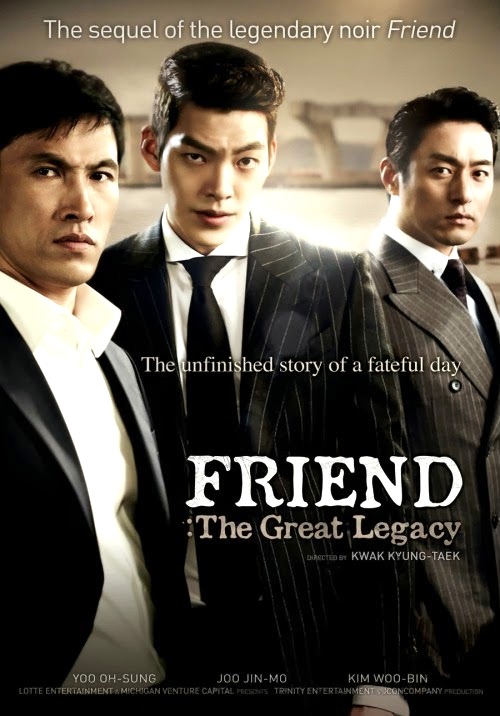
By Joe Bendel. Gangsters have a strong sense of history, probably because the past is constantly coming to bite them. Lee Joon-seok is a case in point. He will have all sorts of unfinished business on his hands after serving his seventeen year prison sentence in Kwak Kyung-taek’s Friend 2: the Legacy, which opens today in New York.

Lee is doing time for ordering the hit on a rival gang leader, who was once his childhood best friend. The turncoat was sort of asking for it, but it still bothers Lee from time to time. Shortly before his release, Lee is visited by a casual social acquaintance from his youth. Her son Choi Seong-hoon is a fellow prisoner, who has been marked for death after crossing Lee’s outfit. Much to his surprise, Lee extends his protection to the young thug, eventually taking him on as a protégé when they are both released.
They will be busy. Lee finds the syndicate his father first organized has been largely hijacked by Eun-gi, a cold-blooded boardroom gangster who exploited the vacuum left by Lee’s incarceration and the failing health of their Chairman. Obviously, Lee is not about to let this stand, even when a fairly obvious revelation threatens to undermine his relationship with the volatile Choi.

Friend 2 probably has four or five flashbacks too many, periodically revisiting not just Lee and Choi’s tumultuous backstories, but also giving viewers the highlights of the gang’s formative days under Lee’s enterprising father. The latter are almost superfluously tangential, but they are executed with a good deal of style and provide a lot of gangster genre goodies, so its worth going along with them, even if they confuse the narrative thread.

Regardless, Yoo Oh-seong is unquestionably Friend 2’s steely MVP. He is all hardnosed business as Lee, yet he still suggests hints of that troubled conscience buried somewhere deep within him. Kim Woo-bin is certainly convincingly erratic as Choi. Frankly, Friend 2 is not a great showcase for women’s roles, but the always reliable Jang Yeong-nam works wonders as Choi’s still attractive and resilient mother.

The gangster themes of family, loyalty, and betrayal are pretty standard stuff by now, but Friend 2 executes them with energy and conviction. The hits and brawls are always quite cinematic and the period scenes are nicely crafted. Propelled by Yoo’s serious-as-a-heart attack performance, Friend 2 is a solidly entertaining (if not exactly game-changing) crime epic, recommended for those who appreciate that specific genre and Korean cinema in general. It opens today (12/13) in New York at the AMC Empire.

LFM GRADE: B

Posted on December 13th, 2013 at 7:25pm.
Seven Brothers vs. The Khitan Army: LFM Reviews Saving General Yang; Now on Blu-ray/DVD

By Joe Bendel. The story of the Yang Family Generals and their noble sacrifices has been told on film before, including twice by the Shaw Brothers. Still, Ronny Yu and his co-screenwriters, Edmund Wong and Scarlett Liu, give it a fresh twist – and an English title obviously intended to evoke Spielberg’s post-D-Day blockbuster. They certainly have plenty of tragedy and bloody warfighting to work with. Death comes swiftly but the stain of dishonor is eternal in Yu’s Saving General Yang, which releases this week on DVD and Blu-ray from Well Go USA.

Nobody is more celebrated throughout the Song Dynasty for keeping the Khitan at bay than General Yang Ye. That also means he has made plenty of enemies, the fiercest being Yelü Yuan, the Khitan commander, who blames Yang for his father’s death in battle. However, Yang’s more politically astute rival Lord Pan poses a greater snake-in-the-grass danger. Despite Yang’s proven military leadership, the emperor appoints Pan as supreme commander of the Imperial Army, essentially demoting Yang to frontline general. He will regret that decision.

Of course, the first chance Pan gets, he retreats, leaving General Yang in the lurch. Rather than moving in for the kill, Yelü allows the wounded Yang to regroup on Wolf Mountain, fully expecting the Yang Brothers will try to rescue their besieged father. It is not just war for him, it is personal.

From "Saving General Yang."

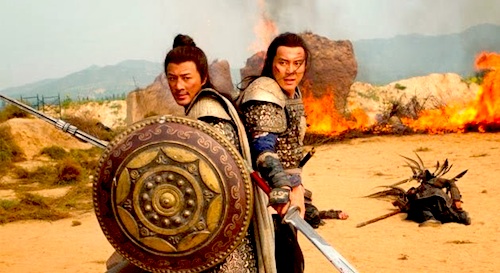
Obviously, the Yang clan is in for a lot of mourning, but at least the brothers die spectacular deaths. Yu and action Stephen Tung Wai know how to stage a battle scene, emphasizing brutal realism instead of super human heroics. These might be some of the roughest, least exaggerated action sequences you will see in a year of wuxia films. On the other hand, when it comes to romance, Saving largely punts. At the least we briefly meet Ady Ang as Princess Chai, who definitely seems like the sort of Imperial royalty you would consider taking home to meet your parents. (Unfortunately, both Yang and Pan have a son who had that same idea, which is how most of this trouble starts in the first place.)

As the titular general, veteran HK actor Adam Cheng is aces at projecting a commanding presence. Likewise, Young & Dangerous franchise alumnus Ekin Cheng is appropriately steely as the first Yang son, Yang Yanping. However, numbers two through seven are largely indistinguishable from each other. All we really know about Vic Chou’s Yang Sanlang (#3) is his prowess with bow-and-arrow, but frankly that’s good enough, considering his role in a massive third act archery duel with Yelü’s chief lieutenant.

Saving’s big battle set pieces are quite impressive, with set designer Kenneth Mak and cinematographer Chan Chi-ying crafting a first class period production with epic sweep and down-and-dirty grit. If you like hot-blooded war films circa 986 AD, this one delivers. Just don’t ask for any extraneous characterization or whatnot. Recommended as red meat for genre fans, especially those who appreciate the enduring story of the honorable Yangs, Saving General Yang is now available for home viewing from Well Go USA.

LFM GRADE: B

Posted on December 11th, 2013 at 1:05pm.

LFM’s Govindini Murty at The Huffington Post: Thirteen Years in the Making: Michèle Stephenson & Joe Brewster Talk About Their Film American Promise

[Editor’s Note: the post below appeared yesterday at The Huffington Post.]

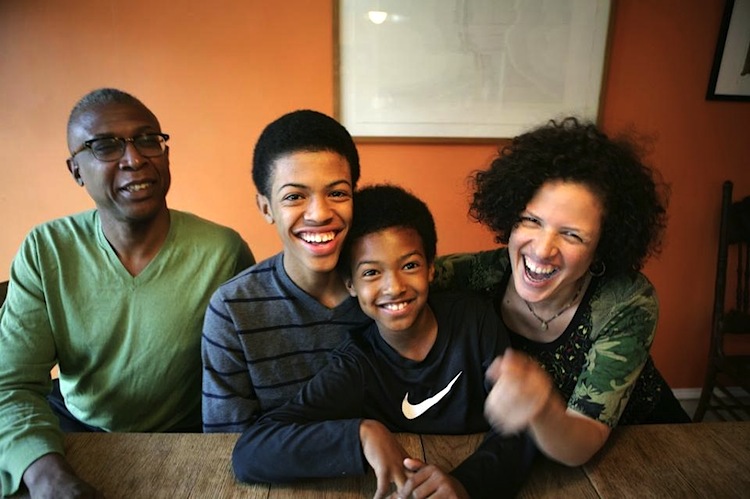
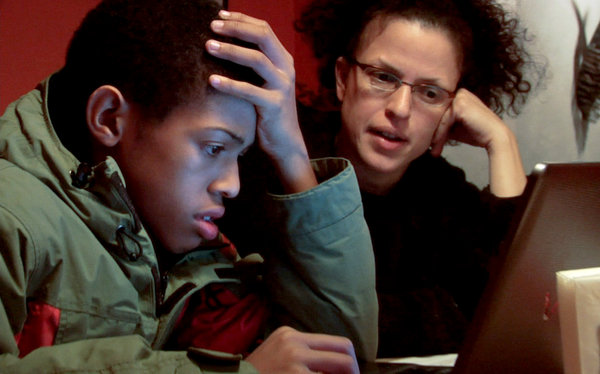
By Govindini Murty. One of the enduring hopes of the digital age is that technology can break down the barriers between peoples and races. Joe Brewster and Michèle Stephenson explore this idea first hand in their compelling new documentary American Promise. A film thirteen years in the making, American Promise follows two African-American boys (one of them Brewster and Stephenson’s own son) from first grade through high-school, showing the challenges and opportunities young black men face in today’s education system. Currently playing in select theaters nationwide, American Promise expands to additional cities this week and will air on PBS in February of 2014.

2013-12-08-americanpromisedoc.jpg
From "American Promise."

Winner of a Special Jury Prize at the 2013 Sundance Film Festival, American Promise follows Idris Brewster and his friend Seun Summers as they attend The Dalton School, an elite private school in Manhattan’s Upper East Side. Despite the high hopes of their parents and teachers that Idris and Seun will succeed as part of the school’s diversity program, the boys have trouble dealing with the pressures of their environment. In part this is because Idris and Seun have learning disorders that go undiagnosed for years, and in part it’s because neither boy feels at home in the predominantly WASP culture of Dalton. Ultimately, Idris and Seun must balance their needs for self-determination with the high expectations of their successful, hard-charging parents.

Ever since the pioneering anthropological documentaries of Robert Flaherty and Merian C. Cooper in the 1920s, and Albert and David Maysles ‘direct cinema’ documentaries of the ’60s and ’70s, the cinema has played a powerful role in collapsing the distinctions between peoples and creating a sense of empathy and common humanity.

Michael Apted’s acclaimed 7-Up documentaries took this idea a step further. An inspiration to Brewster and Stephenson, the series documented the lives of a group of fourteen English children at seven-year intervals, beginning in 1964 and continuing through today. The 7-Up series (the kind of project known in sociology as a ‘longitudinal study’) took advantage of the cinema’s ability to master time, using the movie camera as an all-seeing eye to examine human lives over the course of decades.

2013-12-08-IdrisandMicheleAMERICANPROMISE.jpg
From "American Promise."

The observational capabilities of the cinema have been further expanded by the digital revolution, with low-cost digital cameras making possible the kind of lengthy, first-person videography that comprises American Promise. A classic longitudinal study, American Promise draws on an impressive accumulation of thirteen years of footage to distill insights about families and children that otherwise would go unnoticed in the rush of day-to-day life.

As a result, American Promise elicits lessons that apply not just to African-American children, but to all children as they navigate the shoals of childhood and adolescence. As co-director Joe Brewster noted when we spoke at Sundance, “when people see the film, they get so immersed in the characters, these become their kids.”

The monumental size of the American Promise project required a special level of commitment from the filmmakers and their talented crew. As I chatted with American Promise’s editors and videographers at Sundance (in the photo below with Brewster & Stephenson), it became clear what a labor of love the film had been for them. Editors Erin Casper, Mary Manhardt, and Andrew Siwoff and cinematographers Errol Webber, Alfredo Alcantara, Margaret Byrne, and Jon Stuyvesant all deserve kudos for their work. Continue reading LFM’s Govindini Murty at The Huffington Post: Thirteen Years in the Making: Michèle Stephenson & Joe Brewster Talk About Their Film American Promise

LFM Reviews What’s in a Name

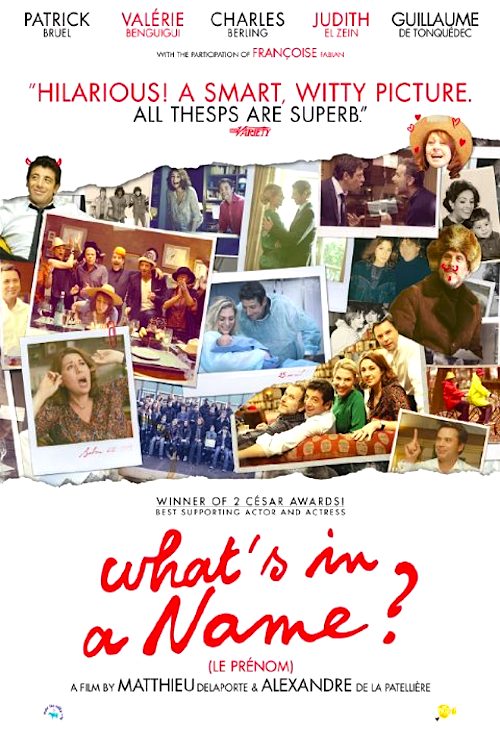
By Joe Bendel. It is a question Shakespeare and Asimov asked, in very different contexts. A group of family and friends will wrestle with it anew during the sort of dinner party you might find in the work of Yasmina Reza. In fact, the name game hysterics unleashed by an expectant father also have their roots on the French stage. After dominating the French box office, co-writer-co-directors Alexandre de La Patellière & Matthieu Delaporte’s screen adaptation of their play What’s in a Name now opens this Friday in New York.

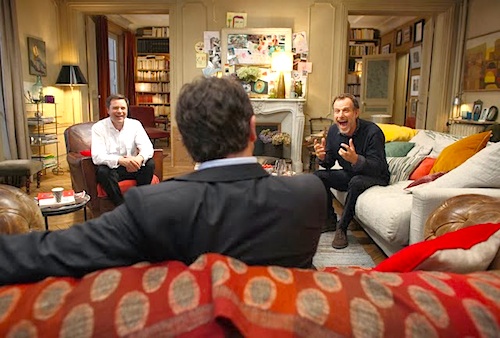
Even though it comes fairly early in the first act, you really have to hear for yourselves what Vincent Larchet plans to name his son. Everybody is rather stunned by the news, particularly his brother-in-law Pierre Garraud, a popular literature professor who wears a lot of corduroy. He might be the most vocal in his disapproval, but Larchet’s sister Elizabeth (a.k.a. “Babu”) and childhood chum Claude Gatignol are rather taken a back as well. Just as emotions start to settle, Larchet’s very pregnant yet still compulsively late wife Anna Caravatti arrives to kick things up again.

Arguably, Name really is a lot like Carnage, except it has considerably more warmth (which is admittedly an easy bar to clear). The initial round of bickering is wickedly funny, even though you have to wonder how any parent could propose doing that to their child. Of course, the heated argument duly dislodges other closely held secrets and resentments, making it quite a dramatic night.

If you like talky movies (in the best sense) than Name is where you want to be. Even in translated subtitles, de La Patellière & Delaporte’s dialogue is deliciously sharp and punchy. Featuring most of the original stage cast, the ensemble’s crisp delivery would pass muster with Howard Hawks and his stop-watch. There are also some rather politically incorrect moments, particularly with everyone’s assumptions regarding Gatignol, a suspiciously sensitive trombone player in the Radio France Orchestra.

From "What’s in a Name."

The Fab Five are all quite strong, but Patrick Bruel really puts his stamp on the film, displaying comedic chops American audiences probably will not expect from his excellent work in A Secret and O Jerusalem. Even though they all get their quirks, Charles Berring’s Garraud becomes what passes for an anchor of stability in this bedlam, yet the newcomer still has some fine moments losing his cool with Bruel. Frankly, Valérie Benguigui’s frumpy martyr act as Garraud-Larchet gets a bit tiresome, but Judith El Zein brings notable grit and verve to bear as the late-coming Caravatti.

Even though Name is essentially still a five character one set affair, de La Patellière & Delaporte open it up enough so it does not feel distractingly claustrophobic. It never drags either. Infused with attitude yet ultimately forgiving of all its characters’ shortcomings, What’s in a Name is smart entertainment, recommended for Francophiles and those who appreciate literate comedy when it opens this Friday (12/13) in New York at the Cinema Village.

LFM GRADE: B+

Posted on December 9th, 2013 at 12:48pm.

LFM Reviews Good Morning Karachi @ The South Asian International Film Festival

By Joe Bendel. Perhaps the only job Arif would allow his fiancée Rafina to take might be Prime Minister. He is an ardent supporter of the exiled Benazir Bhutto, because her party pays him to be. With little education or prospects, he clings to his chauvinism when Rafina finds unlikely success in the Pakistani fashion industry. Despite Bhutto’s example, Rafina will have to overcome constant opposition to pursue her modeling career in Sabiha Sumar’s Good Morning Karachi, the centerpiece selection of this year’s South Asian International Film Festival in New York.

The very notion of a Pakistani Models Inc. sounds like a healthy step in the right direction, but Sumar and her co-writers, Malia Scotch Marmo and Samhita Arni, are not exactly overflowing with optimism. Set in the days leading up to Bhutto’s assassination, Karachi will obviously intersect with tragedy sometime in the third act. However, it resists the temptation to completely intertwine the fate of its characters with that of real world figures. Arguably, Bhutto’s shadow is more of a reality check than a dramatic device.

Yearning for relative independence, Rafina convinces Rosie, a close friend of the family, to find her a spot with her employer: Radiance, an exclusive beauty salon operated by a modeling agency. Of course, Rafina will not have to labor long before her unspoiled beauty lands her in front of a camera. As it happens, she has the perfect look for a difficult client. Naturally, Arif feels betrayed by her success and Rafina’s mother worries about the sort of attention she might attract. She is not being unduly concerned, given the film starts in media res, as masses of Islamist protestors set fire to fashion billboards.

From "Good Morning Karachi."

As fashion model melodramas go, Karachi is a pretty good one, especially considering the general state of Pakistani society. Shrewdly, Sumar does not over-venerate Rafina’s virtues. She makes mistakes and sometimes passively accepts the easier but not necessarily best course of action. She is human and therefore has a right to live her life as she sees fit, which she rather steadfastly does her best to do. However, the film’s attitude towards Bhutto is much more ambivalent, clearly questioning why her administration did so little to improve the outlook for forward thinking women like Rafina.

As Rafina, Amna Ilyes commands the screen, conveying the runway ingénue’s naiveté, without coming across nauseatingly immature. Beo Raana Zafar also adds mountains of dignity as her beloved auntie Rosie. The rest of the cast is a bit spotty, with Yasir Aqueel perhaps being the spottiest as the flyweight Arif. Still, everybody earns some props for appearing in a film that seriously addresses gender issues in Pakistan.

Sumar’s aesthetic restraint and artistic honesty keeps Karachi on course and even keeled the whole way through, while cinematographer Claire Pijman works wonders wonders with Rafina’s lower middle class neighborhood, making it glow suggestively. Sure, to some extent you grade on a curve to encourage a film like this, but Karachi will keep just about any viewer focused on and invested in its business on-screen. Recommended for those interested in women’s issues and/or Middle Eastern-South Asian cinema, Good Morning Karachi screens this Friday (12/6) as the centerpiece of the 2013 SAIFF.

LFM GRADE: B

Posted on December 5th, 2013 at 8:23pm.

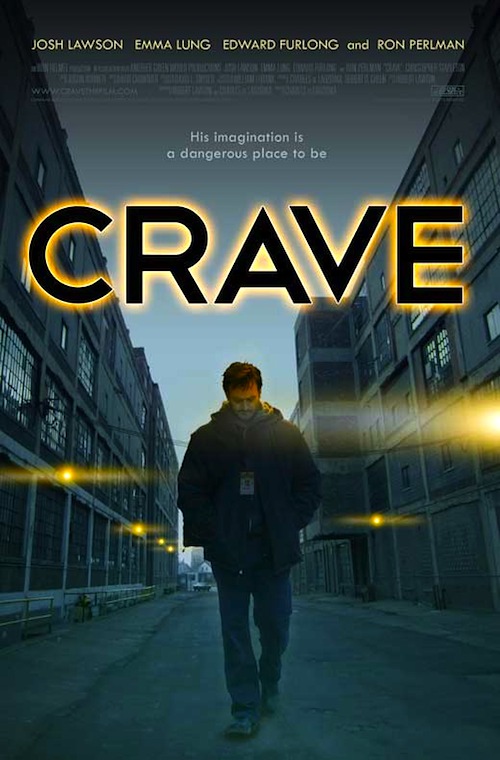
A Violent Imagination: LFM Reviews Crave

By Joe Bendel. This freelance crime photographer certainly lacks the endearing personality and slightly ribald history of the great Weegee (a.k.a. Arthur Fellig). He is also a bit challenged in the mental health department, as well. His violent fantasies threaten to erupt into his real life during Charles de Lauzirika’s Crave, which opens in select theaters later in the week.

Aiden is constantly thinking of what he might do to stand up the rampant crime around him, if he only had the guts. Typically, his fantasies involve some bloody form of payback, followed by an expression of appreciation from an attractive bystander. Photographing crime scenes has probably warped his perspective on humanity. At least he still has one friend: Pete, a cop and fellow AA member.

Against all odds, Aiden commences a halting romantic relationship with Virginia, the neighbor he has long carried a torch for. However, his extreme social awkwardness and simmering anger predictably pushes her away, just about the time he pockets a discarded hand gun from a crime scene. These developments will not have a positive effect on his general stability.

Few genre-ish films are as uncompromisingly gritty and pessimistic as the ill-titled Crave. Set in a pointedly crime-infested Detroit, things start out thoroughly crummy and head swiftly downhill from there. The Walter Mitty sequences are a bit cartoonish, but Lauzirika never stints on the gore. Yet, it is the mental implications for Aiden that are truly disturbing.

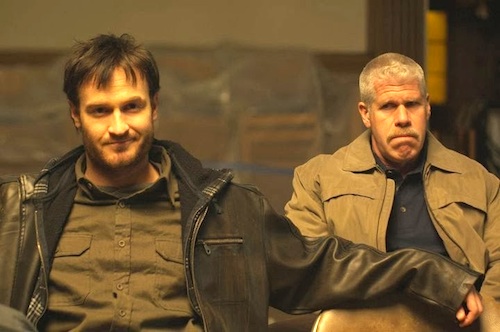
As problematic as Aiden undeniably is, Josh Lawson still manages to connect with audiences on a human level. Light years beyond nebbish, his self-defeating and delusional behavior is absolutely excruciating to behold. This is a hard film to watch, precisely because of acute embarrassment we frequently experience on his behalf. Still, Crave certainly makes you feel more than a month of quirky indies.

From "Crave."

Fortunately, the extreme pathos and lurking creepiness of Lawson’s work is occasionally leavened by Ron Perlman doing his thing as Pete. Holding his shtick in check, he wisecracks within reason, while giving the film a down-to-earth anchor. Emma Lung’s Virginia comes across as a rather bland, lightweight object for obsession (and her intuition is obviously substandard), but perhaps that is sort of the point.

Known for producing deluxe DVD boxed sets, Lauzirika won the AMD Next Wave Best Director Award at last year’s Fantastic Fest and one can see why. His approach is stylish, but he keeps the visual madness tightly under control. Despite Aiden’s tenuous connection to the world around him, ostensive reality is always easy to determine throughout the film.

Lauzirika maintains the courage of his convictions throughout Crave, which is impressive, but frankly it is easy to wish he had punked out a little bit. Not really a horror film or a vigilante thriller, but mindful of both cinematic traditions, Crave is a distinctive downer, recommended for those who looking for something bold. It screens this Thursday night (12/5) at the NoHo Laemmle in Los Angeles and opens in limited release on Friday (12/6),  also launching on VOD via iTunes the same day.

LFM GRADE: B-

Posted on December 5th, 2013 at 8:19pm.