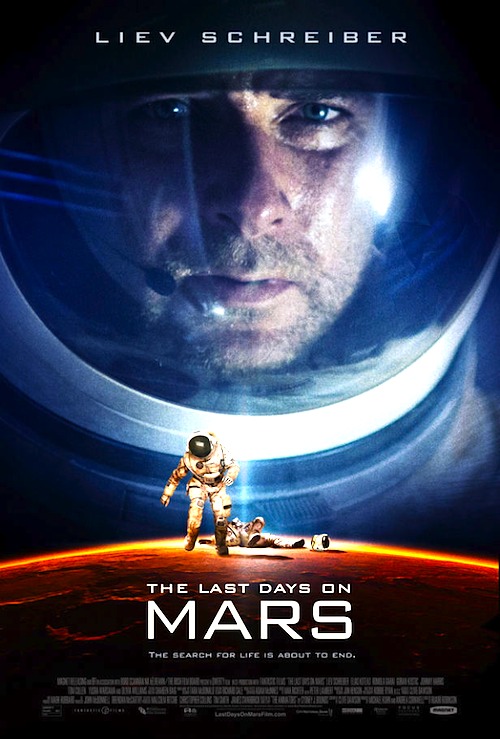
By Joe Bendel. They were gypped out of those long promised canals, but there might just be some form of bacterial life on the Angry Red Planet. Of course, that turns out to be a very bad thing in Ruairí Robinson’s The Last Days on Mars, which opens this Friday in New York.
The first manned mission to Mars is about to head home, destined more for footnote status rather than lasting fame. However, at the eleventh hour, the ambitious Marco Petrovich thinks he may have unearthed the brass ring—bacterial life. Unfortunately, a freak accident causes his death and leads to the apparent disappearance of another crew member. Yet much to everyone’s surprise, Petrovich and his colleague return to base a short time later. Of course, they are not really alive—they are undead and spreading their infection the way zombies do.
Hoping to hold out until the scheduled arrival of their transport ship, the crew of the Tantalus Base applies their scientific expertise to the contagion, but it turns out to be a distinctly slippery biological agent. Human nature also takes an ugly turn as the situation deteriorates.
Right, so first contact is kind of rough. Zombies on Mars might sound distinctly pulpy, but Robinson’s distinguished cast sells it with conviction. Liev Schreiber brings instant credibility as the grizzled but psychologically damaged chief engineer Vincent Campbell. Likewise, Romola Garai classes up the proceedings as his medic lover, Rebecca Lane. Johnny Harris (from BBC America’s The Fades) has a natural talent for getting all panicky and twitchy on-screen. Still, Olivia Williams overwhelms them all as the unrepentantly undiplomatic senior science officer, Kim Aldrich.
In a sense, Last Days is the more stylish and competent version of Roger Christian’s klutzy B-movie, Stranded. Both achieve an effectively claustrophobic vibe, but the former is a vastly more polished package overall. Cinematographer Robbie Ryan (probably best known for his work with Andrea Arnold) gives everything an appropriately dark, crimson-hued look, while production designer Jon Henson’s team creates a convincing near future, other worldly environment.
Last Day’s thematic predecessors are many in number and vary considerably in quality. Nevertheless, the combination of Mars, zombies, and some first class British character actors guarantees a certain level of genre entertainment. What screenwriter Clive Dawson’s adaptation of Sydney J. Bounds’ short story lacks in originality is largely made up for through Robinson’s slick execution. Recommended for its horror flavored science fiction (and vice versa), Last Days on Mars opens this Friday (12/6) in New York at the Landmark Sunshine.
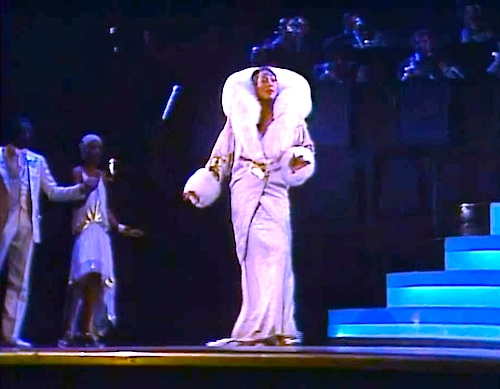
By Joe Bendel. Don’t call the Ellington Orchestra a ghost band. At least it wasn’t in the early 1980’s. The maestro would still recognize most of the members, especially the leader, his son Mercer. Though the Ellington patriarch had gone off to the great bandstand in the sky, the family business was still going strong, thanks to a Broadway show featuring Ellington’s most popular songs and the band, under Mercer’s direction. More of a revue than a musical per se, Sophisticated Ladies ran for 767 performances at the Lunt-Fontanne. Captured live, in performance in 1982, Ellington’s Sophisticated Ladies makes its big screen debut in all its restored and re-mastered glory, courtesy of SpectiCast, beginning today at participating theaters.
If there is one theater Sophisticated Ladies tries to evoke, it is the Cotton Club. Our first clue is probably the big neon sign hanging from the back of the stage that says, “Cotton Club.” However, the production conceived by choreographer Donald McKayle and directed for the stage by Michael Smuin is not pedantically faithful to the era or venue. Ellington’s final theme song, “Satin Girl,” duly finds its way into the program. Also conspicuously anachronistic is the multiracial company of hoofers who dance to Ellington’s classics together, which would have been a major no-no during the Cotton Club’s heyday—so some things really aren’t how they used to be.
On the other hand, the immortal appeal of Ellington’s swinging standards comes through loud and clear. Ladies actually starts with the “Sophisticated Gentlemen” performing a relatively minor piece of Ellingtonia, “I’ve Got to be a Rug Cutter,” but it sure is a handy vehicle for some tap pyrotechnics. Likewise, “Music is a Woman” has never been excessively covered, but it is a nice up-tempo introduction for Paula Kelly, who looks terrific in flapper fashions (some might also recognize her, or perhaps not, from her trailblazing appearance in Playboy).
In a related development, one of the Ladies’ few missteps is a Josephine Baker-esque “jungle” style rendition of “The Mooche” that is probably quite true to the show’s Cotton Club roots, but has not aged well. The band still sounds great on it, though. Terri Klausner then commences torching up the old chestnut “Hit Me with a Hot Note and Watch Me Bounce” something impressively fierce. Kelly, two gentleman admirers, and a red piano keep the sassiness cranked up to the max with a “Love You Madly/Perdido” medley. It is elegant, but also pretty darn hot.
Phyllis Hyman starts “It Don’t Mean a Thing” in an unusally diva-ish bag, but it segues into show-stopping tap showcase for the gents. The video crew really shines during these big dance numbers. Clearly, multiple cameras were involved, mostly captured the company in full Astaires, with a few close-ups of their flying feet thrown in for good measure. The jitterbuggers take over during “Cotton Tail” and they don’t skimp on the air-steps. The rendition of “Solitude” is a bit miasmic for jazz tastes, but Kelly cranks the energy level back up with a duet-medley of “Don’t Get Around Much/I Let a Song Go Out of My Heart.” Unfortunately, a killer “Drop Me Off in Harlem” is slightly marred by a dated Chinese caricature.
From "Sophisticated Ladies."
For hardcore Duke fans, “Diminuedo in Blue” leads into the intermission, but without the “Crescendo,” probably because nobody would want to try to replicate Paul Gonsalves’ epic solo. Oddly, there is nothing representing the Sacred Concerts, which seems like a lost opportunity, but so be it. Considered the star, Hyman specializes in ballads like “In a Sentimental Mood” that are all very nice, but Kelly steals the show out from under her with saucy twists on favorites like “I’m Beginning to See the Light.” There is also good reason why she is the featured dancer for the pseudo title song, “Sophisticated Lady.”
The choreography of McKayle and Smuin (with a tap assist from Henry LeTang) translates well to the screen. In fact, the dance sequences are distinguished by an exuberance that remains fresh and appealing thirty-some years later. The cats in the band sound great too, but they are mostly stuck behind a gauzy curtain for most of the show (at one point future Lincoln Center mainstay Joe Temperley can be positively id’ed, but few others get even fleeting face time). The current Broadway production After Midnight does a better job in this respect, featuring the Jazz @ Lincoln Center affiliated band clearly on-stage, even giving them their own front-and-center number. It is a great show, but if you cannot make it to New York, there is considerable crossover between the two productions’ choice of tunes, so keep an eye out for Ladies.
Indeed, there is both timelessness and nostalgia to be found in Sophisticated Ladies. Most of Ellington’s songs sound as vital today as they did in the 1930’s and a few outliers are nicely rehabilitated by the Sophisticated Ladies and Gentlemen. Yet, when the camera pans the audience, we see folks dressed to the nines for Broadway. The men are wearing suits at the least, with a fair smattering of tuxedoes out there. Those days are gone, but the music swings like it always did. Highly recommended for fans of Ellington and Broadway, Sophisticated Ladies will have limited screenings in select theaters nationwide, beginning December 4th until the 18th, depending on the schedules of participating locations—including today (12/4) at the Chelsea Cinemas in New York.
By Joe Bendel. Life is cheap in Pakistan. Toting a gun will not raise any eyebrows, but a camera will quickly attract suspicion. This grimly ironic reality provided the initial germ of inspiration for Hammad Khan’s defiantly outraged Anima State, which will have its world premiere at the 2013 South Asian International Film Festival.
His face is bandaged like the Invisible Man. Do not bother asking the Stranger’s name or backstory. What matters is that he is angry and armed. He is about to embark on a killing spree, but it will not raise much of a fuss. Unsatisfied with his mounting body count, he resolves to commit suicide if he can find a large enough audience. An anchor for a nakedly propagandistic news network is happy to oblige. However, the ostensive journalist’s leading questions about America, Britain, and India are not taking the opening interview where the Stranger wants it to go.
Perhaps none of that really happened. Maybe the Stranger was really the product of an unnamed filmmaker’s subconscious. While the cops were content to let his armed-and-dangerous alter ego walk about freely, they instinctively clamp down on someone apparently engaged in either art or journalism.
From "Anima State."
If you see an angrier film than Anima State this year, it certainly was not because Khan lacked conviction. Time and again, he calls out contemporary Pakistani culture for normalizing violence and misogyny. Frankly, the film inspires real world concerns, particularly for Malika Zafar, the bold actress playing the “Archetypes of Woman,” including a battered wife and a prostitute, whose sexual confidence causes the Stranger no end of angst.
There is no getting around Anima’s ragged edges, but there is power in its grunginess. Produced with the revenue generated by Khan’s relatively apolitical Slackistan (which was banned in Pakistan nonetheless), Anima represents independent filmmaking at its most independent. Khan has a lot to say about the nexus between the government and the media and how they scapegoat YouTube videos and the like. He clearly admonishes Pakistan to look inside rather than outside for the source of its woes, which is never a well received message.
The mere fact that Khan successfully followed through on the concept of Anima is a tribute to him and his cast and crew. If at times it is a bit confusing or overindulges in the surrealist vibe, then so be it. A bracing indictment of institutionalized intolerance, Anima State is a must-see for anyone concerned about the future of cinema in Pakistan and the wider Islamic world. Recommended for those who can handle its rough aesthetic and truth-telling essence, it premieres this Wednesday (12/4) at the SVA Theatre as part of this year’s SAIFF.
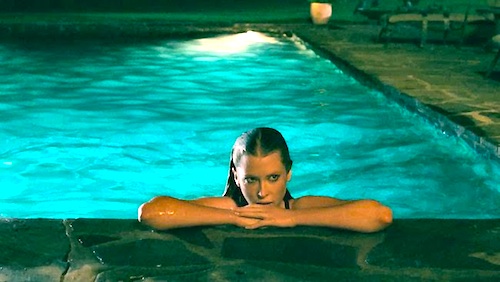
By Joe Bendel. The whole honesty thing does not seem to be working out for an Australian veteran driving cross country for a job interview. He tries to do the right thing with the briefcase full of cash he finds at the site of an accident, but the local cop is a bit on the dodgy side. It turns out he has issues, largely revolving around his wife Jina in Craig Lahiff’s Swerve, which opens this Friday in New York.
Jina will walk away from the crash unscathed, but the other party will be leaving feet first. Considering he had just pulled off his own murder-double cross, karma certainly came back around for the drug dealer quickly. However, it is a safe bet someone will come looking for the case of dirty money Colin, the innocent bystander, turns over to Frank, the local law, after driving the strangely composed Jina home. As a fellow veteran, Frank insists on putting Colin up at his place, which leads to the awkward realization that Jina is the copper’s wife.
Needless to say, it is not a happy marriage. Both husband and wife appear to be hatching schemes against each other that will start to involve the stash of cash in Frank’s jail cell. Colin will try to avoid getting entangled in their drama – but yeah right, good luck with that.
From "Swerve."
Anyone who has seen Body Heat or The Postman Always Rings Twice will have a pretty good idea what twists and turns lay ahead, except Lahiff’s screenplay is relatively demur by the standards of sexually charged thrillers. In fact, it is a modest film in many ways, seemingly mindful it has not reinvented any cinematic conventions. Yet, its thriller mechanics are pretty solid and all three sides of the central noir triangle have above average presence.
While the entire cast (even the smaller supporting figures) is well known in Australia, Jason Clarke will be the most recognizable to American audiences from Zero Dark Thirty. He does the swaggering small town crooked cop well, playing his problematic nature more in terms of erratic recklessness than outright evil. Emma Booth looks more like a girl next door than a femme fatale, but she vamps it up in style. Rounding out the trio, David Lyons makes a reasonably credible everyman and a refreshingly sympathetic on-screen portrayal of an Iraq War veteran (even if Clarke’s Frank is considerably less so).
As if in observance of film noir tradition, Swerve culminates on a night train headed out of town. Trains might not automatically come to mind when you think of Australia, but they have them. It’s a big country, after all. Regardless, Lahiff hits all of the chamber thriller bases, usually with a fair degree of authority. Swerve is the sort of film most viewers will say is “pretty good,” which is not bad at all, considering the rubbish that gets released. It could well have been acquired with the home viewing market in mind, which is exactly where it should have a long and prosperous life. Recommended accordingly (particularly for those who follow Australian cinema), Swerve opens this Friday (12/6) in New York at the AMC Loews Village 7.
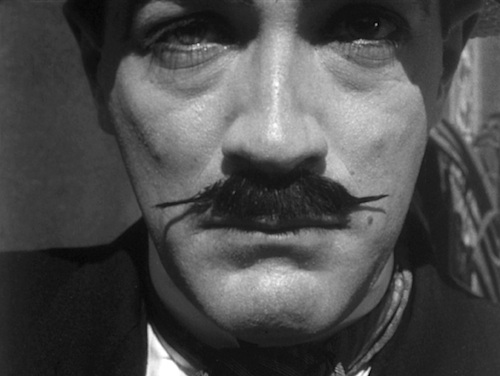
By Joe Bendel. It is not exactly the missing forty minutes of The Magnificent Ambersons, but for Orson Welles fans it is still quite significant. Long considered lost to the ages, the silent short films Welles conceived for an ahead-of-its time stage production have been found (in Italy, as it happens) and restored by the film preservation department of the George Eastman House. Despite their strange genesis, the shorts known collectively as Too Much Johnson perfectly represent the Welles filmography—they are brash, innovative, and unfinished. Always fascinating and sometimes genuinely entertaining, Too Much Johnson, Welles’ first stab at filmmaking,had its long awaited New York premiere last night, courtesy of the Eastman House.
William Gillette’s summer stock staple Too Much Johnson is not revived very often anymore—and the Mercury Theatre’s disastrous production probably deserves its share of the blame. It literally bombed in New Haven. Welles’ original vision was rather ground-breaking. Each act would be preceded by a short silent film in the Max Sennett tradition that would dramatize all the play’s exposition and backstories. Of course, Welles never finished any of the shorts (and it is unclear whether the Stony Creek Theater could have accommodated them anyway), but since he had cut all the presumably redundant background information from the text, the production reportedly baffled critics and patrons alike.
To help contemporary viewers, the Eastman House’s preservation and curatorial staff provided running commentary throughout the New York screening, in addition to the requisite piano accompaniment. Eastman House made no editorial decisions, preserving every frame that came in the can. As a result, there are plenty of gaps, as well as repetitive takes of the same scene. Yet, the finished restoration is a smoother audience experience than it might sound like. Serendipitously, the multiple versions are often madcap hi-jinks that when viewed continuously appear as if the characters are caught in a surreal loop.
From the Orson Welles-Mercury "Too Much Johnson" (1938).
The first act prelude is the most complete and easiest to follow. Joseph Cotten plays a man named Billings, who has been romancing another man’s wife under the assumed name of Johnson. Coming home earlier than expected, the betrayed Dathis chases the man he thinks is Johnson across the future Meatpacking District, eventually ending on the ocean liner that will take both men’s families to Cuba for a dubious vacation. (Once there, Billings looks up an old friend, only to find his plantation is now owned by a man who really is named Johnson. Hilarity no doubt ensues.)
Frankly, Cotten’s prowess for Harold Lloyd comedy is quite impressive. He shimmies across ledges and drags ladders over rooftops like a rubber-boned pro. As if that were not enough, the first short also delivers Welles’ ever indulgent producer, John Houseman, as a bumbling beat cop.
The second and third constituent shorts are much more fragmentary, but there are some striking day-for-night shots of a Hudson Valley quarry, decked out with palm trees to resemble Cuba. Periodically, one gets a glimmer of Welles’ developing eye for composition. Cotten also maintains his energetic good sportsmanship as the caddish anti-hero.
Johnson might be a bunch of odds and ends compared to Welles later masterpieces, but it is strangely compelling to watch the bedlam he unleashes with his co-conspirators. The Eastman program also includes a three minute 16mm film documenting Welles directing Johnson that seems about as chaotic as you would imagine. Yet, there is also something very poignant about the happy-go-lucky but incomplete work, prefiguring Welles later abortive attempts to produce his Don Quixote.
Too Much Johnson is enormously important as cinematic history but also a good deal of fun. The Eastman House intends to hold future screenings with live commentary, so cineastes should definitely keep an eye on their website. They also hope to stage Welles’ adaptation of the stage play incorporating excerpts of the shorts, which is impressively ambitious.
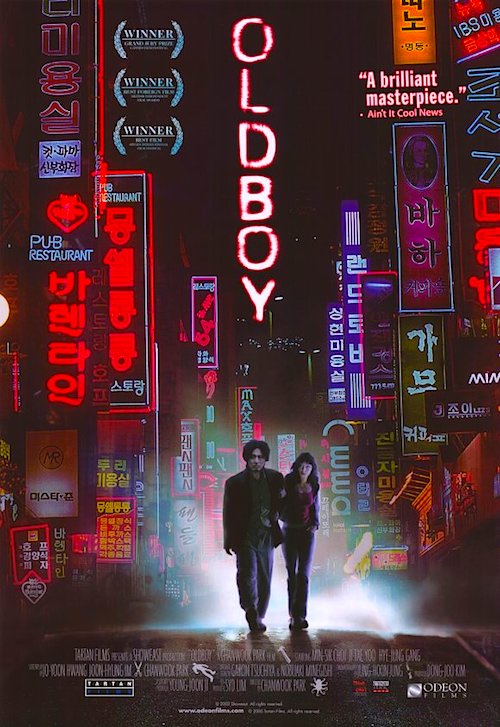
By Joe Bendel. As president of the jury at the 2004 Cannes Film Festival, Quentin Tarantino lobbied hard on behalf of Park Chan-wook’s Oldboy, but his fellow jurors were dead set on giving the Palme d’Or to Fahrenheit 9/11. You have to wonder how well that politically motivated decision sits with Kathleen Turner and Tilda Swinton, in retrospect. In contrast, Tarantino’s judgment looks sound as a pound, particularly in light of a once prominent director’s decision to remake Oldboy in a desperate attempt to maintain his relevancy. Viewers should accept no substitutes when Park’s original Oldboy returns to New York theaters today.
Oh Dae-sul is completely awful at being a husband, father, and businessman. Generally, he is an all around despicable human being, but he will pay. After a drunken bender, Oh wakes up confined to a seedy hotel room, which is actually a cell in an underground prison. For the next fifteen years, he will remain secretly confined there, while his nemesis frames him for the murder of his wife.
For no apparent reason, Oh is suddenly released, but it quickly becomes clear the shadowy mastermind has simply moved on to the next phase of his scheme. With his daughter adopted by foreign parents, the solitary pariah crashes with Mi-do, the young sushi chef in the restaurant he passed out in. As Oh pursues vengeance and answers, the question becomes “why” rather than “who.” Of course, he will be returning to that prison and he’s bringing a hammer (nope, Spike didn’t come up with that bit).
Arguably, Oldboy is the perfect film for Thanksgiving because it features one of the most memorable celebratory meals ever filmed. You’ll know it when you see it. Yes, it has its share of graphic violence and shocking subject matter that would be spoilery to reveal. However, the psychological torment is far more unsettling than the physical beatdowns. By the time it reaches its climax, Oldboy absolutely strips Oh emotionally bare—and he is not the only one to have his psyche ripped open in the process.
From "Oldboy."
Starting with Oldboy and continuing with Nameless Gangsterand New World, Choi Min-sik has staked a claim as one of the world’s preeminent screen actors, doing the sort of work Robert De Niro should have done instead of slumming in dozens of Meet the Parents sequels. Choi has that sort of magnetic presence and visceral physicality. Thanks to his powerhouse turn, Oldboy rises to the level of classical tragedy. He is nicely abetted by the ethereal Kang Hye-jung as the disarmingly waifish Mi-do.
Part noir and part fairy tale, Oldboy is defiantly ambiguous at times, but never nihilistic. It has an indescribable vibe light years removed from most filmmakers’ comfort zones. Remaking (or re-conceiving or whatever term they might want to use) it is a highly questionable proposition, doomed to failure whenever hipper audiences compare it to the original. Avoid shoddy counterfeits and check out Park Chan-wook’s Old Boy. Highly recommended for the adventurous, it opens today (11/29) in New York at the Quad Cinemas and streams (now with subtitles) on Netflix.
 Hoping to hold out until the scheduled arrival of their transport ship, the crew of the Tantalus Base applies their scientific expertise to the contagion, but it turns out to be a distinctly slippery biological agent. Human nature also takes an ugly turn as the situation deteriorates.