Don’t Hock What You Can’t Afford to Lose: LFM Reviews Pawn Shop Chronicles

By Joe Bendel. How did we get so pathetically starved for entertainment as a society that we made reality TV stars out of pawn shop dudes? At least this slightly macabre anthology film puts hock shops back in their properly sleazy place. Everyone doing business at the General Lee Pawn Shop will be getting the shaft, but it will be fate and human nature doing the dirty work in Wayne Kramer’s Pawn Shop Chronicles, which opened Friday in New York.

Alton and his crony Johnson sit about the store grunting and guffawing, pausing to deal with the occasional pawn. Each transaction will cause big time trouble and regret for the General Lee’s walk-ins, like Vernon the meth head, who hocks his shotgun right before meeting up with his white supremacist buddies, Raw Dog and Randy, to hold-up their dealer. Of course, they are rather disappointed in his short-sightedness.

On paper, “The Shotgun” sounds like a cheap bit of hicksploitation, but it features some of the wickedest dialogue in the film, which Paul Walker and Kevin Rankin chew on with proper relish. Gleefully embracing cartoonish violence and a bizarre redneck brand of tolerance, PSC arguably puts its strongest foot forward first.
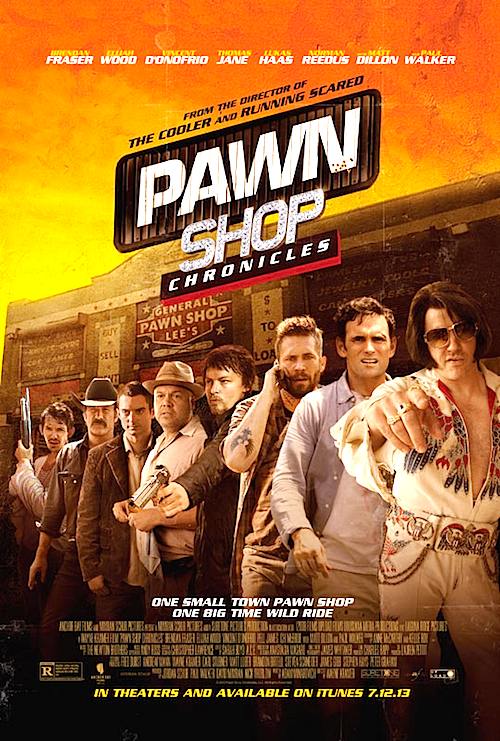
“The Ring” also has its exploitation merits, but viewers should be warned that it is the most explicit and disturbing installment of the film. Making amends for Crash, PSC’s pretentious evil twin, Matt Dillon plays a newlywed who chances into the General Lee, only to discover his presumably late first wife’s custom ring in the display case. Following the chain of wrongful ownership takes him into the lair of Johnny Shaw, the latest serial killer to be played by Elijah Wood.

Despite a sly riff on the crossroads legend, “The Medallion” is PSC’s weakest link. Seriously, a little bit of Brendan Fraser shticking up the joint as Ricky Baldoski, the low rent Elvis impersonator, goes a long, long way. Eventually, strands of the previous stories will transect this Faustian tale, but first viewers must sit through an extended gag involving the town’s rival barbershops that feels like it runs longer than The Winds of War.

Many have long awaited the film that features Wood, Lukas Haas, and DJ Qualls, but since they never appear here in the same scene together, we still cannot definitely say they are not one and the same person. Vincent D’Onofrio and Chi McBride are mildly amusing in the General Lee framing segments, but it is Walker, Rankin, and Dillon who are the film’s overachievers.

Much like a chaotic pawn shop, the inspired and the stupid comfortably sit side-by-side in PSC. To his credit, Kramer (in a radical departure from his excellent more-or-less feature debut, The Cooler) helms the madness with considerable energy and absolutely no shame. On balance, b-movie connoisseurs will enjoy checking it has appeared on VOD. It has also opened theatrically in New York at the AMC Empire and in Colorado at the AMC Westminster Promenade.

Posted on July 15th, 2013 at 9:32am.
Death By Webcomics: LFM Reviews Killer Toon

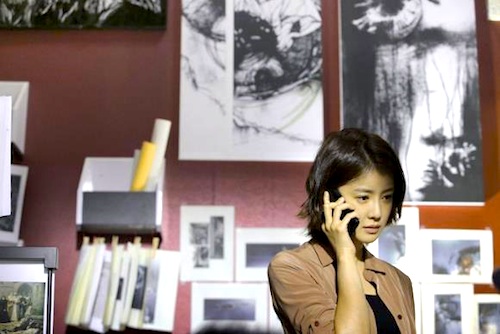
By Joe Bendel. Maybe those fuddy-duddies at the Comics Code Authority were not completely off-base regarding the corrupting influence of comic books. Take for instance Kang Ji-yoon’s webcomics. Her lurid depictions of supernatural vengeance are certainly popular, but they also seem to be coming true in real life. How exactly does she get her ideas? That will be the question in Kim Young-gyun’s Killer Toon, which opened Friday in Los Angeles at the CGV Cinemas.

Kang is not great when it comes to deadlines, so her editor Seo Mi-sook is initially quite relieved to finally receive her latest comic via e-mail. Then she starts reading it. Oddly, the first panels self-referentially depict her working late on the very same webcomic, but then flash back to her deepest, darkest secret. A malevolent presence starts terrorizing the understandably freaked out Seo, eventually forcing her to commit suicide, both in the comic and real life.

Responding to the call, Detective Lee Ki-cheol finds Seo’s body and the suspicious comic open on her computer. Having evidently never seen a horror movie before, he decides this could be a career making case. Logically, Kang becomes their prime suspect after she mysteriously arrives on the scene of another ostensive suicide foretold in her comics, at least until yet another interested party kidnaps her.

Like the E.C. Comics that obviously inspired it, everyone is guilty of something in Toon and therefore has it coming to some extent. Combining live action with liberal samples of Kang’s work presented in a motion comic style, Kim’s film clearly evokes Creepshow and Tales from the Crypt, but it takes the concept even further.

From "Killer Toon."

As a result, Toon looks very cool, but it has an unfortunate habit of contradicting itself. In fact, it seems compulsively driven to pull late inning switcheroos with the true nature of a primary character that simply become exhausting. Still, Kim consistently maintains the heavy atmosphere of portent, slickly transitioning between Kang’s comics and the film’s objective reality. The past clearly haunts the present, regardless of the exact nature of the machinations at work.

In probably his darkest role to date, musical theater veteran Um Ki-joon is surprisingly good as Det. Lee, an arrogant and ambitious man, but not a dumb flatfoot by any stretch. Likewise, popular rom-com movie star Lee Si-young is quite the convincing basket case as the gruesome graphic novelist. Kim Do-young’s ill-fated editor makes a memorable opening scene victim and Hyun Woo is also appropriately cold and clammy as Det. Lee’s twitchy junior.

Indeed, Toon boasts a strong ensemble and a darkly stylish look. Unfortunately, screenwriter Lee Sang-hak’s adaptation of Lee Hoo-kyung’s novel just doesn’t always add up. There are far too many “wait, why did …” moments. Still, for fans of horror movies and comics, there is some fun stuff to be found here, as well as some hardcore retribution to keep them on the straight-and-narrow. Recommended for genre enthusiasts who value visual flair over narrative logic, Killer Toon opened Friday in LA, at the CGV Cinemas.

LFM GRADE: B-

Posted on July 15th, 2013 at 9:31am.

LFM Reviews I’m Flash @ The 2013 Japan Cuts + The 2013 New York Asian Film Festival

From "I’m Flash."

By Joe Bendel. Rui Yoshino’s family heeded the advice of a certain science fiction novelist: they started their own religion. Perhaps ‘cult’ would be a more accurate term. Regardless, his telegenic looks have served the church well during his tenure as “Guru.” Unfortunately, scandal threatens to disrupt the family business in Toshiaki Toyoda’s I’m Flash, which screened as a co-presentation of this year’s Japan Cuts: the New York Festival of Contemporary Japanese Cinema and the New York Asian Film Festival.

The Guru has not been himself lately. Physically, he is fine. He walked away from the car crash that killed a motorcyclist and left his single young lady passenger in a coma. However, the incident has left its mark in other ways, as viewers will learn over time. To protect their frontman and their interests, the family sequesters the Guru in his tropical compound, recruiting three unnamed underworld types to serve as his bodyguards. Their services will indeed be needed.

A controversial figure in his own right, Toyoda bounced back from his unplanned filmmaking hiatus with two wildly idiosyncratic films. His hard-rocking period fantasy Blood of Rebirth is a redemption allegory of unusual power, which will reverberate in viewers’ heads, perhaps for all eternity.  His subsequent Monster’s Club, an austere invitation to sympathize with the devil, might have been more about exorcising some of his own tortured demons. Happily, I’m Flash is an eerie return to form and arguably Toyoda’s most accessible film since his “troubles.” In fact, I’m Flash often seems poised on the brink of a caustic noir portrait of corruption in the Chinatown tradition, yet it always remains slyly elusive.

From "I’m Flash."

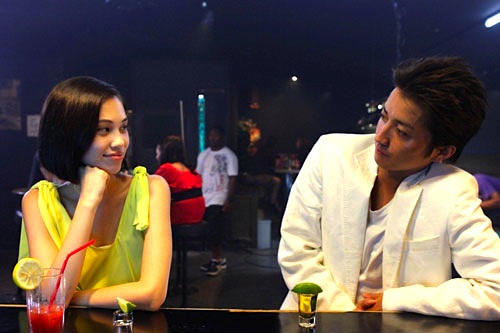
Death Notes Tatsuya Fujiwara nicely hints at the imp of perverse lurking inside the not-as-dumb-as-he-looks Guru and Ryuhei Matsuda sets off all the right alarms bells as the bodyguard who is not too young and impetuous or old and cantankerous, but just deadly right. Kiko Mizuhara also keeps viewers thoroughly off balance in her flashback sequences as the mystery woman. Still, everybody wilts when sharing the screen with Michiyo Ookusu as the Guru’s Machiavellian mother—have mercy.

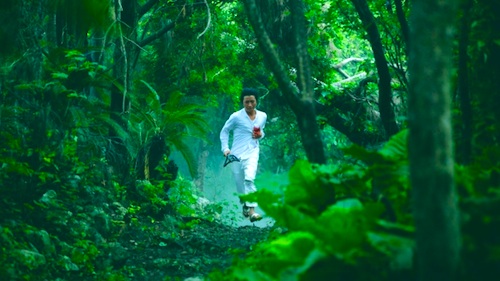
Like everything about Toyoda, I’m Flash is bound to be divisive. Those with a taste for intelligently challenging films will appreciate its genuine air of mystery. It is also a surprisingly handsome production, capitalizing on the evocative locale and subtly creepy set design, most notably the Guru’s villa, which looks as if it could grace the cover of both Architectural Digest and Cult Living.

Toyotarô Shigemori’s cinematography is also weirdly effective, in a way that is difficult to pin down. Over-used as a form of critical shorthand, the term “fever dream” does not really apply here. This is clearly our world, in broad daylight, but something still feels not quite right. Very highly recommended for the moderately adventurous, I’m Flash screened at the Japan Society on the opening night of this year’s Japan Cuts, in conjunction with the New York Asian Film Festival.

LFM GRADE: A

Posted on July 15th, 2013 at 9:30am.

LFM Reviews Beijing Blues @ The 2013 New York Asian Film Festival

By Joe Bendel. Fred Dryer would approve of this Beijing police detective named after his famous TV character. Brother Zhang Huiling (Hunter) is a broken-down, asthmatic copper, pursuing workaday crooks on Beijing’s bunco squad, but there is no denying his work ethic. After years of hard drinking and hard policing, Zhang encounters his personal Moriarty in Gao Qunshu’s Beijing Blues (trailer here), which screens today during the 2013 New York Asian Film Festival.

There is a lot of money on the streets of Beijing, but many of the flim-flam artists Brother Zhang’s team investigates prey on their fellow proletarian. Shot in a hand-held, on-the-fly docudrama style, Blues is initially rather episodic, capturing Brother Zhang on the job, stalking and eventually busting assorted counterfeit pushers, traffic accident scammers, and fortune-telling hucksters. However, the legendary con artist Gold-Digger Zhang has reportedly blown into town and dispatched his minions for an impending crime wave. A street level chess match ensues between the two old dogs.

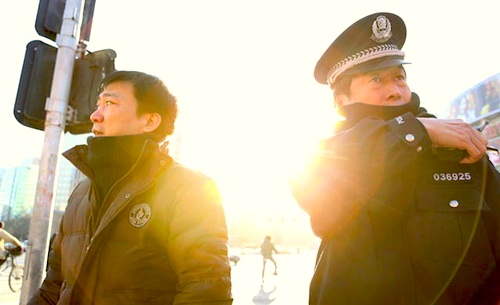
Having established his blockbuster credentials in recent years, Gao returns to the gritty aesthetic and unconventional casting of his kind of brilliant, NYAFF-selected Old Fish. Like the real life cop who played Fish’s protagonist, many of Beijing’s Finest appear in Blues, usually playing cops, logically enough. However, most of the cast were well known Chinese bloggers and social media figures, including former publisher Zhang Lixian, who is sensational as Brother Zhang. Zhang perfectly expresses his namesake’s world-weariness, as well as his steadfast commitment to principle, while still suggesting he is always an inch away from doing a full Howard Beale.

From "Beijing Blues."

Gao could have easily trimmed some of Brother Zhang’s plugging away from the repetitive mid-section, yet his character is always engaging. When Gao kicks it into gear, the tension truly mounts, but in subtly ironic ways. Much like Fish, Blues consistently defies cop movie conventions. While his earlier film presented a jaundiced view of the corrupt and ineffectual police bureaucracy, Blues lets Brother Zhang’s colleagues and superiors off the hook. Instead, contemporary Chinese go-go-don’t-get-involved society falls under Blues’ withering glance.

Who knew China’s micro-bloggers, street buskers, reality show contestants, and screenwriters were such good actors? From stem to stern, the entire ensemble appears true-to-life and completely believable in character. Led by Zhang’s richly textured lead performance, Beijing Blues delivers entertaining idiosyncrasies and unexpected depth. Highly recommended, it screens today (7/9) at the Walter Reade as part of this year’s New York Asian Film Festival.

LFM GRADE: B+

Posted on July 9th, 2013 at 12:13pm.

LFM Reviews The Last Supper @ The 2013 New York Asian Film Festival

From "The Last Supper."

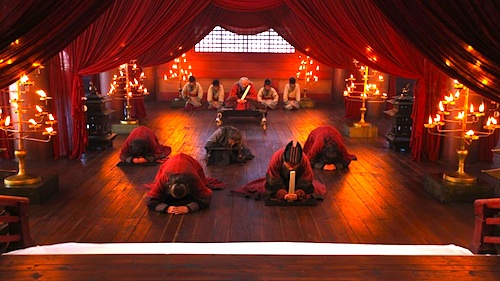
By Joe Bendel. The Biblical echoes are slightly misleading, but not wholly inappropriate. For those present, the notorious Hongmen Banquet is the betrayal that keeps on betraying. The murky events in question will continue to haunt the first Han Emperor until his final tormented moments in Lu Chuan’s The Last Supper (trailer here), which screens Wednesday during the 2013 New York Asian Film Festival.

Everyone realizes Emperor Gaozu, a.k.a. Liu Bang, is not long for this earth, including the common-born emperor from Pei County. However, he is not going out gracefully. Haunted by nightmares and visions of his past, Liu Bang sees conspiracies in every shadow. He ought to know. He reached the throne through some shrewdly timed treachery. Once sworn allies with Lord Yu and General Xin, he has killed the former and imprisoned the latter to solidify his hold on the throne.

Liu Bang has not exactly been scrupulously faithful to his wife, the Empress Lü Zhi, either. Regardless, she will act ruthlessly to protect his legacy. The empress decides it is time to be well rid of Xin once and for all, but his prominence and his highly placed friends in court provide him a slim measure of protection.

Frankly, we are quite fortunate to have Last Supper screening at NYAFF, considering its release was held up for four months by government censors. It is not hard to see what troubled the obedient apparatchiks. Even a bureaucrat could pick up on the film’s “absolute power corrupts absolutely” implications. This is the high tragedy of a man who gains an empire but loses his humanity (a point that also emerges, albeit somewhat less forcefully, in Daniel Lee’s White Vengeance, which also dramatizes the circumstances surrounding the Hongmen Banquet.)

From "The Last Supper."

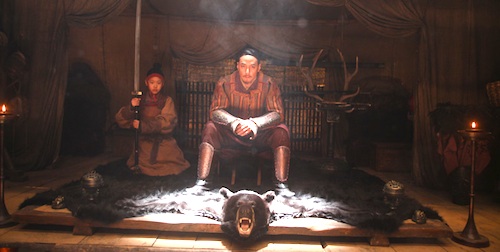
For Lu, this represents a dramatic change of pace from his stark portrayal of Japanese war crimes in City of Life and Death. Obviously less politically correct for the powers that be, Supper is further differentiated by a feverish atmosphere that often approaches the outright demonic. Yet, it is also a grand period production, with enough imposing sets and palace guard extras to satisfy Cecil B. DeMille.

Supper is also notable for the geographically diverse casting of the main triumvirate that surely ought to pay dividends at the respective box offices. Mainlander Liu Ye nicely portrays the raging paranoia of Liu Bang’s twilight years without descending to shtick or gimmicks. Hong Kong super-star Daniel Wu captures the nobility of the tragic Lord Yu, while Taiwanese Chang Chen is impressively steely as General Xin. Nonetheless, Qin Lan (Lu’s wife and frequent collaborator) dominates the film with her spellbinding Lady Macbeth-like portrayal of Lü Zhi.

The strangely timely Supper comes as a welcome rebuttal to Chinese films like Hero or The Guillotines that celebrate or at least excuse strong centralized authority. Lu’s vision of Liu Bang clearly suggests the emperor’s madness and absolute power are two sides of the same coin. In addition to its challenging subtext, The Last Supper also happens to be an excellent film, well worth seeing for its striking look and Qin Lan’s commanding performance. Highly recommended, it screens Wednesday afternoon (7/10) at the Walter Reade as part of this year’s New York Asian Film Festival.

LFM GRADE: A-

Posted on July 8th, 2013 at 1:08pm.

LFM Reviews When a Wolf Falls in Love with a Sheep @ The 2013 New York Asian Film Festival

By Joe Bendel. So far, American teens have largely been spared the joys of cram school. In Taiwan, they are a fact of life for those facing the highly competitive university entrance tests. It does not leave students much time for romance, but there just might be something cooking between two young back office workers. Modern love is decidedly confused in Hou Chi-jan’s When a Wolf Falls in Love with a Sheep, which screens Tuesday during the 2013 New York Asian Film Festival.

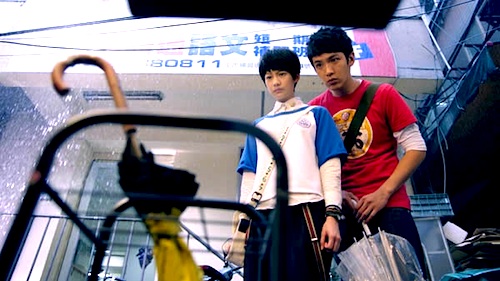
After leaving a “back soon” sticky note on his sleeping forehead, Tung’s girlfriend walked out of his life and has yet to return. Maybe it was because he dressed too much like “Where’s Waldo.” Emerging from a heartsick tailspin, the dopey kid takes a job at a copy shop in the Nanyang cram school district, because he can do the work on autopilot and live in the loft above the store. Making deliveries to the Bisheng School, Tung meets the cute but artistically frustrated Yang, who draws little sheep cartoons on the bottom of the school’s test papers. One day, he responds with his own big bad wolf character and a doodle flirtation starts to blossom, much to the amusement of the student body.

Wolf is compulsively sweet, but it has tons more style than your average rom-com. Hou integrates little animated vignettes of the sheep and wolf, as well as some completely fresh and original sight gags. It sometimes feels a bit prone to ADD, but Hou eventually loops every rangy subplot back into his main narrative quite cleverly. Despite its frothy tone, Wolf has some rather smart stuff to it, particularly in the manner it presents the pseudo-courtship between Tung and Yang. It is a two-tiered relationship, playful on paper but much more reserved in person, which really rings true.

From "When a Wolf Falls in Love with a Sheep."

As Tung, Kai Ko is appropriately sad-eyed and sensitive, while Chien Man-shu gives refreshing depth to the more philosophical Yang. Wolf is also loaded with colorful supporting players, most notably including Lin Ching-tai (the star of Warriors of the Rainbow: Seediq Bale), playing off his real life persona as a former Presbyterian minister with his turn as a priest moonlighting as a noodle-cart vendor, wisdom dispenser, and general jack-of-all-trades.

Energetic and winning, Wolf is the sort of rom-com where fate is not content to merely take a hand, but will go so far as to smack characters alongside the head and yell “go after her, you schmuck.” If that is manipulative at times, Hou nicely compensates with the originality of his execution. Highly recommended for anyone who appreciates a good date movie, When a Wolf Loves a Sheep screens Tuesday afternoon (7/9) at the Walter Reade Theater, as part of this year’s New York Asian Film Festival. Those who go should stay through the final credits for several reasons, including the attendance of director and festival special guest Hou Chi-jan.

LFM GRADE: A-

Posted on July 8th, 2013 at 1:08pm.