LFM Reviews An Inaccurate Memoir @ The 2013 New York Asian Film Festival

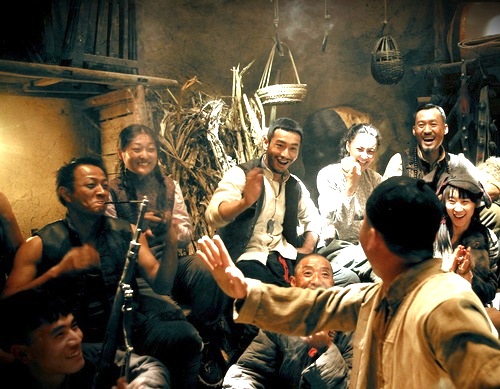
From "An Inaccurate Memoir."

By Joe Bendel. Bet you didn’t know Dodge City was once occupied by the Japanese. Evidently they took it from the Chinese, but one undercover freedom fighter is determined to take it back in Leon Yang Shu-peng’s An Inaccurate Memoir, which screened yesterday as part of the Well Go USA spotlight at the 2013 New York Asian Film Festival.

Ambushed by the Japanese, the wounded Gao Dong-liang lies low in Taiping, a Northern Chinese city that mostly consists of jails and brothels. After watching Fang You-wang’s gang break their ringleader out of prison with lickety-split efficiency, he starts hatching ideas. Masquerading as a tempting rich twit, Gao gets himself kidnapped by the Fang gang, subsequently insinuating himself into the gang, after they tire of beating and torturing his uncooperative hide.

Fang’s younger sister Jen takes a particular shine to him, which the outlaw is not exactly thrilled about. Aside from Gao, the gang is not keen to tangle with the Japanese, but the Imperial Army forces their hands when they raid the hideout. Suddenly Fang is down with Gao’s crazy plan, but he gives it a distinctly bandito spin.

Inaccurate Memoir has already been widely compared to Jiang Wen’s Let the Bullets Fly, but it is less shticky, with more Spaghetti western grit to it. Yang gets a bit bogged down with Gao’s first act abduction scenes, but once the soldier is part of the gang, Memoir settles down to business with commendable energy.

To its credit, the Fang Gang also boasts an unusually number of strong women members. Working as a “professional” in town, Lady Dagger is as dangerous as she sounds, while the quiet but violent Lassie follows in the beloved tradition of lethal school girls. However, the guys in the gang tend to blend together. (You can tell this will be a problem when the film feels compelled to use on-screen graphics to introduce them to viewers by name.)
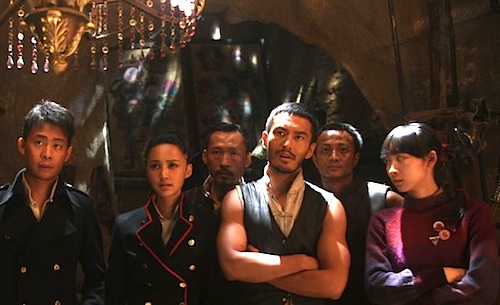
From "An Inaccurate Memoir."

Regardless, Yang, the self-taught crash-the-party filmmaker, blows stuff up quite nicely. Character development may not be his strong suit, but he helms some inventive action sequences and pays proper homage to the Seven Samurai/Magnificent Seven/Dirty Dozen tradition, in which a pack of scraggly ruffians ultimately embrace and one-by-one die for a righteous cause.

Huang Xiaoming certainly looks the part of roguish Fang, but Zhang Yi’s Gao is a more multi-faceted character. Still, Zhang Xinyi, Ni Jingyang, and Zhang Yue often steal the show as Jen, Lady Dagger, and Lassie.

Yang gets a big assist from his production and set designers, who created a richly appointed subterranean hideout. The film’s eccentric vibe helps soften the requisite Chinese nationalism and anti-Japanese sentiments. (However, the sheer volume of recent releases waving the bloody WWII shirt could lead to long term image problems for Chinese cinema in the international market place.) Shrewdly, Yang always keeps the mayhem entertaining. Recommended for fans of war movies with an eastern western sensibility, An Inaccurate Memoir screened yesterday afternoon (7/7) at the Walter Reade, as part of the Well Go USA spotlight at this year’s New York Asian Film Festival.

LFM GRADE: B-

Posted on July 8th, 2013 at 1:07pm.
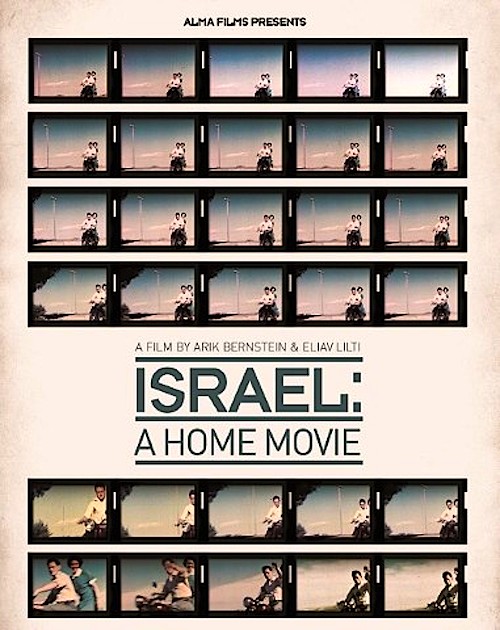
A Collage of History: LFM Reviews Israel: A Home Movie

By Joe Bendel. Technology has been a blessing to historians, resulting in an explosion of primary sources. This is particularly so in a country as small as Israel, where great historical events often intrude on personal day-to-day life. Assembling a collage of amateur video, director Eliav Lilti and project creator-producer Arik Bernstein create a fragmentary portrait of the Middle East’s only democracy in Israel: a Home Movie (clip here), which opens this Wednesday in New York at Film Forum.

Bernstein’s team is blessed with a wealth of source material, dating back to the 1930’s well before the formal establishment of the State of Israel. There are weddings, celebrations, and people just fooling around with their cameras. Yet the resulting footage serves as a time capsule of each era. In some cases, the informal videographers documented undeniable history as it happened. Easily the most dramatic example is the footage shot by beach partiers of Egyptian MiGs shot of the sky by pursuing Israeli fighter pilots after executing the sneak attack that launched the Yom Kippur War.

A film like Home Movies arguably says more about the editorial hand shaping it than those who originally shot the constituent videos. In this case, Bernstein and Lilti’s team clearly reflects the inclination of liberal humanism (broadly defined) to hold one’s self or one’s country to a higher standard than those who inveigh against us. It is a noble, forgiving instinct, but it is often misplaced. Time and again, the disembodied narrators bemoan Israel’s inability to make peace with the Arab populations, asking what they could have done differently.

From "Israel: A Home Movie."

In contrast, little attention is paid to the terrorism Israel has faced since her inception—just the occasional ghostly picture of a relative cut down before she reached thirty. Still, the rockstar treatment afforded to journalist Dan Shilon at a swinging 1970’s wedding after his uncompromising reporting on the murder of the Israeli Olympians is certainly a telling moment. Yet, the resilient hope that peace might finally follow each successive war is a refrain heard from Israelis throughout Home Movies, speaking volumes about the inherent difference in values held by Israel and its haters.

Indeed, Home Movies is a deliberate and knowing exercise in subjectivity, in which truth seeps in through the conspicuous margins. It should therefore neither be the first nor the last word on the Israeli experience. (Viewers looking for a quick primer should check out the lucid and comprehensive The Case for Israel featuring Prof. Alan Dershowitz.)

There are many striking (though grainy) images and several intriguing anecdotes in Home Movies. Where else will you see such candid footage of Moshe Dayan (courtesy of his son)? Nonetheless, it is important to understand that it is a product of an Israeli film establishment not so very different from our own. Recommended for history buffs, but with reservations, Israel: a Home Movie opens this Wednesday (7/10) at New York’s Film Forum.

LFM GRADE: B-/C+

Posted on July 8th, 2013 at 1:05pm.

LFM Reviews AninA @ Lincoln Center’s 2013 Latinbeat

By Joe Bendel. It seems like everybody picks on Anina Yatay Salas. She’s a kid, you see. She’s a good kid though, who will be getting the sort of lessons that will make her a good grown-up in Alfredo Soderguit’s animated feature, AninA (trailer here), which screens this weekend during the Film Society of Lincoln Center’s 2013 Latinbeat.

The Spanish word for palindrome is capicúa, a fact young Anina knows only too well. She has three of them in her name, which she finds rather excessive. Her Ned Flanders-ish father thought it was delightful, but the bratty kids at school delight in taunting her with the word “capicúa.” Still, she has good friends, like Florencia, but certainly not Yisel. During one fateful recess, an innocent stumble leads to a playground dust-up and a mutual trip to the principal’s office. As punishment, both she and Yisel receive mysterious sealed envelopes only to be opened in the principal’s presence, the following week.

Obsessing over her scarlet envelope, Anina and Florencia start following Yisel, in hopes of sneaking a peek inside hers. However, to her considerable surprise, Anina starts sharing strange bonding moments with her nemesis at school, stemming from their gossip-spawning punishment.

From "Anina."

AninA is a wonderfully innocent and endearing film with absolutely no objectionable material whatsoever. Adults will probably have a good idea of where it is headed, but they will approve every step of the way. Adapting Sergio López Suárez’s book for young readers (which he illustrated), Soderguit maintains a similarly gentle style. His simple figures are rather soothing, evoking nostalgia for the old fashioned children’s books of eras gone by.

There are thoughtful bits of adolescent experience throughout AninA, but it is the title character (sensitively voiced by Federica Lacaño) that makes it such a winner. Boys of a certain age and immaturity level might grow restless during the film, but girls and adults of all varieties will find it completely charming. Recommended with enthusiasm, AninA screens this coming Saturday (7/13) and Sunday (7/14) afternoons at the Beale Theatre, as part of Latinbeat ’13.

LFM GRADE: A-

Posted on July 8th, 2013 at 1:04pm.

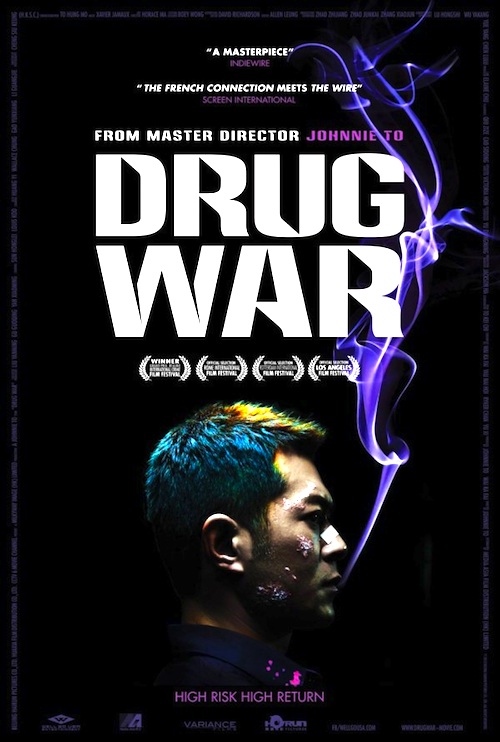
LFM Reviews Drug War @ The 2013 New York Asian Film Festival

By Joe Bendel. Divide-and-conquer and playing one opponent against another might sound like shrewd Art of War strategies, but they can land you in the midst a crossfire. Frankly, there is no safe place to be in Johnnie To’s Drug War. The HK action auteur’s lean, mean return to form screens today at the 2013 New York Asian Film Festival just ahead of its July 26th New York opening, courtesy of Well Go USA, the intrepid distributor getting a special shout-out at this year’s festival with their own special programming spotlight.

“I’m a cop—I didn’t betray you, I busted you.” Captain Zhang Lei’s choice words for the somewhat disappointed drug courier he just collared will echo throughout To’s first gangster throwdown set and co-produced in Mainland China. Zhang also reeled in a bigger fish: Timmy Choi, a meth lab proprietor and trusted liaison between various criminal factions.

Facing the death penalty, Choi agrees to play ball with Zhang. He will introduce Zhang to Brother Haha, a distribution kingpin looking for product and the representative of a shadowy supply consortium. At each meeting, Zhang pretends to be the opposite gangster, in hopes of taking down both operations simultaneously. He is not absolutely, positively sure he can trust Choi, but it is too good an opportunity to pass up.

Unusually gritty compared to the operatic Vengeance and Exiled, the first two acts of Drug War are essentially street-level procedurals, but darn good ones. To shows us the nuts and bolts of the Tianjin drug squad at work, as well as the extreme lengths Zhang will go to take down his targets. However, when it is finally go time, Drug War erupts into cold, hard, violent bedlam.

As Zhang, Sun Honglei is the absolute essence of hard-nosed steeliness. Initially, it is rather jarring to hear him giggling in the guise of Haha, put he pulls that off too. Likewise, Louis Koo will make viewers forget all about his recent leading man rom-com roles in his coldest, weasliest performance in years, even if he was dubbed for Mandarin speaking audiences. His Choi is truly a survivor, like a cockroach.

To fans will also being relieved to hear Lam Suet eventually turns up, as a criminal mastermind, no less. Aside from a bit of comic relief here and there, the soldier-like supporting cast sets the right tone, particularly the glammed-down, nonsense Crystal Huang as Zhang’s colleague, Yang Xiabei.

The massively cool Drug War does not just pack a punch. It is more like a body slam. Critics and fans were concerned whether To’s hardboiled brand of crime drama would fly in China, but somehow he slipped this pitch black gem past the Party goalie. A case of a master filmmaker and an all-star cast working at the tops of their respective games, Drug War is very highly recommended for action and gangster movie enthusiasts. It screens today (7/5) at the Walter Reade Theater as part of this year’s NYAFF and opens its regular IFC Center engagement for the Fest feted Well Go USA on Friday the 26th.

LFM GRADE: A

Posted on July 5th, 2013 at 2:35pm.

LFM Reviews The Last Tycoon @ The 2013 New York Asian Film Festival

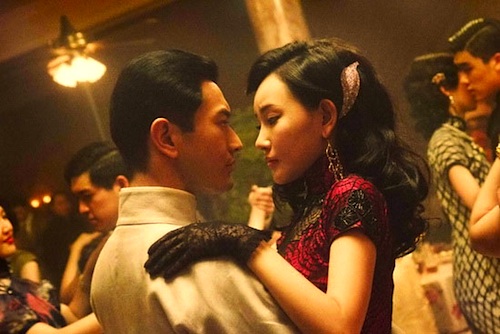
By Joe Bendel. There are explosions, talk of independence, and a villain named Mao. What more could you ask for in a Fourth of July screening?  Shanghai’s most prominent gangster and his two very different mentors will choose up sides amid the turmoil of Republican era China in Wong Jing’s The Last Tycoon, which screens today during the 2013 New York Asian Film Festival.

Cheng Daqi is very loosely based on the real life historical figure, Du Yuesheng, a high-ranking Shanghai mobster, who supported the Nationalists out of anti-Communist and anti-Japanese sentiments. As a young man, Cheng always intended to make a name for himself in the big city, but a scrape with a corrupt cop forced his hand. It also introduced him to his temporary cellmate, Mao Zai, an army officer serving as an unofficial liaison to the underworld. When Mao’s men spring them from prison, Cheng follows them to Shanghai.

Cheng quickly rises through the ranks, apprenticing under the top gangster, Hong Shouting. However, he still remembers his great love, Ye Zhiqui. She has also fulfilled her ambition to become the toast of Beijing’s opera, eventually marrying Cheng Zhaimei, a scholar and clandestine operative in the revolutionary underground. Of all the nightclubs in Shanghai, Ye and her husband walk into Cheng Daqi’s, because it is the biggest and most ostentatious.

From "The Last Tycoon."

There are echoes of Casablanca throughout Tycoon, but Wong never slavishly parallels the Bogart classic. He also departs considerably from the established facts of Du’s life. However, he clearly plays to the strengths of his star, Chow Yun-fat, giving him plenty of opportunity to blast away two-handed while dressed to the nines. Although The Assassins was pretty good, Tycoon is really the sort of film his fans have been waiting years for.

Chow does his stone cold cool thing and it still works like a charm. Sammo Hung also brings all kinds of gravitas and good karma as his patriotic master, Hong. Clearly enjoying the heavy role, Francis Ng is charismatically villainous as the turncoat Mao Zai (not Zedong, but close enough for the 4th). While his Mao is not exactly analogous to Claude Rains’ Captain Renault, Monica Mok really throws a wrench in the Casablanca works as Cheng Daqi’s wife, Bao. Sensitive but strong and resilient, she rather walks away with the audience’s sympathies.

Produced by special festival guest Andrew Lau, Tycoon is the sort of sprawling gangster/war epic that HK cinema does so well. It is a quality period production, boasting quite a few get-your-money’s-worth action sequences. Sure to satisfy fans of the all-star cast and of martial arts shoot-outs, The Last Tycoon screened last night (7/4) at the Walter Reade Theater, as part of the 2013 New York Asian Film Festival.  Happy 4th of July.

LFM GRADE: B+

Posted on July 5th, 2013 at 2:34pm.

LFM Reviews Comrade Kim Goes Flying @ The 2013 New York Asian Film Festival

By Joe Bendel. The North Korean film authorities must love training montages. You will find conspicuous examples in Pak Chong-song’s Centre Forward as well as this strange new North Korean-European co-production. Granted, that is not a very large sampling, but it is not like there is room for much aesthetic diversity with the powers-that-be. The production values have improved, but the dialogue is as stilted as ever in Kim Gwang-hun, Nicholas Bonner, and Anja Daelemans’ Comrade Kim Goes Flying, which screens today during the 2013 New York Asian Film Festival.

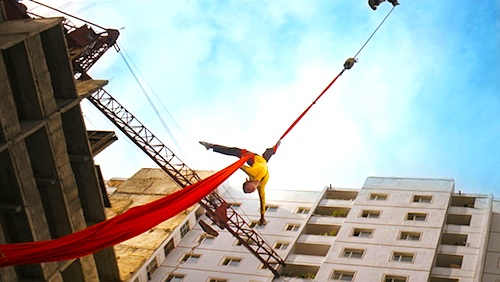
Viewers will quickly realize Flying is a fantasy because characters constantly sit down to big traditional meals. In between smashing daily production quotas, coalminer Kim Yong-mi dreams of being an acrobat in the Pyongyang Circus. Her gruff father sounds a little like Casey Kasem, telling her to “keep her feet on the ground and her head out of the clouds.” However, when Comrade Kim is temporarily transferred to the Pyongyang construction brigade, she jumps at a chance to audition for the Circus School.

Unfortunately, the circus elites do not appreciate her raw talent and enthusiasm. Initially deflated, her spirit rebounds when Commander Sok Gun, the kindly foreman, enlists her to train a troupe of construction worker-acrobats. Witnessing the salt-of-the-earth workers’ performance, Pak Jang-phil, the stuck-up trapeze strongman, realizes how much he and the circus need her. When she finally gets her shot, will Comrade Kim be able to endure the rigorous training and make the final cut?

Obviously, Flying is an odd film, particularly given the open portrayal of class conflict between the scrappy workers and the snobby circus performers. You might have thought the DPRK was a unified workers’ paradise, but evidently not. In that case, just what have the Great Leader, the Dear Leader, and the Great Successor been doing all this time?

On the plus side, Flying is a much more polished film than Centre Forward. Hwang Jin-sok’s candy-colored cinematography is rather appealing and the battery of co-directors keeps the action moving along quite spritely. The brief animated sequences, adapted from old school North Korean socialist realist wood-cuts (of which co-director Bonner is considered the world’s leading collector) are also quite striking. Nevertheless, the propaganda-laden dialogue, brimming with worker solidarity rhetoric and praise for the Party, just clunks along like an old jalopy.

From "Comrade Kim Goes Flying."

Having recently reviewed Marc Wiese’s harrowing Camp 14—Total Control Zone, one hesitates to single out any of the cast for praise, in the fear it might somehow be used against them. After all, any bourgeoisie association can be lethal in the DPRK police state. In general terms, many of the cast members are veterans of the Pyongyang Circus, who have real credibility in their acrobatic scenes and transition fairly well into dramatic acting. Those who really must be charming for the film to work are indeed quite winning and attractive. One of several cast and crew members officially designated a “People’s Artist,” Ri Yong-ho is a particularly strong and engaging presence as the sensitive hardhat, Sok Gun.

Evidently, women’s stories are largely under-represented in North Korean cinema, so Comrade Kim can be considered progressive on that front. It is always nice to see an underdog triumph over adversity, especially when it is rendered with energy and bright colors.

Indeed, it is good for North Korea watchers to get a gander at the film, like old Kremlinologists leafing through an issue of Soviet Life. However, presenting it without a reality check is a tad problematic. In contrast, the 2011 Korean American Film Festival offered a more robust and informed picture of the notoriously closed country by programming Centre Forward on a double bill with Mads Brügger’s mind-blowing comedic expose Red ChapelComrade Kim Goes Flying boasts a fresh-faced, highly likable cast, but the didactic script often undermines their efforts. Recommended for curious audiences experienced in parsing propaganda, it screens this afternoon (7/5) at the Walter Reade, as part of this year’s NYAFF.

Posted on July 5th, 2013 at 2:34pm.