Killer Fridge: LFM Reviews The Fridge @ The 2013 New York Asian Film Festival

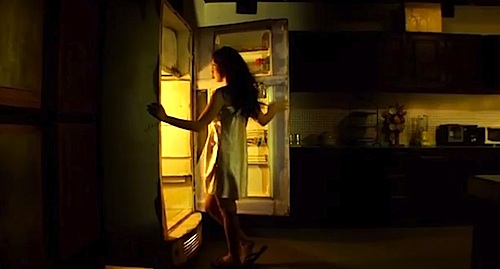
From "The Fridge."

By Joe Bendel. Somebody get this woman a box of industrial strength Arm & Hammer. She just can’t get that musty malevolent spirit out of her refrigerator. Yes, she has a demonic appliance. Evil takes many forms, so just go with it when Rico Maria Ilarde’s The Fridge screens tonight during the 2013 New York Asian Film Festival.

After years in America, Tina has returned to her old family home in the Philippines, hoping to discover what happened to her parents. Nobody wants to talk about it, so it must have been awful. The house looks spooky from the street, but it is pretty cozy on the inside, aside from that hulking, ugly-looking refrigerator. Turns out the appliance has an attitude to match.

Trying to start a new life, Tina crosses paths with James, an old torch-carrying elementary school friend at the grocery store, and she asks the electrician to come check out her buggy wiring shortly thereafter. If that sounds like a way too convenient coincidence, bear in mind this is a film about a killer refrigerator. Your pedantry is neither useful nor welcome here.

Of course, the fridge with its supernatural tentacles (sort of a cross between Audrey II in Little Shop of Horrors and Cthulhu) starts racking up a respectable body count, in spectacularly bloody fashion. However, most of its victims sort of have it coming, E.C. Comics style. (Maybe not the neighbor’s cat, but it was disposable anyway.)

One of the crazier things about Fridge is its horror movie mechanics are way better than one would expect. Sure, on some level it is cognizant how ludicrous the story truly is. Nonetheless, Ilarde sets the mood nicely and Andi Eigenmann and JM de Guzman play it scrupulously straight as Tina and James. Never winking at the camera, they act like it is pretty dreadful to have a possessed refrigerator in your kitchen, as it most certainly would be.
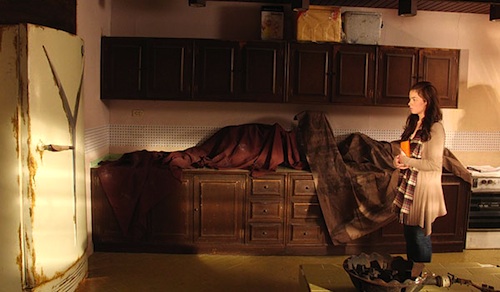
From "The Fridge."

But wait, there’s more—two of the country’s top actors lend their prestige to the picture. Joel Torre soldiers through like a good sport as Tina’s long suffering father and Ronnie Lazaro delivers a stiff shot of badassery as retired Det. Albay, styling an eye-patch and a triple-barreled shotgun.

Seriously, how can you go wrong with a killer refrigerator movie? Executed with earnest confidence, this one will likely exceed audience expectations by a healthy margin. While there is clearly a generous element of camp to it, Fridge holds together surprisingly well. Horror movie fans really have to check it out when it screens tonight (7/5) at the Beale Theater and Wednesday afternoon (7/10) at the Walter Reade as part of this year’s New York Asian Film Festival.

LFM GRADE: B

Posted on July 5th, 2013 at 2:33pm.

More Found Footage of a Cabin in the Woods: LFM Reviews Absence

By Joe Bendel. It is always weird to watch horror movies that kind of, sort of carry pro-life implications. After all, it is never the “fetus” terrorized pregnant mothers worry about, but their “baby.” Poor Liz has already lost her daughter and it wasn’t the dingos that took her. Somehow her seven month old baby just vanished from within. Unfortunately, the unknown responsible party probably still has her on their radar in Jimmy Loweree’s Absence, which opens this Friday in New York.

Not only have Liz and Rick lost their unborn child, everyone in their hometown assumes she is just an attention-seeking Susan Smith. To get away from the pressure, they head to Rick’s isolated family cabin in the mountains. For reasons that escape Rick, they also take along Liz’s immature brother Evan. He intends to document their getaway for his film school thesis, hoping it will show the world who the real Liz really is. Okay, good plan. That hardly sounds exploitative at all. Thanks to Evan, it is time once again for viewers to get their found footage on.

Of course, the audience quickly suspects there is something not quite right going on in the background. However, Evan is real slow on the up-take and evidently never reviews the footage he shoots while in the process of passing out.

From "Absence."

To their credit, Loweree and co-writer Jake Moreno really try to take the time to establish their characters, unlike most found footage formula grinders. It is a nice instinct, but they overcompensate. As a result, Absence feels like it is about 92% percent set-up and 8% getting down to genre business.

Eric Matheny brings a strong presence to the film as the protective Rick and he develops a decent screen rapport with Erin Way’s convincingly fragile Liz. However, as Evan, Ryan Smale cranks up the shtick to the point viewers will become nostalgic for Jaime Kennedy in the Scream franchise.

Ultimately, Absence’s restraint becomes too much of a good thing. The fact that Evan is our primary POV figure also works against the film. At least Loweree sets the scene nicely and never cops out with cheap gotcha scares. There is a cookout scene too, so maybe that makes it fit diehard horror fans’ 4th of July weekend plans. Rather middling overall but competently produced, Absence opens this Friday (7/5) in New York at the Quad Cinema and at the Gateway Film Center in Columbus.

LFM GRADE: C-

Posted on July 5th, 2013 at 2:31pm.

LFM Reviews Mystery @ The 2013 New York Asian Film Festival

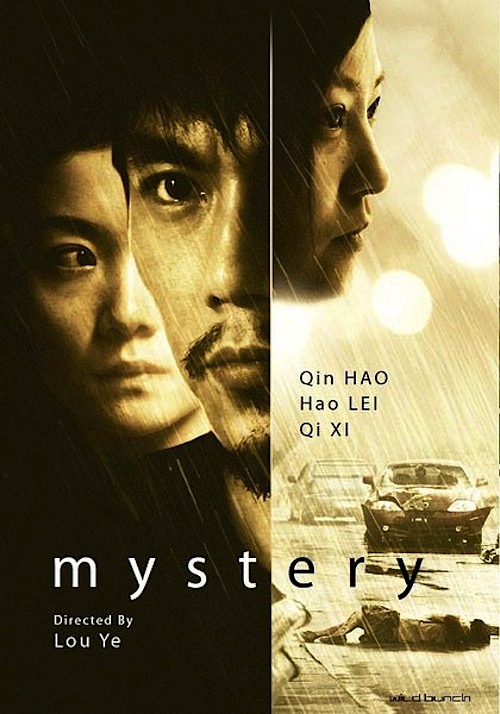
By Joe Bendel. Chinese film censors often seem to get rather acute cases of “approver’s remorse.” After allowing Lou Ye to screen his latest film at Cannes (to general acclaim) they suddenly demanded the director edit two “violent” scenes before allowing his film a Mainland theatrical release. Considering that several of Lou’s films have been banned outright in China and the filmmaker has openly defied a state imposed five year filmmaking prohibition in the past, this arguably represents progress. As with his previous work, the Party bureaucrats are protecting the public from an excellent film. New Yorkers can judge for themselves when Lou’s Mystery (trailer here), screens today at the 2013 New York Asian Film Festival.

Like most of contemporary China, the industrial city of Wuhan is sharply divided between the have’s and the have-not’s. In the opening scene, a reckless group of have’s runs over a woman. Their first response is neither compassion nor remorse. Hold that thought. Lou will return to the woman on the motorway in due time. However, he abruptly shifts his focus to Yongzhao, who is striving to become one of the have’s. As a result, he works late hours, leaving his wife Lu Jie to care for their endearing young daughter, An-an.

One day after school, Lu Jie is asked out on a playdate by Sang Qi. She is not particularly keen to get to know the woman, but An-an clearly gets on with the woman’s son like two peas in a pod. Reluctantly agreeing to subsequently meet the woman for lunch, Lu Jie is rather uncomfortable when Sang Qi asks for advice on how to handle her cheating husband. At that moment, Lu Jie observes her husband across the street, entering a hotel with a woman who is most definitely not herself.

Coincidences do play a role in Mystery, but many things happen for reasons not immediately apparent. Indeed, the police investigation of the opening incident will ultimately involve several of the film’s primary characters. These cases are called crimes of passion, correct?

In the past Lou has addressed topics like homosexuality and Tiananmen Square, which are absolutely radioactive as far as Party bureaucrats are concerned. Mystery implies much about contemporary China’s growing class inequities and the collapse of traditional values, but as an ostensive film noir, it is obviously much less controversial. Domestic critics have often unfairly rapped Lou for his supposed Euro-art house style, but in this case viewers can sort of see it. One might more readily compare his latest to Louis Malle’s Damage than Lou’s Digital Generation-esque Spring Fever.

The star of Lou’s Summer Palace (a tragic love story bound up in the Tiananmen Square protests that went over with the censors like a lead balloon), Hao Lei is scary good as Lu Jie. She takes the audience on quite a ride with her character’s arc of development, vividly illustrating what “a woman scorned” means. Likewise, Qi Xi plays the seemingly naïve Sang Qi with surprising subtly and power. Keep your eyes on them both.

Without question, Mystery is a film for mature adults. While there are exponentially more violent films at this year’s fest, Lou presents the occasional outbreaks in disturbingly intimate terms. Taut and sophisticated, Mystery amply rewards viewers who indulgence its plot contrivances. An important new work from a truly independent filmmaker and an accomplished cast, Mystery is very highly recommended when it screens tonight (7/3) and next Thursday afternoon (7/11) at the Walter Reade Theater, as part of this year’s New York Asian Film Festival.

LFM GRADE: A

Posted on July 3rd, 2013 at 1:19pm.

LFM Reviews Confession of Murder @ The 2013 New York Asian Film Festival

By Joe Bendel. It is the kind of capricious perversity of the legal system that a Victorian novelist would admire. After the statute of limitations expires for his crimes, a serial killer comes forward—ostensibly to repent. However, the cop in charge of the investigation doubts both his sincerity and his veracity in Jung Byoung-gil’s Confession of Murder, which screens today during the 2013 New York Asian Film Festival.

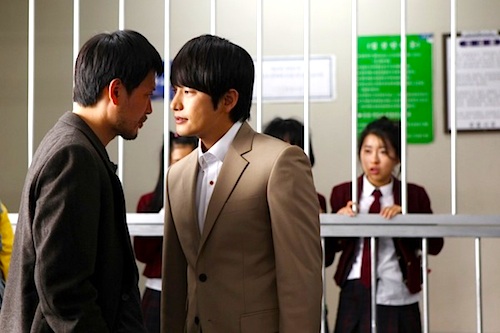
Det. Choi Hyung-goo still bears the scar from his close encounter with a masked serial killer. The case became personal for him—real personal. When Lee Doo-suk steps forward claiming to be the serial killer he is not impressed. Neither are the families of his victims. In marked contrast, the public eats up his phony contrition act, turning Lee into a media phenomenon. Unfortunately, there is little Choi can do, but the families are not so passive.

Directed by Jung, who is best known to NYAFF patrons for Action Boys, his documentary about Korean stuntmen, Confession has its share of big, adrenaline charged chases and fight scenes. However, it is not the stunt work bacchanal one might expect. Instead, Confession plumbs some murky psychological depths. Rather than an action thrill ride, it compares more closely to Kim Jee-woon’s I Saw the Devil.

From "Confession of Murder."

Jung maintains the stark tension throughout the film, but he unleashes a barrage of revelations in the third act. Indeed, viewers might kick themselves for not guessing a few, but Confession serves as an object lesson in how not to telegraph your big twists by keeping everyone distracting with breakneck pacing. This is a really well constructed film, but it is not for those with delicate sensibilities. Yes, there is a fair amount of physical conflict, but the emotional violence is far more unsettling.

Jung Jae-young is all kinds of hardnosed as Det. Choi, yet he also perfectly conveys the damaged cop’s tragic nature. Television star Park Si-hoo is suitably cold and creepy as the serial killer-teen idol. Their scenes together have serious zing, but they are also backed-up by a strong supporting cast that really helps sell the twists and turns.

Presumably most viewers will not be experts in South Korean criminal law, so it is easy to suspend disbelief over its initial MacGuffin. While in America the statute of limitations never expires for murder, Confessions is such a nifty, high concept thriller, it seems ripe for a Hollywood remake nonetheless. (Perhaps a liberal judge in the Dirty Harry tradition could issue a preemptive ruling granting the killer impunity.) Regardless, Confession of Murder is a muscular thriller that ventures into some unusually dark places. Very highly recommended, it screens this afternoon (7/3) at the Walter Reade Theater, as part of the 2013 New York Asian Film Festival.

LFM GRADE: A-

Posted on July 3rd, 2013 at 1:17pm.

LFM Reviews Feng Shui @ The 2013 New York Asian Film Festival

From "Feng Shui."

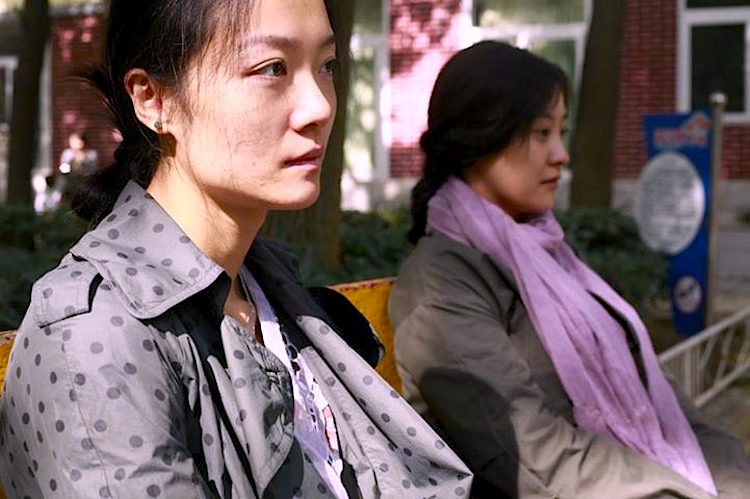
By Joe Bendel. Feng Shui is a traditional Chinese spiritual and aesthetic practice meant to maximize the flow of positive chi in living spaces. The principles of shrewishness are also pretty universal. Both phenomena contribute to a bossy wife and mother’s bad karma in Wang Jing’s Feng Shui (trailer here), which screens tonight during the 2013 New York Asian Film Festival.

As soon as they move into their new flat, Li Baoli starts tearing into her passive husband, Ma Xuewu. Suddenly, neither he nor their studious young son Xiabao seem to do anything right. After about a day of this, Ma declares he wants a divorce, but this only further antagonizes his wife. Launching an emotional cold war against her husband, Li succeeds in pushing him into the arms of his factory colleague Zhou Fen, with disastrous results for the family.

Flashforward ten years: Li is now the primary breadwinner for her resentful son and her grey-haired mother-in-law. Slaving like a dog as a yoke-bearing street porter, Li lives for the day the high achieving Xiabao takes his university entrance exams. However, the teen has a general idea of what transpired between her and her father and he definitely holds it against her.

Basically, Feng Shui is divided into two distinct halves. Initially, Li Baoli is so foul-mouthed, insensitive, and downright mean-spirited that she will have viewers reeling. Surely, no movie character has used the expression “dog-f___er” as much as her. Yet, somehow Yan Bingyan makes us care about her rather deeply during the redemptive karmic payback portion of the film.

From "Feng Shui."

Yan Bingyan is frankly amazing as Li, smoothly segueing from hot mess on wheels to a weathered self-sacrificing maternal goddess in the Ruan Lingyu mold. She makes some extreme extremes look perfectly believable and totally exhausting.

As befitting a woman’s story, Feng Shui’s richest supporting turns mostly come from women. He Minglan gives a wonderfully subtle and humane turn as the mother-in-law who can see both the bad and the good in Li. Likewise, Wang Moxi has some brief but powerful moments as Ma’s almost-mistress. Zhao Qian also adds some seasoning to the film as Li’s best friend, an aging trophy wife (who blames her less fortunate friend’s troubles on bad feng shui). However, for an ostensibly smart kid, the teenaged Xiabao does not seem to have much going on in his head, besides an awkward surliness.

Feng Shui is based on a novel by Fang Fang, whose work is either reminiscent of Neil LaBute or Ozu, depending on which half of the film you judge by. Clearly, Li Baoli’s trials and tribulations are intended to underscore the difficulty realizing social mobility in contemporary China. It might be a stark reflection of reality, but it is a good film. Recommended for those who enjoy a quality tearjerker with an edge, Feng Shui screens tonight (7/3) at the Walter Reade Theater as part of the 2013 NYAFF.

LFM GRADE: B+

Posted on July 3rd, 2013 at 1:16pm.

LFM Reviews Countdown @ The 2013 New York Asian Film Festival

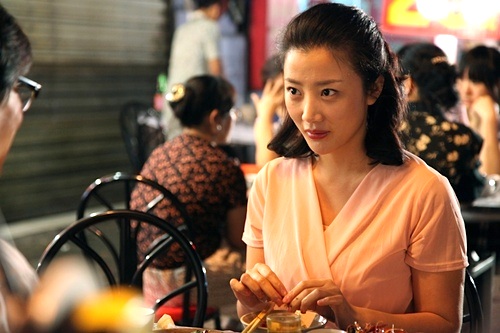
By Joe Bendel. Technically, this is not a home invasion film, because they invited him in. Nor is this psycho dug-dealer exactly whom he seems to be—except maybe the psycho part. Regardless, three privileged Thai expats are in for a really crummy New Year’s Eve in Nattawat Poonpiriya’s Countdown (trailer here), which screens tonight during the 2013 New York Asian Film Festival.

Bee, her boyfriend Jack, and their flat-mate Pam are not big on consequences. They live the bohemian life in New York and their long-suffering parents’ pay the bills. Ironically, their small-time dealer friend sets all the drama in motion when he resolves to clean up his act. Snoopy Jack thinks he found his connection’s ripped up business card, but it is missing a digit. Bee adds a 3 in honor of the New Year of 2013 and presto, Jesus (that is with the Spanish pronunciation, mind you) is on his way over with fresh weed.

From "Countdown."

For a while, the three entitled kids enjoy smoking up with the scraggly looking dealer, despite the rather odd remarks he occasionally lets slip. As the more responsible one, Bee slowly picks up on Jesus’s bad vibe, but with Jack and Pam out-of-their-minds high, she is no match for the large, angry man. Ominously, he also seems to know secrets about them that a garden variety dealer should have no way of knowing. Man, are these cats going to miss Dick Clark.

Countdown starts in a hip Kevin Williamson bag, but things quickly get biblical. Following in the tradition of old school E.C. Comics morality tales, Bee, Jack, and Pam have been bad kids, so viewers will not be overly disturbed when Jesus puts the screws to them. Still, Poonpiriya takes the action to some thematically dark places and does not skimp on the physical violence.

As Jesus, David Asavanond makes a killer villain, so to speak. He struts about and delivers his heavy dialogue with the authority befitting an avenging whatever. However, Jarinporn Joonkiat also does some real acting as Bee. She actually makes her a complex, believable character, which is quite impressive in a neo-exploitation genre mash-up. Essentially, Pachara Chirathivat plays Jack as the character demands: weak and annoying. Likewise, Pattarasaya Kreuasuwansri certainly looks and acts the part as the shallow but photogenic Pam. Indeed, the small, game cast does what they need to do to keep the bloody mayhem on track.

Countdown has the potential to become a midnight movie perennial. Poonpiriya incorporates his New Year’s Eve countdown motif in clever ways, while Asavanond’s gleefully Mephistophelian turn is tailor-made for cult-fandom. Recommended for experienced NYAFF patrons, Countdown screens tonight (7/3) at the Walter Reade Theater, but repent before you go.

LFM GRADE: B

Posted on July 3rd, 2013 at 1:14pm.