Women Blogging for Freedom in China, Cuba & Iran: LFM Reviews Forbidden Voices @ The 2013 Brooklyn Film Festival

By Joe Bendel. For all practical purposes, the act of blogging (something I do every day) is illegal in China, Cuba, and Iran. Despite violent state harassment, three women representing each country have become superstars of citizen journalism. Barbara Miller profiles this brave trio of bloggers in Forbidden Voices, which screens during the 2013 Brooklyn Film Festival.

Probably the best known of the three, Yoani Sánchez blogs at: www.desdecuba.com/generationy. Her reports on Cuban political prisoners and their mothers, wives, and daughters, dubbed the “Ladies in White,” have been picked up around the world. Like many of the peaceful protestors she covers, she has been savagely beaten by Castro’s thugs. Ironically, her international reputation provides her a measure of protection, but there is no mistaking the real and present danger she lives with constantly. For example, during the course of Forbidden, Sánchez reports the suspicious prison death of Orlando Zapata Tamaya and struggles to save the life of hunger-striking Guillermo Fariñas.

As brutal as the Castro regime might be, Zeng Jinyan probably faces an even more perilous situation in China. A human rights activist who blogs at: www.zengjinyan.wordpress.com, Zeng was crudely blocked from leaving her apartment by Party enforcers, well before she was officially sentenced to house arrest. With her fellow activist husband Hu Jia incarcerated, Zeng deals with the challenge of raising her young daughter by herself, in her state of captivity.
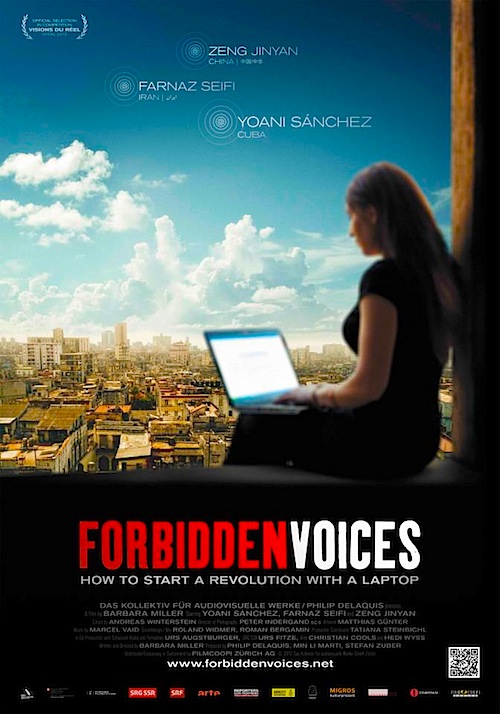
Farnaz Seifi now lives in the safety of exile, but her blog has long been terminated by Iran’s special internet secret police. She tries to support activists within the Islamist state by publicizing their plight as best she can, but she fears the reprisals her family might consequently suffer.

Evidently, it is relatively easy to smuggle hidden cameras into Cuba, because Voices includes more coverage of Sánchez than of her blogging colleagues. Yet, the images of Zeng are probably the most dramatic, including a brief interview with the confined woman, shouting down from her window. This is not meant to short change Seifi. She has seen the inside of interrogation chambers and her concerns for her family, friends, and country are genuine and genuinely moving.

Indeed, all three women are truly heroic, pure and simple. By shining a spotlight on Sánchez and Zeng, Miller makes it more difficult for their oppressors to make them conveniently disappear. When watching Voices, viewers will start to understand that conditions are far worse in each country than even the most steadfast critics of Communism and Islamist Fundamentalism most likely realized. This is truly an often shocking but extremely timely and compelling exposé. Frankly, it is hard to conceivably imagine how the upcoming Human Rights Watch Film Festival could proceed without it, but give BFF all due credit for selecting it.

Forbidden Voices is a case of cinematic journalism at its finest. These are stories that need to be told. Miller also pays tribute to the blogging ideal, rather elegantly celebrating the powerful and surprisingly poetic quality of their words. As a result, it is also quite rewarding when judged as a film on strictly formalistic criteria. Very highly recommended, Forbidden Voices screens this Wednesday (6/5) at Windmill Studios and Saturday (6/8) at IndieScreen as part of the “Magnetic” edition of the Brooklyn Film Festival.

LFM GRADE: A

Posted on June 3rd, 2013 at 1:06pm.
Resnais Adapts Anouilh: LFM Reviews You Ain’t Seen Nothin’ Yet

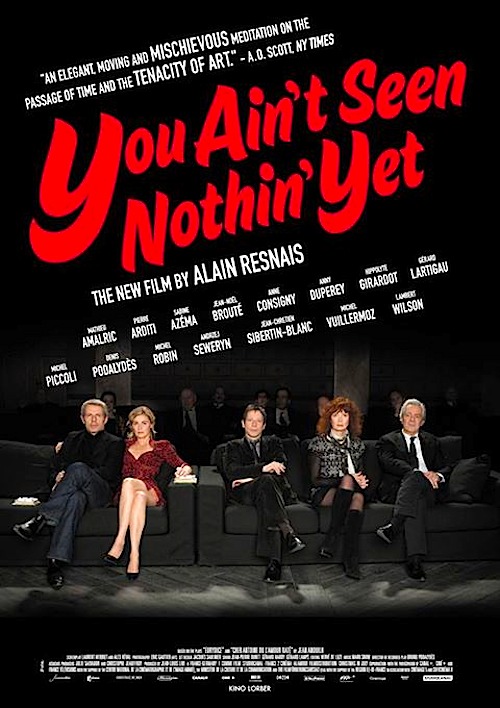
By Joe Bendel. Can a play from the 1940’s, based on classical mythology, still speak to contemporary audiences? Alain Resnais will answer in the affirmative. As a consummate cinematic game-player, he naturally stacks the deck, casting a who’s who of French thespians in his meta-adaptation of Jean Anouilh’s Eurydice. Regardless, the star-crossed love still resonates in You Ain’t Seen Nothin’ Yet, which opens this Friday in New York.

Orpheus and Eurydice supply the back bone of YASNY, but the framing device incorporates Anouilh’s Cher Antoine ou l’amour Rate. Playing themselves, the leading lights of French stage and screen are summoned to a memorial for their dear departed friend, playwright Antoine d’Anthac. As part of the ceremony, they are to watch a video of his/Anouilh’s Eurydice, to determine whether the avant-garde revival is worth staging. It is a work they are all familiar with, having each appeared in previous productions. Watching the screen, they get caught up in the story and their own memories and begin to act out Eurydice in concert with the recorded rehearsal.

Cast members overlap and echo each other, but Resnais always maintains the integrity of Eurydice’s storyline. It all sounds very post-modern, but it is really a case of the narrative overpowering its meta-conceits rather than being defined by them.

Of course, it is hard to go wrong with YASNY’s cast. While Resnais has three sets of Orpheus and Eurydice at his disposal, he clearly favors Pierre Arditi and Sabine Azéma (two of his longtime collaborators), with good reason. Watching this couple on the late side of middle age portraying the doomed young lovers is eerily moving. Their experienced faces seem to amplify the tragedy rather than distract from it. Nonetheless, Anne Consigny’s Eurydice is exquisitely brittle and dignified, overshadowing the aloof Lambert Wilson.

Former Bond villain Mathieu Amalric exudes a deliciously Mephistophelean vibe while maintaining the moral ambiguity of Monsieur Henri, death’s avatar, a role he mostly has to himself. Michel Piccoli nicely anchors the film with his warm gravitas, ostensibly revisiting the role of Orpheus’s father, while leading the cheering section within the elite audience. In addition to playing d’Anthac with eccentric flair, Denis Podalydès (from the Comédie Française) was recruited to direct the hipster Eurydice video segments, further complicating notions of what the film is and who is its author. It is Anouilh’s Eurydice, as well as d’Anthac’s, but it is also partially Cher Antoine, mostly reconceived by Resnais, but also shaped by Podalydès.

The key point is: it’s all good. With its cast members handing off their batons like relay runners, YASNY’s affection for the theater’s passion and artifice becomes infectious. Featuring music by X-Files composer Mark Snow and Eric Gautier’s richly noir-ish cinematography, it is an unusually elegant film. Cerebral yet strangely poignant, the highly recommended You Ain’t Seen Nothin’ Yet opens this Friday (6/7) in New York at the Quad Cinema.

LFM GRADE: A-

Posted on June 3rd, 2013 at 1:04pm.

After the Apocalypse: LFM Reviews In the Flesh; Premieres This Week on BBC America

By Joe Bendel. Here’s the good news: the zombie apocalypse is over and humanity won. Gracious in victory, we have developed something of a Marshall Plan for the undead. The proper term is now “Partially Deceased Syndrome.” With proper treatment, those afflicted can regain their consciousness and eventually be reintegrated into society. At least that is the theory. Reality is a lot trickier for one PDS teenager in series writer-creator Dominic Mitchell’s three part In the Flesh (promo here), which premieres this Thursday on BBC America.

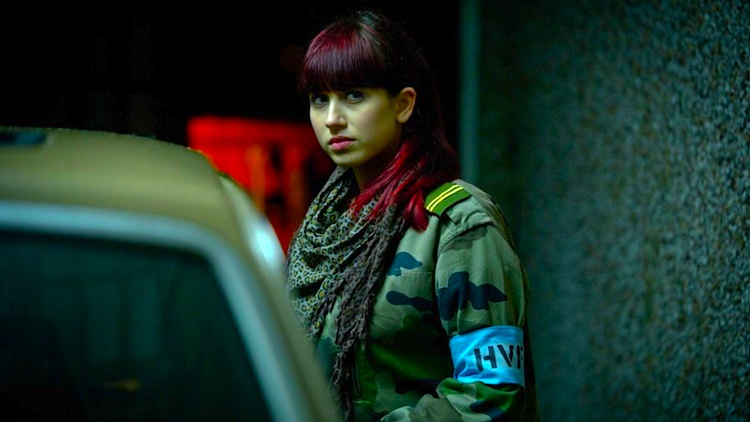
The small town of Roarton suffered heavy losses during what is now called “the Rising.” The Human Volunteer Force (HVF) militias were first founded here and Roarton’s unit has yet to disband. It is the worst place a rehabilitated zombie to re-enter society, but it is where Kieren Walker’s family lives. His parents are walking on eggshells, determined to keep his homecoming a secret, but nonetheless overjoyed to have their son back. His younger sister Jem is a different story. Active in the local HVF, she now considers their militant leader Bill Macy a mentor. Kieren Walker already has some complicated history with the Macy family and it will soon get even thornier.

Following the lead of George Romero’s Night of the Living Dead, Flesh employs zombies as a vehicle for social commentary. However, this approach is always limited by the nature of the genre. We see through Walker’s flashbacks the terrors he wreaked in his feral state. It was not his fault according to his doctors, but it still isn’t pretty. With rumors swirling of rehabbed PDS cases deliberately going off their meds, it is hard to blame the good citizens of Roarton for being slightly on edge. Nonetheless, Mitchell stacks the deck against them, casting the fire-and-brimstone Vicar and the unhinged Macy as paranoid demagogues.

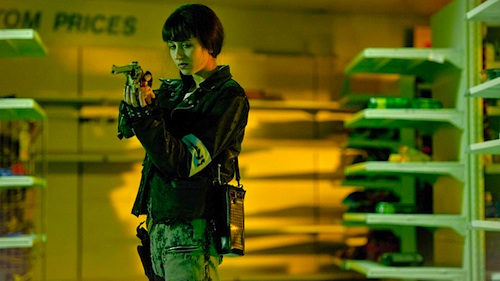
From "In the Flesh."

Flesh works considerably better on the micro level when it focuses on Walker’s guilt for both his zombie atrocities and the circumstances that led to his initial death. There is also an interesting relationship that develops between him and Amy Dyer, a more free-spirited PDS teen.

Luke Newberry is adequately morose as Walker, but he is frequently upstaged by other Walker family members. Harriet Cains shows potential star power as the forceful Jem, but Steve Cooper really gets to lower the emotional boom as Kieren’s still reeling father. Unfortunately, Steve Evets (so engaging in Ken Loach’s Looking for Eric) and Kenneth Cranham largely portray Macy and the Vicar as crude caricatures. In contrast, lefty comic Ricky Tomlinson nicely humanizes anti-PDS activist Ken Burton, while Emily Bevan adds some energy to the dour milieu as Dyer.

Already renewed for a second season in the UK, In the Flesh ends its first outing with some intriguing avenues open for further exploration. Yet it faces an obvious dilemma. To satisfy genre fans, eventually the show must produce the shuffling hordes, but to do so would undercut their peace and tolerance soap-boxing. Notable as an original premise, imperfectly executed but showing promise for future development, the first season of In the Flesh airs this Thursday, Friday, and Saturday (6/6-6/8) on BBC America.

LFM GRADE: B-

Posted on June 3rd, 2013 at 1:03pm.

Our Voyeuristic Future: LFM Reviews Channeling @ The 2013 Dances With Films

By Joe Bendel. In the very near future, about five minutes from now, people will become even more exhibitionistic. Personal internet reality shows are the thing, made possible by special contact lens cameras. ‘Channelers’ broadcast themselves snowboarding, booty calling, and navel gazing. Some also broadcast criminal activity, such as an Army sergeant’s estranged brother. When the punk winds up dead, his avenging sibling assumes control of his channel in Drew Thomas’s Channeling (see viral teaser above), which screens tomorrow during the 2013 edition of Dances With Films.

The Maddox family was always pretty dysfunctional. The death of Wyatt, the Fast & Furious wannabe, does not help much. Returning on a bereavement leave, Jonah soon starts nosing around with the help of Tara, his brother’s on-camera co-host, sidekick, or whatever. Essentially, this leaves all the responsible stuff to his younger sister, Ashleigh. She broadcasts her life too, in hopes of finding validation from voyeuristic netizens. That is really the wrong place to be looking.

It is always pretty obvious who the bad guys are in this film, but it is never clear why they had it in for the Brothers Maddox. Wyatt’s ratings were always pretty good by channeling standards, unlike the late Howard Beale in Network. Regardless, it offers Jonah an excuse to boost some fast cars.

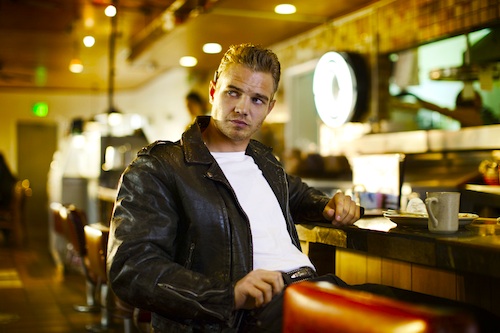
From "Channeling."

Channeling is a serviceable enough b-movie, but it pales in comparison to Bertrand Tavernier’s thematically similar Death Watch, which remains an eerily prescient critique of our media-driven society even over thirty years after its initial release. It is also hard to compete with Harvey Keitel, Harry Dean Stanton, and Romy Schneider.

Regardless, as a leading man, Dominic De Vore seems to have graduated from the Caspar Van Dien school of acting. He is adequately square-jawed in the action scenes, but that’s about all you get. However, Kate French (probably best known from The L Word and One Tree Hill) lends the film some style and presence riding shotgun as Tara, while Taylor Handley does a presentable James Dean impression as the ill-fated Wyatt.

Thomas and cinematographer Andrew Huebscher keep things looking slick and cool throughout. Cars will be wrecked and thugs will get their beatdowns. It’s all a cut above SyFy Channel original movies, but those primarily intrigued by the premise should checkout Tavernier’s underappreciated gem instead. For Kate French’s fans, it screens tomorrow night (6/2) as part of this year’s Dances With Films in Hollywood, CA.

LFM GRADE: C+

Posted on June 1st, 2013 at 1:02pm.

Post-Dystopia Depression: LFM Reviews A Better World @ The 2013 Brooklyn Film Festival

By Joe Bendel. Think of this as what happens after the famous 1984 Apple commercial. Big Brother has fallen. Unfortunately, Henry Dremmel is no Winston Smith. Adjusting to a post-dystopian world will be difficult for him in Sacha Feiner’s short film A Better World, which screens during the 2013 Brooklyn Film Festival.

Dremmel the tool, works for the Domestic Denunciation Program. All day he monitors security cameras, reporting even the slightest deviations from the norm. One fateful night, Dremmel wakes to the sound of fireworks. The regime has fallen. Freedom has broken out, but the Denunciator cannot handle it. He prefers the structure of his drab, harshly regimented former existence.

Audiences are unlikely to see a film more explicitly associating the compulsive need for security with oppressive statism in a month of Sundays. What’s even more mind-blowing is that it hails from Belgium, the EU’s happy host nation. Regardless, writer-director Feiner really cuts to the heart of the matter. Dremmel is not an odious villain. A pathetic figure, he is the final victim of a de-humanizing collectivist system.

From "A Better World."

A Better World is also quite an impressive looking production. Olan Bowland’s bleak, washed-out cinematography and Julia Irribaria’s imposing sets create a perfectly Orwellian environment. Almost a prop himself, Vincent Kohler is appropriately cringey and clammy as Dremmel.

Despite its twenty-four minute running time, A Better World has more to say than most features. A genuinely challenging work (especially for Williamsburg hipsters), it is one of the best dystopian films of any length to hit the festival circuit. Very highly recommended, it screens this coming Monday (6/3) and Wednesday (6/5) as part of the 2013 Magnetic edition of the Brooklyn Film Festival.

Posted on May 31st, 2013 at 12:05pm.

LFM Reviews Kumpanía Flamenco Los Angeles @ The 2013 Dances With Films

By Joe Bendel. Maybe there’s still yet hope for Los Angeles: the city is home to a small but vibrant flamenco scene. Of course, nobody is making much money—quite the contrary. The musicians, vocalists, and dancers all simply share a passion for the music. Katina Dunn documents their musical camaraderie in Kumpanía Flamenco Los Angeles, which screens this afternoon during the “Sweet Sixteen” edition of Dances With Films.

Flamenco originated in the tightly knit Roma community of Seventeenth Century Spain. Musicians and dancers from other cultures have been drawn to the music, but according to one vocalist, only Spaniards can sing Flamenco with the right accent. (Yes, he happens to be a Spanish expat.) Regardless of authenticity issues, the Los Angeles Flamenco community is distinctly diverse. Many local Hispanic musicians have adopted the music as their own – including Joey Heredia, a professional drummer comfortable crossing stylistic lines, whose impressive credits include work with Tania Maria, Poncho Sanchez, and Diane Reeves.

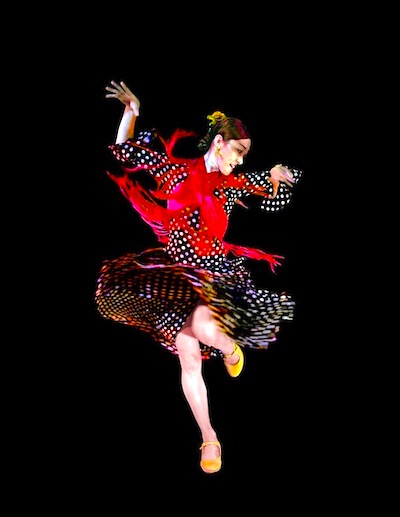
From "Kumpanía Flamenco Los Angeles."

Japanese artists are also well represented in KFLA. Kyoto native Jose Tanaka is not just a leading guitarrista and composer, but clearly serves as a leader holding the community together. However, if one star truly emerges from the film, it would have to be Bailaora (dancer) Mizuho Sato. A striking performer with flawless technique, her sequences will hold viewers spellbound. She also provides real insight into the Flamenco aesthetic, especially when explaining how the demur nature of the presentation is part of what makes it all smolder.

Dunn nicely conveys the scene’s vibe and gives interested viewers an easy starting point to check out the assembled artists live—namely, the Fountain Theatre. Her selective but clever use of archival footage adds fitting context as well. She does right by the music, which is the most important thing.

While not reaching the lofty heights of Fernando Trueba’s Calle 54 (the true gold standard of music performance docs), KFLA is still quite a dynamic and engaging film. At just a whisker over an hour, it will leave most viewers wanting more. Appealing to the eyes and ears, Kumpanía Flamenco Los Angeles is recommended for general audiences when it screens this afternoon (5/31) as part of the 2013 edition of Dances With Films, in Hollywood, California.

LFM GRADE: B

Posted May 31st, 2013 at 12:04pm.