Kung Fu in The New China: LFM Reviews Dragon Girls @ The 2013 Brooklyn Film Festival

By Joe Bendel. Will one of these girls be the next Michelle Yeoh?  Possibly, but none of them seems to harbor such lofty aspirations. Regardless, they all train harder than most professional athletes in hopes of earning a better life for their families (shouldn’t that be the other way around?). Inigo Westmeier observes the rigorous routine of the Shaolin Tagu Kung Fu School’s students in Dragon Girls, which screens during the 2013 Brooklyn Film Festival.

For these mostly poor provincial students, kung fu school can lead to better military and police jobs than might otherwise be available to them. Unfortunately, the seven day training regime does not leave much time for the kids to be kids. The Shaolin Tagu School accepts both boys and girls, but Westmeier devotes about ninety percent of his attention to the latter, focusing on three particular girls with complicated family circumstances.

Much like the apparently abusive Shanghai Circus School documented by Guo Jing & Ke Dingding, life at Shaolin Tagu does not look like a lot of fun. On the other hand, at least it offers the girls some camaraderie. Given the realities of life for poor rural girls (such as the protagonist of Wang Bing’s Three Sisters), things could arguably be worse for the students. Still, the sanctimonious headmaster is obviously cutting corners with respects to sanitation and nutrition. Yet the most trying aspect for most of the girls is the lingering sensation of abandonment. Clearly, the school functions as an alternative to an orphanage for many essentially absentee parents.

Westmeier captures his three primary POV figures at their most open and vulnerable moments. Frankly, it is often difficult watching them struggle physically and emotionally, because they are really just kids. The extent of the headmaster’s authoritarian indoctrination is nearly as disturbing, if not more so.
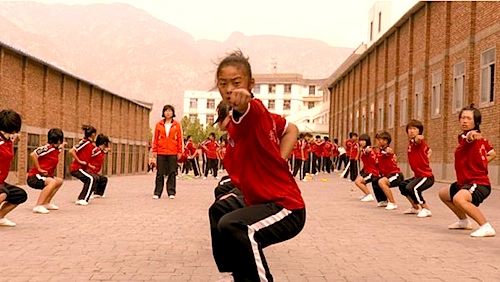
From "Dragon Girls."

Despite all the issues the film raises, seeing the collective student body of 35,000 in action is admittedly impressive. For an observational style doc, there is a heck of a lot of spectacle in Dragon Girls. These kids are good—but the monks in the Shaolin monastery next door are probably better. As one might expect, they are less dogmatic and far more Zen-like in their approach to martial arts. Westmeier tellingly contrasts the two so-close-yet-so-far-apart Shaolin institutions without belaboring the point.

Dragon Girls further testifies to the vast class divisions demarcating today’s China. It might be tough viewing, but it is an honest reflection of reality. The extent to which Westmeier melds the social issue documentary with martial arts cinema is also rather notable. Recommended for fans of both genres who can handle some unvarnished truth, Dragon Girls screens this Saturday (6/1) at Windmill Studios and the following Thursday (6/6) at IndeiScreen as part of the “Magnetic” 2013 Brooklyn Film Festival.

LFM GRADE: B+

Posted on May 30th, 2013 at 4:27pm.
A Very Private Apocalypse: LFM Reviews The Wall

By Joe Bendel. When the television adaptation of Stephen King’s Under the Dome hits the airwaves, fans will duly wonder where he gets his ideas from. Hmm, maybe Christoffer Boe’s Allegro or Marlen Haushofer’s Die Wand. Of course, both predecessors are much more introspective in nature. Indeed, viewers witness a very private apocalypse in Julian Pölsler’s adaptation of Haushofer’s 1963 novel, The Wall, which opens this Friday in New York at the IFC Center.

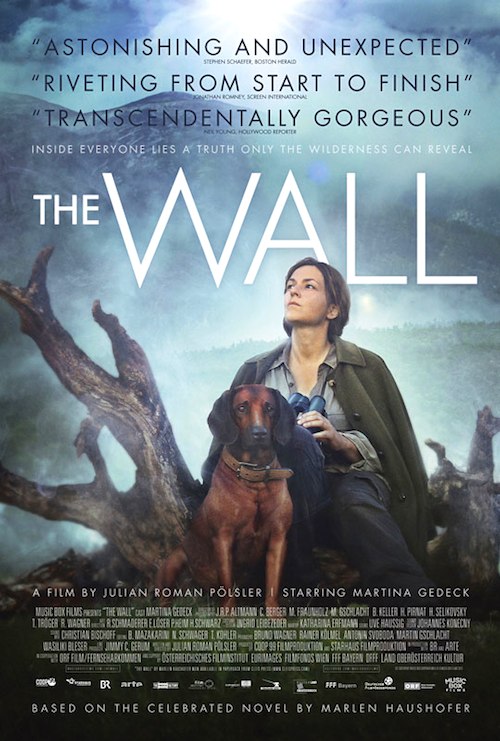
A woman is holidaying with friends in an Austrian mountain lodge. Her hosts drive into town for supplies and never return. Venturing out the next morning she discovers an invisible barrier blocking the road. Scouting the mountainside, she discovers that the strange wall encircles her. She can see people on the other side, but they appear frozen in place. Time seems to only pass on her side of the wall, but it passes very slowly.

Told in flashbacks via the unnamed woman’s journal entries, The Wall consciously echoes Robinson Crusoe. With no Man Friday, the woman develops a close bond with the couple’s dog, Lynx. Indeed, it is largely her rapport with animals that keeps the woman engaged in her solitary world.

Obviously, The Wall implies much about man and our unbalanced relationship with nature. The English language voice-overs are often rather heavy-handed (and clash with the limited subtitled German dialogue) but the film’s vibe and rhythm are eerily evocative. Viewers will feel like they are getting a true taste of what it would be like to be the last sentient person on Earth.

Shot over the course of several seasons, Pölsler and his battery of cinematographers fully capitalize on the stunning scenic vistas that utterly dwarf the lone woman. Carrying the film almost single-handedly, Martina Gedeck (co-star of the modern classic The Lives of Others) gives a remarkably assured performance. Mixing depression and empowerment, it might be the purest cinematic portrayal of existential living. However, it is also worth noting Pölsler’s own dog Lynx is quite the performer in his own right.

The Wall may well be a rebuke of patriarchy and industrialization, but it still works rather well as a survivor’s story. Admittedly, it is deliberately paced (for obvious reasons), but the overall effect is hypnotic. Recommended for those who appreciate apocalyptic and allegorical cinema, The Wall opens this Friday (5/31) at the IFC Center.

LFM GRADE: B

Posted on May 30th, 2013 at 4:26pm.

LFM Reviews 113 Degrees @ The 2013 Brooklyn Film Festival

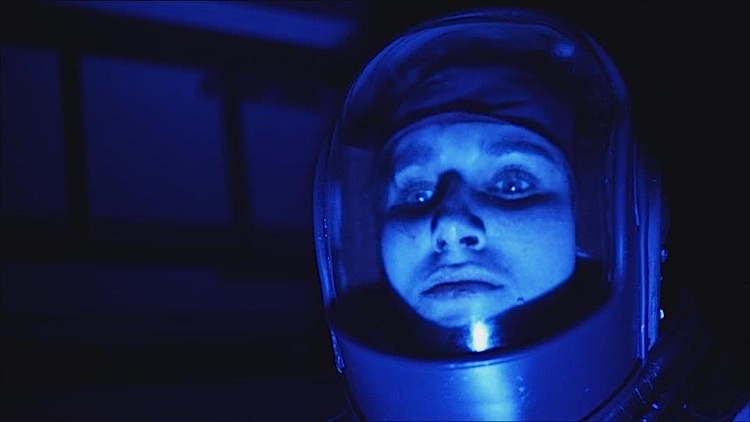
By Joe Bendel. In space, no one can hear a heart break—unless the aggrieved lover decides not to bear her disappointment in silence. Confined environments are difficult places to work out relationship problems as the crew of a two-person space station learns in writer-director Sabrina Doyle’s short film 113 Degrees (trailer here), which screens during the 2013 Brooklyn Film Festival.

Francesca and Joe have grown close during their time in space together. At this point, they share the same bunk. It would seem to be an Eden-like situation, but an interstellar call from Joe’s terrestrial wife serves as a rude awakening for his commander. Disturbed by the incident, she carries her agitation with her during a supposedly routine space walk. This leads to serious complications.

Granted, most romantic tragedies are not overly concerned with cooling systems, but the guts of 113 involve the lovers’ betrayal and sacrifice. This is really the sort of film that uses science fiction trappings to tell a straight forward human story. Indeed, it hits some deep chords. However, it is important to note that Doyle, producer Matilde Barbagallo, and editor Marian Jiménez are all women – lest the film be accused of perpetuating the stereotype that women are more likely to become emotionally overwrought than men.

As Francesca and Joe, Lizzy Davis and Brian Groh quickly convey a sense they share some long, intimate history together. They are a believably flawed couple. However, his long haired hipster coif looks rather out of place. Even in the future, aside from space tourists, most astronauts are still likely to be ex-military.

Regardless, the rest of the production is technically quite impressive, especially considering Doyle’s budget constraints. Hollywood tent-pole veteran Greg Derochie’s VFX team convincingly renders Francesca’s space walk outside the station and the deteriorating conditions within. One could easily believe this is the same world as the Alien franchise or Duncan Jones’ similarly scrappy Moon. Recommended for SF fans with a weakness for tales of star-crossed love, the twenty-one minute 113 Degrees screens Monday (6/3) and Wednesday (6/5) as part of this year’s “Magnetic” BFF.

Posted on May 30th, 2013 at 4:25pm.

MoMA’s Chinese Realities Series: LFM Reviews The Questioning

From "The Questioning."

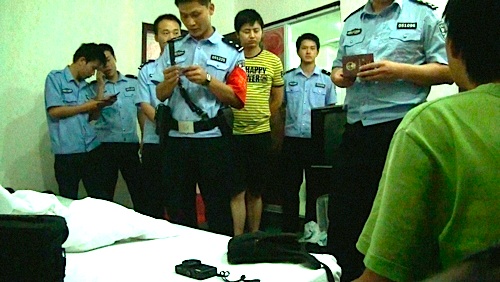
By Joe Bendel. When these cops show up to “inspect” your hotel room, it is a case of pure intimidation. It is also something of a badge of honor in today’s China. Film producer and festival impresario Zhu Rikun was the target of such a police roust, but he had the presence of mind to keep his camera rolling. His resulting short documentary The Questioning screens with Ai Weiwei’s thematically similar Disturbing the Peace as part of MoMA’s continuing Chinese Realities/Documentary Visions film series.

Evidently, it takes six cops to ask for Zhu’s papers. Surely being familiar with Teacher Ai’s experience, Zhu handles himself masterfully. He is distinctly uncooperative, but never gives them anything they could describe as provocative. The entire episode degenerates into absurdist theater, with Zhu refusing to answers basic questions, instead referring his interrogators to the very documents they hold in their hands. Viewers can well imagine the flustered enforcers reassuring themselves how badly they shook up Zhu once they retreat from his room.

Indeed, Questioning plays like a revised scene from the ill fated Chengdu trip in Disturbing, but unfortunately, Ai Weiwei and his team were not so deft at handling their harassers. Teacher Wei would take a shot to the head, which would eventually lead to a serious medical crisis, and his assistant would be held incommunicado in gross violation of China’s (ostensible) law.

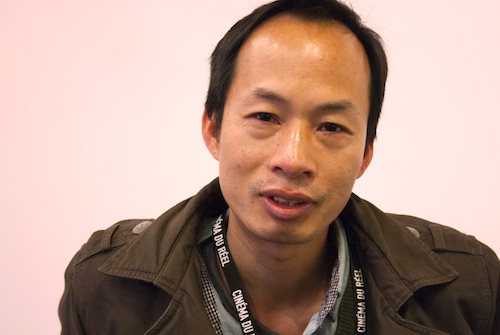
Filmmaker Zhu Rikun.

In her insightful post-screening Q&A, Ai Weiwei: Never Sorry director Alison Klayman really put her finger on the phenomenon both films document. Both Zhu and Teacher Ai could be so assertive in confrontations with authority figures because there is no rule of law to govern such encounters. As a result, the strongest personality has an advantage. Ironically, that gives Teacher Ai the advantage. And Zhu is certainly no shrinking violet, either.

Disturbing the Peace is a film everyone should watch to understand contemporary China. Zhu’s The Questioning is also quite valuable. It is short, but extremely telling. One could argue he does not do much directing, per se, merely turning on the stationary camera his surprise guests never notice -but as a cinematic journalist, he is incredibly gutsy. (However, one might say that his overly large cast is lousy at taking direction.) Both highly recommended films screen together again (sans Klayman) this coming Saturday (6/1), concluding Chinese Realities at MoMA.

Posted on May 28th, 2013 at 12:33pm.

LFM Reviews Black Out @ The 2013 Brooklyn Film Festival

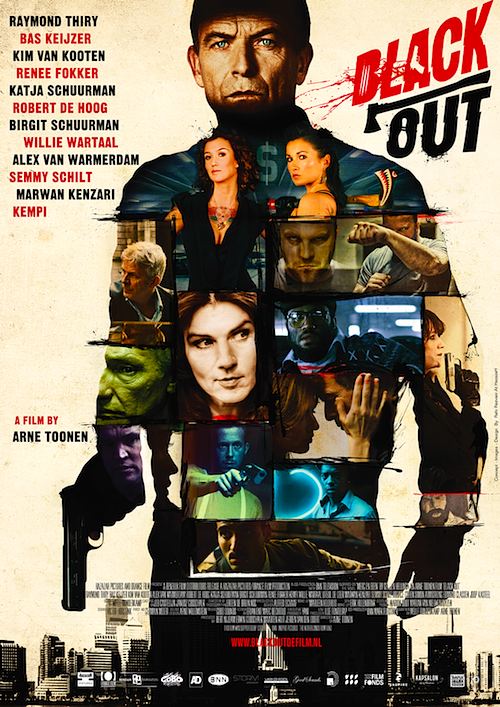
By Joe Bendel. Those idiots from the Hangover franchise have nothing on Jos Vreeswijk, who is about to wake up next to a dead body, a smoking gun, and no memory of the last twenty four hours. He has one day to get it all sorted if he wants to make it to the church in time for his wedding in Arne Toonen’s Black Out, which screens during the 2013 Brooklyn Film Festival.

Vreeswijk was once a criminal, but he went straight. It seemed to take, up until the point he woke up with a corpse in his bed. His fiancée Caroline knows he has a shady past, but she accepts him nonetheless. His prospective father-in-law is less understanding, but he seems to be up to his eyeballs in the mess enveloping Vreeswijk. Evidently it involves twenty kilos of cocaine two rival gang lords think he owes them. To get back to the straight-and-narrow, Vreeswijk will have to boost somebody else’s coke. There seems to be plenty around, but holding onto it is a trickier proposition.

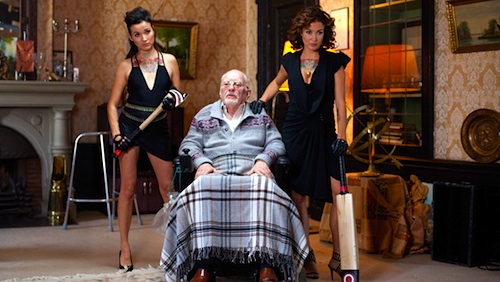
Black Out is a darkly comic, slightly cartoony criminal caper which hums along quite energetically. You have your ballet dancers-turned Russian mobsters, psycho baby doll enforcers, malevolent grandpas, and out of their depth dog groomers all getting in on the action. Yet, it is the steely Robert Conrad-esque Raymond Thirry who anchors the bedlam quite effectively as the reformed everyman, Vreeswijk. Despite all the betrayal and confusion exploding around him, he is always manly and never whiny.

From "Black Out."

Likewise, Kim van Kooten is pleasantly down to earth and pragmatic as the innocent Caroline. All the crazy acting out is left to the rest of the cast, who gorge on scenery like a Bonanza buffet. Arguably the subtlest, most intriguing supporting character is Renee Fokker’s Inez, the “Connoisseur of Coke” and formerly Vreeswijk’s close associate.

Tonnen is obviously influenced by Tarantino and the recent bumper crop of Scandinavian noirs, but even if he never reinvents the wheel, he keeps things punchy and pacey. Violence and eccentricity are liberally mixed together, but Black Out still feels fresh thanks to Thirry’s grounded center. A slickly entertaining one-darned-thing-after-another gangster romance-beatdown, Black Out is recommended pretty enthusiastically for genre fans when it screens this coming Sunday (6/2) and Monday (6/3) at Windmill Studios, as part of the 2013 Brooklyn Film Festival.

LFM GRADE: B+

Posted on May 28th, 2013 at 12:31pm.

LFM Reviews Sunny @ New York’s Korean Movie Night

By Joe Bendel. If Rizzo were dying of cancer, surely Frenchie would reunite the Pink Ladies. Such is the position married and well-to-do Im Na-mi finds herself in. Some members of the girl gang are happy to get back together, but others are harder to find in Kang Hyeong-chul’s monster hit Sunny, which screens tonight as part of the Korean Cultural Service’s free Korean Movie Night in New York.

While not exactly a life of quiet desperation, Im leads a sheltered existence that is not wholly fulfilling. Since her husband and daughter are too busy to visit her mother-in-law in the hospital, she upholds their obligations. During one such visit, she chances across the room of Ha Chun-hwa, the leader of the clique dubbed “Sunny.” When Im’s family moved to Seoul from the countryside, Ha took the shy teen under her wing. As we watch in flashbacks, most of Sunny quickly fell in line, but not Jung Su-ji, the moody prospective model.

When not rumbling with other girl gangs, Sunny practiced their choreography. However, they were never able to perform their big number, for reasons that will eventually be revealed. Hmm, anyone smell some unfinished business here?

In a Korean film, when a character is introduced with a fatal illness in the first act, it is a cinch there will be an emotional funeral coming down the pike. This goes way beyond Chekhov’s gun. Without a big weepy payoff, audiences would want their money back. Not to be spoilery, but Sunny delivers the goods.

Yes, this is a chick flick, but it is an admittedly well crafted film. Employing some surprisingly striking transitions for each temporal shift, Sunny is more visually stylish than it probably needed to be. In fact, Nam Na-yeoung won the best editing honors at Daejong Film Awards for good reason. As the narrative unfolds, it pulls you in – despite viewers’ macho or hipster resistances.

From "Sunny."

Yoo Ho-jeong plays grown-up Im with admirable restraint, never overplaying the gilded cage empowerment card. Likewise, Shim Eun-kyung is earnest and awkward as teenaged Im. Yet both Jin Hee-kyung and Kang Sora really outshine the ensemble as the ailing adult and fearless teenaged, Ha, respectively. Although hardly a teen herself, singer Min Hyo-rin has her moments as the high school ice queen, Jung. As for her adult counterpart, that is really the question driving Sunny’s third act.

If Cyndi Lauper floats your boat and you prefer Boney M’s version of the title song over Bobby Hebb’s original, than Sunny’s unabashedly 1980’s soundtrack will be your catnip. The ways screenwriter-director Kang interjects and darts around the May 1980 democracy protests also gives the film a bit of seasoning. He certainly conveys his point of view, without waving the bloody shirt. Sunny is shamelessly manipulative and sentimental, but it does exactly what it sets out to do. Recommended for those looking to celebrate sisterhood, it screens tonight (5/28) at the Tribeca Cinemas—free of charge, courtesy of the Korean Cultural Service in New York.

LFM GRADE: B-

Posted on May 28th, 2013 at 12:30pm.