LFM Reviews Thangka @ IBFF Showcase 2013

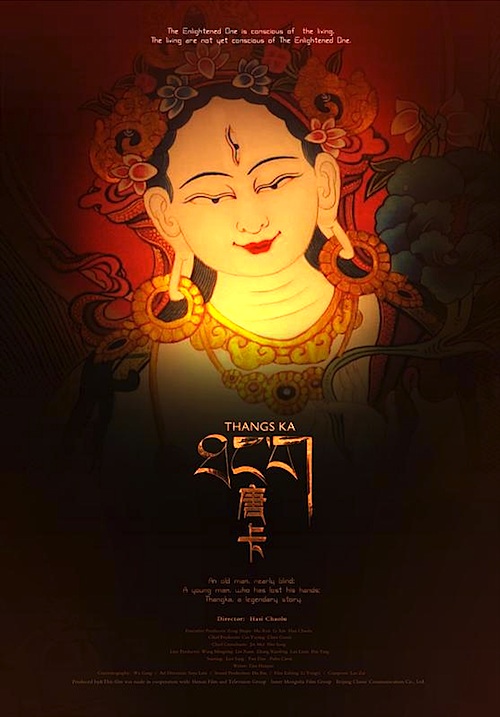
By Joe Bendel. Dunzhu’s impending blindness is not an uncommon phenomenon for painters of traditional Tibetan Thangkas (works that frequently, but not exclusively, depict sacred Buddhist figures). Like drummers who still perform despite developing deafness, they can still perceive and transmit their art. However, the dwindling ranks of his peers alarms the old artist, who sets out to find the reincarnation of his late teacher in Mongolian-born filmmaker Hasi Chaolu’s Thangka, which screens during the 2013 International Buddhist Film Festival Showcase in the Bay Area.

Dunzhu is a traditionalist, who has no patience for his son Basen’s modern-influenced Thangkas. As his eyesight steadily deteriorates, the old man is determined to find a protégé worthy of being his artistic heir. Clearly, that will not be Basen, but the dutiful son nonetheless assists his father as he searches for his reincarnated master, in much the same manner as Tibetan Buddhist monks seeking reincarnated scholars.

Their quest bears fruit surprisingly quickly, but there are complications. While Dunzhu is convinced the armless Gaga is the one, the nomadic artist’s slacker attitude is disappointing. As the national Thangka exhibition fast approaches, Dunzhu’s presumed successor struggles with his new role, while Basen seeks treatment for Gaga’s young sister Zhuoma, who also suffers from progressive blindness.

Shot on location in Tibet, Thangka features some striking vistas and cherry picks some of the more cinematic architectural backdrops in Lhasa (in marked contrast to Pema Tseden’s Old Dog). Not surprisingly though, Hasi is rather vague about why Tibetan cultural practices like Thangka painting are disappearing, casting it largely in terms of modernity conflicting with tradition. The presence of an occupying power is completely ignored. Still, it all looks great through cinematographer Wang Gu’s lens.
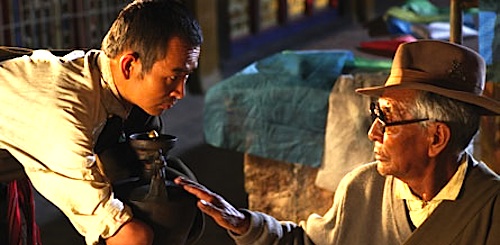
From "Thangka."

While many supporting characters are messily shoehorned into Thangka, the unexpected connections between the two families work quite well in dramatic context, rather than feeling forced. As Dunzhu, Luo Sang’s Zen-like gravitas perfectly anchors the film. Pubu Ciren’s Basen is also sufficiently earnest and long-suffering in a sympathetic way. Recording artist Suolang Wangmu (born into similar circumstances as her character) adds a bit of celebrity, as well as credibility for Tibetan audiences as Gaga’s grown sister, Baima.

Addressing themes of art, family, compassion, and of course Buddhism, Thangka champions what might be called traditional Tibetan values, which is refreshing in any film. It is also surprisingly uplifting. Yet the problem of Tibet’s atrophying culture it insufficiently diagnoses remains a very real concern. Regardless, Thangka will hook in most viewers with its sincerity, particularly those with an interest in Tibetan art and Buddhism. It screened last night (3/3) at the Smith Rafael Center, as a selection of the IBFF Bay Area Showcase.

LFM GRADE: B

Posted on March 4th, 2013 at 3:02pm.

LFM Reviews The Great Pilgrim @ IBFF Showcase 2013

From "The Great Pilgrim."

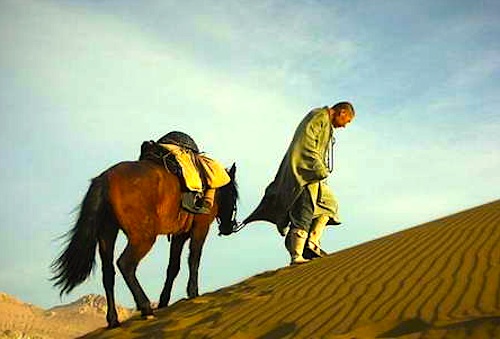
By Joe Bendel. Xuanzang was a Buddhist monk dedicated to peaceful scholarship. Yet, his life indirectly inspired many martial arts sagas. The classic Ming novel Journey to the West is very loosely based on his pilgrimage from China to India. While the novel is still widely read and adapted to many formats (particularly the chapters involving the Monkey King), Xuanzang’s historical odyssey is often overlooked. Yet, it was quite a dramatic adventure by any earthly standard, as viewers will soon learn from Jin Tiemu’s documentary The Great Pilgrim, which screens this Sunday during the 2013 International Buddhist Film Festival Showcase in the Bay Area.

Xuanzang was born to a prominent family, but he was orphaned as a young child. As a result, the local Buddhist monastery became his home at an early age. He had a scholarly disposition, but was deeply troubled by the lack of Buddhist texts available in China. In the Fifth Century, India was still considered the fountainhead of Buddhist though, so Xuanzang set on a pilgrimage to acquire and translate the great Sanskrit teachings. It would be an arduous trek across the Silk Road, through deserts, mountain passes, and hostile kingdoms.

According to Xuanzang’s account and the writings of his disciples, the monk nearly died of heat and dehydration during an early stage of his journey. It is clear that Xuanzang’s faith sustained him, even to those unwilling to accept a higher authority in the matter. Throughout the pilgrimage, Xuanzang spread Buddhist teachings through western China, Central Asia, Pakistan, and Afghanistan.

From "The Great Pilgrim."

Jin emphasizes the cinematic nature of the tale with dialogue-free dramatic re-enactments and breathtaking shots of the sweeping ruins that once were the great cities Xuanzang passed through. Indeed, following in the monk’s footsteps looks like it would be a once in a lifetime tour for amateur archeologists. While the Chinese voiceover narration sounds a bit overpowering at times, it presumably got the job done for domestic audiences.

Regardless of one’s personal religion, Xuanzang’s story is hugely inspirational. Jin also persuasively establishes his considerable historical importance as the author of the monumental Great Tang Records on the Western Regions and a geo-political game-changer who converted hostile powers to Buddhism. A great looking doc, Pilgrim features striking cinematography and some richly crafted sets. A shrewd selection for this year’s IBFF showcase, it vividly depicts an enormously significant Buddhist figure without ever feeling preachy or didactic. Highly recommended as a documentary for those who usually prefer narratives, The Great Pilgrim screens this Sunday afternoon (3/3) at the Smith Rafael Center, as the IBFF Bay Area Showcase continues.

LFM GRADE: A-

Posted on March 1st, 2013 at 10:19am.

LFM Reviews The Playback Singer @ Cinequest 2013

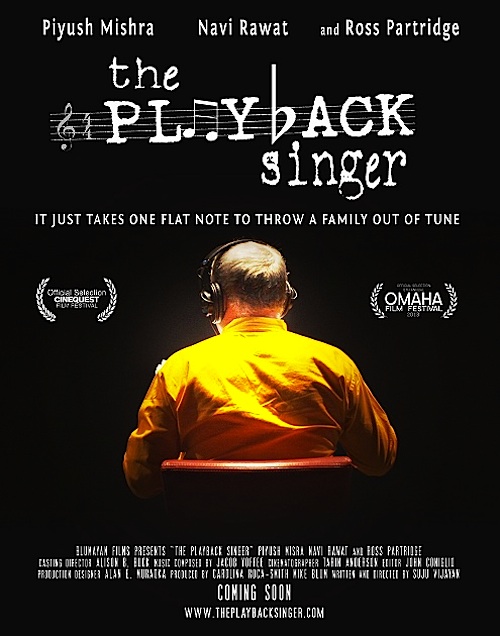
By Joe Bendel. His job is to make others sound great, but he specializes in making himself look bad. He dubs musical numbers for Bollywood actors who cannot carry a tune in a bucket. He does it well. He is also a father, but not such a hot one. Nonetheless, he will be staying for a while with his daughter in Suju Vijayan’s The Playback Singer, which screens as a selection of the 2013 Cinequest Film Festival in San Jose.

Ashok Rao has been married several times, but he only has one daughter: Priya. Of course, he was never around much. Still, she readily agrees to put up her prodigal father when he comes to California for a concert. She is a bit apprehensive about seeing the old man, while her freelance designer husband Ray Tomassi is a bit resentful, knowing full well their limited history together. At first things are tense, especially when an unscrupulous promoter leaves Rao high and dry. Yet, Rao and Tomassi eventually warm towards each other. Wine helps. Before long, she is fast losing patience with both of them.

Bollywood fans might be disappointed to find Playback adheres more closely to an American indie template. Still, Vijayan has the taste and discipline to resist overplaying the fish-out-of-water culture clash card. Instead, it is much more preoccupied with early midlife crises, the fear of failure, and the nasty realization you might have married someone more like your father than you would like to admit.

Tomassi is a dreamer and procrastinator, pathologically incapable of finishing his one commission, a hipster jungle gym. Somehow though, Ross Partridge lets us emphasize with his fears and self-indulgences. His unlikely buddy chemistry with Piyush Mishra’s Rao evolves subtly and naturally. A prominent actor in Bollywood/Parallel cinema (including Gangs of Wasseypur), Mishra invests the titular character with the right mix of dignity and regret. Despite her efforts, Navi Rawat’s responsible daughter gets the shaft from the film, coming across rather uptight and judgmental, even though she’s the only one working a steady job.

Playback never breaks any new ground, but it has some nice moments of honesty. There is a messiness to the characters that rings true. Avoiding quirk for quirk’s sake, The Playback Singer is a small but earnest film that exceeds expectations. Recommended for Mishra’s fans and regular viewers of smarter relationship dramas, The Playback Singer screens today (3/1), Sunday (3/3), and Tuesday (3/5) as part of this year’s Cinequest in San Jose.

LFM GRADE: B

Posted on March 1st, 2013 at 10:18am.

LFM Reviews Mindfulness and Murder @ IBFF Showcase 2013

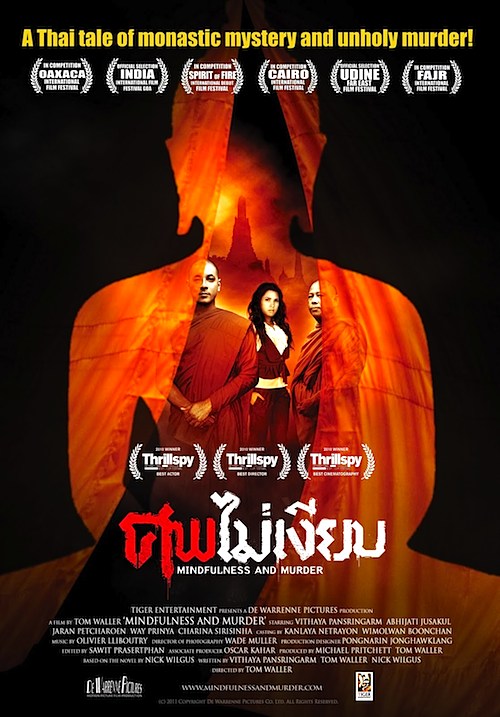
By Joe Bendel. Father Ananda is sort of like a Buddhist Father Brown, except he has more first-hand knowledge of the criminal element. The former police detective intended to lead a peaceful existence as a monk, but homicide has followed him into the monastery in Tom Waller’s Thai mystery Mindfulness and Murder (trailer here), which screens this Saturday night as part of the 2013 International Buddhist Film Festival Showcase in the Bay Area.

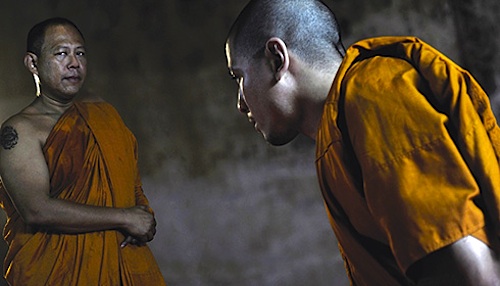
Father Ananda is a man to be reckoned with, but he had his reasons for leaving the job, as viewers learn over the course of the film. When one of the boys in his monastery’s youth shelter program is murdered, the Abbott asks Ananda to investigate. He will not be getting in the way of the cynical Inspector Somchai, who closes the case half an hour after responding to the call. It turns out the late Noi was a hard kid to love, who was reportedly involved in the narcotics trade. Perhaps he was not the only one. Father Ananda soon uncovers rumors of drug-dealing monks and undercover narcs. Suddenly, a person or persons unknown have taken an unwelcome interest in Father Ananda and his temple boy assistant Jak.

Mindfulness is one of the most picturesque murder mysteries you are likely to see anytime soon. Cinematographer Wade Muller exploits the exotic backdrop for all its worth. Similarly, the monastic setting adds unusual wrinkles to whodunit. Solving the case is not merely a matter of earthly justice for Ananda. There are implied karmic implications for the monastery.

Arguably, Mindfulness is rather a bold selection for the IBFF showcase. There is the clear suggestion it is not unheard of for less savory individuals to adopt monks’ robes as a means of gaming the system. Its portrayal of the Thai justice system is also far from flattering. Yet, there is no denying the virtuous nature of Father Ananda or the appeal of Vithaya Pansringarm’s quietly engaging performance. They are an actor-character tandem worthy of a franchise.

The supporting cast is a somewhat mixed bag, but Ahbijati “Meuk” Jusakul is nicely hardboiled as Somchai, while American-born Prinya Intachai has his moments as Brother Satchapalo, the instant prime suspect. For a random bit of celebrity, former Miss Universe Natalie Glebova (currently based in Thailand) also briefly appears as herself.

From "Mindfulness and Murder."

Waller’s tempo is hardly break-neck, which has its pros and cons. Although it might be limiting for genre fans, the meditative tone perfectly suits the hero and setting. Indeed, watching Father Ananda struggle with the demands of the spiritual and worldly is fascinating (more than even the crime story itself). Recommended for those who enjoy cerebral mysteries, Mindfulness and Murder screens Saturday night (3/2) at the Smith Rafael Film Center, as part of this year’s IBFF Showcase in the Bay Area.

During the Showcase, patrons will also be inspired by Dafna Yachin’s Digital Dharma, documenting the efforts of American academic E. Gene Smith to digitize and preserve the sacred and secular texts of Tibet. Further noteworthy selections include Victress Hitchcock’s When the Iron Bird Flies, a provocative exploration of the Tibetan Buddhism’s surprising international growth during its unfortunate period of exile, and Naomi Kawase’s visually dazzling yet deeply humane Mourning Forest. Check their website for times and venues here.

LFM GRADE: A-

Posted on February 27th, 2013 at 9:27am.

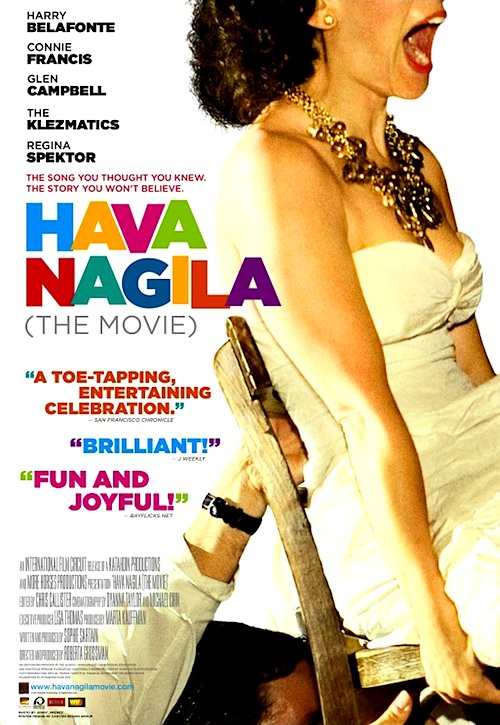
The Story of a Song: LFM Reviews Hava Nagila

By Joe Bendel. Like Abel Meeropol’s “Strange Fruit,” “Hava Nagila” is a song worthy of its own biographical treatment. It started in the Ukraine and became a staple of Jewish American celebrations, but the identity of its composer remains a controversy. Documentary filmmaker Roberta Grossman tells the story of the song and those who sing it in Hava Nagila: the Movie, which opens this Friday in New York.

It was based on a nigun, a wordless prayer chant incorporated into the services of the Nineteenth Century Ukrainian Hasidic community. To commemorate the Balfour Declaration, it was adapted into the song now commonly heard at weddings and bat/bar mitzvahs. Just who adapted it depends on whether you talk to the Idelson or Nathanson families. Likewise, it means different things to different musicians. To a serious Klezmer artist like Frank London, it is rather a cliché. Yet to old school entertainers like Glen Campbell and Irving Fields, it is a rhythmic crowd-pleaser. Yes, that Glen Campbell. He recorded “Hava” as the B-side to his “True Grit” single and shares some pleasant reflections with Grossman during an interview recorded at his synagogue a few years back.

Indeed, Hava will certainly change many viewers perception of Campbell, but it is the ageless Irving Fields who truly demands his own documentary. Known for fusing traditional Jewish music with Latin dance music, the ninety-four year-old Fields still gigs as a leader six nights a week in Manhattan—and could easily pass for a man at least twenty-five years his junior. The music must keep him young, naturally including “Hava.”

Hava boasts some impressive musician-commentators, including Harry Belafonte (interviewed in the Village Vanguard, where he once performed when Max Gordon also booked folkies), Johnny “They Call Me Bruce” Yune, and Russian indie singer-songwriter Regina Spektor, who relates “Hava” to the Russian Refusenik experience.

Less successful is the rather muddled 1960’s section, in which we are told the Jewish children of the suburbs embraced the song as some kind of folky communal something or other. The film’s chatty tone also becomes somewhat problematic over time. Co-produced by Friends co-creator Marta Kauffman, Hava’s shticky title cards and comedy sketch interludes often feel like a sitcom trying too hard to be irreverent.

Although plenty of talking heads consider “Hava” corny, it is hard to dislike a song so deeply associated with celebration and the early founding of the State of Israel. It is also hard to argue with the likes of Campbell, Elvis Presley, and longtime Israel booster Lionel Hampton, all of whom covered “Hava.” Despite its weirdly inconsistent tone, Hava puts “Hava” in the proper historical context. Recommended for those interested in the intersection of Jewish history and musical tradition, Hava Nagila: the Movie opens this Friday (3/1) in New York at the Lincoln Plaza.

LFM GRADE: B-

Posted on February 27th, 2013 at 9:26am.

The House of the Spirits: LFM Reviews The Condemned

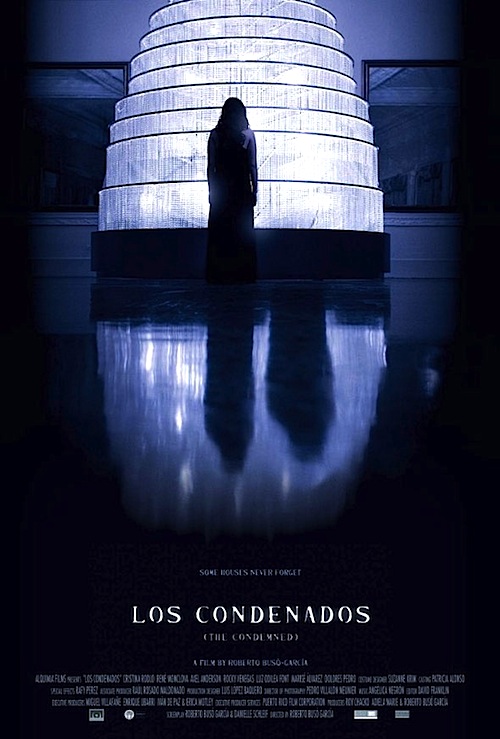
By Joe Bendel. The worst crimes are always committed by altruists, but Ana Puttnam knows her oncologist father is different. She has returned to his home town in hopes of restoring his reputation while he is still alive. However, something or someone in their ancestral home begs to differ in Roberto Busó-García’s supernatural drama The Condemned (trailer here), which opens this Friday in New York.

Largely incapacitated, Dr. Puttnam (with two t’s) is not long for this earth. His daughter has brought him back to their stately manor house in Rosales, Puerto Rico – where it all began – to establish a museum dedicated to his philanthropic work. It was here that he established his first free cancer clinic for the poor. However, he has also been dogged by scandalous rumors regarding his early career. She was hoping the villagers would rally to his defense, but nobody seems to want to get involved. As she presses on, strange things start happening in the house. The planned exhibitions are a particular focus of the mysterious venting.

Only two people in Rosales are happy to see the Puttnams return. One is the loyal family retainer Cipriano. The other is the new chauffeur, the one villager willing to present himself for prospective employment. Each has their reasons for their interest in the Puttnam family. Likewise, they are both uneasy with Ana’s plans to revive the family’s big Christmas soiree for the townsfolk. At least she will get some use out of her mother’s old crystal chandelier tree.

It is hard to decide whether The Condemned is really intended as horror film or more of an uncanny morality tale. There is one gruesome death, but it is rather out of place, leading one to wonder if it was a cast-member request Busó-García obliged. Aside from a handful of shocking moments, it is more about creeping dread and the corrupting influence of the past on the present—almost more Tennessee Williams than H.P. Lovecraft.

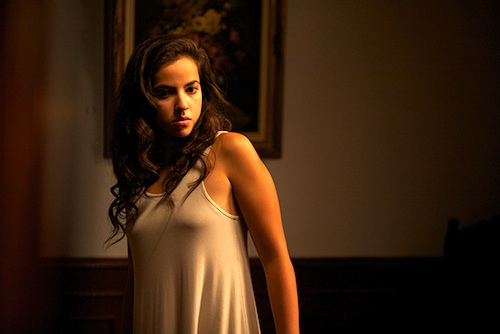
Cristina Rodlo in "The Condemned."

Still, Busó-García and production designer Suzanne Krim’s team crafted quite a gothic setting. That chandelier tree becomes the indelible image of the film, but the rest of the house is quite atmospheric too. Frankly, Busó-García’s deliberate genre coyness deftly keeps viewers off-balance and unlikely to anticipate the third act revelation.

Poised and photogenic, Cristina Rodlo is surprisingly engaging as Ana Puttnam, completely avoiding any scream queen theatrics or manipulations. Her work holds up, even as the audience’s perspective shifts. Popular Puerto Rican comic actor René Monclova is also suitably earnest yet appropriately mysterious as Cipriano.

Visually, one can see the influence of the Spanish horror movie renaissance on The Condemned, but Busó-García tells his tale with restraint. While it is certainly slow by the genre standards that may or may not apply, it all more or less comes together at the end. Recommended for those who enjoy their paranormal fare on the cerebral side, The Condemned opens this Friday (3/1) in New York at the Quad Cinema.

LFM GRADE: B

Posted on February 25th, 2013 at 2:17pm.