LFM Reviews Pandora’s Promise @ The 2013 Sundance Film Festival

By Joe Bendel. Nuclear energy does not burn fossil fuels, nor is it intermittent. Appreciation of these obvious, incontrovertible facts led documentarian Robert Stone and five well known environmental activists to reverse their longstanding opposition to nuclear power. Stone convincingly lays out their green case for nuclear in Pandora’s Promise (see clip above), which screens during the 2013 Sundance Film Festival in Park City.

Stone made his name with the anti-nuclear doc Radio Bikini and would further burnish his green credentials with Earth Days. Very concerned about global warming, Stone could no longer accept the environmental movement’s unrealistic claims about solar and wind power. As his primary POV experts argue, any power plan with a significant wind or solar component will by necessity be heavily dependent on big, dirty fossil fuel plants as a back-up. The simple truth is that the sun does not always shine and the wind does not always blow, but coal burns 24-7.

To his credit, Stone tackles the Fukushima disaster right up front, rather than let it fester in the minds of skeptical audience members. While the devastation of the area gives pause to noted British environmental author and nuclear convert Mark Lynas, the background radiation levels they record are considerably less than what anyone flying on a transatlantic commercial flight would be exposed to.

Building a nuclear power plant in France.

Stone’s battery of experts cogently explains the safety benefits and relative cleanliness of nuclear. Yes, radioactive waste is a potentially inconvenient by-product, but the volume is a fraction of what the public widely assumes. Furthermore, next generation reactors will increasingly be able to recycle the existing nuclear waste, as is already happening in France. Of course, there have been disasters, but Chernobyl was the worst by far. A sterling example of Soviet safety engineering, the Pripyat plant completely lacked any basic containment dome, whereas Western reactors have multiple domes with elaborate, built-in contingency systems.

Surely some will try, but it is impossible to dismiss Stone as a right-of-center partisan. Clearly the Pandora contributors are entirely satisfied global warming is a very real and alarming phenomenon. Indeed, that is largely the impetus for their nuclear apostasy. Considering how many cold shoulders Stone, Lynas, and company are likely to get from former comrades at cocktail parties, their conviction cannot be questioned. Their logic is also sound and consistent. Highly recommended for anyone with an open mind who self-identifies with the environmental cause (broadly defined), Pandora’s Promise screens again on Saturday (1/26) in Salt Lake as a Doc Premiere at this year’s Sundance.

LFM GRADE: A

Posted on January 24th, 2012 at 11:07pm.

LFM Reviews Charlie Victor Romeo @ The 2013 Sundance Film Festival

By Joe Bendel. This is a rather bold programming choice, considering how many attending Sundance have flown in from New York and Los Angeles. Originally, it started as an Off-Broadway theater production, based on the real life transcripts of black boxes recovered from plane crashes. Though it retains the potentially stagey single cockpit set and the revolving ensemble, Robert Berger & Karlyn Michelson’s Charlie Victor Romeo holds the distinction of being Sundance’s first 3D film, screening as part of the New Frontiers track.

For a film entirely depicting systems failures, it is ironically fitting that CVR’s Monday night screening had to be presented in 2D due to technical difficulties. While some of the schematics incorporated into the film might look cool in 3D, it is hard to see how the film lends itself to the process. The real story is the impressively realistic sound, designed by Jamies Mereness, recorded and edited by Kevin Reilly, and mixed by Joel Hamilton. The theatrical nature of the solitary set also becomes quite cinematic, thanks to the eerie lighting.

The constituent stories of CVR are a bit bracing, since in each case a plane is going down. The only question is how bad will it be? In general, the short ones are more disturbing. However, the clear dramatic highpoint of the film recreates efforts to save a Peruvian flight that lost all instrumentation, including velocity and altitude, soon after take-off.

The cast-members are all quite strong in their various roles, particularly Patrick Daniels (the director and co-writer of the original stage version) in the Lima installment. They quickly create convincing working relationships amongst the flight crews, which are almost immediately tested in crisis situations.

CVR is kind of like the parts of Zemeckis’s Flight audiences really want to see, played repeatedly with key variations each time. An intriguing application of technology to film (which is why it is a New Frontiers selection), but also an unusually faithful adaptation of a stage piece for the big screen, Charlie Victor Romeo is recommended for fearless flyers when it screens again Monday (1/28) at Park City’s Prospector Square Theatre (the designated 3D venue) as part of this year’s Sundance Film Festival. Travel safe everyone.

LFM GRADE: B

Posted on January 24th, 2012 at 11:06pm.

LFM Reviews Jug Face @ The 2013 Slamdance Film Festival

By Joe Bendel. Moonshine and pottery are a wicked combination. One young woman living in a hillbilly cult understands that only too well. She knows the kiln tolls for her in Chad Crawford Kinkle’s Jug Face (trailer here), a Modernciné production which premiered last night at the 2013 Slamdance Film Festival.

“The pit wants what it wants.” In return, it cures members of the hardscrabble hill country community. That was how their grandpappies survived the great cholera outbreak. All that is required is a periodic sacrifice. They will know who has been chosen from the special jugs the designated potter casts in a state of paranormal ecstasy. Ada was supposed to be next, but she chanced upon her jug face before Dawai came out of his pit-induced stupor. Stashing it in the woods, Ada is determined live—not just for herself, but also for her unborn child.

Whose child would that be? Take a lurid guess. It is not Dawai’s, unfortunately, since he’s not a bad chap, really. Nor is the boy to whom she is to be “joined” the father (a term that sounds uncomfortably Human Centipede like). The answer will be pretty easy to guess, given general filmmaker attitudes towards rural border state residents. Ada is definitely in for a hard go of things, and the deadly visions she gets from the pit will not help.

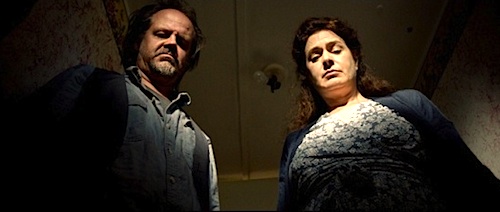
Basically, Jug Face is southern gothic exploitation fare, which co-star and Glass Eye Pix producer Larry Fessenden certainly understands. As Ada’s cult leader father Sustin, he is not nearly as loathsome or malevolent as one might expect. He might even be half-human. In the lead, Lauren Ashley Carter’s eyes are almost supernaturally wide. Her Ada is also reasonably down to earth for a sheltered cult-child. Looking not unlike Will Ferrell on a below average morning, Sean Bridgers finds surprising pathos in Dawai. In fact, if it really were Will Ferrell, it would probably be his best performance ever. It is hard to recognize Sean Young as mother dearest, but at least her off-screen persona does not distract from the on-screen action.

From "Jug Face."

Evoking the spirit of outsider art, Jug Face’s opening credits effectively set an unsettling tone right from the start. However, the pit is a little underwhelming. It just gurgles a little and turns red from time to time. Regardless, Kinkle really knows how to tap into coastal dwellers’ hillbilly phobias, without going the full Deliverance route. Unfortunately, the climax is more of a deflation than a conflagration. Still, those looking to shudder at ritual murder and Appalachian inequities will find plenty of fodder in Jug Face. Recommended for Fessenden fans with a taste for hicksploitation, Jug Face should have many midnight screenings ahead of it after its Slamdance premiere last night in Park City.

LFM GRADE: B-

Posted on January 24th, 2012 at 11:05pm.

LFM Reviews Gangs of Wasseypur Parts I & II @ The 2013 Sundance Film Festival

By Joe Bendel. For three criminal clans in India’s coal country, life is defined by family and their vendettas. The two are not mutually exclusive in Anurag Kashyap’s epic Gangs of Wasseypur (trailer here), which screens in all its 320 minute glory at the 2013 Sundance Film Festival in Park City.

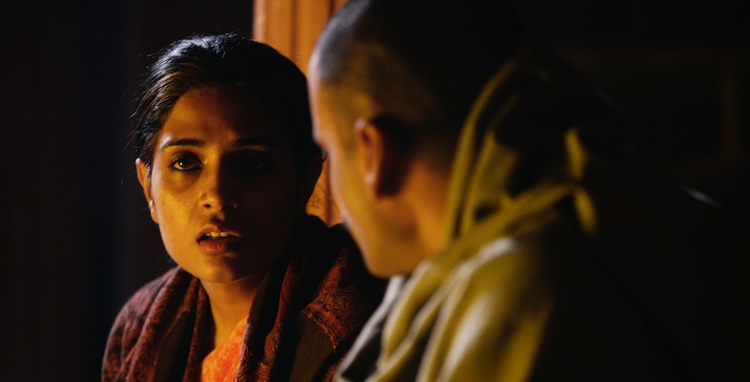
The family tradition began with Shahid Khan, who robbed British trains while masquerading as an infamous Muslim dacoit Sultana. Expelled by the real Sultana’s clan, Khan toils in the Dhanbad coalmines, working for the ruthless Ramadhir Singh. After independence, ownership of the mine is transferred to the super-connected Singh, who hires Khan as his chief muscle-man. Mindful of Khan’s ambitions to replace him, Singh arranges his murder, but the foreman’s young son, Sardar, is rescued by his father’s cousin.

As a boy, Sardar Khan swears vengeance against Singh. As a man, Khan the budding crime lord is in a position to take it. However, Singh is shrewd enough to call a temporary truce, while forging a secret alliance with the heir to his father’s old nemesis, Sultan Qureshi. Distracted by the demands of an increasingly complicated family, consisting of five sons from two wives (and no divorce), Khan effectively defers his vengeance to the next generation.

In part two, there is a changing of the guard within the Khan family. Leadership duties will fall upon Khan’s hashish-addicted second son, Faizal Khan. Nobody expects much from the spare heir, least of all his mother, but when he starts killing, his ferocity makes everyone sit up and take notice.

Frankly, Wasseypur is truly light years removed from Kashyap’s last film to find American distribution, The Girl with Yellow Boots. Spanning three generations and seven decades, it is a big film by any measure. Part one is a bit slow at times, because of all the grudges and betrayals it must establish. A dark brooder punctuated by moments of grandly operatic violence, the tone of the first half could be described as a provincial Indian Godfather.

However, the second part segues into Scarface territory, as Faizal Khan goes medieval on everyone standing in his way. In fact, Wasseypur steadily builds momentum throughout its daunting five and a half hours, culminating with two spectacular action sequences, including a hospital shootout that could hold its own with John Woo’s Hardboiled.

Adding further depth, Wasseypur offers some intriguing social context, such as the post-Raj cronyism and corruption Western audiences rarely see reflected on film. It is also fascinating to watch Singh use trade unions and his political office to build a criminal syndicate. Likewise, Wasseypur clearly attributes the Pashtun Khan organization’s local popularity to their willingness to stand up to the bullying Qureshi Muslim establishment. Although there are no traditionally splashy musical numbers in Wasseypur, Kashyap shrewdly uses era-specific Bollywood hits to help delineate the passage of years for Indian audiences.

Nawazuddin Siddiqui’s feral, drug-addled Faizal Khan is all kinds of unsettling. Many viewers will find themselves actively rooting against his protagonist during the second half. Still, that kind of strong reaction means he is doing something right. Reema Sen is also quite the domestic femme fatale as wife #2. Yet it is Tigmanshu Dhulia, better known as a screenwriter and director, who delivers the most nuanced supporting turn as Singh.

Wasseyrup would be impressive simply for its ambition, but Kashrup rises to the challenge, staging some distinctly stylish action sequences and cogently telling a richly intricate story, based on historical events in the region. It could even lay a claim to being the Great Indian Crime Story, encompassing multiple generations, ethnic groups, and religions in its nefarious dealings. Enthusiastically recommended for fans of high-end gangster films, Gangs of Wasseypur screens again tomorrow (1/24) in Park City and Saturday (1/26) in Salt Lake as part of this year’s Sundance Film Festival.

LFM GRADE: A- (B for Part I, A for Part II)

Posted on January 23rd, 2012 at 10:17am.

LFM Reviews Which Way is the Front Line from Here? The Life and Time of Tim Hetherington @ Sundance; Debuts on HBO April 18th

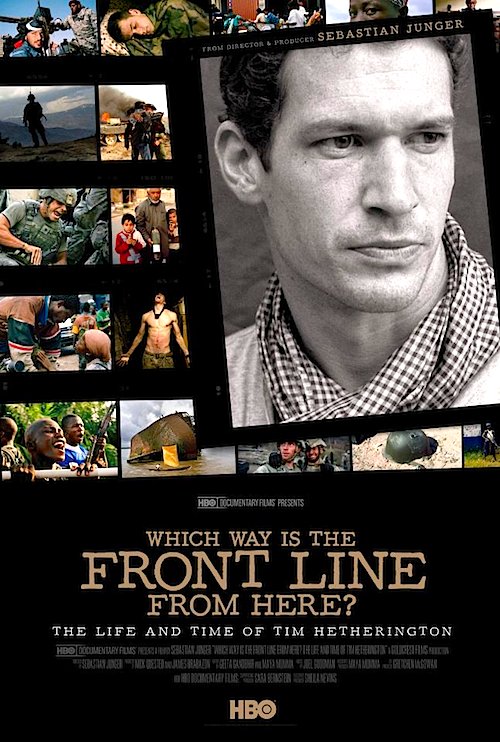
By Joe Bendel. Photographer-filmmaker Tim Hetherington never considered himself an artist. Nor could he be dubbed a partisan—his work was far too honest. The terms “photojournalist” and “war correspondent” sound insufficient, but they might have to do. It was in such a role Sebastian Junger met his late friend and collaborator, whom he profiles in Which Way is the Front Line from Here? The Life and Time of Tim Hetherington, which screens during the 2013 Sundance Film Festival in Park City.

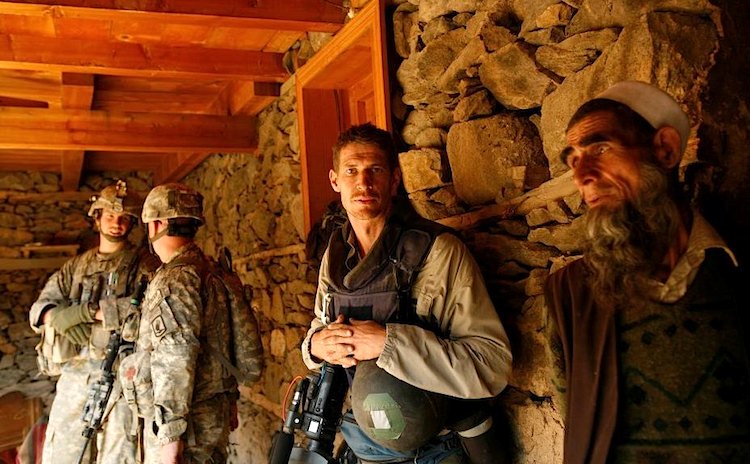
Hetherington is best known for co-directing the Academy Award nominated Restrepo with Junger. Following a platoon’s fifteen month deployment to Afghanistan’s Korengal Valley, Restrepo is widely considered by both critics and veterans to be the most accurate depiction of what war is like on a day-to-day basis. Yet Junger clearly suggests it was his time spent in Liberia that most shaped Hetherington’s professional approach. After his name-making series was published, Hetherington stayed in the West African nation for another two years. If anyone could be considered the opposite of drive-by journalism, it would have been Hetherington.

Hetherington and Junger showed similar commitment in Afghanistan, becoming perhaps the most deeply embedded journalists ever. Logically, the Korengal period factors prominently in Front Line, including footage and interviews with veterans of the platoon that will surely interest viewers familiar with Restrepo.

Junger also interviews Hetherington’s colleagues, parents, and the woman he was planning to start a family with. However, Junger saves the last word for himself and he makes it count. As a result, one can see Front Line as a tragically fitting sequel to Restrepo.

Sadly, Hetherington accepted one assignment too many, dying from shrapnel wounds during the Libyan Civil War. (Lest the State Department jump to conclusions again, it should be noted this happened over a year before the Innocence of Muslims protests.) It was a terrible loss, as viewers can judge from the ample selection of Hetherington’s photos illustrating his work. Despite his protestations, Hetherington’s work shows a remarkable sense of composition. He had an eye. Junger presents it well in a moving tribute to his friend and comrade. Highly recommended, Which Way is the Front Line from Here screens again tomorrow (1/23) and Friday (1/25) in Park City and Saturday (1/26) in Salt Lake during this year’s Sundance.

LFM GRADE: A-

Posted on January 22nd. 2012 at 11:58pm.

LFM Reviews Kill Your Darlings @ The 2013 Sundance Film Festival

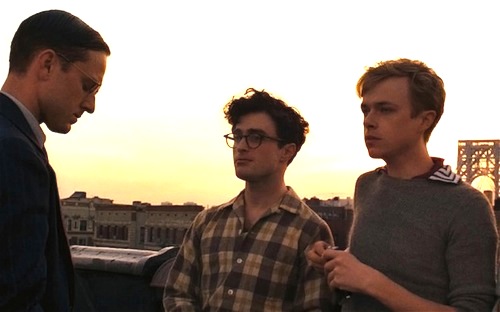
From "Kill Your Darlings."

By Joe Bendel. In 1944, by a confluence of fate, the leading lights of the Beat movement assembled together around Columbia University, including Allen Ginsburg, Jack Kerouac, William Burroughs, and Lucien Carr. There is a reason you might not recognize the latter name. Poetry and scandal mix freely in the Beat origin story dramatized in John Krokidas’s Kill Your Darlings, which screens during the 2013 Sundance Film Festival in Park City.

Allen Ginsburg is certain that poetry is his calling. His certainty about sexuality is another matter. Arriving at Columbia, his Jewish background automatically sets him apart as an outsider. His resistance to aesthetic orthodoxy, however, establishes his credibility with Carr, the campus literary rebel. Soon Ginsburg is visiting jazz clubs, sampling Benzedrine with their mutual friend Burroughs, and pining for the androgynous Carr.

Ginsburg is not the only one carrying a torch for Carr. Former professor David Kammerer appears to exert some sort of malevolent emotional hold on his ambiguous friend, which Carr increasingly resents. Since Darlings starts in media res, viewers realize this will all end in tragedy.

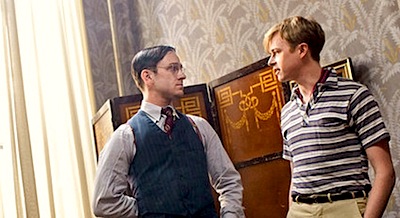
Known to a scruffy handful of fans for a series of British films about boarding school students dabbling in the occult, Daniel Radcliffe is serviceably nebbish as Ginsburg. At least he looks like a confused kid. However, Ben Foster is almost worth the price of admission by himself, nailing not just the Burroughs drawl, but also his eccentric cadences and precise demeanor. Unfortunately, Jack Huston’s Kerouac is 100% meathead and 0% poet. Still, even though he looks like he stepped out of a fashion commercial, Dane DeHaan is convincingly dissolute as Carr.

From "Kill Your Darlings."

Darlings is a decent period production, featuring some swinging tracks from Vince Giordano. Frustratingly, music comes dead last in the closing credits, well after the caterers and the drivers, even though it contributes far more to the overall viewing experience. What would Ginsburg and Kerouac say about that? However, the colorless underscore is a truly baffling creative decision. David Amram is still at the top of his game and has considerable experience scoring films; had Darlings brought him onboard they would have had an apostolic connection to the Beat Generation. That’s his music in Pull My Daisy, after all. Instead, they opted for the light classical approach.

Indeed, Darlings represents a series of missed opportunities. Foster is terrific and the mid-1940’s New York vibe is appealing. It even has Sledgehammer!’s David Rasche as the Dean of Columbia. Nonetheless, the film’s lurid preoccupation with Carr’s sex life becomes tiresome. More music and more poetry would have made it a stronger work. Mostly of interest to earnest Ginsburg and Burroughs fans, Kill Your Darlings screens again today (1/22), tomorrow (1/23), and Friday (1/25) in Park City as part of this year’s Sundance.

Posted on January 22nd, 2012 at 11:57pm.